Simona CavaluProfessorFaculty of Medicine and PharmacyUniversity of OradeaROMANIA 
New bioceramicsfor hard tissue replacement and drug/ protein delivery: physical and biological approach
Highlights Bioglass for controlled drug release (antibiotics) 
Surface functionalization and conformational changes of proteins adsorbed on Bioglass Insulin microencapsulation and release from zinc/silica microparticles
A real story…turns to history 
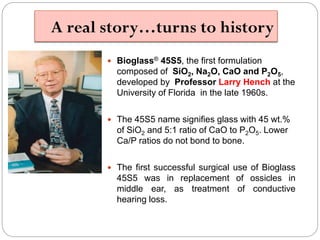
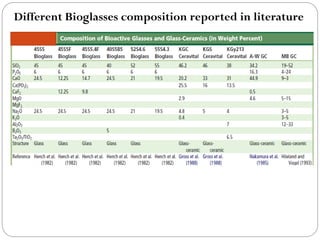
Bioglass®45S5, the first formulation composed of SiO2, Na2O, CaOand P2O5, developed by Professor Larry Hench at the University of Florida in the late 1960s. 
The 45S5 name signifies glass with 45 wt.% of SiO2and 5:1 ratio of CaOto P2O5. Lower Ca/P ratios do not bond to bone. 
ThefirstsuccessfulsurgicaluseofBioglass45S5wasinreplacementofossiclesinmiddleear,astreatmentofconductivehearingloss.
Different Bioglassescomposition reported in literature
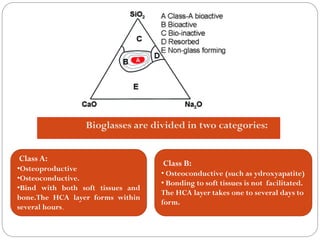
Bioglassesare divided in two categories: 
ClassA: 
•Osteoproductive 
•Osteoconductive. 
•Bindwithbothsofttissuesandbone.TheHCAlayerformswithinseveralhours. 
ClassB: 
•Osteoconductive(such as ydroxyapatite) 
•Bonding to soft tissues is not facilitated. The HCA layer takes one to several days to form.
Advantage/disadvantage 
Theprimaryadvantageofbioactiveglassesistheirrapidrateofsurfacereactionwhichleadstofasttissuebonding. 
Theirprimarydisadvantageismechanicalweaknessandlowfracturetoughnessduetoanamorphoustwo-dimensionalglassnetwork. 
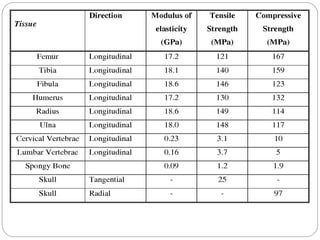
Tensilebendingstrengthofmostofthecompositionsisintherangeof40-60MPawhichmakethemunsuitableforloadbearingapplications. 
Forsomeapplicationslowstrengthisoffsetbytheglasses’lowmodulusofelasticityof30-35GPa.Thisvalueisclosetothatofcorticalbone.
Compositions such as 45S5 Bioglasswith high rates of bioactivity produce rapid regeneration of trabecularbone with an amount, architecture and bio-mechanical quality of bone that matches that originally present in the site. 
The rapid regeneration of bone is due to a combination of processes called osteostimulationand osteoconduction
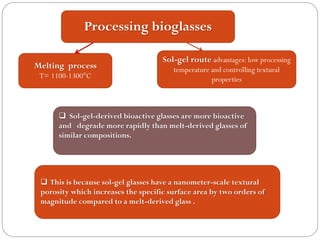
Processing bioglassesMelting process 
T= 1100-1300°CSol-gel route advantages: low processing temperature and controlling textural properties Sol-gel-derived bioactive glasses are more bioactive and degrade more rapidly than melt-derived glasses of similar compositions. This is because sol-gel glasses have a nanometer-scale textural porosity which increases the specific surface area by two orders of magnitude compared to a melt-derived glass .
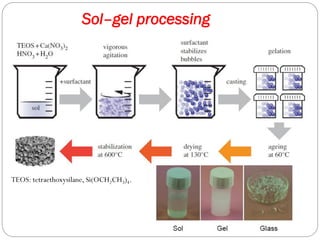
Sol–gel processing 
TEOS: tetraethoxysilane, Si(OCH2CH3)4.
Pharmaceutical applications 
Designofbioglassandbioceramicdrugdeliverysystemswhichallowtheeffectivetargeteddeliverydosageofproducts,rangingfrominorganicandorganicmoleculesofdifferentsizeandproperties,tobecontrolled. 
Clientbespokeformulationsforspecificapplications, includingthecontrolledreleaseofpharmaceuticalactivecompounds,suchasvitamins,antibioticsandanti- inflammatorydrugs,andalsotheenablingofsequential,andtimeandsitewell-ordered,deliveryofmultipleagents 
Characterizationtomonitorandevaluatecontrolledreleased(fromhourstodays,even,tomonths)
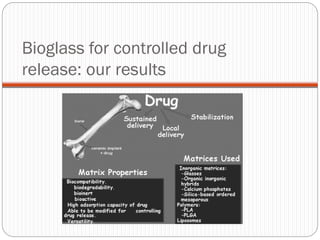
Bioglassfor controlled drug release: our results
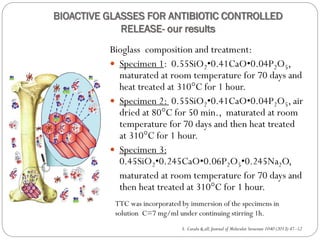
BIOACTIVE GLASSES FOR ANTIBIOTIC CONTROLLED RELEASE-our results 
Bioglasscomposition and treatment: 
Specimen 1: 0.55SiO2•0.41CaO•0.04P2O5, maturated at room temperature for 70 days and heat treated at 310°C for 1 hour. 
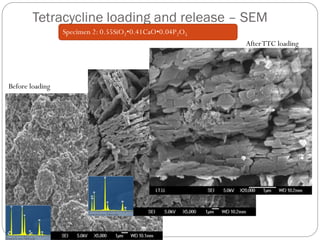
Specimen 2: 0.55SiO2•0.41CaO•0.04P2O5, air dried at 80°C for 50 min., maturated at room temperature for 70 days and then heat treated at 310°C for 1 hour. 
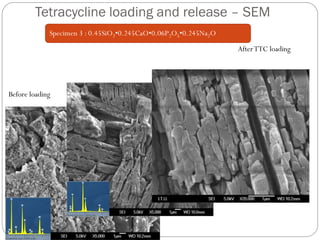
Specimen 3: 0.45SiO2•0.245CaO•0.06P2O5•0.245Na2O, 
maturated at room temperature for 70 days and then heat treated at 310°C for 1 hour. 
S. Cavalu & all, Journal of Molecular Structure 1040 (2013) 47–52 
TTC was incorporated by immersion of the specimens in solution C=7 mg/ml under continuing stirring 1h.
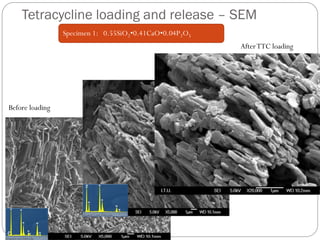
Tetracycline loading and release –SEM 
Before loading 
After TTC loading 
Specimen 1: 0.55SiO2•0.41CaO•0.04P2O5
Tetracycline loading and release –SEM 
Before loading 
After TTC loading 
Specimen 2: 0.55SiO2•0.41CaO•0.04P2O5
Tetracycline loading and release –SEM 
Before loading 
After TTC loading 
Specimen 3 : 0.45SiO2•0.245CaO•0.06P2O5•0.245Na2O
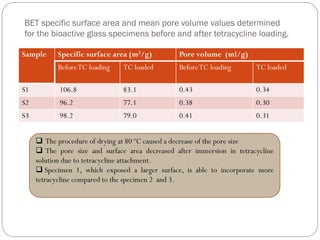
BET specific surface area and mean pore volume values determined for the bioactive glass specimens before and after tetracycline loading. 
Sample 
Specific surface area (m2/g) 
Pore volume (ml/g) 
Before TC loading 
TC loaded 
Before TC loading 
TC loaded 
S1 
106.8 
83.1 
0.43 
0.34 
S2 
96.2 
77.1 
0.38 
0.30 
S3 
98.2 
79.0 
0.41 
0.31 
Theprocedureofdryingat80ºCcausedadecreaseoftheporesize 
Theporesizeandsurfaceareadecreasedafterimmersionintetracyclinesolutionduetotetracyclineattachment. 
Specimen1,whichexposedalargersurface,isabletoincorporatemoretetracyclinecomparedtothespecimen2and3.
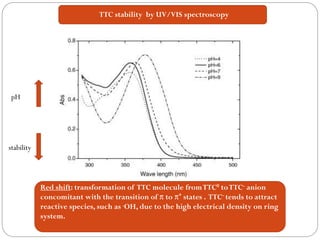
TTC stability by UV/VIS spectroscopy 
pH 
stability 
Red shift: transformation of TTC molecule from TTC0to TTC-anion concomitant with the transition of π to π*states . TTC-tends to attract reactive species, such as .OH, due to the high electrical density on ring system.
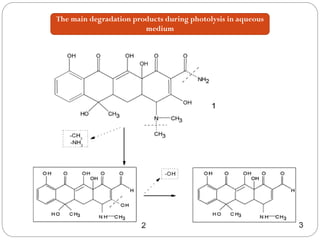
The main degradation products during photolysis in aqueous medium
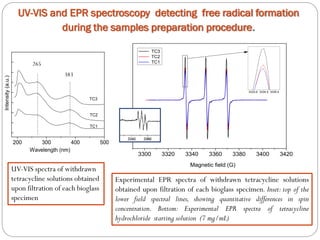
UV-VIS and EPR spectroscopy detecting free radical formation 
during the samples preparation procedure. 
200 300 400 500 
TC3 
TC2 
Intensity (a.u.) 
Wavelength (nm) 
TC1 
3300 3320 3340 3360 3380 3400 3420 
3333.6 3334.5 3335.4 
Magnetic field (G) 
TC3 
TC2 
TC1 
Experimental EPR spectra of withdrawn tetracycline solutions 
obtained upon filtration of each bioglass specimen. Inset: top of the 
lower field spectral lines, showing quantitative differences in spin 
concentration. Bottom: Experimental EPR spectra of tetracycline 
hydrochloride starting solution (7 mg/mL) 
265 
383 
UV-VIS spectra of withdrawn 
tetracycline solutions obtained 
upon filtration of each bioglass 
specimen
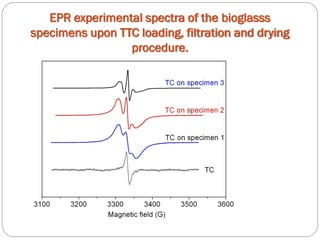
EPR experimental spectra of the bioglasssspecimens upon TTC loading, filtration and drying procedure.
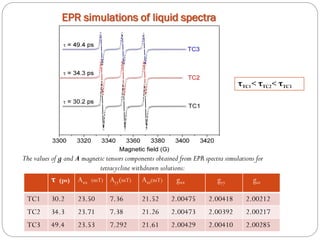
EPR simulations of liquid spectra 
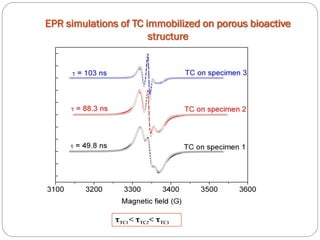
The values of gand Amagnetic tensors components obtained from EPR spectra simulations for tetracycline withdrawn solutions: 
τTC1< τTC2< τTC3 
τ(ps) 
Axx(mT) 
Ayy(mT) 
Azz(mT) 
gxx 
gyy 
gzz 
TC1 
30.2 
23.50 
7.36 
21.52 
2.00475 
2.00418 
2.00212 
TC2 
34.3 
23.71 
7.38 
21.26 
2.00473 
2.00392 
2.00217 
TC3 
49.4 
23.53 
7.292 
21.61 
2.00429 
2.00410 
2.00285
EPR simulations of TC immobilized on porous bioactive structure 
τTC1< τTC2< τTC3
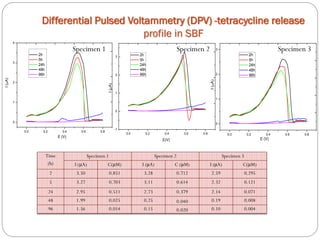
Differential Pulsed Voltammetry (DPV) -tetracycline release 
profile in SBF 
0.0 0.2 0.4 0.6 0.8 
0 
1 
2 
3 
4 
I (A) 
E (V) 
2h 
5h 
24h 
48h 
96h 
0.0 0.2 0.4 0.6 0.8 
-1 
0 
1 
2 
3 
I ( A) 
E(V) 
2h 
5h 
24h 
48h 
96h 
0.0 0.2 0.4 0.6 0.8 
0 
1 
2 
3 
E (V) 
I (A) 
2h 
5h 
24h 
48h 
96h 
Specimen 1 Specimen 2 Specimen 3 
Time 
(h) 
Specimen 1 Specimen 2 Specimen 3 
I (μA) C(μM) I (μA) C (μM) I (μA) C(μM) 
2 3.50 0.851 3.28 0.712 2.59 0.295 
5 3.27 0.703 3.11 0.614 2.32 0.121 
24 2.95 0.511 2.73 0.379 2.14 0.071 
48 1.99 0.025 0.25 0.040 0.19 0.008 
96 1.56 0.014 0.15 0.020 0.10 0.004
Tetracycline hydrochloride may act as a chemical spin trap. 
EPR and UV/VIS spectroscopy have shown that the specimen with a larger surface are is able to incorporate more tetracycline. 
The maximum TC amount was released after 2 h, and thereafter the release continued slightly for 24 h, followed by a drastic diminution after 48 h. 
The pores size modification and specific surface area after tetracycline loading seems to be the main factor in tetracycline controlled released process. 
Similar results were obtained for different pharmaceutical compounds: hydrocortisone, propolis, β-cyclodextrin[ Z.R. Domingues& all, Biomaterials 25 (2004) 327–333; A. L. Andrade & all, Journal of Non-Crystalline Solids 355 (2009) 811– 816]. Observations
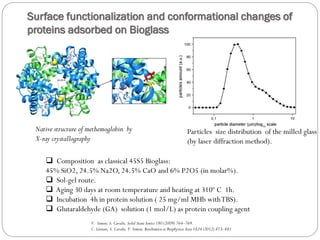
Surface functionalizationand conformational changes of proteins adsorbed on Bioglass 
Native structure of methemoglobinby 
X-ray crystallography 
Composition as classical 45S5 Bioglass: 
45% SiO2, 24.5% Na2O, 24.5% CaOand 6% P2O5 (in molar%). 
Sol-gel route. 
Aging 30 days at room temperature and heating at 310º C 1h. 
Incubation 4h in protein solution ( 25 mg/ml MHbwith TBS). 
Glutaraldehyde(GA) solution (1 mol/L) as protein coupling agent 
Particles size distribution of the milled glass (by laser diffraction method). 
V. Simon, S. Cavalu, Solid State Ionics 180 (2009) 764–769. 
C. Gruian, S. Cavalu, V. Simon, Biochimicaet BiophysicaActa1824 (2012) 873–881
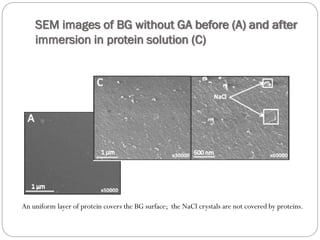
SEM images of BG without GA before (A) and after immersion in protein solution (C) 
An uniform layer of protein covers the BG surface; the NaClcrystals are not covered by proteins.
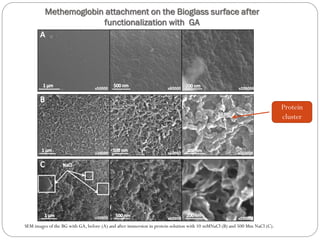
Methemoglobinattachment on the Bioglasssurface after functionalizationwith GA 
SEM images of the BG with GA, before (A) and after immersion in protein solution with 10 mMNaCl(B) and 500 Mm NaCl(C). 
Protein cluster
FTIR spectroscopy 
X –ray Photoelectron Spectroscopy 
evidence of MetHBadsorbed on Bioactive glass
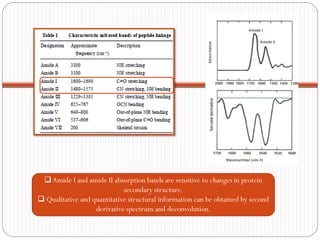
Amide I and amide II absorption bands are sensitive to changes in protein secondary structure. 
Qualitative and quantitative structural information can be obtained by second derivative spectrum and deconvolution.
Native MeMb 
MethMbon BG 
MetMbon BG-GA 
Native MetMb 
MethMbon BG 
MetMbon BG-GA 
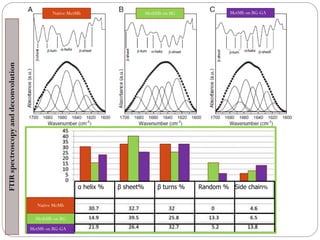
FTIR spectroscopy and deconvolution 
αhelix % βsheet% βturns % Random % Side chain%
Observations 
Oneadditionalpeakcenteredat1648cm−1appearsoriginatingfromrandomstructure. 
Also,themajorbandsat1656and1654cm−1,assignedtoα- helixstructuresinthenativemethemoglobinareshiftedtohigherwavenumbersuponadsorption.Thehigherbandpositioncorrespondstoweakerhydrogenbonding,leadingtomoreflexiblehelices,asaconsequenceoftheinteractionbetweentheproteinsandbioactiveglass. 
Theproteinlooseapproximatelyhalfoftheα-helicalstructureafteradsorptiononBG,butonly1/3whenBGisfunctionalizedwithGA.
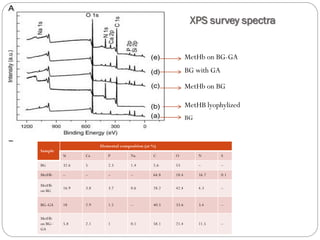
XPS survey spectra 
Sample 
Elemental composition (at %) 
Si 
Ca 
P 
Na 
C 
O 
N 
S 
BG 
32.6 
5 
2.3 
1.4 
5.6 
53 
– 
– 
MetHb 
– 
– 
– 
– 
64.8 
18.4 
16.7 
0.1 
MetHb on BG 
16.9 
3.8 
3.7 
0.6 
28.2 
42.4 
4.3 
– 
BG–GA 
18 
2.9 
1.5 
– 
40.5 
33.6 
3.4 
– 
MetHb on BG– GA 
5.8 
2.1 
1 
0.1 
58.1 
21.4 
11.5 
– 
BG 
MetHBlyophylized 
MetHbon BG 
BG with GA 
MetHbon BG-GA
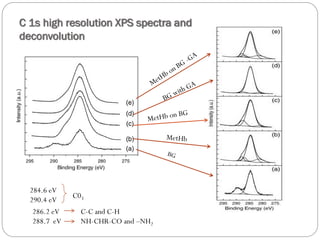
C 1s high resolution XPS spectra and deconvolution 
284.6 eV 
290.4 eV 
C03 
286.2 eVC-C and C-H 
288.7 eVNH-CHR-CO and –NH2
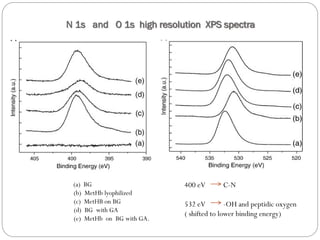
N 1s and O 1s high resolution XPS spectra 
(a) BG 
(b) MetHblyophilized 
(c) MetHBon BG 
(d) BG with GA 
(e) MetHbon BG with GA. 
400 eVC-N 
532 eV-OH and peptidicoxygen ( shifted to lower binding energy)
Observations 
The marker bands N 1s and C 1s specific to proteins shows an increasing intensity on GA functionalized sample. 
The surface functionalizationof the bioactive glass substrate with GA provides a better protein adherence that is considered beneficial for further interaction of biomaterial surface with surrounding cells.
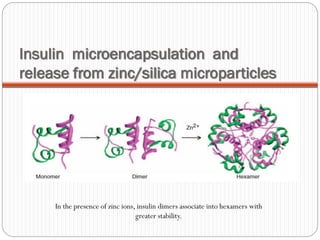
Insulin microencapsulation and release from zinc/silica microparticles 
In the presence of zinc ions, insulin dimersassociate into hexamerswith greater stability.
Advantages 
Microencapsulation is considered one of the best oral drug delivery approaches. 
Overcome the enzimaticand physical barriers of gastro intestinal tract. 
Advantages of encapsulation using inorganic silica: highly inert and stable (compared to organic polymers), amorphous silica (in contrast to crystalline silica) is not toxic being recognized by the Food and Drug Administration as safe food additive and excipientfor vitamins. 
Silica shell with pores typically < 10 nm 
ZnOhas antiseptic effect 
Addition of Zn ions proved to preserve the secondary structure of some proteins.
Sol -gel route 
Sol-gel 95 SiO2 ●5ZnO (mol%) 
20 mg Insulin addition to zinc silicate sol (before gelation) pH=2+ 
Spray-dried microcapsules 
Inlet temperature T= 120 ◦C 
Outlet T=75 ºC 
Freeze-dried microparticles 
T= -196 ºC 
Dried at T= 37 ºC
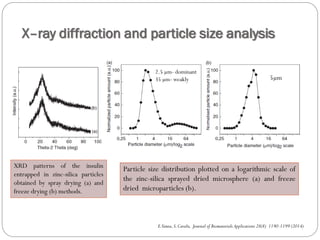
X–ray diffraction and particle size analysis 
XRDpatternsoftheinsulinentrappedinzinc-silicaparticlesobtainedbyspraydrying(a)andfreezedrying(b)methods. 
Particlesizedistributionplottedonalogarithmicscaleofthezinc-silicasprayeddriedmicrosphere(a)andfreezedriedmicroparticles(b). 
2.5 μm-dominant 
35 μm-weakly 
5μm 
E. Vanea, S. Cavalu, Journal of Biomaterials Applications 28(8) 1190-1199 (2014)
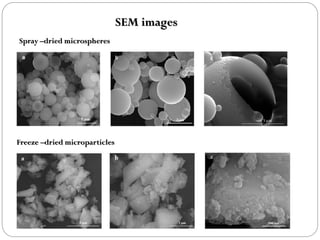
SEM imagesSpray –dried microspheres Freeze –dried microparticles
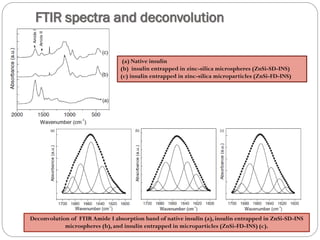
FTIR spectra and deconvolution 
(a) Native insulin 
(b) insulin entrapped in zinc-silica microspheres (ZnSi-SD-INS) 
(c) insulin entrapped in zinc-silica microparticles(ZnSi-FD-INS) 
Deconvolutionof FTIR Amide I absorption band of native insulin (a), insulin entrapped in ZnSi-SD-INS microspheres (b), and insulin entrapped in microparticles(ZnSi-FD-INS) (c).
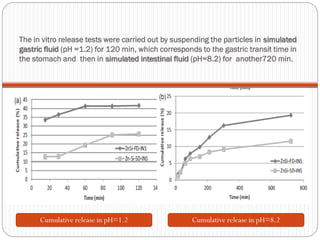
The in vitro release tests were carried out by suspending the particles in simulated gastric fluid (pH =1.2) for 120 min, which corresponds to the gastric transit time in the stomach and then in simulated intestinal fluid (pH=8.2) for another720 min. 
Cumulative release in pH=1.2 
Cumulative release in pH=8.2
Observations 
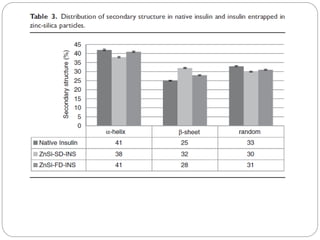
Insulinencapsulationinzinc-silicamicroparticlesfollowingthesol-gelroutecombinedwithfreezedryingandspraydryingprocedurehasbeendemonstratedtopreservetheintegrityofinsulin. 
Formationofinsulinhexamersinthepresenceofzincionsleads 
toanincreasedstabilityoftheinsulinthree-dimensionalstructureduringpreparation,storageandrelease. 
Thereleaseprofilecanbeadaptedbysynthesisrouteofmicroparticles.
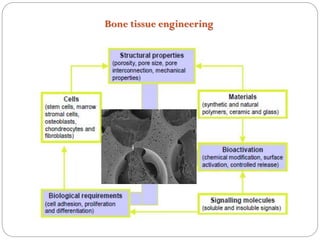
The future of bioglasses Bone tissue engineering-combines cells and biodegradable 3D scaffold to repair diseased or damaged bone tissue. 
Scaffolds are needed that can act as temporary templates for bone regeneration and actively stimulate vascularizedbone growth so that bone grafting is no longer necessary.
Bone tissue engineering
Requirements for the future: 
Improvementofthemechanicalperformanceofexisting 
bioactiveceramics. 
Enhancedbioactivityintermsofgeneactivation. 
Improvementintheperformanceofbiomedicalcoatingsin 
termsoftheirmechanicalstabilityandabilitytodeliverbiologicalagents. 
Developmentsmartmaterialscapableofcombiningsensing 
withbioactivity. 
Developmentofimprovedbiomimeticcomposites.
Simona cavalu apmas2014

Simona cavalu apmas2014

  • 1.
    Simona CavaluProfessorFaculty ofMedicine and PharmacyUniversity of OradeaROMANIA New bioceramicsfor hard tissue replacement and drug/ protein delivery: physical and biological approach
  • 3.
    Highlights Bioglass forcontrolled drug release (antibiotics) Surface functionalization and conformational changes of proteins adsorbed on Bioglass Insulin microencapsulation and release from zinc/silica microparticles
  • 4.
    A real story…turnsto history Bioglass®45S5, the first formulation composed of SiO2, Na2O, CaOand P2O5, developed by Professor Larry Hench at the University of Florida in the late 1960s. The 45S5 name signifies glass with 45 wt.% of SiO2and 5:1 ratio of CaOto P2O5. Lower Ca/P ratios do not bond to bone. ThefirstsuccessfulsurgicaluseofBioglass45S5wasinreplacementofossiclesinmiddleear,astreatmentofconductivehearingloss.
  • 5.
  • 6.
    Bioglassesare divided intwo categories: ClassA: •Osteoproductive •Osteoconductive. •Bindwithbothsofttissuesandbone.TheHCAlayerformswithinseveralhours. ClassB: •Osteoconductive(such as ydroxyapatite) •Bonding to soft tissues is not facilitated. The HCA layer takes one to several days to form.
  • 8.
    Advantage/disadvantage Theprimaryadvantageofbioactiveglassesistheirrapidrateofsurfacereactionwhichleadstofasttissuebonding. Theirprimarydisadvantageismechanicalweaknessandlowfracturetoughnessduetoanamorphoustwo-dimensionalglassnetwork. Tensilebendingstrengthofmostofthecompositionsisintherangeof40-60MPawhichmakethemunsuitableforloadbearingapplications. Forsomeapplicationslowstrengthisoffsetbytheglasses’lowmodulusofelasticityof30-35GPa.Thisvalueisclosetothatofcorticalbone.
  • 10.
    Compositions such as45S5 Bioglasswith high rates of bioactivity produce rapid regeneration of trabecularbone with an amount, architecture and bio-mechanical quality of bone that matches that originally present in the site. The rapid regeneration of bone is due to a combination of processes called osteostimulationand osteoconduction
  • 11.
    Processing bioglassesMelting process T= 1100-1300°CSol-gel route advantages: low processing temperature and controlling textural properties Sol-gel-derived bioactive glasses are more bioactive and degrade more rapidly than melt-derived glasses of similar compositions. This is because sol-gel glasses have a nanometer-scale textural porosity which increases the specific surface area by two orders of magnitude compared to a melt-derived glass .
  • 12.
    Sol–gel processing TEOS:tetraethoxysilane, Si(OCH2CH3)4.
  • 13.
    Pharmaceutical applications Designofbioglassandbioceramicdrugdeliverysystemswhichallowtheeffectivetargeteddeliverydosageofproducts,rangingfrominorganicandorganicmoleculesofdifferentsizeandproperties,tobecontrolled. Clientbespokeformulationsforspecificapplications, includingthecontrolledreleaseofpharmaceuticalactivecompounds,suchasvitamins,antibioticsandanti- inflammatorydrugs,andalsotheenablingofsequential,andtimeandsitewell-ordered,deliveryofmultipleagents Characterizationtomonitorandevaluatecontrolledreleased(fromhourstodays,even,tomonths)
  • 14.
    Bioglassfor controlled drugrelease: our results
  • 15.
    BIOACTIVE GLASSES FORANTIBIOTIC CONTROLLED RELEASE-our results Bioglasscomposition and treatment: Specimen 1: 0.55SiO2•0.41CaO•0.04P2O5, maturated at room temperature for 70 days and heat treated at 310°C for 1 hour. Specimen 2: 0.55SiO2•0.41CaO•0.04P2O5, air dried at 80°C for 50 min., maturated at room temperature for 70 days and then heat treated at 310°C for 1 hour. Specimen 3: 0.45SiO2•0.245CaO•0.06P2O5•0.245Na2O, maturated at room temperature for 70 days and then heat treated at 310°C for 1 hour. S. Cavalu & all, Journal of Molecular Structure 1040 (2013) 47–52 TTC was incorporated by immersion of the specimens in solution C=7 mg/ml under continuing stirring 1h.
  • 16.
    Tetracycline loading andrelease –SEM Before loading After TTC loading Specimen 1: 0.55SiO2•0.41CaO•0.04P2O5
  • 17.
    Tetracycline loading andrelease –SEM Before loading After TTC loading Specimen 2: 0.55SiO2•0.41CaO•0.04P2O5
  • 18.
    Tetracycline loading andrelease –SEM Before loading After TTC loading Specimen 3 : 0.45SiO2•0.245CaO•0.06P2O5•0.245Na2O
  • 19.
    BET specific surfacearea and mean pore volume values determined for the bioactive glass specimens before and after tetracycline loading. Sample Specific surface area (m2/g) Pore volume (ml/g) Before TC loading TC loaded Before TC loading TC loaded S1 106.8 83.1 0.43 0.34 S2 96.2 77.1 0.38 0.30 S3 98.2 79.0 0.41 0.31 Theprocedureofdryingat80ºCcausedadecreaseoftheporesize Theporesizeandsurfaceareadecreasedafterimmersionintetracyclinesolutionduetotetracyclineattachment. Specimen1,whichexposedalargersurface,isabletoincorporatemoretetracyclinecomparedtothespecimen2and3.
  • 20.
    TTC stability byUV/VIS spectroscopy pH stability Red shift: transformation of TTC molecule from TTC0to TTC-anion concomitant with the transition of π to π*states . TTC-tends to attract reactive species, such as .OH, due to the high electrical density on ring system.
  • 21.
    The main degradationproducts during photolysis in aqueous medium
  • 22.
    UV-VIS and EPRspectroscopy detecting free radical formation during the samples preparation procedure. 200 300 400 500 TC3 TC2 Intensity (a.u.) Wavelength (nm) TC1 3300 3320 3340 3360 3380 3400 3420 3333.6 3334.5 3335.4 Magnetic field (G) TC3 TC2 TC1 Experimental EPR spectra of withdrawn tetracycline solutions obtained upon filtration of each bioglass specimen. Inset: top of the lower field spectral lines, showing quantitative differences in spin concentration. Bottom: Experimental EPR spectra of tetracycline hydrochloride starting solution (7 mg/mL) 265 383 UV-VIS spectra of withdrawn tetracycline solutions obtained upon filtration of each bioglass specimen
  • 23.
    EPR experimental spectraof the bioglasssspecimens upon TTC loading, filtration and drying procedure.
  • 24.
    EPR simulations ofliquid spectra The values of gand Amagnetic tensors components obtained from EPR spectra simulations for tetracycline withdrawn solutions: τTC1< τTC2< τTC3 τ(ps) Axx(mT) Ayy(mT) Azz(mT) gxx gyy gzz TC1 30.2 23.50 7.36 21.52 2.00475 2.00418 2.00212 TC2 34.3 23.71 7.38 21.26 2.00473 2.00392 2.00217 TC3 49.4 23.53 7.292 21.61 2.00429 2.00410 2.00285
  • 25.
    EPR simulations ofTC immobilized on porous bioactive structure τTC1< τTC2< τTC3
  • 26.
    Differential Pulsed Voltammetry(DPV) -tetracycline release profile in SBF 0.0 0.2 0.4 0.6 0.8 0 1 2 3 4 I (A) E (V) 2h 5h 24h 48h 96h 0.0 0.2 0.4 0.6 0.8 -1 0 1 2 3 I ( A) E(V) 2h 5h 24h 48h 96h 0.0 0.2 0.4 0.6 0.8 0 1 2 3 E (V) I (A) 2h 5h 24h 48h 96h Specimen 1 Specimen 2 Specimen 3 Time (h) Specimen 1 Specimen 2 Specimen 3 I (μA) C(μM) I (μA) C (μM) I (μA) C(μM) 2 3.50 0.851 3.28 0.712 2.59 0.295 5 3.27 0.703 3.11 0.614 2.32 0.121 24 2.95 0.511 2.73 0.379 2.14 0.071 48 1.99 0.025 0.25 0.040 0.19 0.008 96 1.56 0.014 0.15 0.020 0.10 0.004
  • 27.
    Tetracycline hydrochloride mayact as a chemical spin trap. EPR and UV/VIS spectroscopy have shown that the specimen with a larger surface are is able to incorporate more tetracycline. The maximum TC amount was released after 2 h, and thereafter the release continued slightly for 24 h, followed by a drastic diminution after 48 h. The pores size modification and specific surface area after tetracycline loading seems to be the main factor in tetracycline controlled released process. Similar results were obtained for different pharmaceutical compounds: hydrocortisone, propolis, β-cyclodextrin[ Z.R. Domingues& all, Biomaterials 25 (2004) 327–333; A. L. Andrade & all, Journal of Non-Crystalline Solids 355 (2009) 811– 816]. Observations
  • 28.
    Surface functionalizationand conformationalchanges of proteins adsorbed on Bioglass Native structure of methemoglobinby X-ray crystallography Composition as classical 45S5 Bioglass: 45% SiO2, 24.5% Na2O, 24.5% CaOand 6% P2O5 (in molar%). Sol-gel route. Aging 30 days at room temperature and heating at 310º C 1h. Incubation 4h in protein solution ( 25 mg/ml MHbwith TBS). Glutaraldehyde(GA) solution (1 mol/L) as protein coupling agent Particles size distribution of the milled glass (by laser diffraction method). V. Simon, S. Cavalu, Solid State Ionics 180 (2009) 764–769. C. Gruian, S. Cavalu, V. Simon, Biochimicaet BiophysicaActa1824 (2012) 873–881
  • 29.
    SEM images ofBG without GA before (A) and after immersion in protein solution (C) An uniform layer of protein covers the BG surface; the NaClcrystals are not covered by proteins.
  • 30.
    Methemoglobinattachment on theBioglasssurface after functionalizationwith GA SEM images of the BG with GA, before (A) and after immersion in protein solution with 10 mMNaCl(B) and 500 Mm NaCl(C). Protein cluster
  • 31.
    FTIR spectroscopy X–ray Photoelectron Spectroscopy evidence of MetHBadsorbed on Bioactive glass
  • 32.
    Amide I andamide II absorption bands are sensitive to changes in protein secondary structure. Qualitative and quantitative structural information can be obtained by second derivative spectrum and deconvolution.
  • 33.
    Native MeMb MethMbonBG MetMbon BG-GA Native MetMb MethMbon BG MetMbon BG-GA FTIR spectroscopy and deconvolution αhelix % βsheet% βturns % Random % Side chain%
  • 34.
    Observations Oneadditionalpeakcenteredat1648cm−1appearsoriginatingfromrandomstructure. Also,themajorbandsat1656and1654cm−1,assignedtoα-helixstructuresinthenativemethemoglobinareshiftedtohigherwavenumbersuponadsorption.Thehigherbandpositioncorrespondstoweakerhydrogenbonding,leadingtomoreflexiblehelices,asaconsequenceoftheinteractionbetweentheproteinsandbioactiveglass. Theproteinlooseapproximatelyhalfoftheα-helicalstructureafteradsorptiononBG,butonly1/3whenBGisfunctionalizedwithGA.
  • 35.
    XPS survey spectra Sample Elemental composition (at %) Si Ca P Na C O N S BG 32.6 5 2.3 1.4 5.6 53 – – MetHb – – – – 64.8 18.4 16.7 0.1 MetHb on BG 16.9 3.8 3.7 0.6 28.2 42.4 4.3 – BG–GA 18 2.9 1.5 – 40.5 33.6 3.4 – MetHb on BG– GA 5.8 2.1 1 0.1 58.1 21.4 11.5 – BG MetHBlyophylized MetHbon BG BG with GA MetHbon BG-GA
  • 36.
    C 1s highresolution XPS spectra and deconvolution 284.6 eV 290.4 eV C03 286.2 eVC-C and C-H 288.7 eVNH-CHR-CO and –NH2
  • 37.
    N 1s andO 1s high resolution XPS spectra (a) BG (b) MetHblyophilized (c) MetHBon BG (d) BG with GA (e) MetHbon BG with GA. 400 eVC-N 532 eV-OH and peptidicoxygen ( shifted to lower binding energy)
  • 38.
    Observations The markerbands N 1s and C 1s specific to proteins shows an increasing intensity on GA functionalized sample. The surface functionalizationof the bioactive glass substrate with GA provides a better protein adherence that is considered beneficial for further interaction of biomaterial surface with surrounding cells.
  • 39.
    Insulin microencapsulation andrelease from zinc/silica microparticles In the presence of zinc ions, insulin dimersassociate into hexamerswith greater stability.
  • 40.
    Advantages Microencapsulation isconsidered one of the best oral drug delivery approaches. Overcome the enzimaticand physical barriers of gastro intestinal tract. Advantages of encapsulation using inorganic silica: highly inert and stable (compared to organic polymers), amorphous silica (in contrast to crystalline silica) is not toxic being recognized by the Food and Drug Administration as safe food additive and excipientfor vitamins. Silica shell with pores typically < 10 nm ZnOhas antiseptic effect Addition of Zn ions proved to preserve the secondary structure of some proteins.
  • 41.
    Sol -gel route Sol-gel 95 SiO2 ●5ZnO (mol%) 20 mg Insulin addition to zinc silicate sol (before gelation) pH=2+ Spray-dried microcapsules Inlet temperature T= 120 ◦C Outlet T=75 ºC Freeze-dried microparticles T= -196 ºC Dried at T= 37 ºC
  • 42.
    X–ray diffraction andparticle size analysis XRDpatternsoftheinsulinentrappedinzinc-silicaparticlesobtainedbyspraydrying(a)andfreezedrying(b)methods. Particlesizedistributionplottedonalogarithmicscaleofthezinc-silicasprayeddriedmicrosphere(a)andfreezedriedmicroparticles(b). 2.5 μm-dominant 35 μm-weakly 5μm E. Vanea, S. Cavalu, Journal of Biomaterials Applications 28(8) 1190-1199 (2014)
  • 43.
    SEM imagesSpray –driedmicrospheres Freeze –dried microparticles
  • 44.
    FTIR spectra anddeconvolution (a) Native insulin (b) insulin entrapped in zinc-silica microspheres (ZnSi-SD-INS) (c) insulin entrapped in zinc-silica microparticles(ZnSi-FD-INS) Deconvolutionof FTIR Amide I absorption band of native insulin (a), insulin entrapped in ZnSi-SD-INS microspheres (b), and insulin entrapped in microparticles(ZnSi-FD-INS) (c).
  • 46.
    The in vitrorelease tests were carried out by suspending the particles in simulated gastric fluid (pH =1.2) for 120 min, which corresponds to the gastric transit time in the stomach and then in simulated intestinal fluid (pH=8.2) for another720 min. Cumulative release in pH=1.2 Cumulative release in pH=8.2
  • 47.
    Observations Insulinencapsulationinzinc-silicamicroparticlesfollowingthesol-gelroutecombinedwithfreezedryingandspraydryingprocedurehasbeendemonstratedtopreservetheintegrityofinsulin. Formationofinsulinhexamersinthepresenceofzincionsleads toanincreasedstabilityoftheinsulinthree-dimensionalstructureduringpreparation,storageandrelease. Thereleaseprofilecanbeadaptedbysynthesisrouteofmicroparticles.
  • 48.
    The future ofbioglasses Bone tissue engineering-combines cells and biodegradable 3D scaffold to repair diseased or damaged bone tissue. Scaffolds are needed that can act as temporary templates for bone regeneration and actively stimulate vascularizedbone growth so that bone grafting is no longer necessary.
  • 49.
  • 50.
    Requirements for thefuture: Improvementofthemechanicalperformanceofexisting bioactiveceramics. Enhancedbioactivityintermsofgeneactivation. Improvementintheperformanceofbiomedicalcoatingsin termsoftheirmechanicalstabilityandabilitytodeliverbiologicalagents. Developmentsmartmaterialscapableofcombiningsensing withbioactivity. Developmentofimprovedbiomimeticcomposites.