Classification and Structure of
             Amino Acid


By:- Vivek Kumar
Programme:- Bs-Ms (Physics)
School:- School Of Basic Sciences   and Researches
[1] Amino Acids

(1) Description
• The “standard” amino acids are α-amino acids.
‒ primary amino group (−NH2)
‒ carboxylic acid group (−COOH)

•Proline is an exception
 with a secondary amino group,
 but, it is still referred to
 as an α-amino acid.
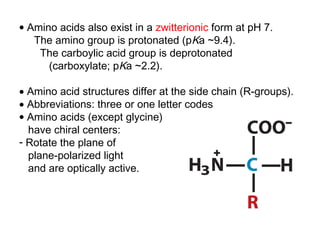
• Amino acids also exist in a zwitterionic form at pH 7.
   The amino group is protonated (pKa ~9.4).
    The carboylic acid group is deprotonated
      (carboxylate; pKa ~2.2).

• Amino acid structures differ at the side chain (R-groups).
• Abbreviations: three or one letter codes
• Amino acids (except glycine)
  have chiral centers:
- Rotate the plane of
  plane-polarized light
  and are optically active.
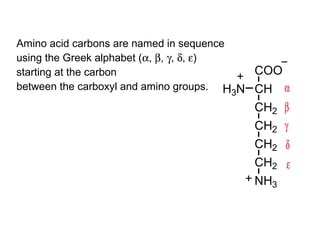
Amino acid carbons are named in sequence
using the Greek alphabet (α, β, γ, δ, ε)
starting at the carbon                     COO
between the carboxyl and amino groups. H N CH α
                                         3
                                        CH2   β
                                        CH2   γ
                                        CH2   δ
                                        CH2   ε
                                        NH3
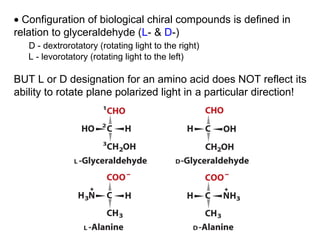
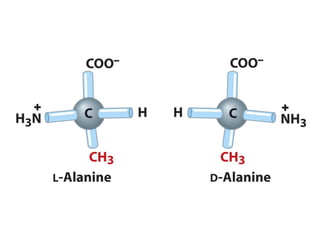
• Configuration of biological chiral compounds is defined in
relation to glyceraldehyde (L- & D-)
   D - dextrorotatory (rotating light to the right)
   L - levorotatory (rotating light to the left)

BUT L or D designation for an amino acid does NOT reflect its
ability to rotate plane polarized light in a particular direction!
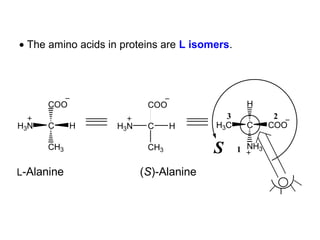
• The amino acids in proteins are L isomers.


      COO                  COO                  H
                                          3             2
H3N   C     H       H3N    C     H      H3C     C      COO

      CH3                  CH3          S      1 NH3

L-Alanine                 (S)-Alanine
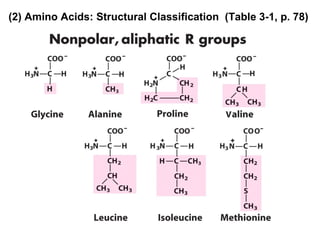
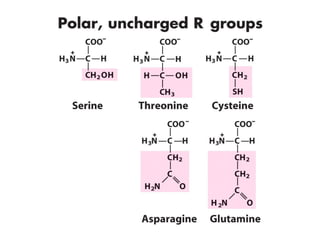
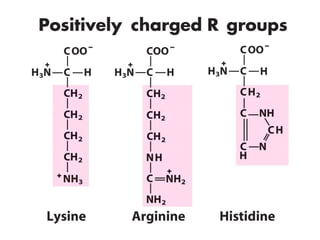
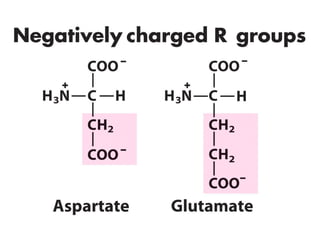
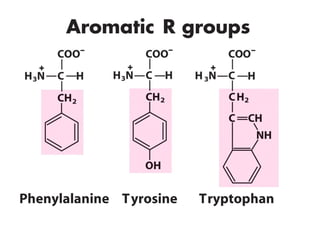
(2) Amino Acids: Structural Classification (Table 3-1, p. 78)
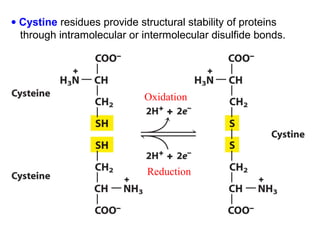
• Cystine residues provide structural stability of proteins
  through intramolecular or intermolecular disulfide bonds.


                            Oxidation


                             Reduction
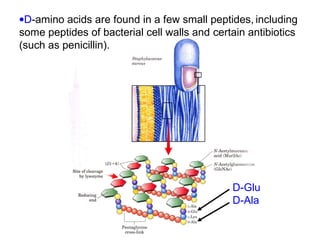
•D-amino acids are found in a few small peptides, including
some peptides of bacterial cell walls and certain antibiotics
(such as penicillin).


                                              D-Glu
                                              D-Ala
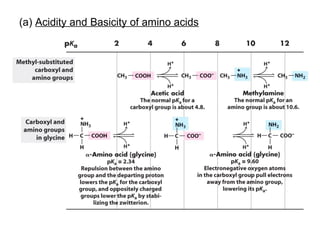
(a) Acidity and Basicity of amino acids
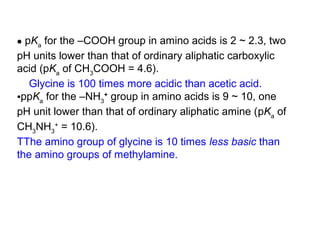
• pKa for the –COOH group in amino acids is 2 ~ 2.3, two
pH units lower than that of ordinary aliphatic carboxylic
acid (pKa of CH3COOH = 4.6).
   Glycine is 100 times more acidic than acetic acid.
•ppKa for the –NH3+ group in amino acids is 9 ~ 10, one
pH unit lower than that of ordinary aliphatic amine (pKa of
CH3NH3+ = 10.6).
TThe amino group of glycine is 10 times less basic than
the amino groups of methylamine.
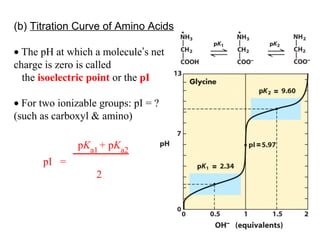
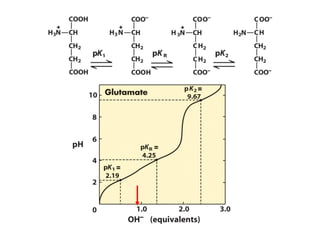
(b) Titration Curve of Amino Acids

• The pH at which a molecule’s net
charge is zero is called
  the isoelectric point or the pI

• For two ionizable groups: pI = ?
(such as carboxyl & amino)

              pKa1 + pKa2
      pI =
                   2
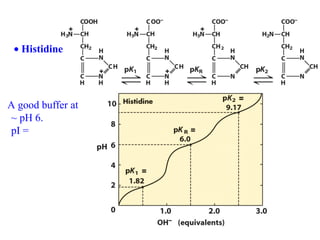
• Histidine


A good buffer at
~ pH 6.
pI =
(4) Functions

1. Chemical Messengers: Neurotransmitters are roughly divided
into small molecules & peptidic (neuropetides), these are further
classified as inhibitor and excitatory.
(A) Inhibitory Neurotransmitters
• Glycine (-OOC-CH2-NH3+)
– binds a receptor that depolarizes the synapse by Cl- release
– involved in motor and sensory functions
• γ-Aminobutyric acid (-OOC-(CH2)3-NH3+) – GABA
– Glutamic acid derivative
– Most common neurotransmitter in brain
– Huntington’s disease - altered levels
(B) Excitatory Neurotransmitters
• Glutamic acid and Aspartic acid: learning and memory
• Epinephrine (=adrenaline) and norepinephrine
  are derived from tyrosine .
2. Monomeric subunits of proteins
All proteins are composed of some or all of the 20 "standard"
    amino acids
‒ two new amino acids have been recently discovered!
Discovery of 21st amino acid: (Selenocystein)
Discovery of 22nd amino acid: (Pyrrollysine)


3. Energy metabolites – many are essential nutrients and
   can be used as precursors to other molecules.
[2] Peptides and Proteins (MW > 10,000):
    Polymers of amino acids


   Peptide synthesis:


 Energetically unfavourable
        (∆G > 0)

→ Couple with energetically
  favourable reaction(s)
  (Leaving group activation)
  (Lehninger Fig 27-14, p.1052.)
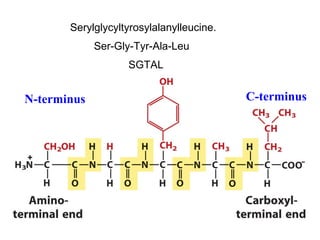
Serylglycyltyrosylalanylleucine.
             Ser-Gly-Tyr-Ala-Leu
                   SGTAL


N-terminus                                C-terminus
• Peptide bonds are stable:
 t1/2 = 7 yrs in cells due to high ∆G‡ of the hydrolysis reaction.

• Peptides (and proteins) have their unique pI values
  depending on the a.a. compositions.

• Biologically active peptides:
  oxytocin, bradykinin, vasopressin, etc.
  insulin, glucagon,
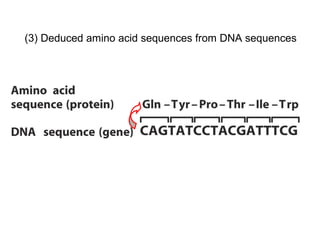
(3) Deduced amino acid sequences from DNA sequences
Protein function ⇐ 3-D structure ⇐ Sequence

The goal is to learn, from sequence, as much
information as possible on its structure,
function, and its evolutionary history.
[4] Protein Sequences and Evolution

• Genes and proteins from closely related organisms
  should be similar.

• The sequences increasingly diverge as the evolutionary
  distance between two organisms increases.

 • Conserved a.a. residues: amino acid residues essential
  for function and structure are conserved throughout the
  evolution.

 • Variable residues: Those less important vary over time.
  ⇒ polymorphism
• Protein family: A group of proteins with significant
  sequence similarity (>25%), and/or with similar
  structure and function.
  • Likely share common evolutionary origin.
    Ser proteinases: chymotrypsin, trypsin, elastase, etc.
    Cytochrome P450 family.


• Homologs, paralogs (gene duplication), orthologs (speciation)
•Multiple sequence alignment & Conservative Substitution

Homologs are identified by comparing multiple sequences of a
protein from different organisms.

Multiple sequences are aligned to maximize the sequence
similarity.

Conservative substitution by a chemically similar a.a. residue
(Asp and Glu, Lys and Arg, Trp and Phe, etc) is given a high
score during alignment according to the scoring system
such as Blosum62.

08 h3

  • 1.
    Classification and Structureof Amino Acid By:- Vivek Kumar Programme:- Bs-Ms (Physics) School:- School Of Basic Sciences and Researches
  • 2.
    [1] Amino Acids (1)Description • The “standard” amino acids are α-amino acids. ‒ primary amino group (−NH2) ‒ carboxylic acid group (−COOH) •Proline is an exception with a secondary amino group, but, it is still referred to as an α-amino acid.
  • 3.
    • Amino acidsalso exist in a zwitterionic form at pH 7. The amino group is protonated (pKa ~9.4). The carboylic acid group is deprotonated (carboxylate; pKa ~2.2). • Amino acid structures differ at the side chain (R-groups). • Abbreviations: three or one letter codes • Amino acids (except glycine) have chiral centers: - Rotate the plane of plane-polarized light and are optically active.
  • 4.
    Amino acid carbonsare named in sequence using the Greek alphabet (α, β, γ, δ, ε) starting at the carbon COO between the carboxyl and amino groups. H N CH α 3 CH2 β CH2 γ CH2 δ CH2 ε NH3
  • 5.
    • Configuration ofbiological chiral compounds is defined in relation to glyceraldehyde (L- & D-) D - dextrorotatory (rotating light to the right) L - levorotatory (rotating light to the left) BUT L or D designation for an amino acid does NOT reflect its ability to rotate plane polarized light in a particular direction!
  • 7.
    • The aminoacids in proteins are L isomers. COO COO H 3 2 H3N C H H3N C H H3C C COO CH3 CH3 S 1 NH3 L-Alanine (S)-Alanine
  • 8.
    (2) Amino Acids:Structural Classification (Table 3-1, p. 78)
  • 13.
    • Cystine residuesprovide structural stability of proteins through intramolecular or intermolecular disulfide bonds. Oxidation Reduction
  • 14.
    •D-amino acids arefound in a few small peptides, including some peptides of bacterial cell walls and certain antibiotics (such as penicillin). D-Glu D-Ala
  • 15.
    (a) Acidity andBasicity of amino acids
  • 16.
    • pKa forthe –COOH group in amino acids is 2 ~ 2.3, two pH units lower than that of ordinary aliphatic carboxylic acid (pKa of CH3COOH = 4.6). Glycine is 100 times more acidic than acetic acid. •ppKa for the –NH3+ group in amino acids is 9 ~ 10, one pH unit lower than that of ordinary aliphatic amine (pKa of CH3NH3+ = 10.6). TThe amino group of glycine is 10 times less basic than the amino groups of methylamine.
  • 17.
    (b) Titration Curveof Amino Acids • The pH at which a molecule’s net charge is zero is called the isoelectric point or the pI • For two ionizable groups: pI = ? (such as carboxyl & amino) pKa1 + pKa2 pI = 2
  • 19.
    • Histidine A goodbuffer at ~ pH 6. pI =
  • 20.
    (4) Functions 1. ChemicalMessengers: Neurotransmitters are roughly divided into small molecules & peptidic (neuropetides), these are further classified as inhibitor and excitatory. (A) Inhibitory Neurotransmitters • Glycine (-OOC-CH2-NH3+) – binds a receptor that depolarizes the synapse by Cl- release – involved in motor and sensory functions • γ-Aminobutyric acid (-OOC-(CH2)3-NH3+) – GABA – Glutamic acid derivative – Most common neurotransmitter in brain – Huntington’s disease - altered levels (B) Excitatory Neurotransmitters • Glutamic acid and Aspartic acid: learning and memory • Epinephrine (=adrenaline) and norepinephrine are derived from tyrosine .
  • 21.
    2. Monomeric subunitsof proteins All proteins are composed of some or all of the 20 "standard" amino acids ‒ two new amino acids have been recently discovered! Discovery of 21st amino acid: (Selenocystein) Discovery of 22nd amino acid: (Pyrrollysine) 3. Energy metabolites – many are essential nutrients and can be used as precursors to other molecules.
  • 22.
    [2] Peptides andProteins (MW > 10,000): Polymers of amino acids Peptide synthesis: Energetically unfavourable (∆G > 0) → Couple with energetically favourable reaction(s) (Leaving group activation) (Lehninger Fig 27-14, p.1052.)
  • 23.
    Serylglycyltyrosylalanylleucine. Ser-Gly-Tyr-Ala-Leu SGTAL N-terminus C-terminus
  • 24.
    • Peptide bondsare stable: t1/2 = 7 yrs in cells due to high ∆G‡ of the hydrolysis reaction. • Peptides (and proteins) have their unique pI values depending on the a.a. compositions. • Biologically active peptides: oxytocin, bradykinin, vasopressin, etc. insulin, glucagon,
  • 25.
    (3) Deduced aminoacid sequences from DNA sequences
  • 26.
    Protein function ⇐3-D structure ⇐ Sequence The goal is to learn, from sequence, as much information as possible on its structure, function, and its evolutionary history.
  • 27.
    [4] Protein Sequencesand Evolution • Genes and proteins from closely related organisms should be similar. • The sequences increasingly diverge as the evolutionary distance between two organisms increases. • Conserved a.a. residues: amino acid residues essential for function and structure are conserved throughout the evolution. • Variable residues: Those less important vary over time. ⇒ polymorphism
  • 28.
    • Protein family:A group of proteins with significant sequence similarity (>25%), and/or with similar structure and function. • Likely share common evolutionary origin. Ser proteinases: chymotrypsin, trypsin, elastase, etc. Cytochrome P450 family. • Homologs, paralogs (gene duplication), orthologs (speciation)
  • 29.
    •Multiple sequence alignment& Conservative Substitution Homologs are identified by comparing multiple sequences of a protein from different organisms. Multiple sequences are aligned to maximize the sequence similarity. Conservative substitution by a chemically similar a.a. residue (Asp and Glu, Lys and Arg, Trp and Phe, etc) is given a high score during alignment according to the scoring system such as Blosum62.