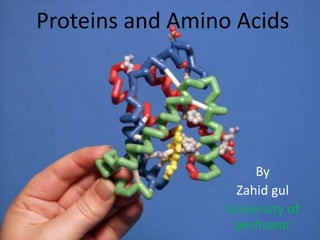
Proteins and Amino Acids
By
Zahid gul
University of
peshawar
Protein
• Proteins are the most abundant and functionally
diverse molecules in living systems where they
constitute 50% or more of their dry mass.
• The word protein is derived from the Greek Protos,
which means the first or supreme.
• Proteins are nitrogenous macromolecules,composed
of aminoacids linked by peptide bond.
Amino acid
•monomers of protein.
•consists of carbon,hydrogen,oxygen,nitrogen
and some contain sulfur.
• our body protein are made up from 20 types
amino acids.
• Although more than 300 naturally
occurring amino acids are known but only
20 amino acids take part in the formation
of all types of proteins,plants as well as
animal in origin.
• These 20 amino acids are known as
Primary,Standard or normal amino acids.
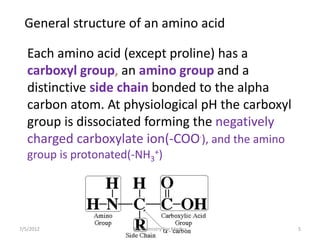
General structure of an amino acid
Each amino acid (except proline) has a
carboxyl group, an amino group and a
distinctive side chain bonded to the alpha
carbon atom. At physiological pH the carboxyl
group is dissociated forming the negatively
charged carboxylate ion(-COO-
), and the amino
group is protonated(-NH3
+)
7/5/2012 5Biochemistry For Medics
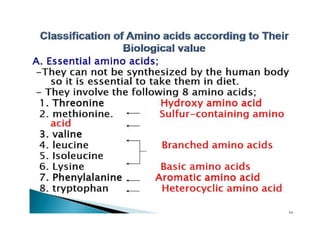
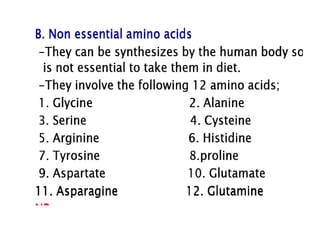
• Semi-essential aminoacids.
Two amino acid cysteine and tyrosine can
be sythesiszed from essential amino
acid{thionine and phenyalanine} and can
also be consumed in diet.
• the process of amino acid formation from
other amino acid is called transamination
Classification of proteins regarding
nutrition
• HIGH QUALITY PROTEINS
Protein that contain all the nine essential
amino acid
• LOW QUALITY PROTEINS
Protein that lack one or more essential
amino acid
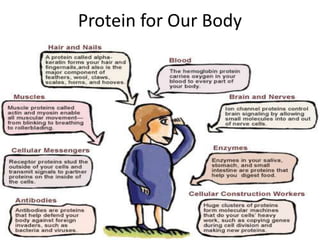
Protein for Our Body
Protein synthesis
• DNA contains coded instructions for protein
synthesis in the form of three nucleotide per
unit of instruction called codon, each codon
represent a specific amino acid.
• Protein synthesis consists of two main steps,
• Transcription and translation.
Transcription
• Formation of mRNA from DNA is called
transcription.
• Transcription occurs in three stages:
1.Initiation:
– RNA polymerase binds to DNA at a specific
sequence of nucleotides called the promoter.
– The promoter contains an initiation site where
transcription of the gene begins.
Transcription
– RNA polymerase than unwinds DNA at the
beginning of the gene.
• 2.Elongation:
– Only one of the unmound DNA strands acts as a
template for the RNA synthesis.
– RNA polymerase can only add nucleotides to the
3' end of the strand.
– Free nucleotides from the cytoplasm are paired
up with their complementary base on the
exposed DNA template.
Transcription
Termination:
RNA polymerase continues to elongate until it
reaches the terminator, a specific sequence of n
Transcription stops and mRNA polymerase and
the new mRNA transcript are released from DNA.
The DNA double helix reforms.
• And the mRNA enters into the cytoplasm.
translation
• Translation may be divided into three distinct
steps.
translation
• Inatiation,results in the formation of an initiation complex
in which the ribosome is bound to the specific initiation
(start) site on the mRNA while the initiator tRNA is
annealed to the initiator codon and bound to the ribosome.
• , elongation consists of joining amino acids to the growing
polypeptide chain according to the sequence specified by
the message. Incorporation of each amino acid occurs by
the same mechanism. Thus, the same steps are repeated
over and over again until the termination codon is reached
in the message. The termination codon gives the signal for
the third and last stage of protein synthesis, the
termination in which the ready-made protein is released
from the ribosome.
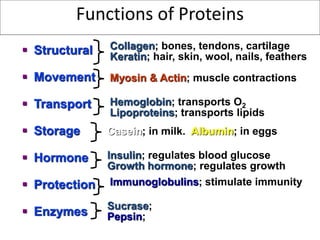
 Structural
 Movement
 Transport
 Storage
 Hormone
 Protection
 Enzymes
Collagen; bones, tendons, cartilage
Keratin; hair, skin, wool, nails, feathers
Myosin & Actin; muscle contractions
Hemoglobin; transports O2
Lipoproteins; transports lipids
Casein; in milk. Albumin; in eggs
Insulin; regulates blood glucose
Growth hormone; regulates growth
Immunoglobulins; stimulate immunity
Sucrase;
Pepsin;
Functions of Proteins
Protein Deficiency
• Protein-energy malnutrition (PEM)
World’s most widespread malnutrition problem
Includes both marasmus and kwashiorkor and states
of overlap
MARASMUS. { to waste away}
symptoms.
Muscle wasting, Impaired immunity ,Lethargy,
Vomiting, Delayed wound healing, Loss of fat
stores and muscles
Causes.
•due to diet containing less amount of protein and
energy.
•no breast feeding or stop breast feeding in early
month
•working mother feed their infants through bottle
which also can cause this condition.
• in hospitalized patient marasmus can be caused by
lack of proper diet.
Kwashiorkor
• symptoms :
• change in skin and hair color (reddish-orange color)
• fatigue
• diarrhea
• loss of muscle mass
• failure to grow or gain weight
• damaged immune system, which can lead to more frequent
and severe infections
• irritability
• rash
• large belly that sticks out
Causes
• Kwashiorkor is a world from ghana that means
“ the disease that the first child gets when
the new child comes”
• When the breast feeding is no longer
possible for the first child the child diet
changes and can not fulfill the energy and
protein requirement of he child,
• The child also has infections and parasites,
Protein Digestion
and
absorbtion
Protein Digestion
• is the degradation of proteins by cellular enzymes
enzymes in a process called hydrolysis.
• Protein digestion takes place in two different
phases:
– In the stomach
– In the small intestine
• Both of these phases of digestion are based on
several types of enzymes that are called
proteinases and proteases.
In the Stomach : start of protein
Digestion
Gastrin
-stimulates Parietal cells to secrete HCL; Chief
cells of the gastric glands to secrete pepsinogen
Hydrochloric acid
-Denatures protein structure
-Activates pepsinogen (zymogen) to pepsin
Pepsin
-hydrolyzes proteins to smaller polypeptides and
some free amino acids.
In the intestine
. The remainder of protein digestion occurs in
the small intestine as the result of the action
of enzymes
such as trypsin (secreted by the pancreas) and
peptidases (located in the cells that line the
small intestine).
In the Small Intestine : enzymes
Secretin
- stimulates the pancreas to secrete bicarbonate
into the small intestine to neutralize the gastric HCl
Cholecystokinin
-stimulates secretion of several pancreatic enzyme
with activity optima pH 7 to 8.
In the Small Intestine
Trypsin
- activates chymotrypsinogen chymotrypsin
procarboxypeptidasescarboxypeptidases
proelastaseelastase
-further hydrolyze the peptides that were produced by
pepsin in the stomach specifically the peptide bonds next
to lysine and arginine
Chymotrypsin
-cleaves peptide bonds
Carboxypeptidase A & B
-cleave amino acids from the acid (carboxyl) ends of
polypeptides
Elastase and collagenase
-cleave polypeptides into smaller polypeptides and
tripeptides
Intestinal tripeptidases
-Cleave tripeptides to dipeptides and amino acids
Intestinal dipeptidases
-cleave dipeptides to amino acids
Intestinal aminopeptidases
-cleave amino acids from the amino ends of small
polypeptides (oligopeptides)
Amino acids absorbed
Free amino acid  small
intestine(villi)Liverblood circulation
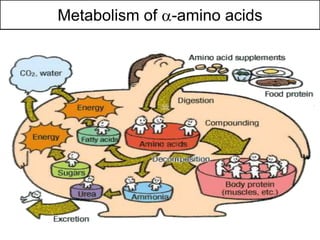
Metabolism of -amino acids
Alcohol
• Alcohol are chemically called ethanol.
• Alcohol are classed as depressant because it
slows down vital function resulting in slurred
speech, unsteady movement, disturbed
perception and inability to react quickly,
• Alcohol overdose can causes coma and death
also.
• Besides these and many other effects alcohol
is a good source of energy
Alcohol metabolism
• Metabolism of alcohol is dependent on many
factors like gender, race, size and physical
condition.
• Alcohol is metabolized by three pathways.
• Alcohol dehydrogenase pathway.
• Microsomal ethanol oxidizing system.
• Catalase pathway.
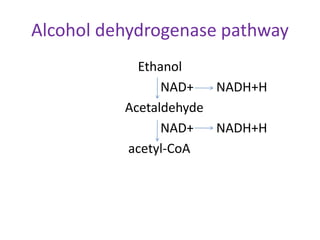
Alcohol dehydrogenase pathway
Ethanol
NAD+ NADH+H
Acetaldehyde
NAD+ NADH+H
acetyl-CoA
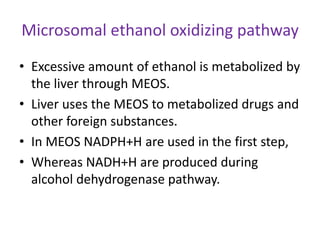
Microsomal ethanol oxidizing pathway
• Excessive amount of ethanol is metabolized by
the liver through MEOS.
• Liver uses the MEOS to metabolized drugs and
other foreign substances.
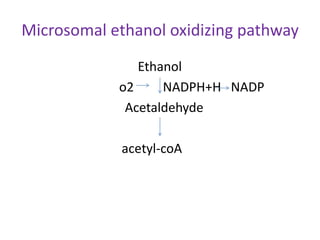
• In MEOS NADPH+H are used in the first step,
• Whereas NADH+H are produced during
alcohol dehydrogenase pathway.
Microsomal ethanol oxidizing pathway
Ethanol
o2 NADPH+H NADP
Acetaldehyde
acetyl-coA
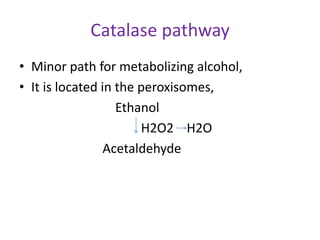
Catalase pathway
• Minor path for metabolizing alcohol,
• It is located in the peroxisomes,
Ethanol
H2O2 H2O
Acetaldehyde
Health problem and alcohol
• Alcohol is the third leading cause of preventable
death in north America
• Causes of alcohol are heart failure, cancer, liver
cirrhosis, motor vehicle accidents, hypertension,
hemorrhagic stroke, osteoporosis, brain damage,
suppression of immune system.
• Liver cirrhosis affects about 2 million people in
USA, AND IS the second leading cause of the liver
transplants.
Health problem and alcohol
• In 2011 about 35,000 American died of liver
cirrhosis.
• Increase heart muscle damage, blood clotting
and blood pressure.
• Reduce insulin sensitivity and damage to
pancreas,
• Damage skeletal muscle,

Protein anino acid and alcohol

  • 1.
    Proteins and AminoAcids By Zahid gul University of peshawar
  • 2.
    Protein • Proteins arethe most abundant and functionally diverse molecules in living systems where they constitute 50% or more of their dry mass. • The word protein is derived from the Greek Protos, which means the first or supreme. • Proteins are nitrogenous macromolecules,composed of aminoacids linked by peptide bond.
  • 3.
    Amino acid •monomers ofprotein. •consists of carbon,hydrogen,oxygen,nitrogen and some contain sulfur. • our body protein are made up from 20 types amino acids.
  • 4.
    • Although morethan 300 naturally occurring amino acids are known but only 20 amino acids take part in the formation of all types of proteins,plants as well as animal in origin. • These 20 amino acids are known as Primary,Standard or normal amino acids.
  • 5.
    General structure ofan amino acid Each amino acid (except proline) has a carboxyl group, an amino group and a distinctive side chain bonded to the alpha carbon atom. At physiological pH the carboxyl group is dissociated forming the negatively charged carboxylate ion(-COO- ), and the amino group is protonated(-NH3 +) 7/5/2012 5Biochemistry For Medics
  • 8.
    • Semi-essential aminoacids. Twoamino acid cysteine and tyrosine can be sythesiszed from essential amino acid{thionine and phenyalanine} and can also be consumed in diet. • the process of amino acid formation from other amino acid is called transamination
  • 10.
    Classification of proteinsregarding nutrition • HIGH QUALITY PROTEINS Protein that contain all the nine essential amino acid • LOW QUALITY PROTEINS Protein that lack one or more essential amino acid
  • 11.
  • 12.
    Protein synthesis • DNAcontains coded instructions for protein synthesis in the form of three nucleotide per unit of instruction called codon, each codon represent a specific amino acid. • Protein synthesis consists of two main steps, • Transcription and translation.
  • 13.
    Transcription • Formation ofmRNA from DNA is called transcription. • Transcription occurs in three stages: 1.Initiation: – RNA polymerase binds to DNA at a specific sequence of nucleotides called the promoter. – The promoter contains an initiation site where transcription of the gene begins.
  • 14.
    Transcription – RNA polymerasethan unwinds DNA at the beginning of the gene. • 2.Elongation: – Only one of the unmound DNA strands acts as a template for the RNA synthesis. – RNA polymerase can only add nucleotides to the 3' end of the strand. – Free nucleotides from the cytoplasm are paired up with their complementary base on the exposed DNA template.
  • 15.
    Transcription Termination: RNA polymerase continuesto elongate until it reaches the terminator, a specific sequence of n Transcription stops and mRNA polymerase and the new mRNA transcript are released from DNA. The DNA double helix reforms. • And the mRNA enters into the cytoplasm.
  • 16.
    translation • Translation maybe divided into three distinct steps.
  • 17.
    translation • Inatiation,results inthe formation of an initiation complex in which the ribosome is bound to the specific initiation (start) site on the mRNA while the initiator tRNA is annealed to the initiator codon and bound to the ribosome. • , elongation consists of joining amino acids to the growing polypeptide chain according to the sequence specified by the message. Incorporation of each amino acid occurs by the same mechanism. Thus, the same steps are repeated over and over again until the termination codon is reached in the message. The termination codon gives the signal for the third and last stage of protein synthesis, the termination in which the ready-made protein is released from the ribosome.
  • 18.
     Structural  Movement Transport  Storage  Hormone  Protection  Enzymes Collagen; bones, tendons, cartilage Keratin; hair, skin, wool, nails, feathers Myosin & Actin; muscle contractions Hemoglobin; transports O2 Lipoproteins; transports lipids Casein; in milk. Albumin; in eggs Insulin; regulates blood glucose Growth hormone; regulates growth Immunoglobulins; stimulate immunity Sucrase; Pepsin; Functions of Proteins
  • 19.
    Protein Deficiency • Protein-energymalnutrition (PEM) World’s most widespread malnutrition problem Includes both marasmus and kwashiorkor and states of overlap MARASMUS. { to waste away} symptoms. Muscle wasting, Impaired immunity ,Lethargy, Vomiting, Delayed wound healing, Loss of fat stores and muscles
  • 20.
    Causes. •due to dietcontaining less amount of protein and energy. •no breast feeding or stop breast feeding in early month •working mother feed their infants through bottle which also can cause this condition. • in hospitalized patient marasmus can be caused by lack of proper diet.
  • 21.
    Kwashiorkor • symptoms : •change in skin and hair color (reddish-orange color) • fatigue • diarrhea • loss of muscle mass • failure to grow or gain weight • damaged immune system, which can lead to more frequent and severe infections • irritability • rash • large belly that sticks out
  • 22.
    Causes • Kwashiorkor isa world from ghana that means “ the disease that the first child gets when the new child comes” • When the breast feeding is no longer possible for the first child the child diet changes and can not fulfill the energy and protein requirement of he child, • The child also has infections and parasites,
  • 23.
  • 24.
    Protein Digestion • isthe degradation of proteins by cellular enzymes enzymes in a process called hydrolysis. • Protein digestion takes place in two different phases: – In the stomach – In the small intestine • Both of these phases of digestion are based on several types of enzymes that are called proteinases and proteases.
  • 25.
    In the Stomach: start of protein Digestion Gastrin -stimulates Parietal cells to secrete HCL; Chief cells of the gastric glands to secrete pepsinogen Hydrochloric acid -Denatures protein structure -Activates pepsinogen (zymogen) to pepsin Pepsin -hydrolyzes proteins to smaller polypeptides and some free amino acids.
  • 26.
    In the intestine .The remainder of protein digestion occurs in the small intestine as the result of the action of enzymes such as trypsin (secreted by the pancreas) and peptidases (located in the cells that line the small intestine).
  • 27.
    In the SmallIntestine : enzymes Secretin - stimulates the pancreas to secrete bicarbonate into the small intestine to neutralize the gastric HCl Cholecystokinin -stimulates secretion of several pancreatic enzyme with activity optima pH 7 to 8.
  • 28.
    In the SmallIntestine Trypsin - activates chymotrypsinogen chymotrypsin procarboxypeptidasescarboxypeptidases proelastaseelastase -further hydrolyze the peptides that were produced by pepsin in the stomach specifically the peptide bonds next to lysine and arginine Chymotrypsin -cleaves peptide bonds
  • 29.
    Carboxypeptidase A &B -cleave amino acids from the acid (carboxyl) ends of polypeptides Elastase and collagenase -cleave polypeptides into smaller polypeptides and tripeptides
  • 30.
    Intestinal tripeptidases -Cleave tripeptidesto dipeptides and amino acids Intestinal dipeptidases -cleave dipeptides to amino acids Intestinal aminopeptidases -cleave amino acids from the amino ends of small polypeptides (oligopeptides)
  • 31.
    Amino acids absorbed Freeamino acid  small intestine(villi)Liverblood circulation
  • 32.
  • 33.
    Alcohol • Alcohol arechemically called ethanol. • Alcohol are classed as depressant because it slows down vital function resulting in slurred speech, unsteady movement, disturbed perception and inability to react quickly, • Alcohol overdose can causes coma and death also. • Besides these and many other effects alcohol is a good source of energy
  • 34.
    Alcohol metabolism • Metabolismof alcohol is dependent on many factors like gender, race, size and physical condition. • Alcohol is metabolized by three pathways. • Alcohol dehydrogenase pathway. • Microsomal ethanol oxidizing system. • Catalase pathway.
  • 35.
    Alcohol dehydrogenase pathway Ethanol NAD+NADH+H Acetaldehyde NAD+ NADH+H acetyl-CoA
  • 36.
    Microsomal ethanol oxidizingpathway • Excessive amount of ethanol is metabolized by the liver through MEOS. • Liver uses the MEOS to metabolized drugs and other foreign substances. • In MEOS NADPH+H are used in the first step, • Whereas NADH+H are produced during alcohol dehydrogenase pathway.
  • 37.
    Microsomal ethanol oxidizingpathway Ethanol o2 NADPH+H NADP Acetaldehyde acetyl-coA
  • 38.
    Catalase pathway • Minorpath for metabolizing alcohol, • It is located in the peroxisomes, Ethanol H2O2 H2O Acetaldehyde
  • 39.
    Health problem andalcohol • Alcohol is the third leading cause of preventable death in north America • Causes of alcohol are heart failure, cancer, liver cirrhosis, motor vehicle accidents, hypertension, hemorrhagic stroke, osteoporosis, brain damage, suppression of immune system. • Liver cirrhosis affects about 2 million people in USA, AND IS the second leading cause of the liver transplants.
  • 40.
    Health problem andalcohol • In 2011 about 35,000 American died of liver cirrhosis. • Increase heart muscle damage, blood clotting and blood pressure. • Reduce insulin sensitivity and damage to pancreas, • Damage skeletal muscle,

Editor's Notes

  • #25 The enzymes for protein digestion are collectively called proteinases (protein-ACES) or proteases (pro-tea-ACES). Proteins are broken apart by the protein-digesting enzymes in a process called hydrolysis. Proteases- enzymes that hydrolyze protein
  • #26 .Entry of dietary protein into the stomach stimulates the gastric mucosa to secrete the hormone gastrin, which in turn stimulates the secretion of hydrochloric acid by the parietal cells and pepsinogen by the chief cells of the gastric glands .The acidic gastric juice (pH 1.0t o 2.5) is both an antiseptic,killing most bacteria and other foreign cells, and a denaturing agent, unfolding globular proteins and rendering their internal peptide bonds m ore accessible to enzymatic hydrolysis. Pepsinogen ,an inactive precursor or zymogen is converted to active pepsin by an autocatalytic cleavage(a cleavage mediated b y thepepsinogen it self) that occurs only at low pH. In the stomach, pepsin hydrolyzes ingested proteins at peptide bonds on the amino terminai side of the aromatic amino acid residues Phe, Ttp, and T}rr cleaving long polypeptide chains into a mixture of smaller peptides.
  • #27 Enteropeptidase ( an enzyme in the small intestine activates trpsinogen to trypsin/ it converts pancreatic trypsinogen to trypsin.)
  • #28 As the acidic stomach contents pass into the small intestine,the low pH triggers secretion of the hormone secretin into the blood. Secretin stimulates the pancreas to secrete bicarbonate into the small intestine to neutralize the gastnc HCl, abruptly increasing the pH to about 7.(All pancreatic secretions pass into the small intestine through the pancreatic duct.) The digestion of proteins now continues in the small intestine. Arrival of amino acids in the upper part of the intestine (duodenum) causes release into the blood of the hormone cholecystokinin, which stimulates secretion of several pancreatic enzyme with activity optima pH 7 to 8.
  • #29 Enteropeptidase converts pancreatic trypsinogen to trypsin. Trypsinogen,chymotrypsinogen, and procarboxypeptidases A and B—the zymogens of trypsin, chymotrypsin, and carboxypeptidases A and B--are synthesized and secreted by the exocrine cells of the pancreas. Trypsinogen is converted to its active form, trypsin, by enteropeptidase, a proteolytic enzymes secreted by intestinal cells. Free trypsin then catalyzes the conversion of additional trypsinogen to trypsin .Trypsin also activates chymotrypsinogen, the procarboxypeptidases and proelastase. Trypsin and chymotrypsin further hydrolyze the peptides that were produced by pepsin in the stomach. This stage of protein digestion is accomplished very efflciently,because pepsin, trypsin, and chymotrypsin have different amino acid speciflcities .
  • #30  Degradation of the short peptides in the small intestine is then completed by other intestinal peptidases. These include carboxypeptidases A and B (both of which are zinc-containing enzymes), which remove successive carboxyl-terminal residues from peptides,
  • #31 aminopeptidase that hydrolyzes successive amino-terminal residues from short peptides.
  • #32 The resulting mixture of free amino acids is transported into the epithelial cells lining the small intestine, through which the amino acids enter the blood capillaries in the villi and travel to the liver and then go into the blood of the general circulation In humans, most globular proteins from animal sources are almost completely hydrolyzed to amino acids in the gastrointestinal tract, but some fibrous proteins,such as keratin, are only partly digested. In addition, the protein content of some plant foods is protected against breakdown by indigestible cellulose husks.