Creating the Project
Charter
By Badre Edine Mokhlisse
Senior Software Engineer At Digimind
mokhlisse_badre@yahoo.fr
Table of contents
● How projects are initiated
○ Needs and Demands
○ Feasibility Studies
○ Project Selection methods
● Project Charter Definition
● Develop Project Charter Inputs
● Develop Project Charter Tools
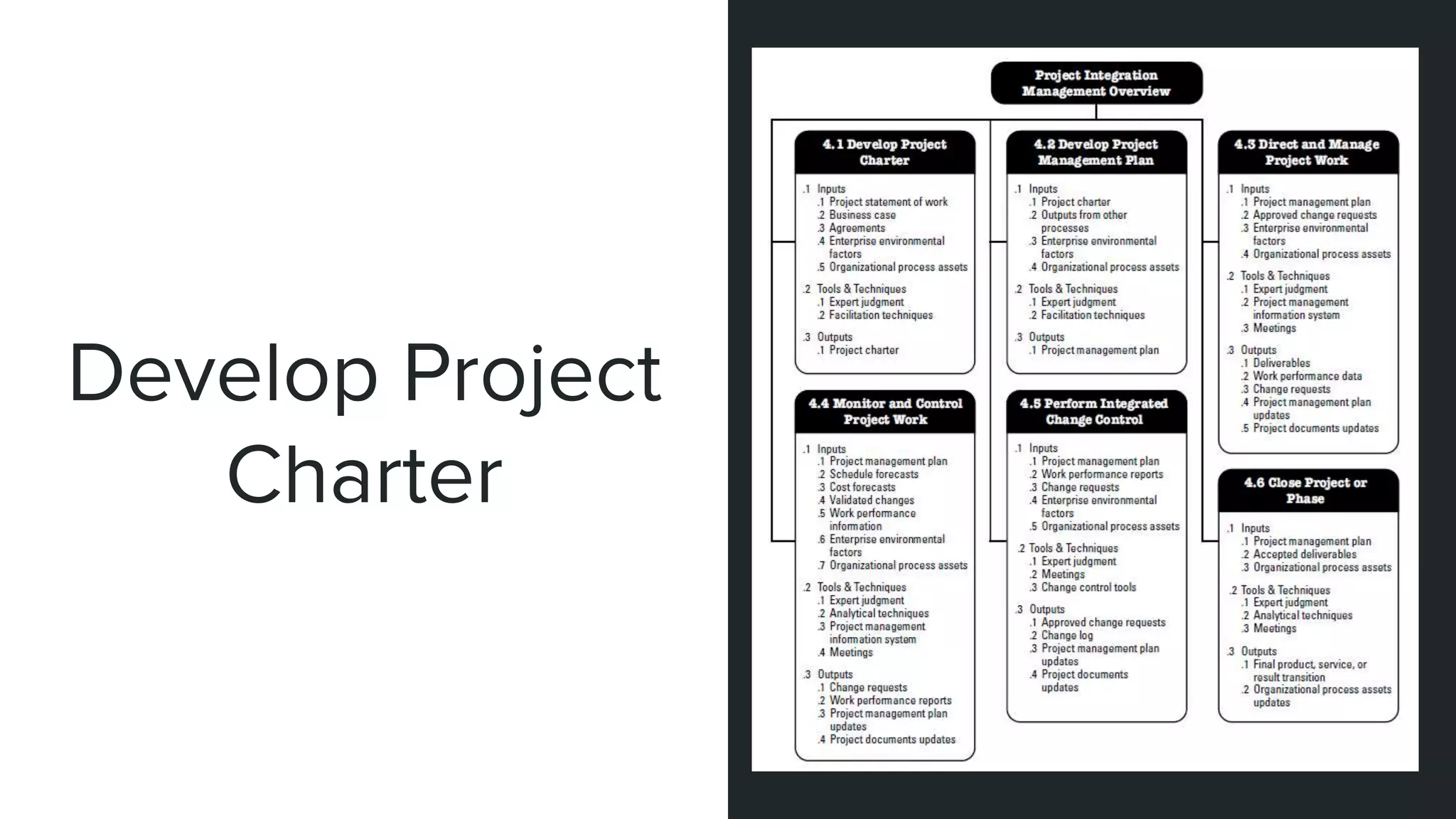
Develop Project
Charter
Needs and
Demands
Projects come about as a result of one of
seven needs or demands:
● Market demand
● Strategic opportunity/business
need
● Customer request
● Technological advance
● Legal requirement
● Ecological impacts
● Social need
Feasibility
Studies
A feasibility study evaluates the project’s
potential for success:
1. Technical Feasibility:
a. determine whether the technical
resources meet capacity
b. technical team is capable of
converting the ideas into working
systems
2. Economic Feasibility: involves cost/
benefits analysis of the project
3. Legal Feasibility: investigates whether
any aspect of the proposed project
conflicts with legal requirements
4. Operational Feasibility
5. Scheduling Feasibility: how much
time the project will take to complete
Project
Selection
Methods
There are various methods which help
choose a project from a selection of
projects:
1. Benefit Measurement Methods
○ Benefit/Cost Ratio
○ Economic Value Added (EVA)
○ Scoring Model
○ Payback Period
○ Net Present Value (NPV)
○ Internal Rate of Return (IRR)
○ Opportunity Cost
2. Constrained Optimization Method
○ Linear Programming
○ Non-linear Programming
○ Integer Programming
○ Dynamic Programming
Project Charter ?
A project charter is a high level document,
which is created initially, as the project is
mooted, to highlight the key need of the
project – the objective, purpose of the
project and its high level deliverables:
● Project Need / Opportunity / Justification for
the Project
● Cost Benefit Analysis
● Project Objectives
● Key Stakeholders
● High Level Risks
● High Level Constraints / Boundaries
● High Level Assumptions
● Summary Budget
● Timeline, Key Milestones
● Success Criteria
● Project Manager and their Authority
Inputs to
Developing a
Project Charter
1. Statement of Work
○ describes the product, service, or
result the project was undertaken
to complete
○ It could be high level, or in detail
○ if internal project: document is
written by either the project
sponsor or the initiator of the
project
○ if external project: buyer writes the
SOW
2. Business Case
3. Agreements or Contracts
4. Enterprise Environmental Factors
5. Organizational Process Assets
1. Statement of Work
2. Business Case
3. Agreements or Contracts
4. Enterprise Environmental
Factors
5. Organizational Process
Assets
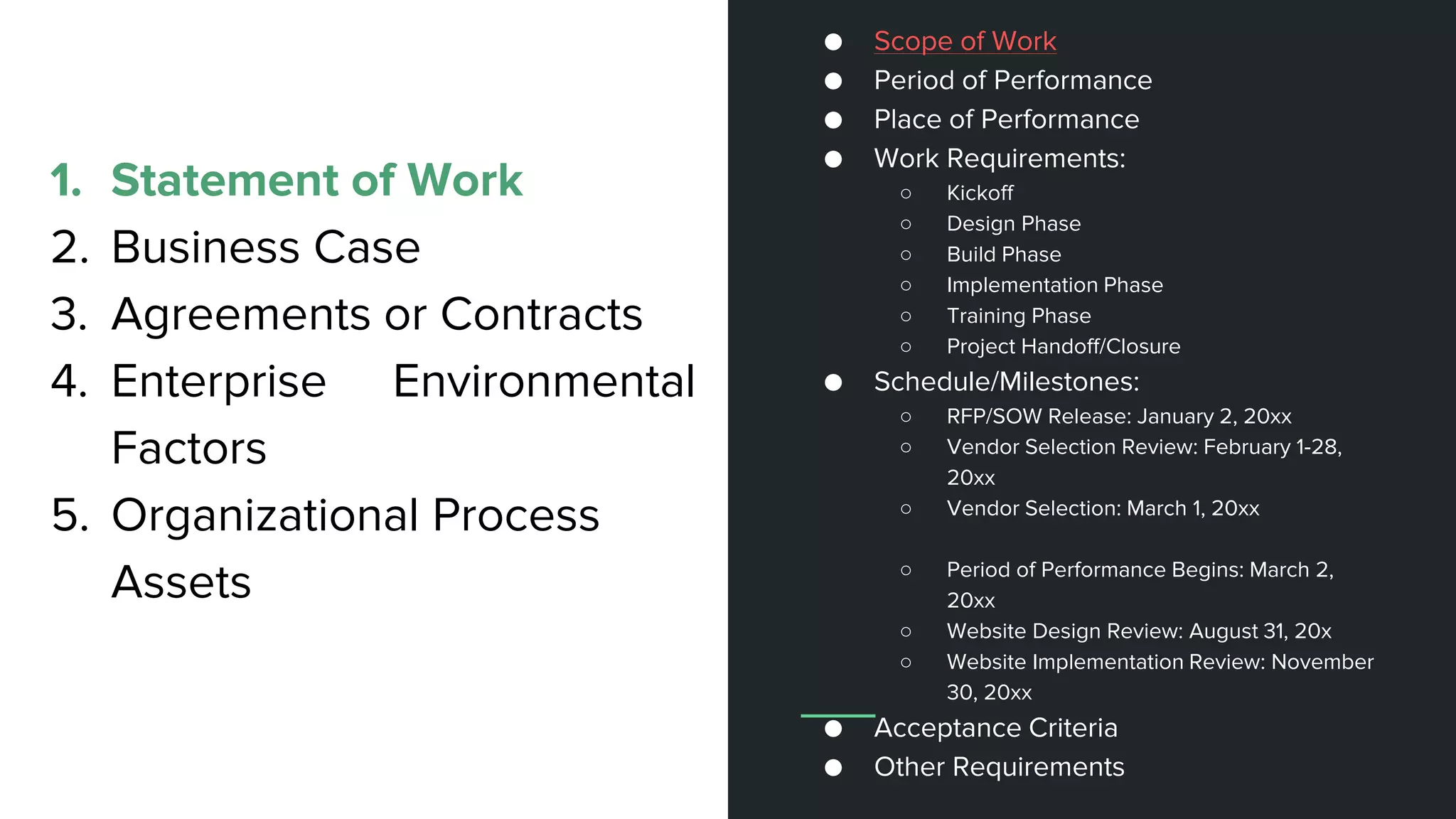
● Scope of Work
● Period of Performance
● Place of Performance
● Work Requirements:
○ Kickoff
○ Design Phase
○ Build Phase
○ Implementation Phase
○ Training Phase
○ Project Handoff/Closure
● Schedule/Milestones:
○ RFP/SOW Release: January 2, 20xx
○ Vendor Selection Review: February 1-28,
20xx
○ Vendor Selection: March 1, 20xx
○ Period of Performance Begins: March 2,
20xx
○ Website Design Review: August 31, 20x
○ Website Implementation Review: November
30, 20xx
● Acceptance Criteria
● Other Requirements
1. Statement of Work
2. Business Case
3. Agreements or Contracts
4. Enterprise Environmental
Factors
5. Organizational Process
Assets
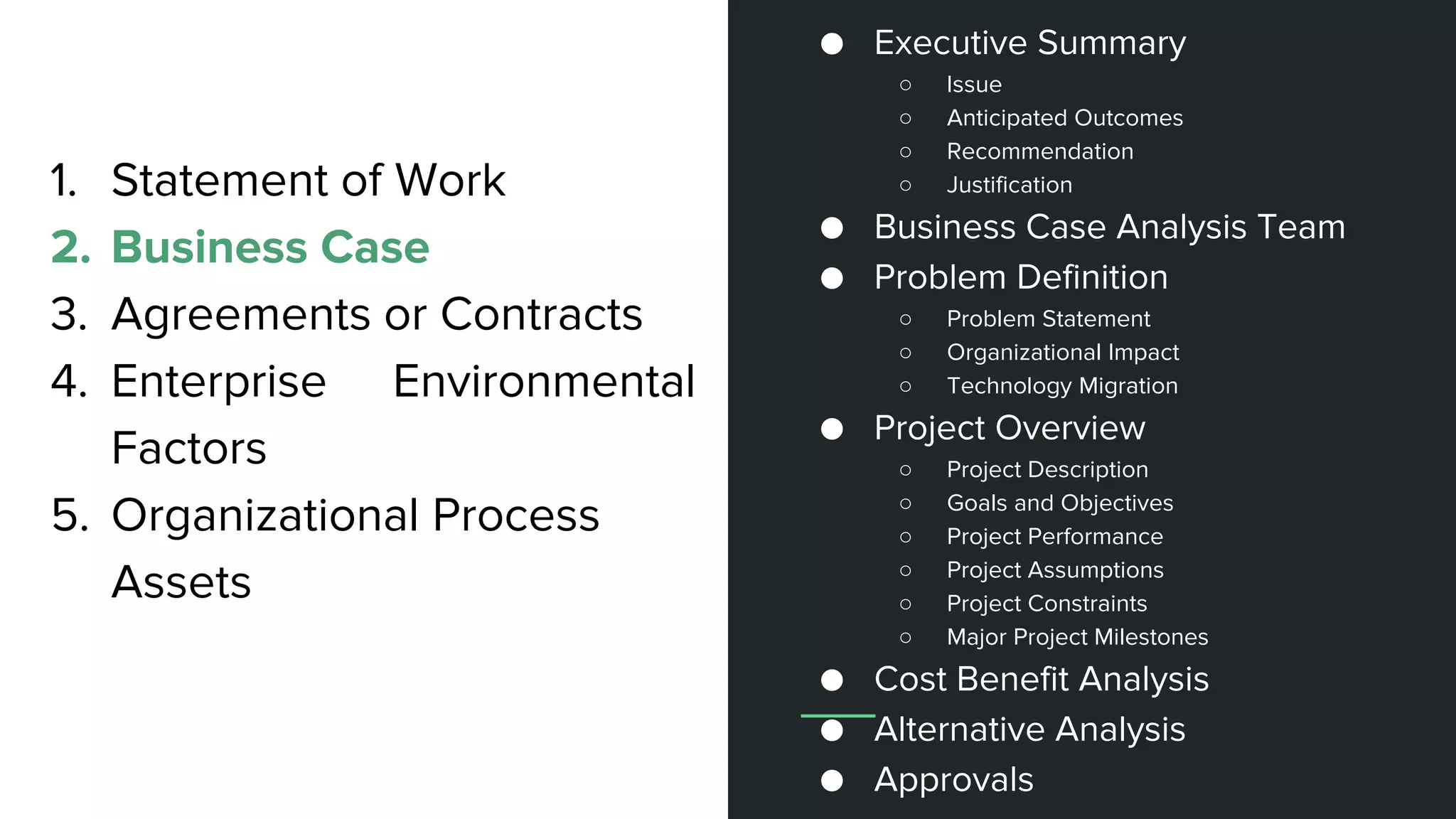
● Executive Summary
○ Issue
○ Anticipated Outcomes
○ Recommendation
○ Justification
● Business Case Analysis Team
● Problem Definition
○ Problem Statement
○ Organizational Impact
○ Technology Migration
● Project Overview
○ Project Description
○ Goals and Objectives
○ Project Performance
○ Project Assumptions
○ Project Constraints
○ Major Project Milestones
● Cost Benefit Analysis
● Alternative Analysis
● Approvals
1. Statement of Work
2. Business Case
3. Agreements or Contracts
4. Enterprise Environmental
Factors
5. Organizational Process
Assets
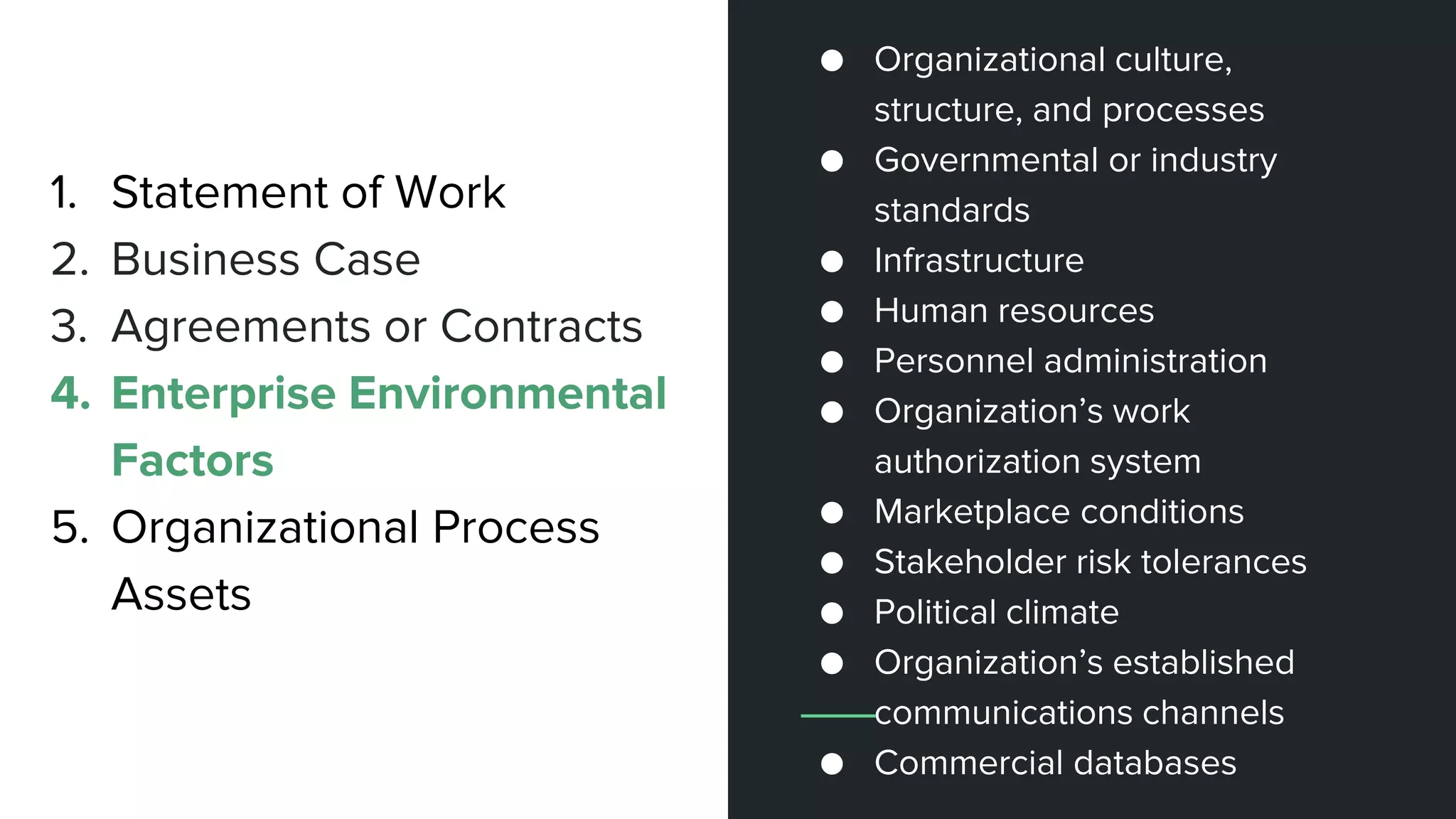
● Organizational culture,
structure, and processes
● Governmental or industry
standards
● Infrastructure
● Human resources
● Personnel administration
● Organization’s work
authorization system
● Marketplace conditions
● Stakeholder risk tolerances
● Political climate
● Organization’s established
communications channels
● Commercial databases
1. Statement of Work
2. Business Case
3. Agreements or Contracts
4. Enterprise Environmental
Factors
5. Organizational Process
Assets
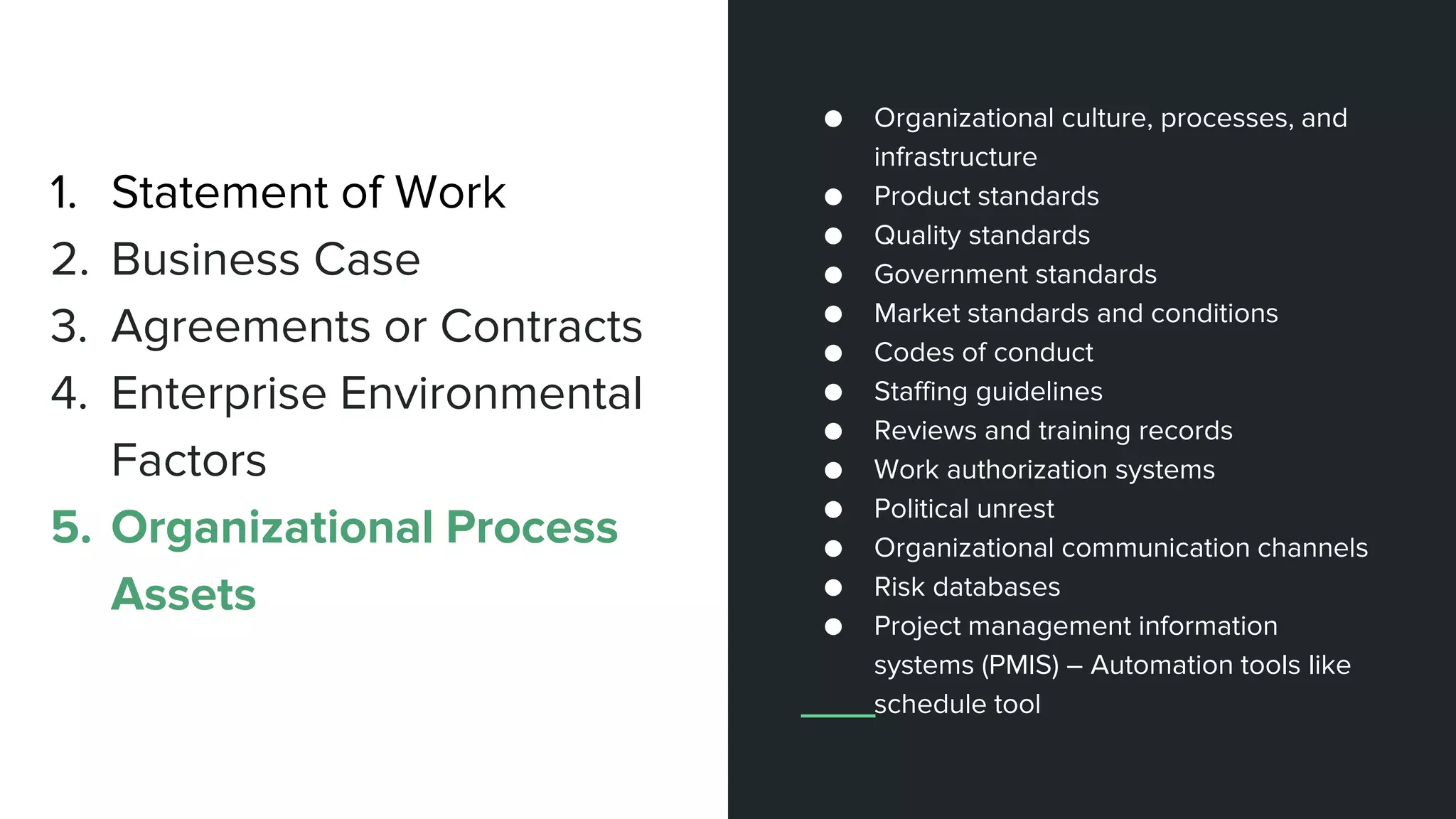
● Organizational culture, processes, and
infrastructure
● Product standards
● Quality standards
● Government standards
● Market standards and conditions
● Codes of conduct
● Staffing guidelines
● Reviews and training records
● Work authorization systems
● Political unrest
● Organizational communication channels
● Risk databases
● Project management information
systems (PMIS) – Automation tools like
schedule tool
Developing a
Project Charter
Tools
1. Expert Judgment
2. Facilitation techniques
Judgment is made based upon a specific set
of criteria and/or expertise that has been
acquired in a specific knowledge area, or
product area, a particular discipline, an
industry, etc:
● Member of the project team
● Multiple members of the project
team
● Team leader or team leaders
● External group or person
● Customers
● Professional and technical
organizations
● Other miscellaneous industry
groups
1. Expert Judgment
2. Facilitation techniques
Examples of key
techniques used by
facilitators:
● Brainstorming
● Conflict resolution
● Problem solving
● Meeting
management
1. Expert Judgment
2. Facilitation techniques
Brainstorming is a group creativity
technique by which efforts are made
to find a conclusion for a specific
problem by gathering a list of ideas
spontaneously contributed by its
members.
Variations:
● Nominal group technique
● Group passing technique
● Team idea mapping method
● Directed brainstorming
● Guided brainstorming
1. Brainstorming
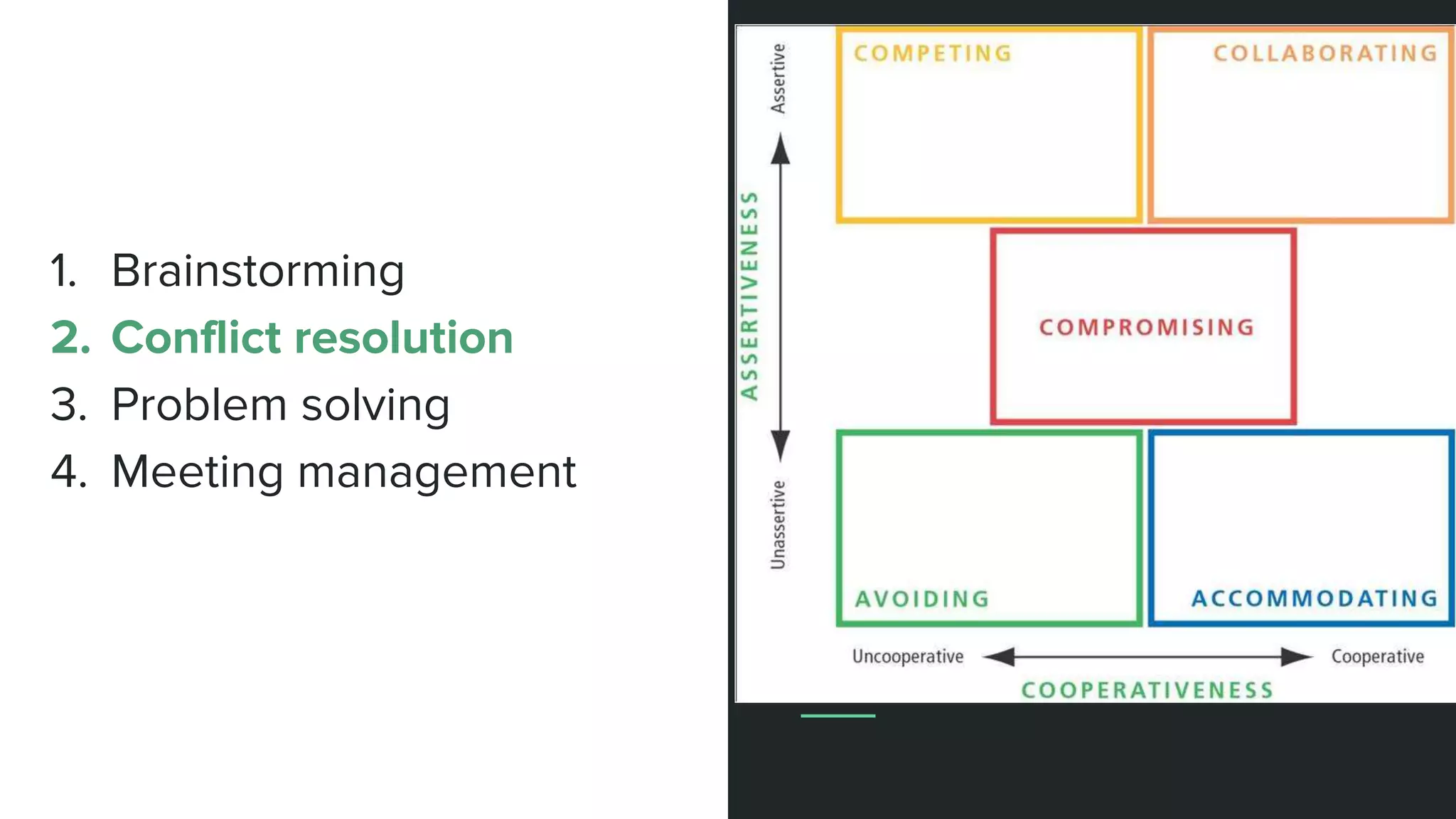
2. Conflict resolution
3. Problem solving
4. Meeting management
1. Brainstorming
2. Conflict resolution
3. Problem solving
4. Meeting management
1. Brainstorming
2. Conflict resolution
3. Problem solving
4. Meeting management
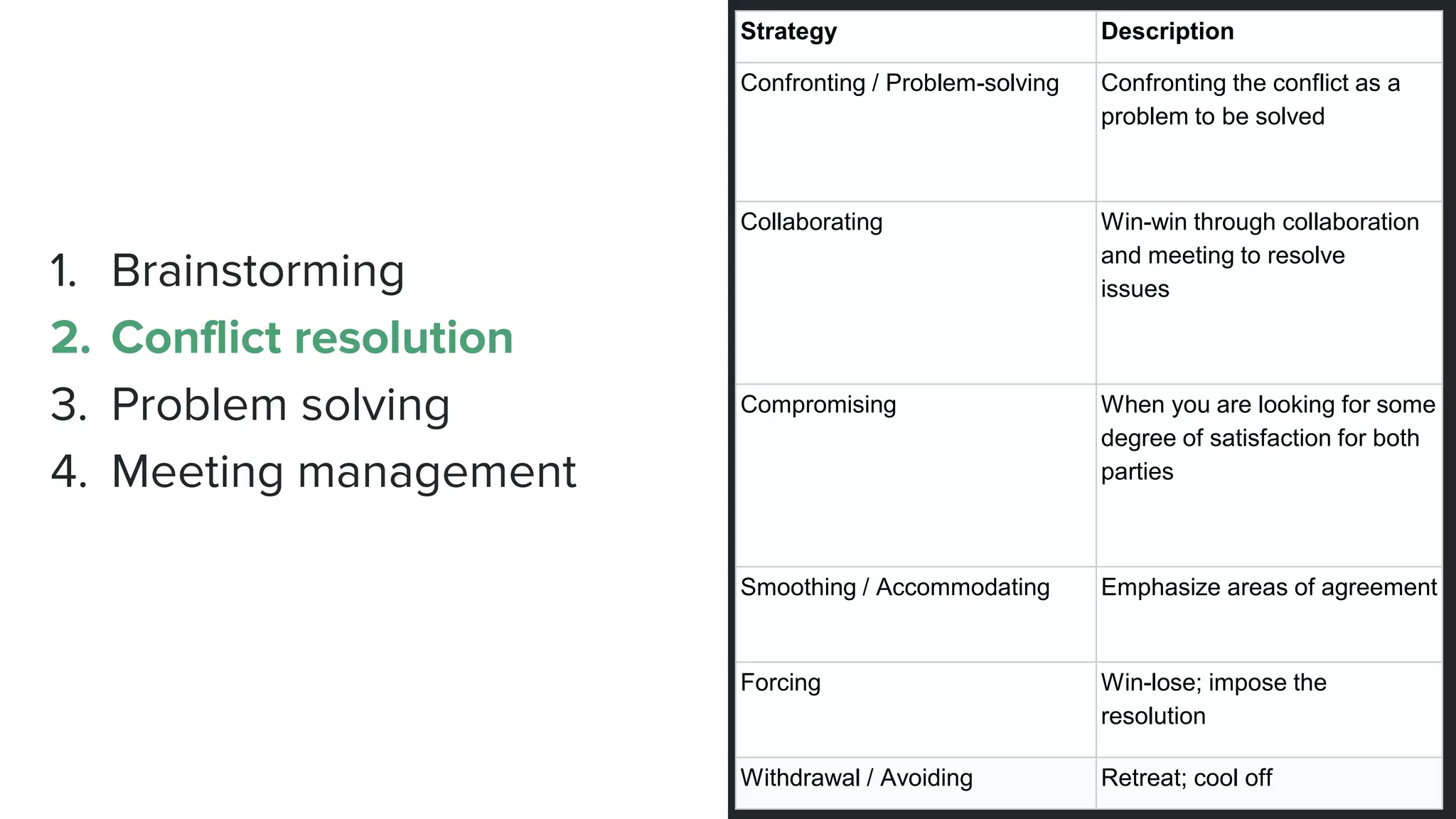
Strategy Description
Confronting / Problem-solving Confronting the conflict as a
problem to be solved
Collaborating Win-win through collaboration
and meeting to resolve
issues
Compromising When you are looking for some
degree of satisfaction for both
parties
Smoothing / Accommodating Emphasize areas of agreement
Forcing Win-lose; impose the
resolution
Withdrawal / Avoiding Retreat; cool off
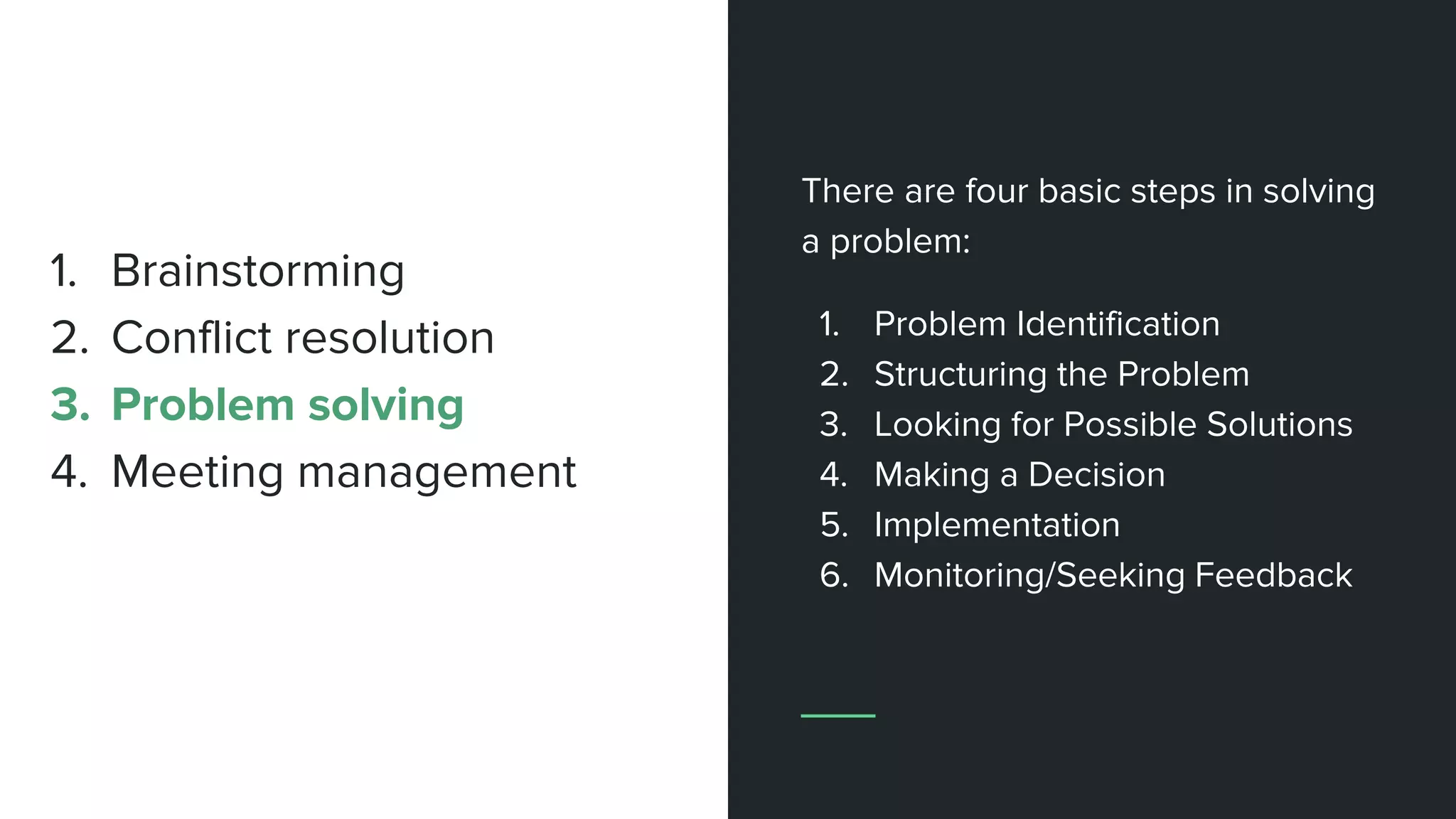
There are four basic steps in solving
a problem:
1. Problem Identification
2. Structuring the Problem
3. Looking for Possible Solutions
4. Making a Decision
5. Implementation
6. Monitoring/Seeking Feedback
1. Brainstorming
2. Conflict resolution
3. Problem solving
4. Meeting management
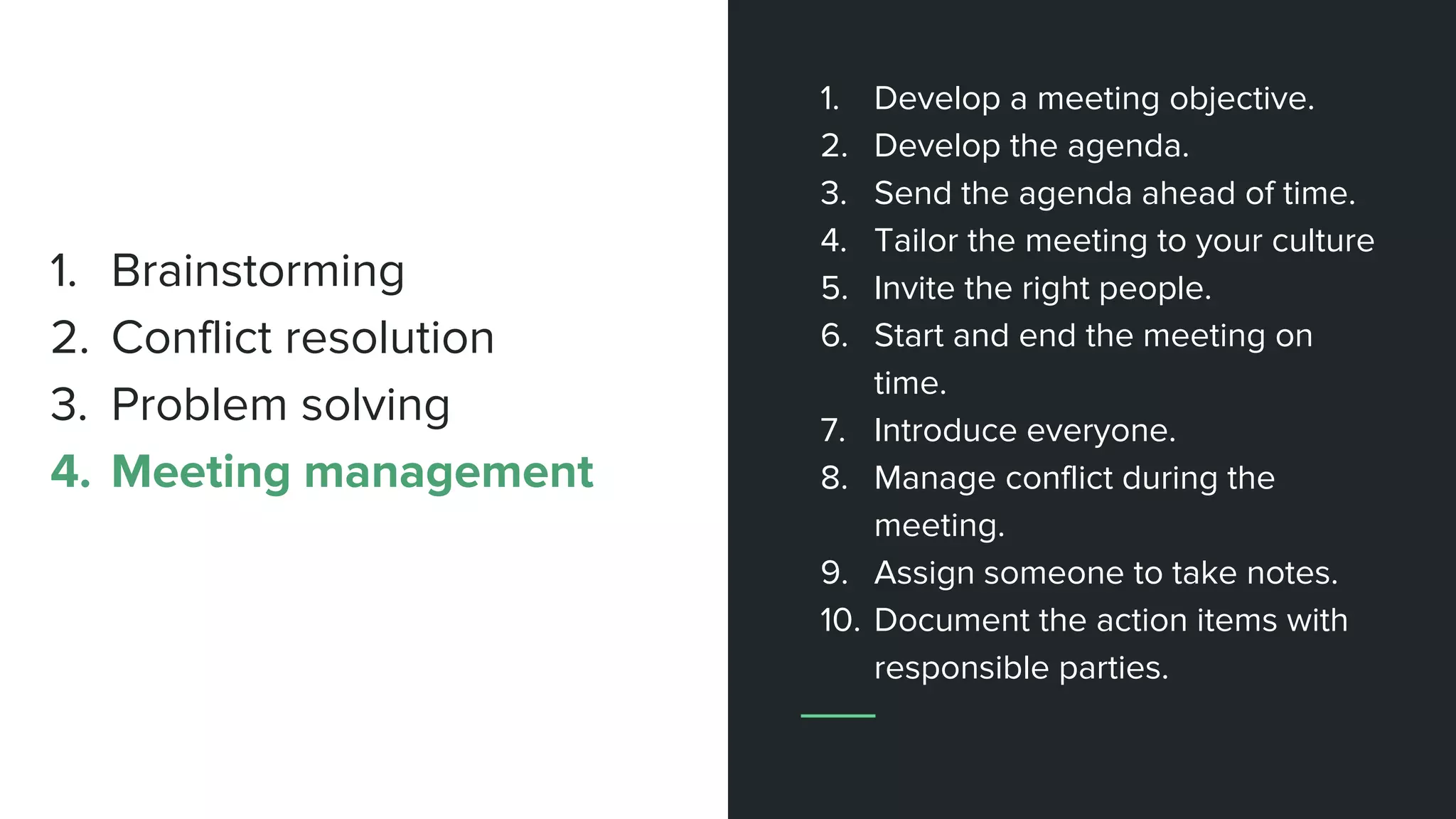
1. Develop a meeting objective.
2. Develop the agenda.
3. Send the agenda ahead of time.
4. Tailor the meeting to your culture
5. Invite the right people.
6. Start and end the meeting on
time.
7. Introduce everyone.
8. Manage conflict during the
meeting.
9. Assign someone to take notes.
10. Document the action items with
responsible parties.
1. Brainstorming
2. Conflict resolution
3. Problem solving
4. Meeting management
Develop Project
Charter: Outputs
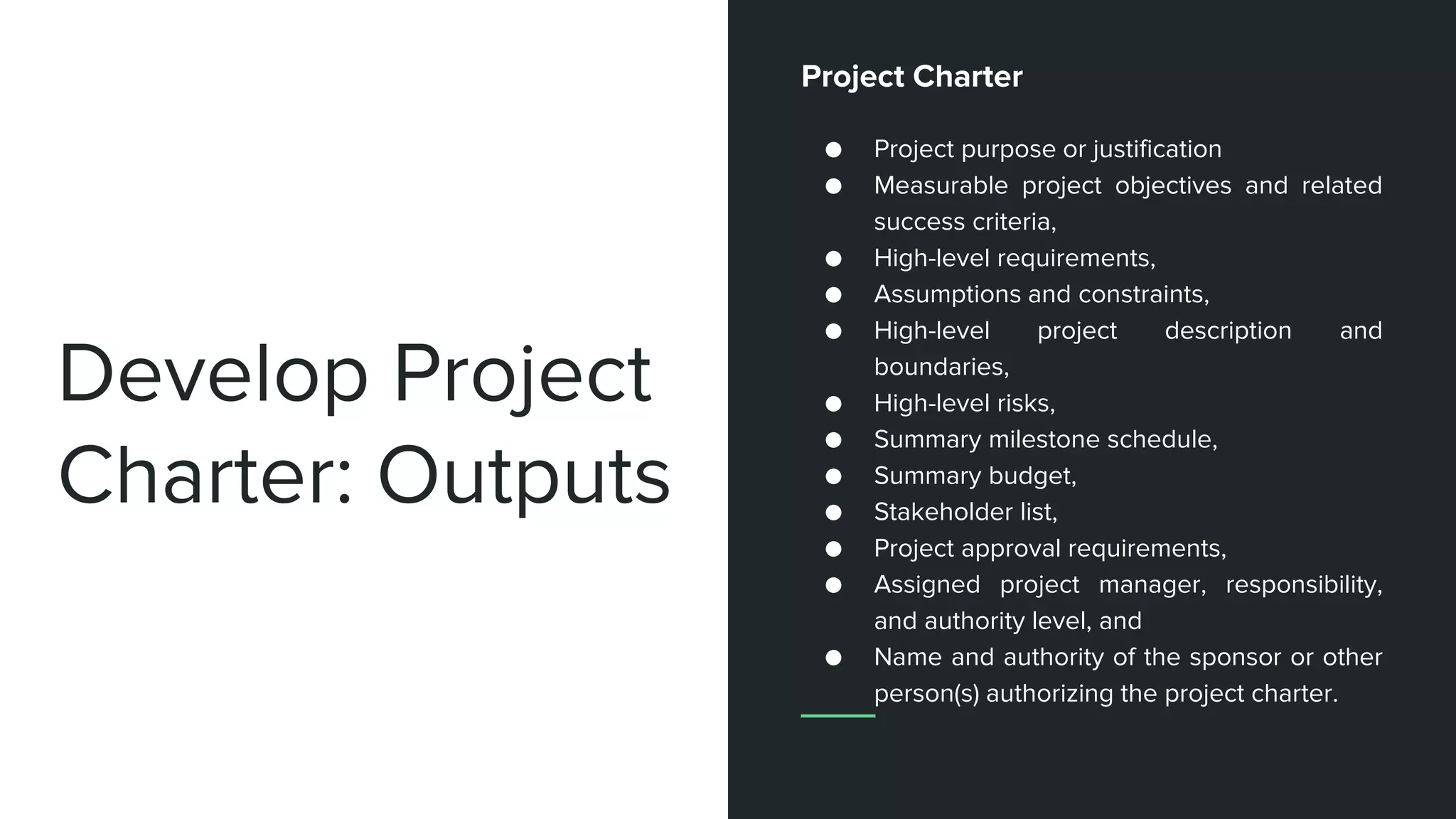
Project Charter
● Project purpose or justification
● Measurable project objectives and related
success criteria,
● High-level requirements,
● Assumptions and constraints,
● High-level project description and
boundaries,
● High-level risks,
● Summary milestone schedule,
● Summary budget,
● Stakeholder list,
● Project approval requirements,
● Assigned project manager, responsibility,
and authority level, and
● Name and authority of the sponsor or other
person(s) authorizing the project charter.
Resources
● PMBOK 5th edition
● Why a Feasibility Study is Important in Project Management
● Project Selection Methods
● All About Project Charter For PMP Exam
● Statement of Work
● Business Case
● Brainstorming
● Problem Solving
● Meeting management

Creating the project charter

  • 1.
    Creating the Project Charter ByBadre Edine Mokhlisse Senior Software Engineer At Digimind mokhlisse_badre@yahoo.fr
  • 2.
    Table of contents ●How projects are initiated ○ Needs and Demands ○ Feasibility Studies ○ Project Selection methods ● Project Charter Definition ● Develop Project Charter Inputs ● Develop Project Charter Tools
  • 3.
  • 4.
    Needs and Demands Projects comeabout as a result of one of seven needs or demands: ● Market demand ● Strategic opportunity/business need ● Customer request ● Technological advance ● Legal requirement ● Ecological impacts ● Social need
  • 5.
    Feasibility Studies A feasibility studyevaluates the project’s potential for success: 1. Technical Feasibility: a. determine whether the technical resources meet capacity b. technical team is capable of converting the ideas into working systems 2. Economic Feasibility: involves cost/ benefits analysis of the project 3. Legal Feasibility: investigates whether any aspect of the proposed project conflicts with legal requirements 4. Operational Feasibility 5. Scheduling Feasibility: how much time the project will take to complete
  • 6.
    Project Selection Methods There are variousmethods which help choose a project from a selection of projects: 1. Benefit Measurement Methods ○ Benefit/Cost Ratio ○ Economic Value Added (EVA) ○ Scoring Model ○ Payback Period ○ Net Present Value (NPV) ○ Internal Rate of Return (IRR) ○ Opportunity Cost 2. Constrained Optimization Method ○ Linear Programming ○ Non-linear Programming ○ Integer Programming ○ Dynamic Programming
  • 7.
    Project Charter ? Aproject charter is a high level document, which is created initially, as the project is mooted, to highlight the key need of the project – the objective, purpose of the project and its high level deliverables: ● Project Need / Opportunity / Justification for the Project ● Cost Benefit Analysis ● Project Objectives ● Key Stakeholders ● High Level Risks ● High Level Constraints / Boundaries ● High Level Assumptions ● Summary Budget ● Timeline, Key Milestones ● Success Criteria ● Project Manager and their Authority
  • 8.
    Inputs to Developing a ProjectCharter 1. Statement of Work ○ describes the product, service, or result the project was undertaken to complete ○ It could be high level, or in detail ○ if internal project: document is written by either the project sponsor or the initiator of the project ○ if external project: buyer writes the SOW 2. Business Case 3. Agreements or Contracts 4. Enterprise Environmental Factors 5. Organizational Process Assets
  • 9.
    1. Statement ofWork 2. Business Case 3. Agreements or Contracts 4. Enterprise Environmental Factors 5. Organizational Process Assets ● Scope of Work ● Period of Performance ● Place of Performance ● Work Requirements: ○ Kickoff ○ Design Phase ○ Build Phase ○ Implementation Phase ○ Training Phase ○ Project Handoff/Closure ● Schedule/Milestones: ○ RFP/SOW Release: January 2, 20xx ○ Vendor Selection Review: February 1-28, 20xx ○ Vendor Selection: March 1, 20xx ○ Period of Performance Begins: March 2, 20xx ○ Website Design Review: August 31, 20x ○ Website Implementation Review: November 30, 20xx ● Acceptance Criteria ● Other Requirements
  • 10.
    1. Statement ofWork 2. Business Case 3. Agreements or Contracts 4. Enterprise Environmental Factors 5. Organizational Process Assets ● Executive Summary ○ Issue ○ Anticipated Outcomes ○ Recommendation ○ Justification ● Business Case Analysis Team ● Problem Definition ○ Problem Statement ○ Organizational Impact ○ Technology Migration ● Project Overview ○ Project Description ○ Goals and Objectives ○ Project Performance ○ Project Assumptions ○ Project Constraints ○ Major Project Milestones ● Cost Benefit Analysis ● Alternative Analysis ● Approvals
  • 11.
    1. Statement ofWork 2. Business Case 3. Agreements or Contracts 4. Enterprise Environmental Factors 5. Organizational Process Assets ● Organizational culture, structure, and processes ● Governmental or industry standards ● Infrastructure ● Human resources ● Personnel administration ● Organization’s work authorization system ● Marketplace conditions ● Stakeholder risk tolerances ● Political climate ● Organization’s established communications channels ● Commercial databases
  • 12.
    1. Statement ofWork 2. Business Case 3. Agreements or Contracts 4. Enterprise Environmental Factors 5. Organizational Process Assets ● Organizational culture, processes, and infrastructure ● Product standards ● Quality standards ● Government standards ● Market standards and conditions ● Codes of conduct ● Staffing guidelines ● Reviews and training records ● Work authorization systems ● Political unrest ● Organizational communication channels ● Risk databases ● Project management information systems (PMIS) – Automation tools like schedule tool
  • 13.
    Developing a Project Charter Tools 1.Expert Judgment 2. Facilitation techniques
  • 14.
    Judgment is madebased upon a specific set of criteria and/or expertise that has been acquired in a specific knowledge area, or product area, a particular discipline, an industry, etc: ● Member of the project team ● Multiple members of the project team ● Team leader or team leaders ● External group or person ● Customers ● Professional and technical organizations ● Other miscellaneous industry groups 1. Expert Judgment 2. Facilitation techniques
  • 15.
    Examples of key techniquesused by facilitators: ● Brainstorming ● Conflict resolution ● Problem solving ● Meeting management 1. Expert Judgment 2. Facilitation techniques
  • 16.
    Brainstorming is agroup creativity technique by which efforts are made to find a conclusion for a specific problem by gathering a list of ideas spontaneously contributed by its members. Variations: ● Nominal group technique ● Group passing technique ● Team idea mapping method ● Directed brainstorming ● Guided brainstorming 1. Brainstorming 2. Conflict resolution 3. Problem solving 4. Meeting management
  • 17.
    1. Brainstorming 2. Conflictresolution 3. Problem solving 4. Meeting management
  • 18.
    1. Brainstorming 2. Conflictresolution 3. Problem solving 4. Meeting management Strategy Description Confronting / Problem-solving Confronting the conflict as a problem to be solved Collaborating Win-win through collaboration and meeting to resolve issues Compromising When you are looking for some degree of satisfaction for both parties Smoothing / Accommodating Emphasize areas of agreement Forcing Win-lose; impose the resolution Withdrawal / Avoiding Retreat; cool off
  • 19.
    There are fourbasic steps in solving a problem: 1. Problem Identification 2. Structuring the Problem 3. Looking for Possible Solutions 4. Making a Decision 5. Implementation 6. Monitoring/Seeking Feedback 1. Brainstorming 2. Conflict resolution 3. Problem solving 4. Meeting management
  • 20.
    1. Develop ameeting objective. 2. Develop the agenda. 3. Send the agenda ahead of time. 4. Tailor the meeting to your culture 5. Invite the right people. 6. Start and end the meeting on time. 7. Introduce everyone. 8. Manage conflict during the meeting. 9. Assign someone to take notes. 10. Document the action items with responsible parties. 1. Brainstorming 2. Conflict resolution 3. Problem solving 4. Meeting management
  • 21.
    Develop Project Charter: Outputs ProjectCharter ● Project purpose or justification ● Measurable project objectives and related success criteria, ● High-level requirements, ● Assumptions and constraints, ● High-level project description and boundaries, ● High-level risks, ● Summary milestone schedule, ● Summary budget, ● Stakeholder list, ● Project approval requirements, ● Assigned project manager, responsibility, and authority level, and ● Name and authority of the sponsor or other person(s) authorizing the project charter.
  • 22.
    Resources ● PMBOK 5thedition ● Why a Feasibility Study is Important in Project Management ● Project Selection Methods ● All About Project Charter For PMP Exam ● Statement of Work ● Business Case ● Brainstorming ● Problem Solving ● Meeting management