Introduction to Construction Industry Understanding Construction The Construction Industry The Project Team
What is Construction Management?? The act, manner or practice in which a construction executive  oversees ,  supervises  or  controls  the  organized process  or  system execution  of a construction project. The focus of construction management is the planning and control of resources within the framework of a project
Understanding Construction The Construction Discipline Construction Technology Construction Administration
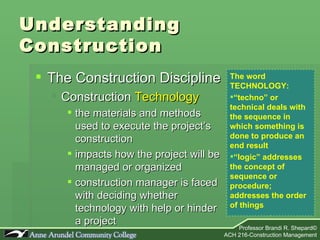
Understanding Construction The Construction Discipline Construction  Technology the materials and methods used to execute the project’s construction  impacts how the project will be managed or organized construction manager is faced with deciding whether technology with help or hinder a project The word TECHNOLOGY: “ techno” or technical deals with the sequence in which something is done to produce an end result “ logic” addresses the concept of sequence or procedure; addresses the order of things
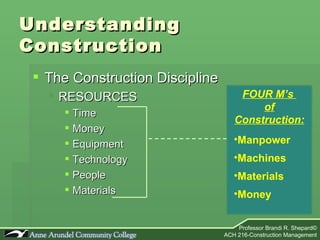
Understanding Construction The Construction Discipline RESOURCES Time Money Equipment Technology People Materials FOUR M’s  of   Construction: Manpower Machines Materials Money
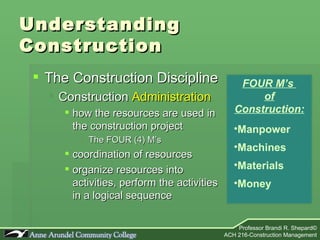
Understanding Construction The Construction Discipline Construction  Administration how the resources are used in the construction project The FOUR (4) M’s coordination of resources  organize resources into activities, perform the activities in a logical sequence FOUR M’s  of   Construction: Manpower Machines Materials Money
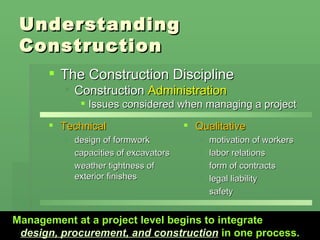
Understanding Construction Technical design of formwork capacities of excavators weather tightness of exterior finishes Qualitative motivation of workers labor relations form of contracts legal liability safety The Construction Discipline Construction  Administration Issues considered when managing a project  Management at a project level begins to integrate   design, procurement, and construction   in one process.
The Construction Industry Nature of the Construction Industry Adversities Faced by Construction Future of Construction The Industry’s Composition
Nature of the  Construction Industry Construction industry is generally focused on the production of a single and/or unique end product. It is both a  manufacturing  and  service  industry.
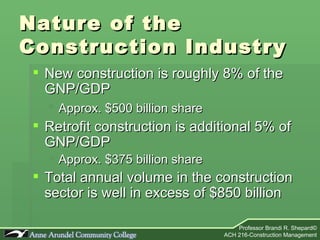
Nature of the  Construction Industry New construction is roughly 8% of the GNP/GDP  Approx. $500 billion share   Retrofit construction is additional 5% of GNP/GDP Approx. $375 billion share Total annual volume in the construction sector is well in excess of $850 billion
Nature of the  Construction Industry More than 1 million firms operate in the construction sector vary in size from  very large  to  very small largest firms sign contracts in excess $20 billion annually and consist of thousand of employees large firms work domestically and internationally 2/3 of the firms have less then 5 employees
Nature of the  Construction Industry More than 10 million people are employed in the construction sector American infrastructure is maintained by the construction sector; facilities that support daily life roads, tunnels, bridges,  communication systems power plants, water treatment plants distribution networks
Adversities Faced by Construction shortages of resources materials equipment skilled labor technical and supervisory staff
Adversities Faced by Construction governmental regulation safety field construction methods environmental consequences personnel policies at all levels
Adversities Faced by Construction economic and cultural realities inflation energy shortages changing world development patterns new social standards
Future of Construction increasing in size, number of projects type of projects are diverse construction organizations unions/labor organizations trade organizations technology & complexity of constructing projects
Future of Construction government demands & regulations building codes Implementation of universal codes environmental issues Energy use Sustainability factors labor policies Dependency on immigrant labor Illegal workers
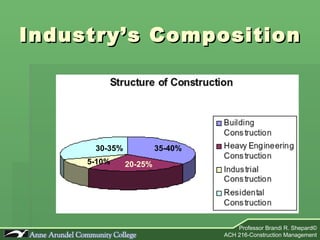
Industry’s Composition 35-40% 30-35% 5-10% 20-25%
Industry’s Composition Building Construction Schools Universities Hospitals Commercial office towers Warehouses Light manufacturing plants Theaters  Government buildings Commercial malls/Retail Recreation centers  Religious centers (churches) Hotels 35 – 40% of construction market financed and built by private sector & public sector design in done by architect working with consultants (i.e., engineers for mechanical, structural, electrical) construction is usually coordinated by general contractors or construction managers; subcontract portions of work to specialty firms
Industry’s Composition Residential Construction Single-family homes Multi-unit townhouses High-rise apartments Condominiums Assisted Living  30 – 35% of construction market largely financed by the private sector design is done by architects, engineers or builders construction is usually handled by independent contractors or developer-builders
Industry’s Composition Heavy Engineering Construction Dams Tunnels Bridges Highways Airports Urban transit systems Ports  Pipelines Water treatment plants Communication networks 20 – 25% of construction market highway and heavy construction financed and built by public sector design and construction is done by civil engineers and specialty contractors
Industry’s Composition Industrial Construction Petroleum refineries Petrochemical plants Synthetic fuel plants Nuclear power plants Steel mills Heavy manufacturing plants 5 – 10% of construction market financed and built by private sector design is done by civil engineers and specialty consultants (i.e., chemical, electrical, mechanical) “ turnkey” contract or design-construct; design firm also does construction
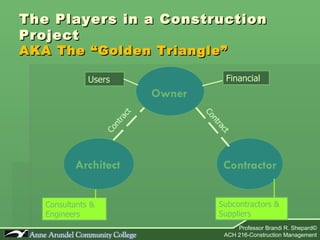
The Project Team Architect Owner Contractor/Construction Manager
The Players in a Construction Project  AKA The “Golden Triangle” Financial Users Architect Owner Contractor Contract Contract Subcontractors & Suppliers Consultants & Engineers
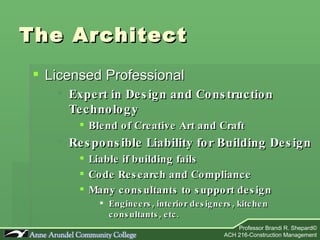
The Architect Licensed Professional Expert in Design and Construction Technology Blend of Creative Art and Craft Responsible Liability for Building Design Liable if building fails Code Research and Compliance Many consultants to support design Engineers, interior designers, kitchen consultants, etc.
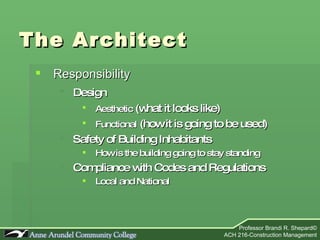
The Architect Responsibility Design   Aesthetic  (what it looks like) Functional  (how it is going to be used) Safety of Building Inhabitants How is the building going to stay standing Compliance with Codes and Regulations Local and National
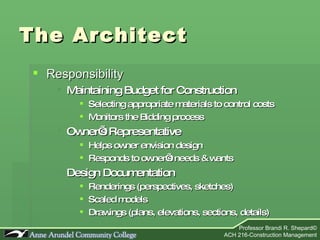
The Architect Responsibility Maintaining Budget for Construction Selecting appropriate materials to control costs Monitors the Bidding process  Owner’s Representative Helps owner envision design Responds to owner’s needs & wants Design Documentation Renderings (perspectives, sketches) Scaled models Drawings (plans, elevations, sections, details)
The Architect Responsibility Administers the Construction Contract Working drawings to build from (Construction Documentation) Written Specifications of quality for building Certifies payment to Contractor Certifies changes during construction Inspects the construction process Assures compliance with Contract Documents Project Completion and Closeout Performs “punch list” (with Owner and Contractor)
The Owner  The person with: The NEED or DESIRE for the project The MONEY for the project Makes most of the major decisions involving the project (when it comes to budget) Depends heavily on the architect for everything involving the project
The Construction Manager Non-Licensed Professional Expert in Construction Technology & Management Blend of Methodology and Organization Responsible for Building Erection and Contract Compliance Liable if building is not built to specification by architect/interior designer Must comply with contract documents Oversees and organizes materials, trades & process during erection Many subcontractors to help complete work
The Construction Manager Responsibility Construction Joining of materials Quality control  Safety of Laborers/Trades Maintaining secure environment during construction Compliance with Contract Documents Building to architects drawings/specifications Cost of Construction Managing trades and materials during construction
NEXT LECTURE Project Development and Organization Management Levels of Construction  Basic Management Activities as applied to Construction Reading Assignment Chapter 1, pages 2-26 Chapter 3, pages 58-70 including Total Quality Management, pgs 71-72

ACH 216 Lecture 01 (Intro To CM)

  • 1.
    Introduction to ConstructionIndustry Understanding Construction The Construction Industry The Project Team
  • 2.
    What is ConstructionManagement?? The act, manner or practice in which a construction executive oversees , supervises or controls the organized process or system execution of a construction project. The focus of construction management is the planning and control of resources within the framework of a project
  • 3.
    Understanding Construction TheConstruction Discipline Construction Technology Construction Administration
  • 4.
    Understanding Construction TheConstruction Discipline Construction Technology the materials and methods used to execute the project’s construction impacts how the project will be managed or organized construction manager is faced with deciding whether technology with help or hinder a project The word TECHNOLOGY: “ techno” or technical deals with the sequence in which something is done to produce an end result “ logic” addresses the concept of sequence or procedure; addresses the order of things
  • 5.
    Understanding Construction TheConstruction Discipline RESOURCES Time Money Equipment Technology People Materials FOUR M’s of Construction: Manpower Machines Materials Money
  • 6.
    Understanding Construction TheConstruction Discipline Construction Administration how the resources are used in the construction project The FOUR (4) M’s coordination of resources organize resources into activities, perform the activities in a logical sequence FOUR M’s of Construction: Manpower Machines Materials Money
  • 7.
    Understanding Construction Technicaldesign of formwork capacities of excavators weather tightness of exterior finishes Qualitative motivation of workers labor relations form of contracts legal liability safety The Construction Discipline Construction Administration Issues considered when managing a project Management at a project level begins to integrate design, procurement, and construction in one process.
  • 8.
    The Construction IndustryNature of the Construction Industry Adversities Faced by Construction Future of Construction The Industry’s Composition
  • 9.
    Nature of the Construction Industry Construction industry is generally focused on the production of a single and/or unique end product. It is both a manufacturing and service industry.
  • 10.
    Nature of the Construction Industry New construction is roughly 8% of the GNP/GDP Approx. $500 billion share Retrofit construction is additional 5% of GNP/GDP Approx. $375 billion share Total annual volume in the construction sector is well in excess of $850 billion
  • 11.
    Nature of the Construction Industry More than 1 million firms operate in the construction sector vary in size from very large to very small largest firms sign contracts in excess $20 billion annually and consist of thousand of employees large firms work domestically and internationally 2/3 of the firms have less then 5 employees
  • 12.
    Nature of the Construction Industry More than 10 million people are employed in the construction sector American infrastructure is maintained by the construction sector; facilities that support daily life roads, tunnels, bridges, communication systems power plants, water treatment plants distribution networks
  • 13.
    Adversities Faced byConstruction shortages of resources materials equipment skilled labor technical and supervisory staff
  • 14.
    Adversities Faced byConstruction governmental regulation safety field construction methods environmental consequences personnel policies at all levels
  • 15.
    Adversities Faced byConstruction economic and cultural realities inflation energy shortages changing world development patterns new social standards
  • 16.
    Future of Constructionincreasing in size, number of projects type of projects are diverse construction organizations unions/labor organizations trade organizations technology & complexity of constructing projects
  • 17.
    Future of Constructiongovernment demands & regulations building codes Implementation of universal codes environmental issues Energy use Sustainability factors labor policies Dependency on immigrant labor Illegal workers
  • 18.
  • 19.
    Industry’s Composition BuildingConstruction Schools Universities Hospitals Commercial office towers Warehouses Light manufacturing plants Theaters Government buildings Commercial malls/Retail Recreation centers Religious centers (churches) Hotels 35 – 40% of construction market financed and built by private sector & public sector design in done by architect working with consultants (i.e., engineers for mechanical, structural, electrical) construction is usually coordinated by general contractors or construction managers; subcontract portions of work to specialty firms
  • 20.
    Industry’s Composition ResidentialConstruction Single-family homes Multi-unit townhouses High-rise apartments Condominiums Assisted Living 30 – 35% of construction market largely financed by the private sector design is done by architects, engineers or builders construction is usually handled by independent contractors or developer-builders
  • 21.
    Industry’s Composition HeavyEngineering Construction Dams Tunnels Bridges Highways Airports Urban transit systems Ports Pipelines Water treatment plants Communication networks 20 – 25% of construction market highway and heavy construction financed and built by public sector design and construction is done by civil engineers and specialty contractors
  • 22.
    Industry’s Composition IndustrialConstruction Petroleum refineries Petrochemical plants Synthetic fuel plants Nuclear power plants Steel mills Heavy manufacturing plants 5 – 10% of construction market financed and built by private sector design is done by civil engineers and specialty consultants (i.e., chemical, electrical, mechanical) “ turnkey” contract or design-construct; design firm also does construction
  • 23.
    The Project TeamArchitect Owner Contractor/Construction Manager
  • 24.
    The Players ina Construction Project AKA The “Golden Triangle” Financial Users Architect Owner Contractor Contract Contract Subcontractors & Suppliers Consultants & Engineers
  • 25.
    The Architect LicensedProfessional Expert in Design and Construction Technology Blend of Creative Art and Craft Responsible Liability for Building Design Liable if building fails Code Research and Compliance Many consultants to support design Engineers, interior designers, kitchen consultants, etc.
  • 26.
    The Architect ResponsibilityDesign Aesthetic (what it looks like) Functional (how it is going to be used) Safety of Building Inhabitants How is the building going to stay standing Compliance with Codes and Regulations Local and National
  • 27.
    The Architect ResponsibilityMaintaining Budget for Construction Selecting appropriate materials to control costs Monitors the Bidding process Owner’s Representative Helps owner envision design Responds to owner’s needs & wants Design Documentation Renderings (perspectives, sketches) Scaled models Drawings (plans, elevations, sections, details)
  • 28.
    The Architect ResponsibilityAdministers the Construction Contract Working drawings to build from (Construction Documentation) Written Specifications of quality for building Certifies payment to Contractor Certifies changes during construction Inspects the construction process Assures compliance with Contract Documents Project Completion and Closeout Performs “punch list” (with Owner and Contractor)
  • 29.
    The Owner The person with: The NEED or DESIRE for the project The MONEY for the project Makes most of the major decisions involving the project (when it comes to budget) Depends heavily on the architect for everything involving the project
  • 30.
    The Construction ManagerNon-Licensed Professional Expert in Construction Technology & Management Blend of Methodology and Organization Responsible for Building Erection and Contract Compliance Liable if building is not built to specification by architect/interior designer Must comply with contract documents Oversees and organizes materials, trades & process during erection Many subcontractors to help complete work
  • 31.
    The Construction ManagerResponsibility Construction Joining of materials Quality control Safety of Laborers/Trades Maintaining secure environment during construction Compliance with Contract Documents Building to architects drawings/specifications Cost of Construction Managing trades and materials during construction
  • 32.
    NEXT LECTURE ProjectDevelopment and Organization Management Levels of Construction Basic Management Activities as applied to Construction Reading Assignment Chapter 1, pages 2-26 Chapter 3, pages 58-70 including Total Quality Management, pgs 71-72