Construction
Design
Project
Ms. R.A.I.Devindi
Module Information
02
Assessment Individual Project
Module Learning Outcomes
 LO1 Discuss the stages of a design process, and the types of information
required to communicate, share and manage the project process.
 LO2 Explain the different types of construction information developed
through the course of a project.
 LO3 Produce design propositions that address project requirements defined
through feasibility stages.
 LO4 Present a construction information package, highlighting the
coordination of information between different project stakeholders to ensure
accuracy.
03
Introduction to construction
project
Project Design process
Project Construction process
01
02
03
04
03
Introduction to
construction
project
05
03
What is the
need of
construction?
06
What is the need of construction?
07
Improve well-being of the nation
What is the need of
construction?
 Shelter
 Education
 Economy
 Recreation
 Reclamation
 Agriculture
 Transport
 Sanitation
08
Types of project
Based on the function and
usage
Based on the purpose, scope
and the nature of work
involved
✓ New construction
✓ Renovation and Remodeling
✓ Specialized construction
✓ Residential
✓ Commercial
✓ Industrial
✓ Infrastructure
✓ Government / Institutional 09
Types of Project
Based on the purpose, scope and the nature of work involved
▪ New construction
▪ Renovation and Remodeling
▪ Specialized construction
10
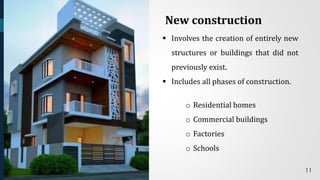
New construction
▪ Involves the creation of entirely new
structures or buildings that did not
previously exist.
▪ Includes all phases of construction.
o Residential homes
o Commercial buildings
o Factories
o Schools
11
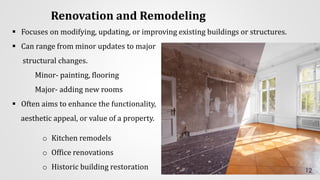
Renovation and Remodeling
▪ Focuses on modifying, updating, or improving existing buildings or structures.
▪ Can range from minor updates to major
structural changes.
Minor- painting, flooring
Major- adding new rooms
▪ Often aims to enhance the functionality,
aesthetic appeal, or value of a property.
o Kitchen remodels
o Office renovations
o Historic building restoration 12
Specialized construction
▪ Involves projects with specialized
requirements, often adhering to
standards or involving unique
construction techniques
▪ Varies widely depending on the
specialization, from sustainable
building practices to highly technical
installations. (eg; Green Buildings)
▪ Often driven by specific goals such as
sustainability, energy efficiency, or
advanced technological integration.
13
Types of Project
14
▪ Residential
▪ Commercial
▪ Government/Institutional
▪ Industrial
▪ Infrastructure
Based on the function and usage
15
Residential
Types
▪ Single family houses
▪ Multi family dwellings
▪ High-rise apartments
✓ Focuses on creating spaces where people live
✓ 30-35 % of the industry
✓ Largely private
✓ Designed by architects, builders/developers
Government/Institutional
▪ Schools and Universities
▪ Government Offices
▪ Hospitals
09
16
17
Commercial
Construction of buildings and facilities used for
business, trade, and services.
▪ Retail stores and shopping centers
▪ Warehouses and light manufacturing
▪ Office buildings (single story to skyscrapers)
▪ Hotels, convention centers, and theaters
18
Industrial
Construction of facilities used for
manufacturing, processing, and
production activities.
▪ Petroleum refineries
▪ Steel mills & aluminum plants
▪ Chemical processing plants
c
03
Infrastructure
▪ Highway & Bridges
▪ Rail Roads
▪ Tunnels and Reservoirs
▪ Airports
▪ Sea Ports
▪ Irrigation Systems
▪ Water Treatment plants
19
20
Infrastructure
✓ Constructing systems and structures that
support the functioning of a community
or society.
✓ Greatest impact on land and water
✓ High degree of mechanization
✓ Contracts awarded through competitive
bidding
✓ Large investments
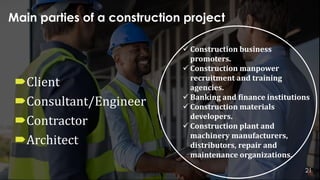
Main parties of a construction project
Client
Consultant/Engineer
Contractor
Architect
21
✓ Construction business
promoters.
✓ Construction manpower
recruitment and training
agencies.
✓ Banking and finance institutions
✓ Construction materials
developers.
✓ Construction plant and
machinery manufacturers,
distributors, repair and
maintenance organizations.
22
Client
The Client/Owner– has specific goals, expectations and a budget that is in alignment
with these goals and expectations
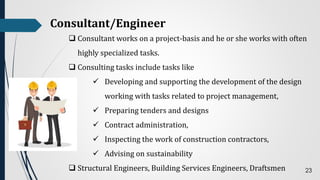
Consultant/Engineer
❑ Consultant works on a project-basis and he or she works with often
highly specialized tasks.
❑ Consulting tasks include tasks like
✓ Developing and supporting the development of the design
working with tasks related to project management,
✓ Preparing tenders and designs
✓ Contract administration,
✓ Inspecting the work of construction contractors,
✓ Advising on sustainability
❑ Structural Engineers, Building Services Engineers, Draftsmen 23
Architect
24
Must guide the Client,
propose reasonable,
sustainable design
solutions, and provide
accurate, detailed drawings.
These must meet the
Client's requirements
as well as applicable
building codes and
zoning criteria.
The finalized
construction documents
will become the Client’s
contract with the
contractor
Contractor
❑ Hired by the client to complete the project
❑ Execution of the work activities that are required for the
completion of the project
❑ Roles and Responsibilities include project planning, management,
monitoring, construction site safety, and legal issues.
❑ The contractor also appoint subcontractor, who have special
expertise, to execute certain parts of the project that cannot be
constructed by the contractor.
25
Type of contractors
26
▪ Traditional contractors / Design- Bid Method
✓ Client wishes to use own design
✓ Appoint consultant to design
▪ Design & build Contractors
✓ Project is more functional
✓ Client does not wish to use own design
27
• Traditional contractors (Design Bid Build)
Type of contractors
▪ Owner manage two separate contractors.
▪ Should set the coordination between the designer and contractor
▪ Designer and contractor can easily blame one another for cost overrun
28
• Design and build contractors
Type of contractors
▪ Owner manages only one contract with a single point of responsibility
▪ Designer and contractor are in the same team
▪ Changes are addressed by the design and build team
▪ Team manages the subcontractors
29
Type of contractors
Traditional contractor
or
Design and build
contractor???
30
Type of contractors
▪ Cost-Comparisons: Greater level of cost comparison between tendering parties
and therefore allows to choose based on the lowest price or the best quality or
the combination of both that fits the needs.
▪ Control: Client has more control over the various contractors and suppliers
throughout the project.
▪ Design: Close working relationship with your chosen design team to get the
design right.
Traditional contractors (Design Bid Build)
Benefits
31
Type of contractors
Traditional contractors (Design Bid Build)
▪ Longer tender process- This is likely to take longer in construction and designs are
separated projects.
▪ Time-Consuming: Generally, the traditional procurement route is more time-
consuming, this will require coordination and continuous discussions.
▪ Multiple Contacts: There are usually more parties to communicate with throughout
a project, generally including – Designer, Project Manager, Main Contractor,
Consultant.
▪ mainly in the pre-construction period.
Drawbacks
32
Type of contractors
Design and build contractors
▪ Communication: one company handle both design and construction minimizing
the needs of coordination and the risk of inconsistencies.
▪ Increase efficiency: One party handle the entire project would result in better
coordination between design skills and construction skills increasing the project
speed .
Benefits
33
Type of contractors
Design and build contractors
▪ Client has less control over project when compared to Design Bid method.
▪ contract price may be higher to reflect the increased contractor risk - if
awarded on a lump sum basis.
▪ Greater reliance on single provider, therefore more trust needed in the team
you appoint.
Drawbacks
Project
Life Cycle
34
Project Life Cycle
❑Series of phases that a
construction project goes through
from initiation to completion
❑Each phase has specific activities,
goals, and deliverables that
collectively guide the project from
start to finish
35
Project Life Cycle
36
✓ Project idea or need identification
✓ Feasibility studies and analyses
✓ Preliminary budget estimation
✓ Project charter development
To define the project's purpose, feasibility, and scope
Initiation
37
To develop a comprehensive project plan that guides execution and
management.
✓ Detailed project scope definition
✓ Work Breakdown Structure (WBS) development
✓ Scheduling (e.g., Gantt charts, Critical Path Method)
✓ Budgeting and cost estimation
✓ Risk management planning
✓ Resource planning (materials, labor, equipment)
✓ Permitting and regulatory approvals
Planning
38
To carry out the project plan and complete the construction work
✓ Site preparation and mobilization
✓ Construction work (foundation, structure, systems installation)
✓ Quality control and assurance
✓ Contractor and subcontractor coordination
✓ Communication management (meetings, reporting)
✓ Change management (handling scope changes or unforeseen issues)
Execution
39
To track, review, and regulate the project's progress and performance to ensure
it stays on track
✓ Performance measurement (time, cost, quality)
✓ Progress tracking against the project plan
✓ Risk monitoring and mitigation
✓ Budget management and cost control
✓ Quality assurance and inspections
Monitoring and controlling
40
To formally complete and close the project, ensuring all work is
finished and handed over to the client.
✓ Final inspections
✓ Project handover to the client
✓ Final financial reconciliation and
payment
✓ Post-construction evaluation
✓ Release of project resources (labor,
equipment)
Closing the project
41
Time - available time to deliver the project.
Cost - amount of money or resources available.
Quality - fit-to-purpose that the project must
achieve to be a success.
The triangle illustrates the relationship
between three primary forces in a project.
Triple constraint in project management
42
Triple constraint / Principal project goals
43
Add time - delay the
project to give you
more time to add the
functionality
Add cost - recruit, hire or
acquire more people to
do the extra work
Cut quality - trade off some
non-essential
requirements for the new
requirements

Construction Design Project for HND Quantity Surveying

  • 1.
  • 2.
  • 3.
    Module Learning Outcomes LO1 Discuss the stages of a design process, and the types of information required to communicate, share and manage the project process.  LO2 Explain the different types of construction information developed through the course of a project.  LO3 Produce design propositions that address project requirements defined through feasibility stages.  LO4 Present a construction information package, highlighting the coordination of information between different project stakeholders to ensure accuracy. 03
  • 4.
    Introduction to construction project ProjectDesign process Project Construction process 01 02 03 04
  • 5.
  • 6.
    03 What is the needof construction? 06
  • 7.
    What is theneed of construction? 07 Improve well-being of the nation
  • 8.
    What is theneed of construction?  Shelter  Education  Economy  Recreation  Reclamation  Agriculture  Transport  Sanitation 08
  • 9.
    Types of project Basedon the function and usage Based on the purpose, scope and the nature of work involved ✓ New construction ✓ Renovation and Remodeling ✓ Specialized construction ✓ Residential ✓ Commercial ✓ Industrial ✓ Infrastructure ✓ Government / Institutional 09
  • 10.
    Types of Project Basedon the purpose, scope and the nature of work involved ▪ New construction ▪ Renovation and Remodeling ▪ Specialized construction 10
  • 11.
    New construction ▪ Involvesthe creation of entirely new structures or buildings that did not previously exist. ▪ Includes all phases of construction. o Residential homes o Commercial buildings o Factories o Schools 11
  • 12.
    Renovation and Remodeling ▪Focuses on modifying, updating, or improving existing buildings or structures. ▪ Can range from minor updates to major structural changes. Minor- painting, flooring Major- adding new rooms ▪ Often aims to enhance the functionality, aesthetic appeal, or value of a property. o Kitchen remodels o Office renovations o Historic building restoration 12
  • 13.
    Specialized construction ▪ Involvesprojects with specialized requirements, often adhering to standards or involving unique construction techniques ▪ Varies widely depending on the specialization, from sustainable building practices to highly technical installations. (eg; Green Buildings) ▪ Often driven by specific goals such as sustainability, energy efficiency, or advanced technological integration. 13
  • 14.
    Types of Project 14 ▪Residential ▪ Commercial ▪ Government/Institutional ▪ Industrial ▪ Infrastructure Based on the function and usage
  • 15.
    15 Residential Types ▪ Single familyhouses ▪ Multi family dwellings ▪ High-rise apartments ✓ Focuses on creating spaces where people live ✓ 30-35 % of the industry ✓ Largely private ✓ Designed by architects, builders/developers
  • 16.
    Government/Institutional ▪ Schools andUniversities ▪ Government Offices ▪ Hospitals 09 16
  • 17.
    17 Commercial Construction of buildingsand facilities used for business, trade, and services. ▪ Retail stores and shopping centers ▪ Warehouses and light manufacturing ▪ Office buildings (single story to skyscrapers) ▪ Hotels, convention centers, and theaters
  • 18.
    18 Industrial Construction of facilitiesused for manufacturing, processing, and production activities. ▪ Petroleum refineries ▪ Steel mills & aluminum plants ▪ Chemical processing plants
  • 19.
    c 03 Infrastructure ▪ Highway &Bridges ▪ Rail Roads ▪ Tunnels and Reservoirs ▪ Airports ▪ Sea Ports ▪ Irrigation Systems ▪ Water Treatment plants 19
  • 20.
    20 Infrastructure ✓ Constructing systemsand structures that support the functioning of a community or society. ✓ Greatest impact on land and water ✓ High degree of mechanization ✓ Contracts awarded through competitive bidding ✓ Large investments
  • 21.
    Main parties ofa construction project Client Consultant/Engineer Contractor Architect 21 ✓ Construction business promoters. ✓ Construction manpower recruitment and training agencies. ✓ Banking and finance institutions ✓ Construction materials developers. ✓ Construction plant and machinery manufacturers, distributors, repair and maintenance organizations.
  • 22.
    22 Client The Client/Owner– hasspecific goals, expectations and a budget that is in alignment with these goals and expectations
  • 23.
    Consultant/Engineer ❑ Consultant workson a project-basis and he or she works with often highly specialized tasks. ❑ Consulting tasks include tasks like ✓ Developing and supporting the development of the design working with tasks related to project management, ✓ Preparing tenders and designs ✓ Contract administration, ✓ Inspecting the work of construction contractors, ✓ Advising on sustainability ❑ Structural Engineers, Building Services Engineers, Draftsmen 23
  • 24.
    Architect 24 Must guide theClient, propose reasonable, sustainable design solutions, and provide accurate, detailed drawings. These must meet the Client's requirements as well as applicable building codes and zoning criteria. The finalized construction documents will become the Client’s contract with the contractor
  • 25.
    Contractor ❑ Hired bythe client to complete the project ❑ Execution of the work activities that are required for the completion of the project ❑ Roles and Responsibilities include project planning, management, monitoring, construction site safety, and legal issues. ❑ The contractor also appoint subcontractor, who have special expertise, to execute certain parts of the project that cannot be constructed by the contractor. 25
  • 26.
    Type of contractors 26 ▪Traditional contractors / Design- Bid Method ✓ Client wishes to use own design ✓ Appoint consultant to design ▪ Design & build Contractors ✓ Project is more functional ✓ Client does not wish to use own design
  • 27.
    27 • Traditional contractors(Design Bid Build) Type of contractors ▪ Owner manage two separate contractors. ▪ Should set the coordination between the designer and contractor ▪ Designer and contractor can easily blame one another for cost overrun
  • 28.
    28 • Design andbuild contractors Type of contractors ▪ Owner manages only one contract with a single point of responsibility ▪ Designer and contractor are in the same team ▪ Changes are addressed by the design and build team ▪ Team manages the subcontractors
  • 29.
    29 Type of contractors Traditionalcontractor or Design and build contractor???
  • 30.
    30 Type of contractors ▪Cost-Comparisons: Greater level of cost comparison between tendering parties and therefore allows to choose based on the lowest price or the best quality or the combination of both that fits the needs. ▪ Control: Client has more control over the various contractors and suppliers throughout the project. ▪ Design: Close working relationship with your chosen design team to get the design right. Traditional contractors (Design Bid Build) Benefits
  • 31.
    31 Type of contractors Traditionalcontractors (Design Bid Build) ▪ Longer tender process- This is likely to take longer in construction and designs are separated projects. ▪ Time-Consuming: Generally, the traditional procurement route is more time- consuming, this will require coordination and continuous discussions. ▪ Multiple Contacts: There are usually more parties to communicate with throughout a project, generally including – Designer, Project Manager, Main Contractor, Consultant. ▪ mainly in the pre-construction period. Drawbacks
  • 32.
    32 Type of contractors Designand build contractors ▪ Communication: one company handle both design and construction minimizing the needs of coordination and the risk of inconsistencies. ▪ Increase efficiency: One party handle the entire project would result in better coordination between design skills and construction skills increasing the project speed . Benefits
  • 33.
    33 Type of contractors Designand build contractors ▪ Client has less control over project when compared to Design Bid method. ▪ contract price may be higher to reflect the increased contractor risk - if awarded on a lump sum basis. ▪ Greater reliance on single provider, therefore more trust needed in the team you appoint. Drawbacks
  • 34.
  • 35.
    Project Life Cycle ❑Seriesof phases that a construction project goes through from initiation to completion ❑Each phase has specific activities, goals, and deliverables that collectively guide the project from start to finish 35
  • 36.
  • 37.
    ✓ Project ideaor need identification ✓ Feasibility studies and analyses ✓ Preliminary budget estimation ✓ Project charter development To define the project's purpose, feasibility, and scope Initiation 37
  • 38.
    To develop acomprehensive project plan that guides execution and management. ✓ Detailed project scope definition ✓ Work Breakdown Structure (WBS) development ✓ Scheduling (e.g., Gantt charts, Critical Path Method) ✓ Budgeting and cost estimation ✓ Risk management planning ✓ Resource planning (materials, labor, equipment) ✓ Permitting and regulatory approvals Planning 38
  • 39.
    To carry outthe project plan and complete the construction work ✓ Site preparation and mobilization ✓ Construction work (foundation, structure, systems installation) ✓ Quality control and assurance ✓ Contractor and subcontractor coordination ✓ Communication management (meetings, reporting) ✓ Change management (handling scope changes or unforeseen issues) Execution 39
  • 40.
    To track, review,and regulate the project's progress and performance to ensure it stays on track ✓ Performance measurement (time, cost, quality) ✓ Progress tracking against the project plan ✓ Risk monitoring and mitigation ✓ Budget management and cost control ✓ Quality assurance and inspections Monitoring and controlling 40
  • 41.
    To formally completeand close the project, ensuring all work is finished and handed over to the client. ✓ Final inspections ✓ Project handover to the client ✓ Final financial reconciliation and payment ✓ Post-construction evaluation ✓ Release of project resources (labor, equipment) Closing the project 41
  • 42.
    Time - availabletime to deliver the project. Cost - amount of money or resources available. Quality - fit-to-purpose that the project must achieve to be a success. The triangle illustrates the relationship between three primary forces in a project. Triple constraint in project management 42
  • 43.
    Triple constraint /Principal project goals 43 Add time - delay the project to give you more time to add the functionality Add cost - recruit, hire or acquire more people to do the extra work Cut quality - trade off some non-essential requirements for the new requirements