Pearson Business Reference and Writer’s Handbook Section One Grammar
This section provides Fundamentals of effective writing through mastery of basic sentence structure and the foundations of correct grammar.
Objectives Recognize basic sentence structure Write complete sentences by properly using the parts of speech to logically form a complete thought Place phrases and clauses correctly to form complete sentences Locate verbs, pronouns, adjectives and adverbs within sentences
Grammar helps you … Write sentences that clearly convey your message and reflect an educated command of English Use proper word forms and functions to clearly state your meaning.  Vary the style of the sentences you write, which makes your writing more interesting to read.
Grammar is important because Grammar rules provide the framework for using words correctly as different parts of speech to construct sentences When you routinely use correct grammar, you can easily spot mistakes and correct them in your writing
Basic sentence structure Every sentence must include a subject and a verb The subject and verb must agree in number Objects answer the question  whom?  or  what ?
Phrases Phrases play different roles in sentences. They can function as subjects, verbs, and modifiers. Their placement is crucial to clarity.
Phrases Phrases may be essential or nonessential to the meaning of the sentence To ensure that sentences make sense, notice whether phrases are connected properly to other parts of the sentence
Clauses Clauses contain a subject and a verb.  A clause may be dependent or independent . Dependent - cannot stand alone and make sense Independent - can stand alone and make sense
Connect independent clauses with: Coordinating conjunctions Transitional words and expressions Punctuation
Recognize comma splices and run-ons Comma splice  - occurs when you place a comma between independent Run-on sentence  - occurs when you join independent clauses with no punctuation at all.
Recognize fragments A sentence fragment is a group of words lacking a subject or a verb but punctuated as if it were a complete sentence
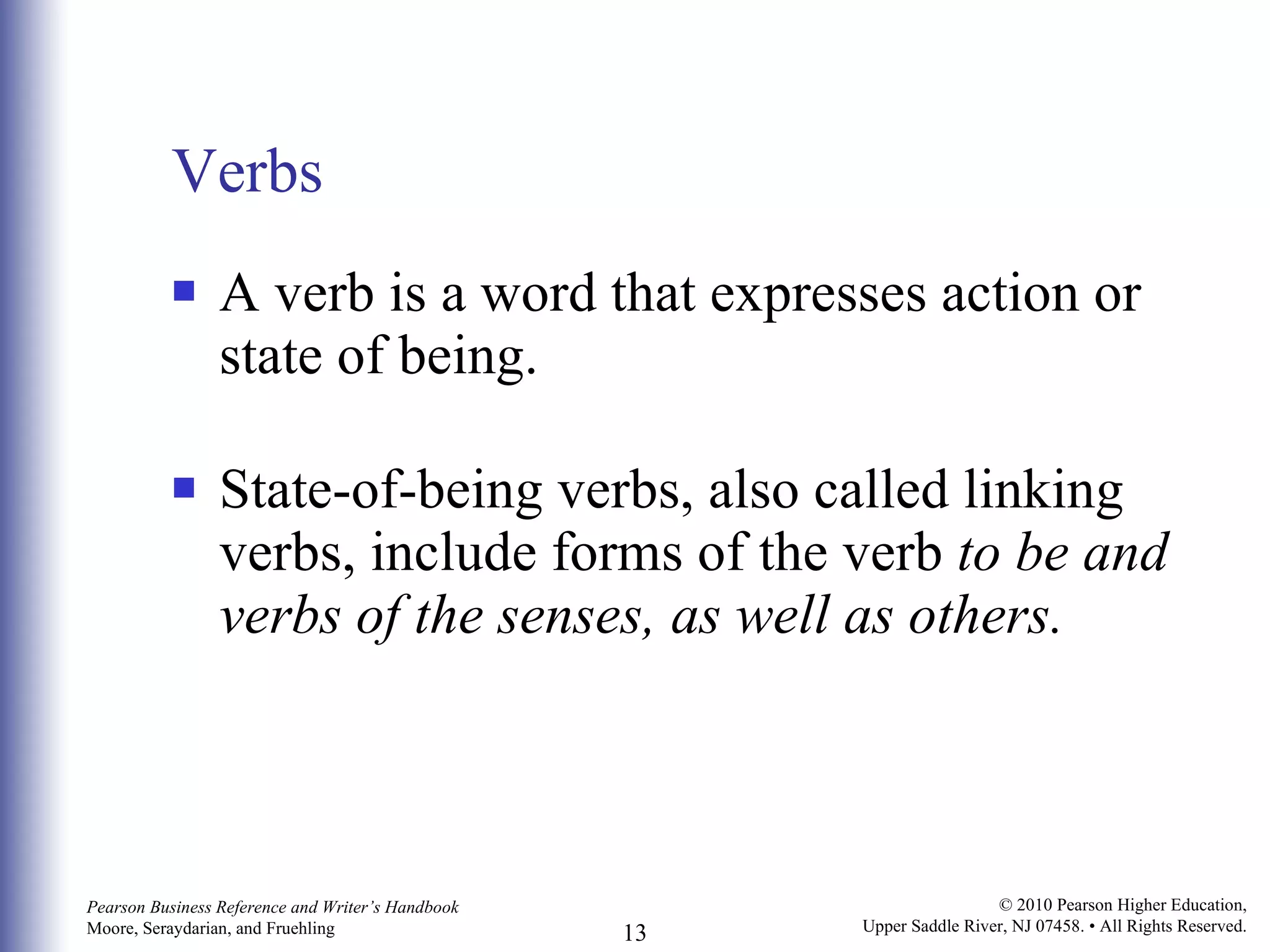
Verbs A verb is a word that expresses action or state of being. State-of-being verbs, also called linking verbs, include forms of the verb  to be and verbs of the senses, as well as others.
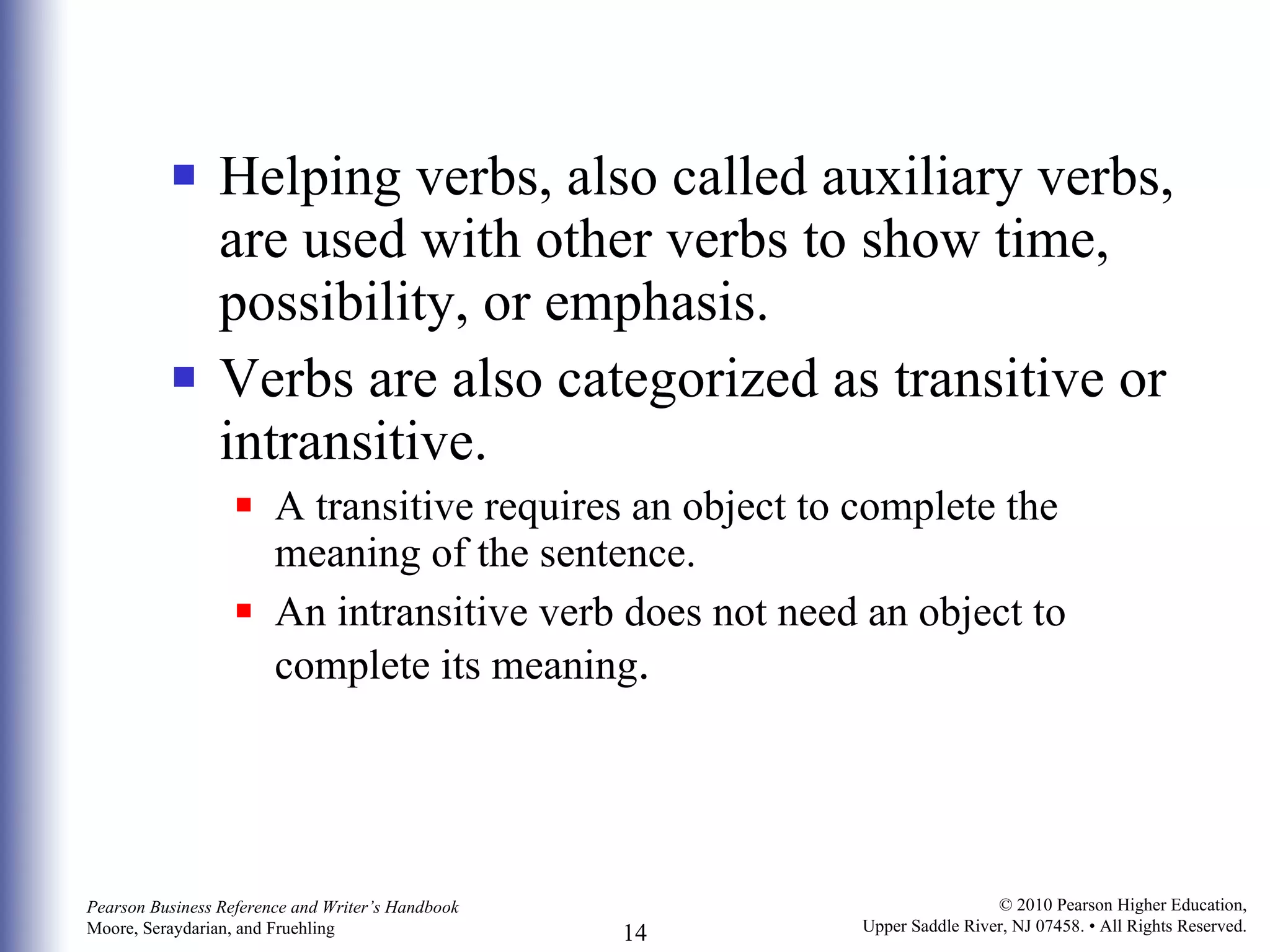
Helping verbs, also called auxiliary verbs, are used with other verbs to show time, possibility, or emphasis. Verbs are also categorized as transitive or intransitive.  A transitive requires an object to complete the meaning of the sentence. An intransitive verb does not need an object to complete its meaning .
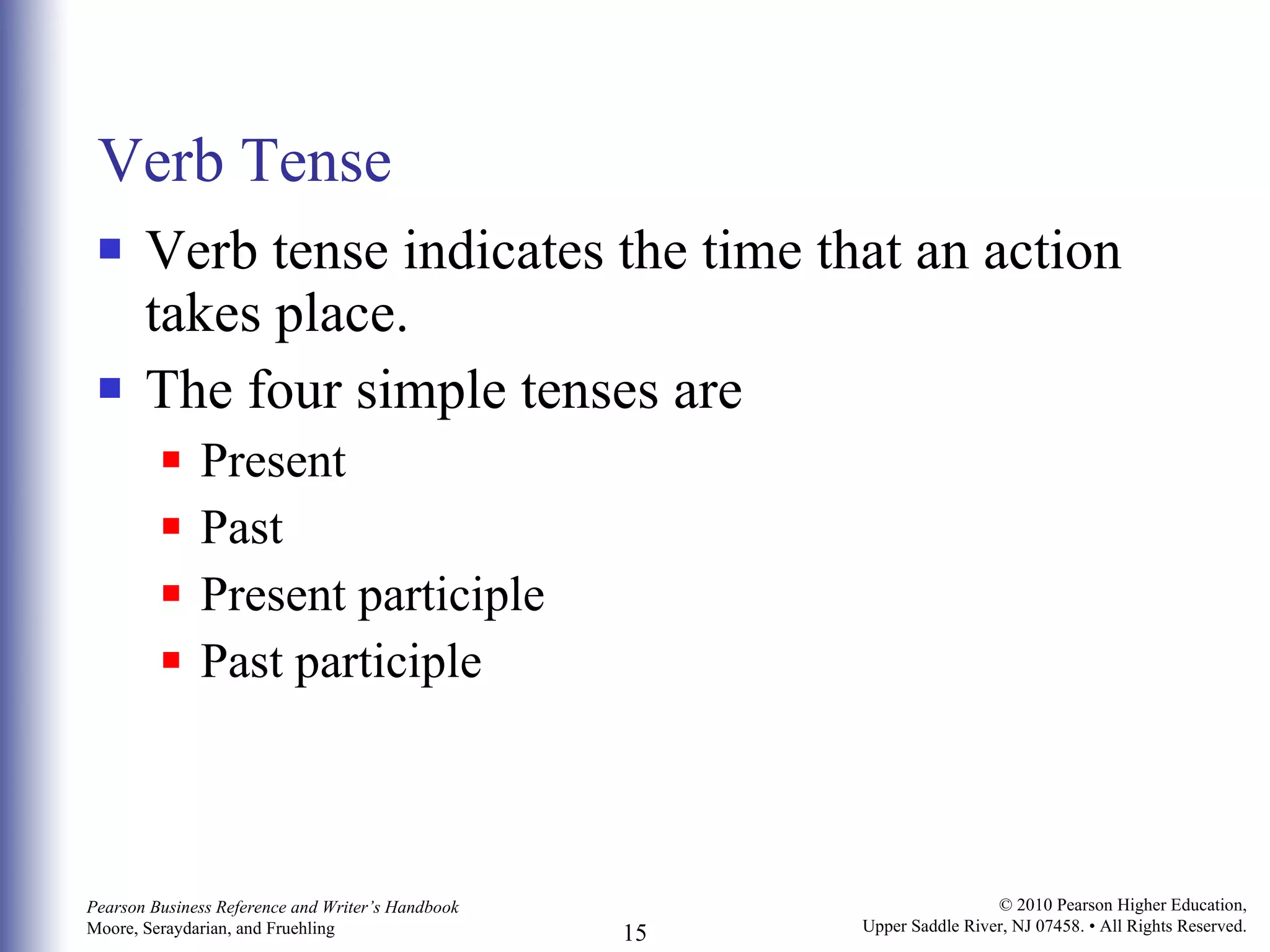
Verb Tense Verb tense indicates the time that an action takes place.  The four simple tenses are  Present Past Present participle Past participle
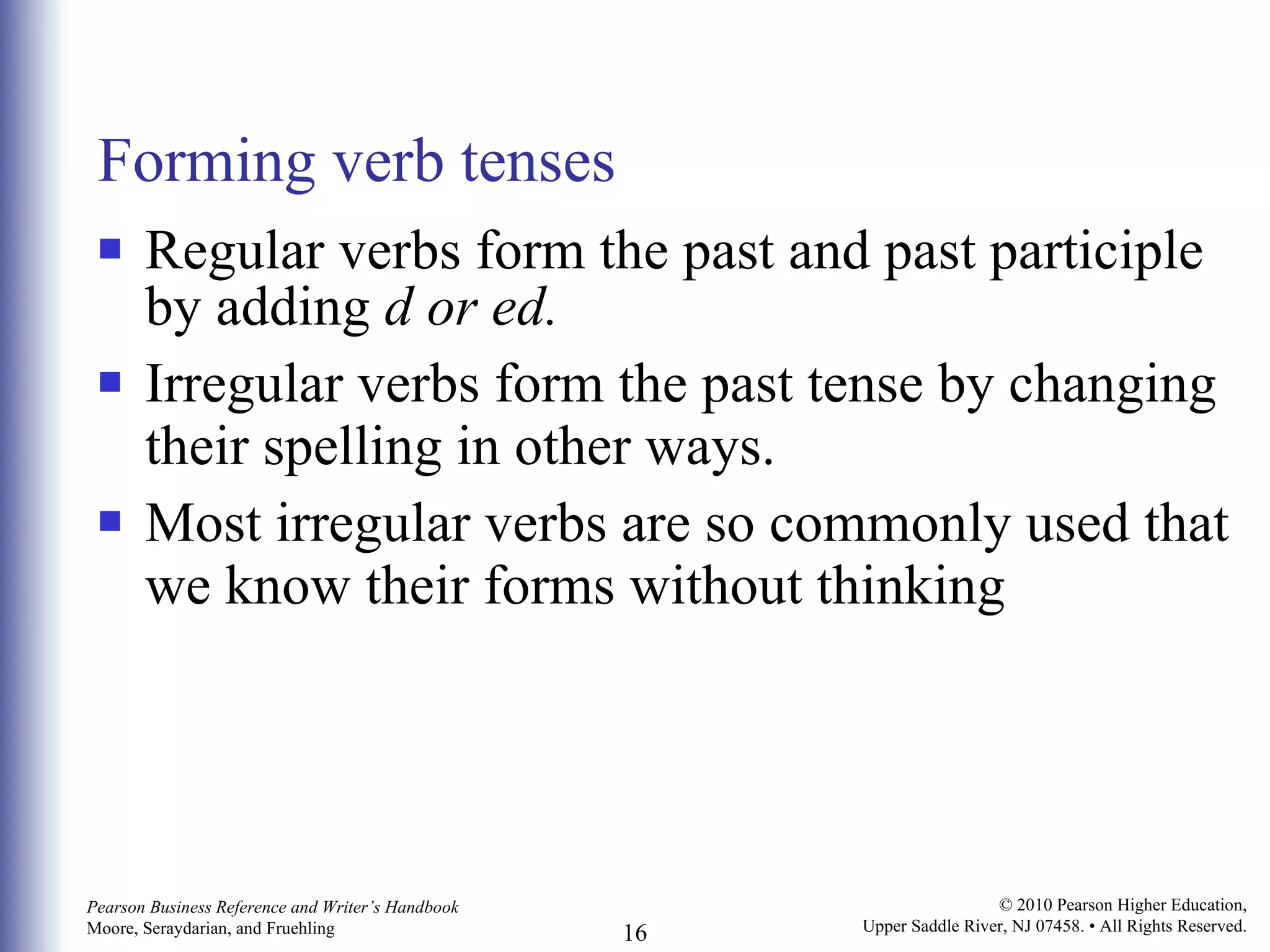
Forming verb tenses Regular verbs form the past and past participle by adding  d or ed.  Irregular verbs form the past tense by changing their spelling in other ways.  Most irregular verbs are so commonly used that we know their forms without thinking
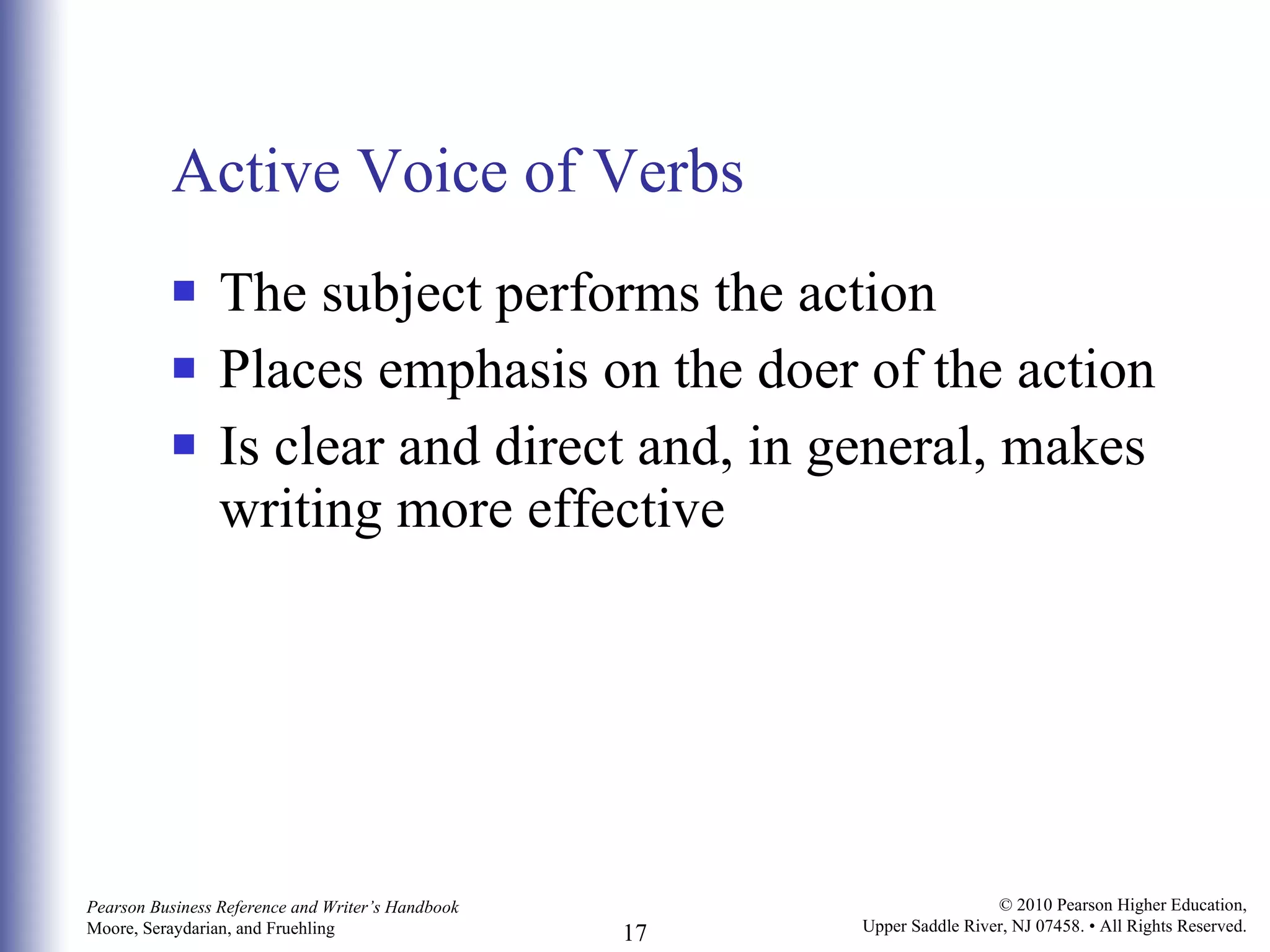
Active Voice of Verbs The subject performs the action Places emphasis on the doer of the action Is clear and direct and, in general, makes writing more effective
Passive Voice of Verbs The subject is the receiver of the action. Used it to invoke a formal tone. Use it to de-emphasize the doer of the action. Use it to create tactful expression of the action.  Otherwise, use the active voice  for more lively, clear
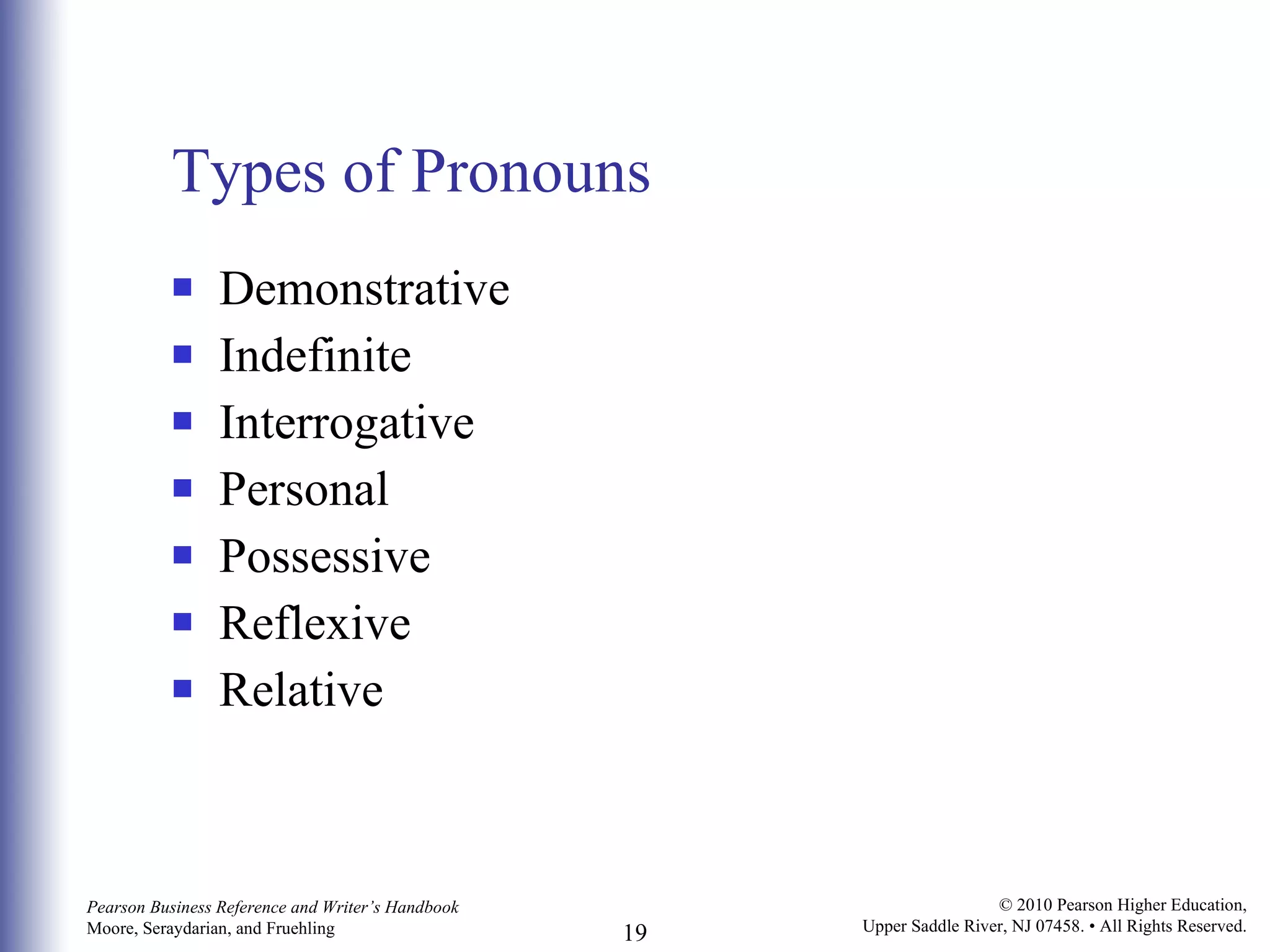
Types of Pronouns Demonstrative Indefinite Interrogative Personal Possessive Reflexive Relative
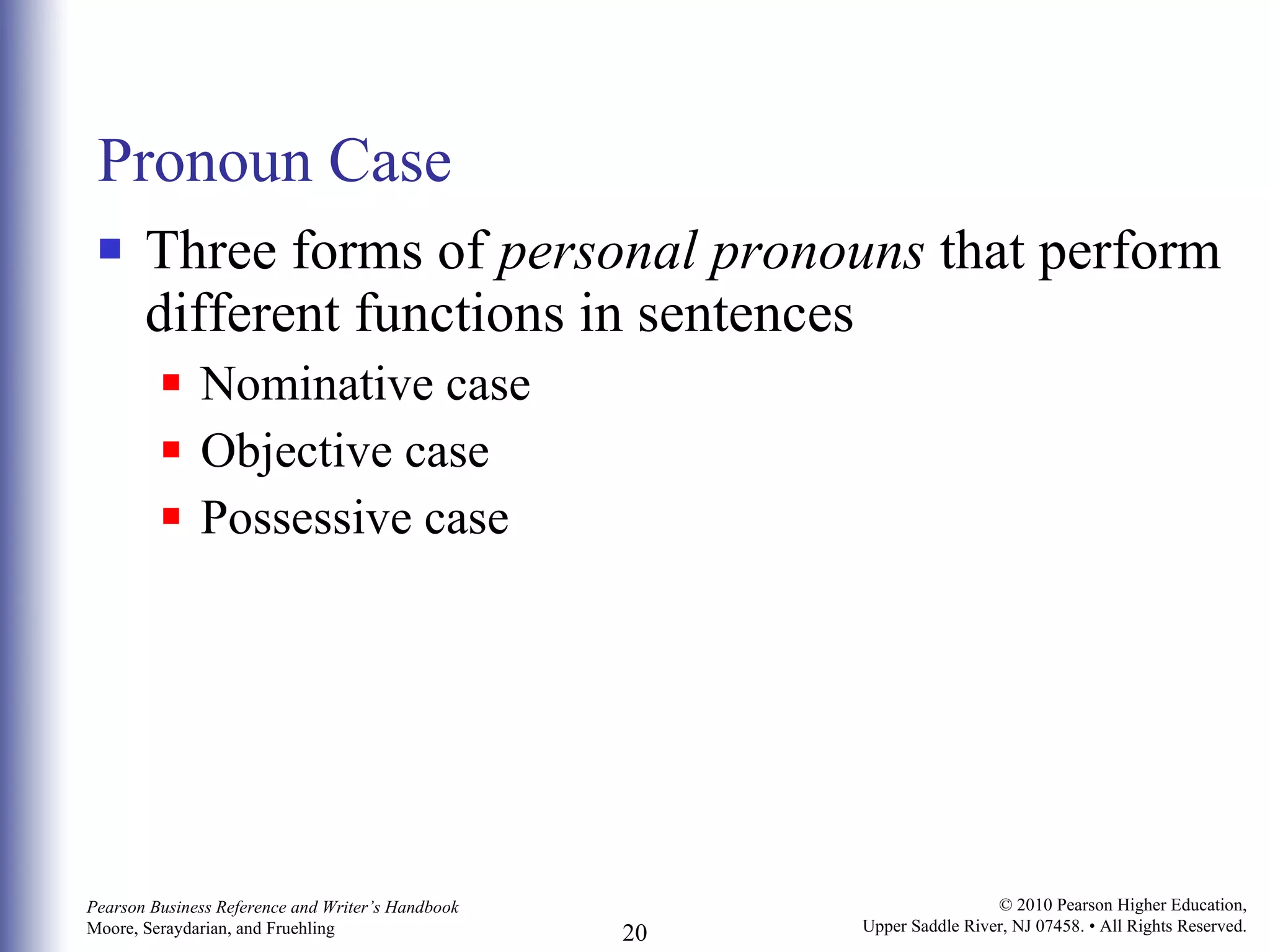
Pronoun Case Three forms of  personal pronouns  that perform different functions in sentences Nominative case  Objective case Possessive case
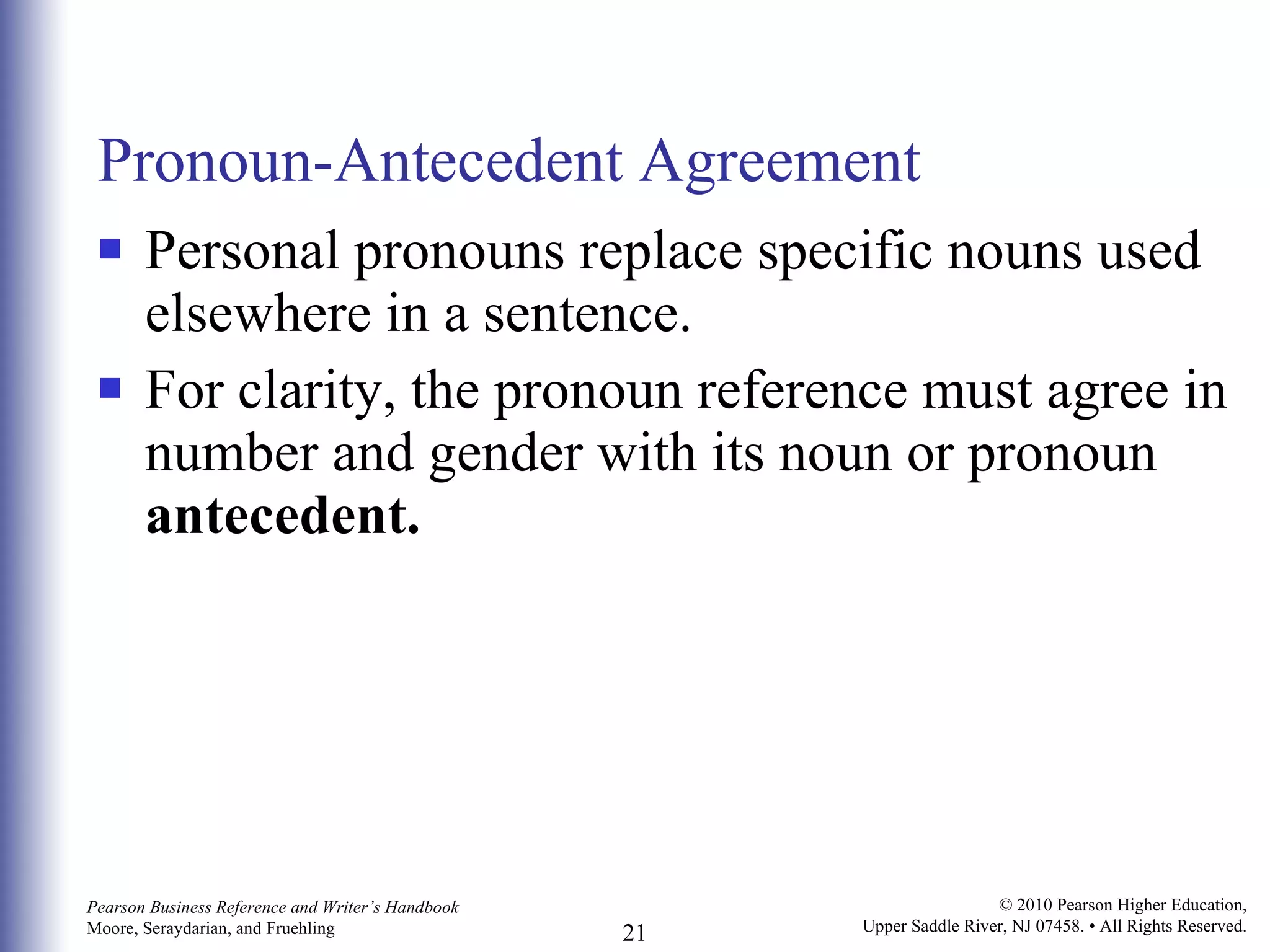
Pronoun-Antecedent Agreement Personal pronouns replace specific nouns used elsewhere in a sentence.  For clarity, the pronoun reference must agree in number and gender with its noun or pronoun  antecedent.
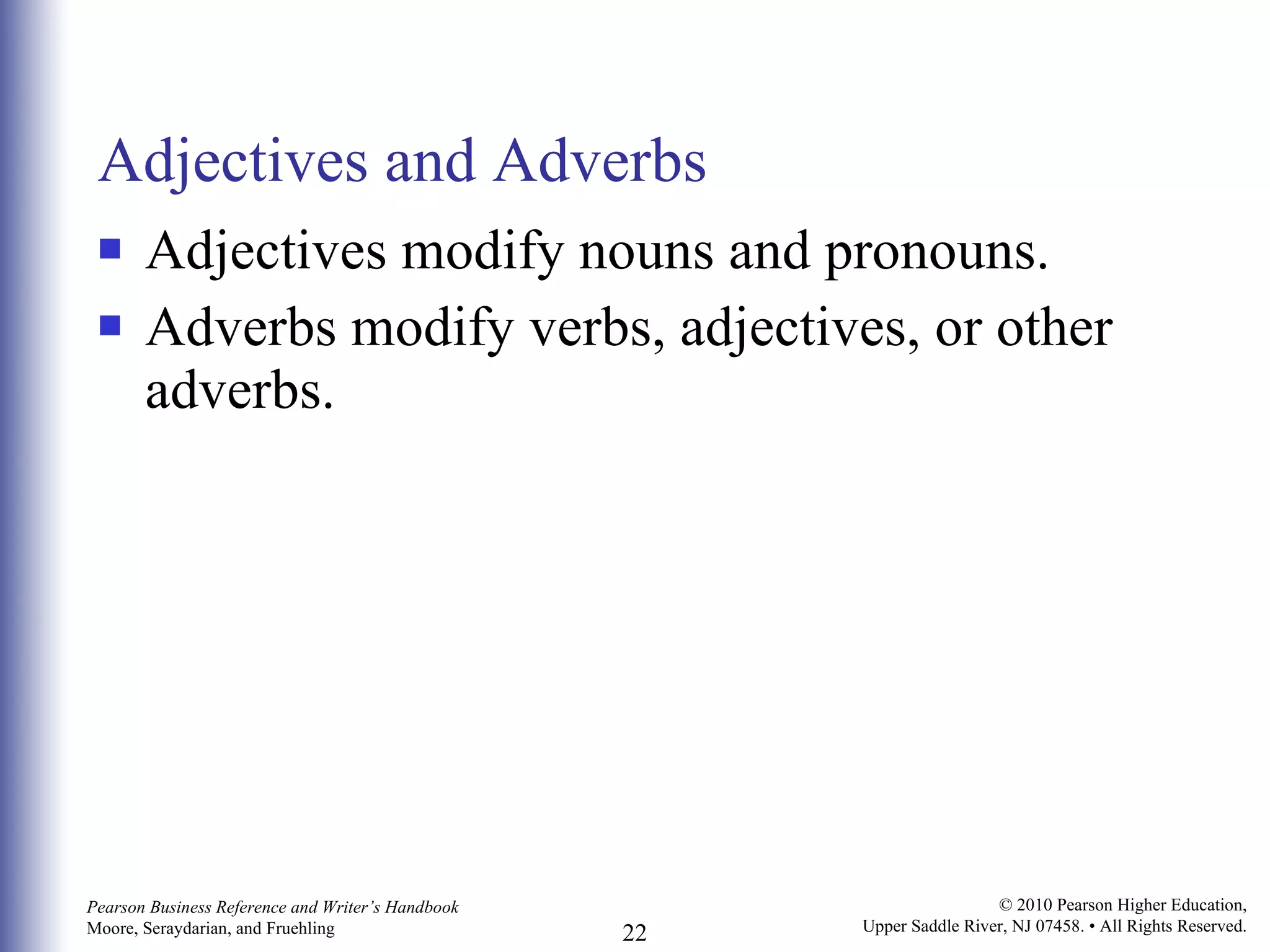
Adjectives and Adverbs Adjectives modify nouns and pronouns. Adverbs modify verbs, adjectives, or other adverbs.
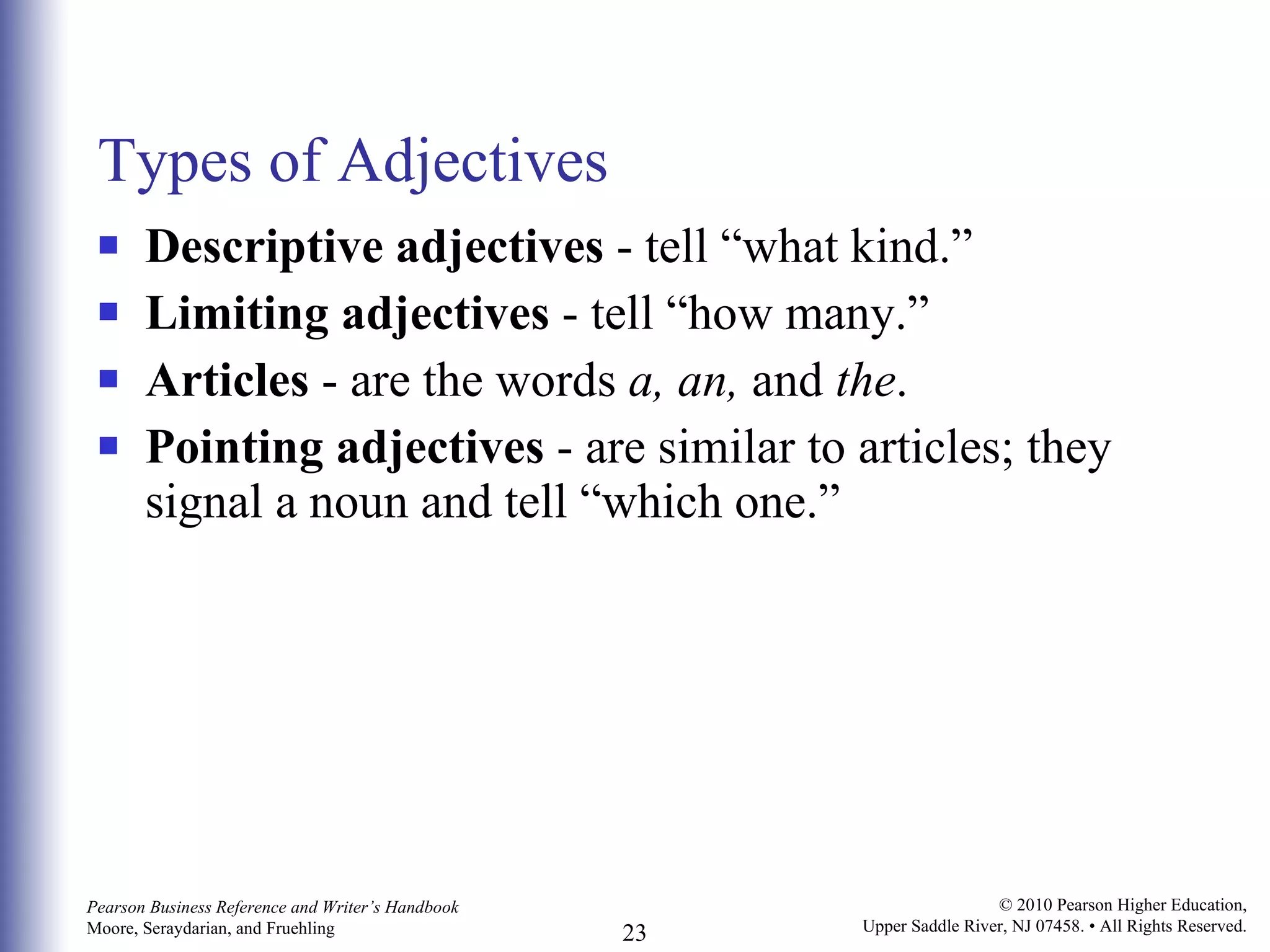
Types of Adjectives Descriptive adjectives  - tell “what kind.”  Limiting adjectives  - tell “how many.” Articles  - are the words  a, an,  and  the .  Pointing adjectives  - are similar to articles; they signal a noun and tell “which one.”
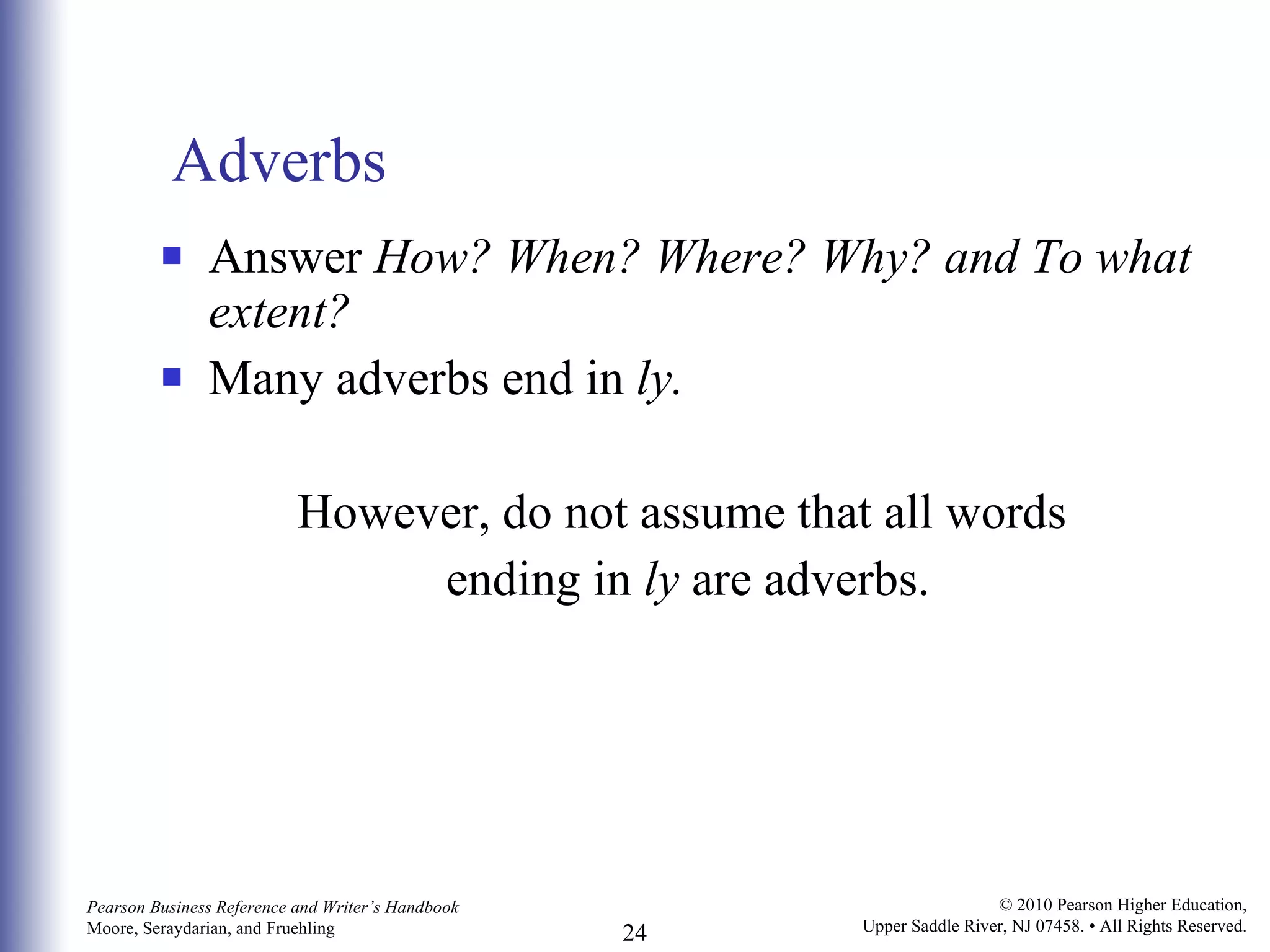
Adverbs Answer  How? When? Where? Why? and To what extent? Many adverbs end in  ly.  However, do not assume that all words  ending in  ly  are adverbs.
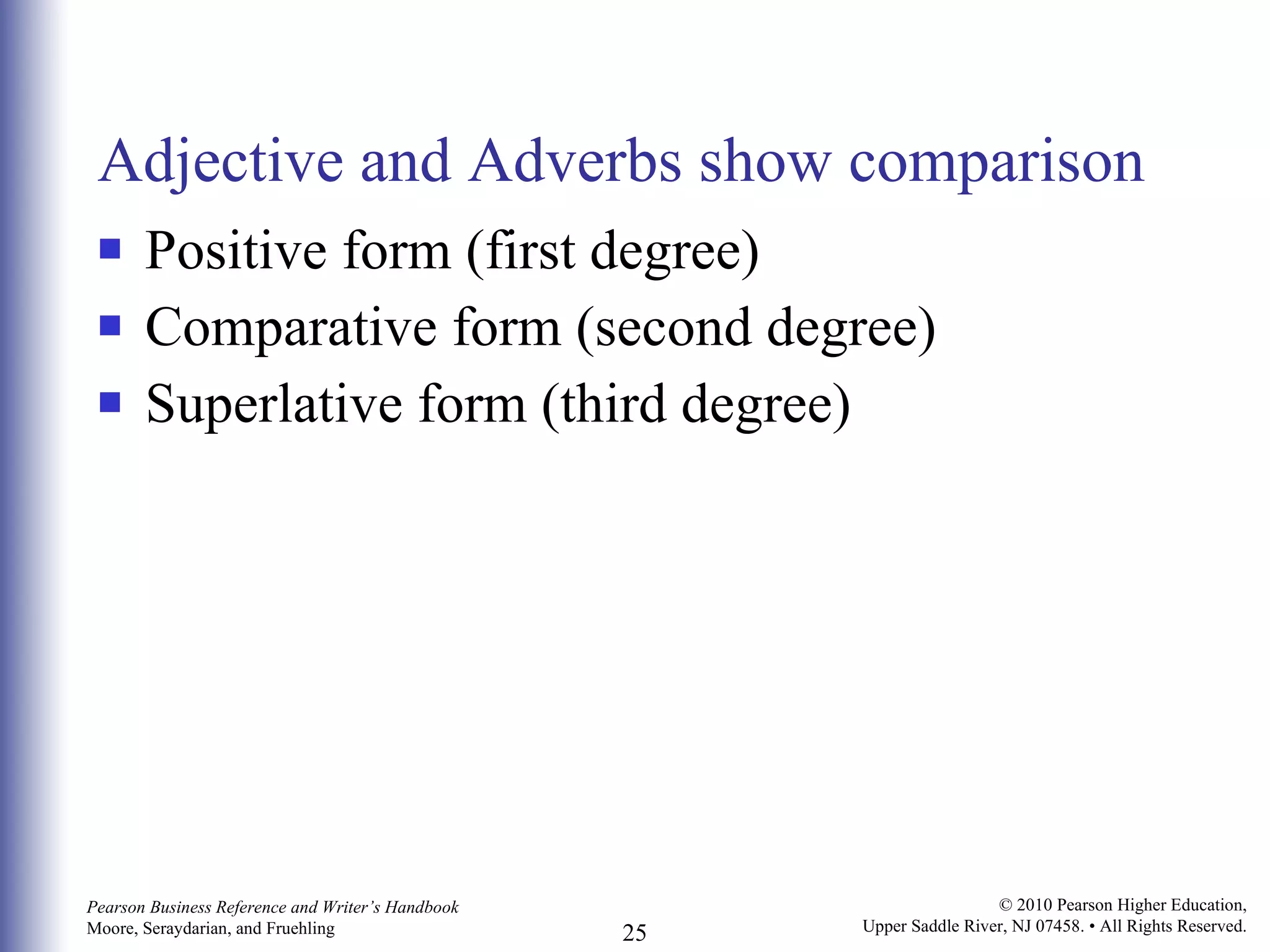
Adjective and Adverbs show comparison Positive form (first degree)  Comparative form (second degree) Superlative form (third degree)
Prepositions Words that connect a noun or pronoun to another word in the sentence to show relationships A prepositional phrase  begins with a preposition
Using prepositions Avoid unnecessary prepositions.  Avoid prepositions at the end of a sentence. Use the correct preposition.
Grammar must be correct in all written documents.  When you are unsure, use the  Pearson Reference Manual and Writer’s Handbook  to check your writing.

0135140560 pp1a

  • 1.
    Pearson Business Referenceand Writer’s Handbook Section One Grammar
  • 2.
    This section providesFundamentals of effective writing through mastery of basic sentence structure and the foundations of correct grammar.
  • 3.
    Objectives Recognize basicsentence structure Write complete sentences by properly using the parts of speech to logically form a complete thought Place phrases and clauses correctly to form complete sentences Locate verbs, pronouns, adjectives and adverbs within sentences
  • 4.
    Grammar helps you… Write sentences that clearly convey your message and reflect an educated command of English Use proper word forms and functions to clearly state your meaning. Vary the style of the sentences you write, which makes your writing more interesting to read.
  • 5.
    Grammar is importantbecause Grammar rules provide the framework for using words correctly as different parts of speech to construct sentences When you routinely use correct grammar, you can easily spot mistakes and correct them in your writing
  • 6.
    Basic sentence structureEvery sentence must include a subject and a verb The subject and verb must agree in number Objects answer the question whom? or what ?
  • 7.
    Phrases Phrases playdifferent roles in sentences. They can function as subjects, verbs, and modifiers. Their placement is crucial to clarity.
  • 8.
    Phrases Phrases maybe essential or nonessential to the meaning of the sentence To ensure that sentences make sense, notice whether phrases are connected properly to other parts of the sentence
  • 9.
    Clauses Clauses containa subject and a verb. A clause may be dependent or independent . Dependent - cannot stand alone and make sense Independent - can stand alone and make sense
  • 10.
    Connect independent clauseswith: Coordinating conjunctions Transitional words and expressions Punctuation
  • 11.
    Recognize comma splicesand run-ons Comma splice - occurs when you place a comma between independent Run-on sentence - occurs when you join independent clauses with no punctuation at all.
  • 12.
    Recognize fragments Asentence fragment is a group of words lacking a subject or a verb but punctuated as if it were a complete sentence
  • 13.
    Verbs A verbis a word that expresses action or state of being. State-of-being verbs, also called linking verbs, include forms of the verb to be and verbs of the senses, as well as others.
  • 14.
    Helping verbs, alsocalled auxiliary verbs, are used with other verbs to show time, possibility, or emphasis. Verbs are also categorized as transitive or intransitive. A transitive requires an object to complete the meaning of the sentence. An intransitive verb does not need an object to complete its meaning .
  • 15.
    Verb Tense Verbtense indicates the time that an action takes place. The four simple tenses are Present Past Present participle Past participle
  • 16.
    Forming verb tensesRegular verbs form the past and past participle by adding d or ed. Irregular verbs form the past tense by changing their spelling in other ways. Most irregular verbs are so commonly used that we know their forms without thinking
  • 17.
    Active Voice ofVerbs The subject performs the action Places emphasis on the doer of the action Is clear and direct and, in general, makes writing more effective
  • 18.
    Passive Voice ofVerbs The subject is the receiver of the action. Used it to invoke a formal tone. Use it to de-emphasize the doer of the action. Use it to create tactful expression of the action. Otherwise, use the active voice for more lively, clear
  • 19.
    Types of PronounsDemonstrative Indefinite Interrogative Personal Possessive Reflexive Relative
  • 20.
    Pronoun Case Threeforms of personal pronouns that perform different functions in sentences Nominative case Objective case Possessive case
  • 21.
    Pronoun-Antecedent Agreement Personalpronouns replace specific nouns used elsewhere in a sentence. For clarity, the pronoun reference must agree in number and gender with its noun or pronoun antecedent.
  • 22.
    Adjectives and AdverbsAdjectives modify nouns and pronouns. Adverbs modify verbs, adjectives, or other adverbs.
  • 23.
    Types of AdjectivesDescriptive adjectives - tell “what kind.” Limiting adjectives - tell “how many.” Articles - are the words a, an, and the . Pointing adjectives - are similar to articles; they signal a noun and tell “which one.”
  • 24.
    Adverbs Answer How? When? Where? Why? and To what extent? Many adverbs end in ly. However, do not assume that all words ending in ly are adverbs.
  • 25.
    Adjective and Adverbsshow comparison Positive form (first degree) Comparative form (second degree) Superlative form (third degree)
  • 26.
    Prepositions Words thatconnect a noun or pronoun to another word in the sentence to show relationships A prepositional phrase begins with a preposition
  • 27.
    Using prepositions Avoidunnecessary prepositions. Avoid prepositions at the end of a sentence. Use the correct preposition.
  • 28.
    Grammar must becorrect in all written documents. When you are unsure, use the Pearson Reference Manual and Writer’s Handbook to check your writing.