Pearson Business Reference and Writer’s Handbook Section Five  Spelling, Word Division, and Word Usage
This section provides The “little” details to be considered in preparing a document for distribution. Spelling errors are among the most glaring that detract from a document’s overall effectiveness.
Objectives Spot and correct the most commonly misspelled words  Distinguish between similar words and correct errors in usage Divide words properly (as needed)
General rule for spelling Misspelled words are not acceptable in any type of business communication.  There are many spelling rules and exceptions. Use the dictionary and the spell checker.  AND ALWAYS PROOFREAD
Electronic spell checkers do not detect most mistakes in Word usage Verb tenses Suffixes Prefixes Wrong word Omitted words
Word Division In general, avoid dividing words at the end of a line. Turn off automatic hyphenation on your word processor.
Use the dictionary To properly spell and identify syllables in words … However, it is not the source for determining proper division of words at the end of a line  in printed documents .
Divide words only between syllables BUT Do not divide before or after a one-letter syllable. Avoid dividing suffixes from the root word, especially short ones. Leave at least two letters of the word being divided on the end of the line, and carry at least three letters to the new line.
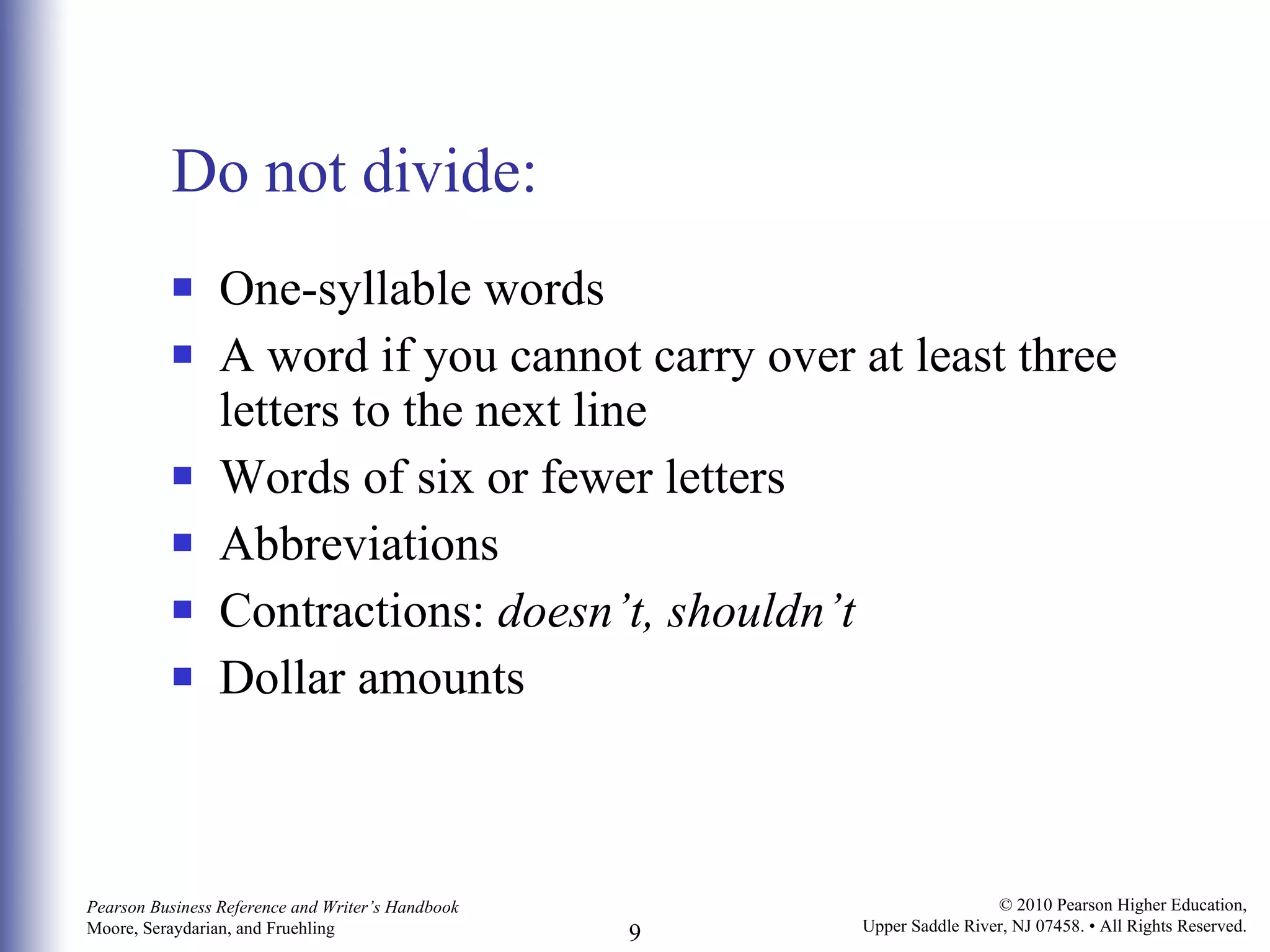
Do not divide: One-syllable words A word if you cannot carry over at least three letters to the next line Words of six or fewer letters Abbreviations Contractions:  doesn’t, shouldn’t Dollar amounts
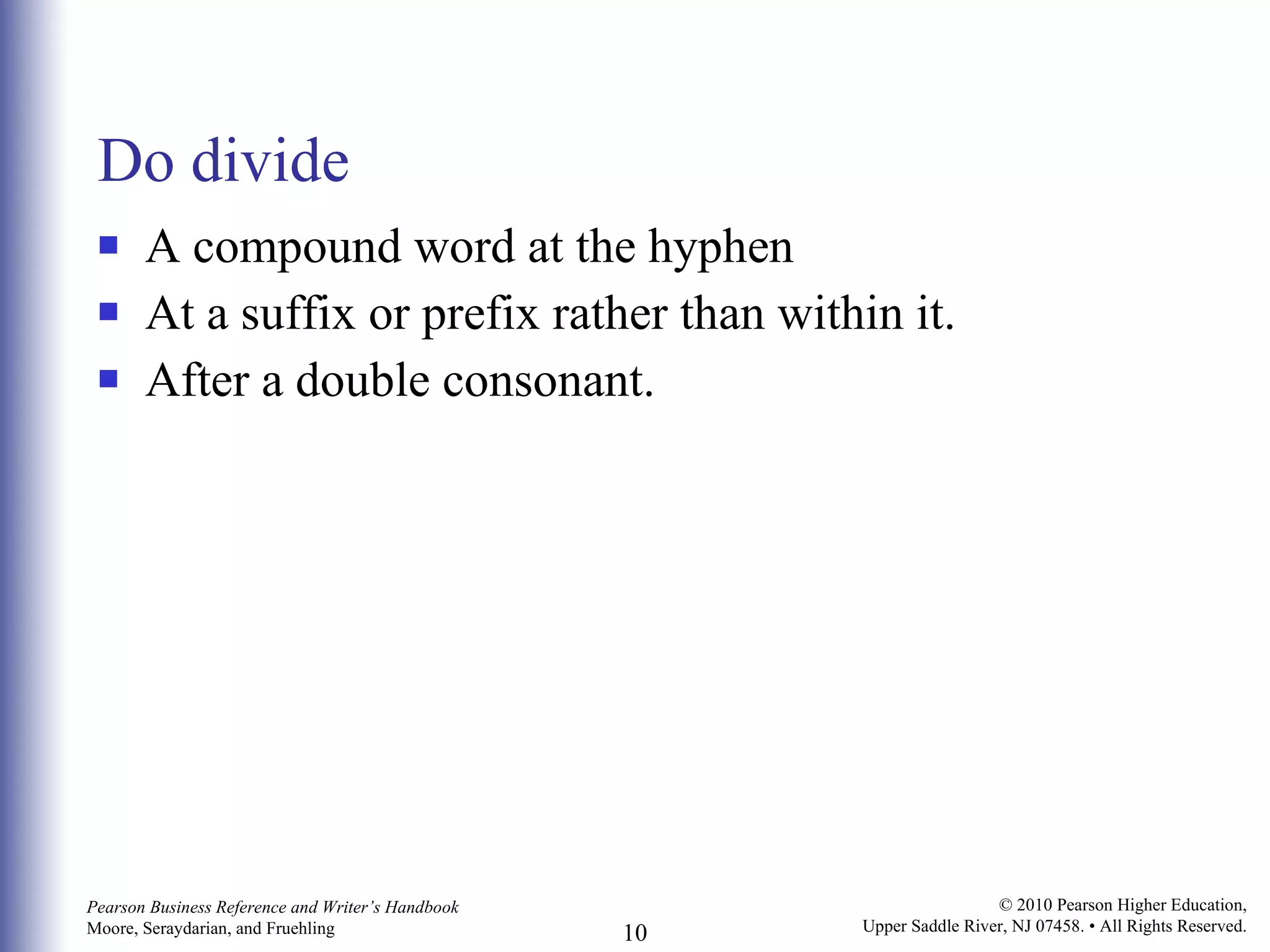
Do divide A compound word at the hyphen  At a suffix or prefix rather than within it. After a double consonant.
Word usage Correct usage of words makes for a skilled writer. Recognize personal weaknesses and avoid them.
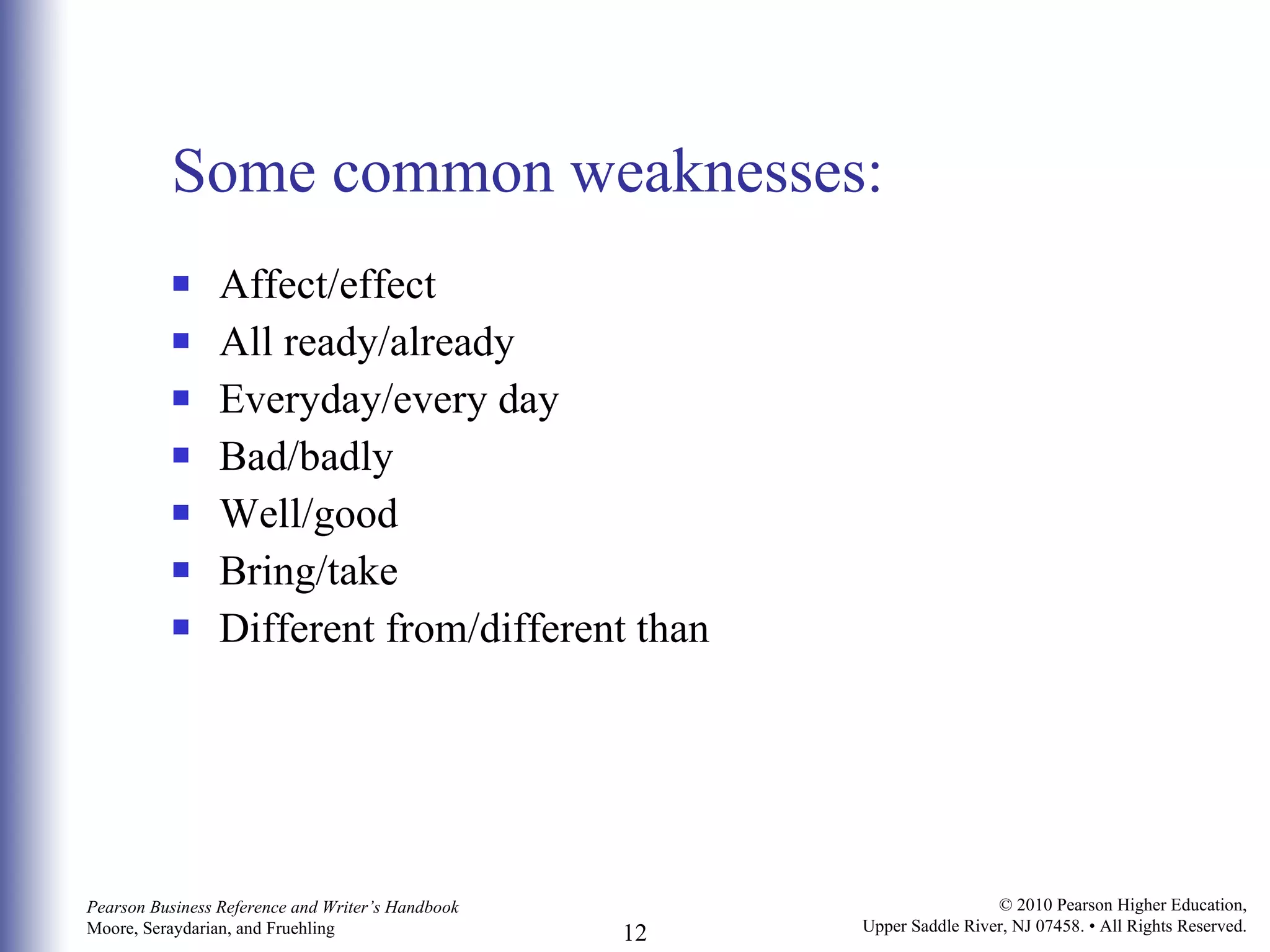
Some common weaknesses: Affect/effect All ready/already Everyday/every day Bad/badly Well/good Bring/take Different from/different than
Spelling and Word Usage Must be correct in all written documents and should be given a final check for accuracy when proofreading.

0135140560 pp5a

  • 1.
    Pearson Business Referenceand Writer’s Handbook Section Five Spelling, Word Division, and Word Usage
  • 2.
    This section providesThe “little” details to be considered in preparing a document for distribution. Spelling errors are among the most glaring that detract from a document’s overall effectiveness.
  • 3.
    Objectives Spot andcorrect the most commonly misspelled words Distinguish between similar words and correct errors in usage Divide words properly (as needed)
  • 4.
    General rule forspelling Misspelled words are not acceptable in any type of business communication. There are many spelling rules and exceptions. Use the dictionary and the spell checker. AND ALWAYS PROOFREAD
  • 5.
    Electronic spell checkersdo not detect most mistakes in Word usage Verb tenses Suffixes Prefixes Wrong word Omitted words
  • 6.
    Word Division Ingeneral, avoid dividing words at the end of a line. Turn off automatic hyphenation on your word processor.
  • 7.
    Use the dictionaryTo properly spell and identify syllables in words … However, it is not the source for determining proper division of words at the end of a line in printed documents .
  • 8.
    Divide words onlybetween syllables BUT Do not divide before or after a one-letter syllable. Avoid dividing suffixes from the root word, especially short ones. Leave at least two letters of the word being divided on the end of the line, and carry at least three letters to the new line.
  • 9.
    Do not divide:One-syllable words A word if you cannot carry over at least three letters to the next line Words of six or fewer letters Abbreviations Contractions: doesn’t, shouldn’t Dollar amounts
  • 10.
    Do divide Acompound word at the hyphen At a suffix or prefix rather than within it. After a double consonant.
  • 11.
    Word usage Correctusage of words makes for a skilled writer. Recognize personal weaknesses and avoid them.
  • 12.
    Some common weaknesses:Affect/effect All ready/already Everyday/every day Bad/badly Well/good Bring/take Different from/different than
  • 13.
    Spelling and WordUsage Must be correct in all written documents and should be given a final check for accuracy when proofreading.