Pearson Business Reference and Writer’s Handbook Section Seven Writing Style
This section provides Writing techniques that improve person-to-person communication and help achieve positive writing in business communications.
Objectives Choose appropriate words and construct precise and correct sentences Use a style that reflects the relationship between the writer and the reader Combine personal style with standard English usage and with the appropriate level of formality Hold the readers attention by sticking to the facts, presenting a coherent message, and sending a timely response
Writing style The words a writer chooses and how they are constructed into sentences define an individual writer’s style.  It is natural and appropriate to vary writing style for different tasks and project.
Choosing the right style Consider the relationship between the writer and the reader.  Consider decisions made about how to best accomplish the writer’s purpose.
Using the appropriate level of formality Combine personal style with Standard English usage.  Be aware of language usage and sentence structure as the building blocks of each piece of writing.
Tone in business writing Is closely related to level of formality. Reveals your attitude toward your audience and topic Lively and friendly language is absolutely necessary.  Operates like “tone of voice” in speech.
To achieve the “right” tone Use simple, clear sentence construction. Use lively and friendly language. BUT Avoid slang, messaging shorthand, and non-Standard English.
Writing strong paragraphs Topic sentences tell the reader what the paragraph is about.  Supporting sentences provide details about the main idea.  Paragraphs do not overload the reader.
To achieve paragraph unity and coherence Group sentences for clarity of relationships  Focus each sentence on the main idea. Use transitions to connect paragraphs and guide the reader logically.
To write effective sentences Vary length and structure. Use active voice to deliver the message clearly and forcefully.  Place words and phrases for emphasis. Avoid clutter by eliminating extra words.
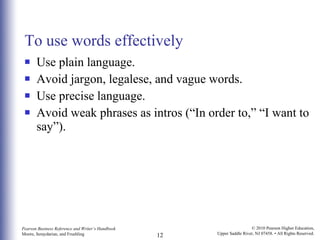
To use words effectively Use plain language.  Avoid jargon, legalese, and vague words. Use precise language.  Avoid weak phrases as intros (“In order to,” “I want to say”).
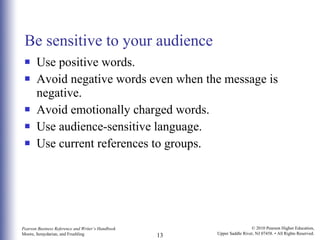
Be sensitive to your audience Use positive words.  Avoid negative words even when the message is negative. Avoid emotionally charged words. Use audience-sensitive language. Use current references to groups.
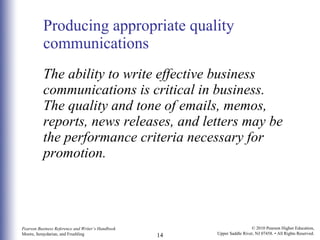
Producing appropriate quality communications The ability to write effective business communications is critical in business. The quality and tone of emails, memos, reports, news releases, and letters may be the performance criteria necessary for promotion.

0135140560 pp7a

  • 1.
    Pearson Business Referenceand Writer’s Handbook Section Seven Writing Style
  • 2.
    This section providesWriting techniques that improve person-to-person communication and help achieve positive writing in business communications.
  • 3.
    Objectives Choose appropriatewords and construct precise and correct sentences Use a style that reflects the relationship between the writer and the reader Combine personal style with standard English usage and with the appropriate level of formality Hold the readers attention by sticking to the facts, presenting a coherent message, and sending a timely response
  • 4.
    Writing style Thewords a writer chooses and how they are constructed into sentences define an individual writer’s style. It is natural and appropriate to vary writing style for different tasks and project.
  • 5.
    Choosing the rightstyle Consider the relationship between the writer and the reader. Consider decisions made about how to best accomplish the writer’s purpose.
  • 6.
    Using the appropriatelevel of formality Combine personal style with Standard English usage. Be aware of language usage and sentence structure as the building blocks of each piece of writing.
  • 7.
    Tone in businesswriting Is closely related to level of formality. Reveals your attitude toward your audience and topic Lively and friendly language is absolutely necessary. Operates like “tone of voice” in speech.
  • 8.
    To achieve the“right” tone Use simple, clear sentence construction. Use lively and friendly language. BUT Avoid slang, messaging shorthand, and non-Standard English.
  • 9.
    Writing strong paragraphsTopic sentences tell the reader what the paragraph is about. Supporting sentences provide details about the main idea. Paragraphs do not overload the reader.
  • 10.
    To achieve paragraphunity and coherence Group sentences for clarity of relationships Focus each sentence on the main idea. Use transitions to connect paragraphs and guide the reader logically.
  • 11.
    To write effectivesentences Vary length and structure. Use active voice to deliver the message clearly and forcefully. Place words and phrases for emphasis. Avoid clutter by eliminating extra words.
  • 12.
    To use wordseffectively Use plain language. Avoid jargon, legalese, and vague words. Use precise language. Avoid weak phrases as intros (“In order to,” “I want to say”).
  • 13.
    Be sensitive toyour audience Use positive words. Avoid negative words even when the message is negative. Avoid emotionally charged words. Use audience-sensitive language. Use current references to groups.
  • 14.
    Producing appropriate qualitycommunications The ability to write effective business communications is critical in business. The quality and tone of emails, memos, reports, news releases, and letters may be the performance criteria necessary for promotion.