Lesson Three Sentence Expansion
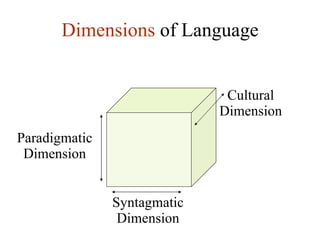
Dimensions  of Language Cultural Dimension Syntagmatic Dimension Paradigmatic Dimension
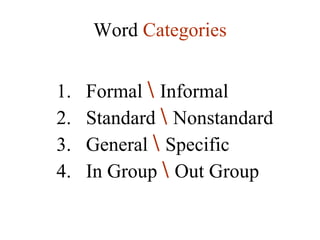
1.   Formal  \   Informal 2.  Standard  \   Nonstandard 3.  General  \   Specific 4.  In Group  \   Out Group Word  Categories
Reference Tools Dictionary merriam-webster.com Thesaurus
The  Writing   Assignment Write one or two paragraphs in which you describe and/or explain  to  one of your classmates your like or dislike for writing in English. Length : 100 - 200 words Due at the beginning of next week’s class.
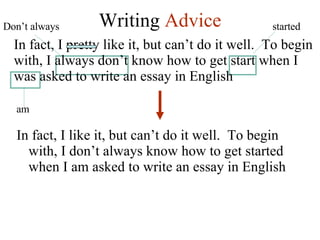
Writing  Advice In fact, I like it, but can’t do it well.  To begin with, I don’t always know how to get started when I am asked to write an essay in English In fact, I pretty like it, but can’t do it well.  To begin with, I always don’t know how to get start when I was asked to write an essay in English Don’t always started am
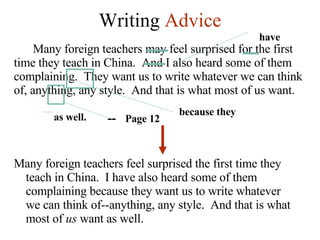
Writing  Advice Many foreign teachers may feel surprised for the first time they teach in China.  And I also heard some of them complaining.  They want us to write whatever we can think of, anything, any style.  And that is what most of us want.  because they --  Page 12 as well. have Many foreign teachers feel surprised the first time they teach in China.  I have also heard some of them complaining because they want us to write whatever we can think of--anything, any style.  And that is what most of  us  want as well.
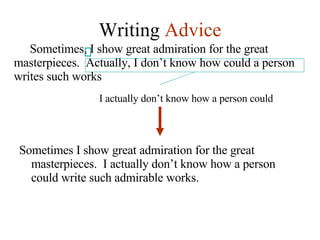
Writing  Advice Sometimes, I show great admiration for the great masterpieces.  Actually, I don’t know how could a person writes such works Sometimes I show great admiration for the great masterpieces.  I actually don’t know how a person could write such admirable works. I actually don’t know how a person could
Sentence  Expansion
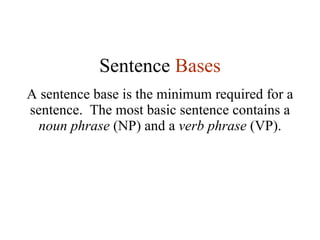
A sentence base is the minimum required for a sentence.  The most basic sentence contains a  noun phrase  (NP)   and a  verb phrase  (VP). Sentence  Bases
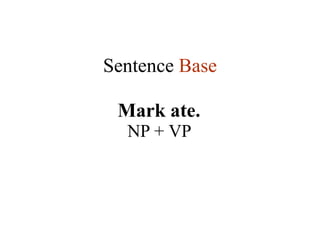
Mark ate. NP + VP Sentence  Base
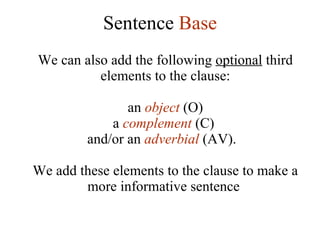
Sentence  Base We can also add the following  optional  third elements to the clause:   an  object  (O) a  complement   (C)  and/or an  adverbial  (AV).  We add these elements to the clause to make a more informative sentence
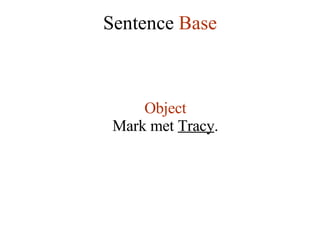
Sentence  Base Object Mark met  Tracy .
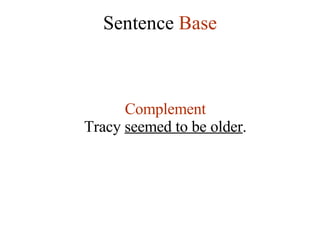
Sentence  Base Complement Tracy  seemed to be older .
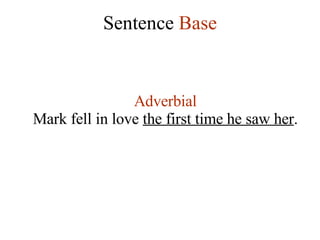
Sentence  Base Adverbial Mark fell in love  the first time he saw her .
Sentence  Expansion 1.  Coordination  2.  Subordination
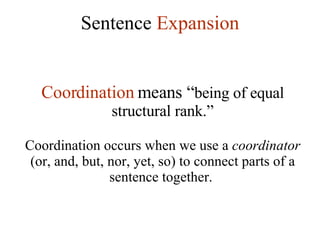
Sentence  Expansion Coordination  means “ being of equal structural rank.” Coordination occurs when we use a  coordinator  (or, and, but, nor, yet, so) to connect parts of a sentence together.
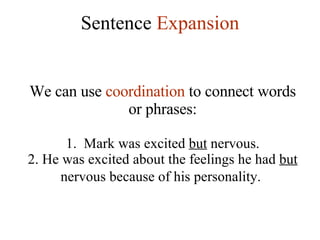
Sentence  Expansion We can use  coordination  to connect words or phrases: 1.  Mark was excited  but  nervous. 2. He was excited about the feelings he had  but  nervous because of his personality.
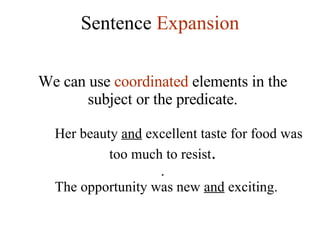
Sentence  Expansion We can use  coordinated  elements in the subject or the predicate.   Her beauty  and  excellent taste for food was too much to resist . .   The opportunity was new  and  exciting.
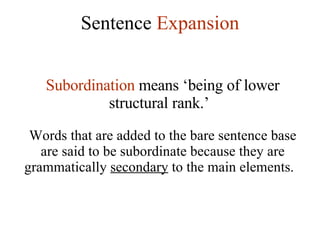
Sentence  Expansion Subordination  means ‘being of lower structural rank.’   Words that are added to the bare sentence base are said to be subordinate because they are grammatically  secondary  to the main elements.
Sentence  Expansion Subordinating  elements  modify  the meaning of the sentence base.   We call theses subordinating elements  modifiers .  Modifiers are absolutely essential to writing effectively because they provide vital, substantial, and specific information.
Sentence  Expansion Subordination  1.  Relative Clauses  2.  Appositive Phrases  3.  Adverbial Clauses  4.  Participial Phrases  5.  Absolute Phrases
Sentence  Expansion 1.   Relative  Clauses Relative clauses  enable the writer to embed a complete subject/predicate into a noun phrase.  Relative = relationship Relative Clauses  are introduced by either a  relative pronoun  (that, who, or which) or a  relative adverb  (where, when, why)
Sentence  Expansion 1.   Relative  Clauses Example: 1. Tracy invited Mark to sit down. 2. They shared a pot of coffee. What is the relationship between these two sentences?  How can we make the relationship more clear?
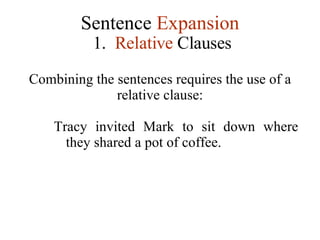
Sentence  Expansion 1.   Relative  Clauses Combining the sentences requires the use of a relative clause: Tracy invited Mark to sit down where they shared a pot of coffee.
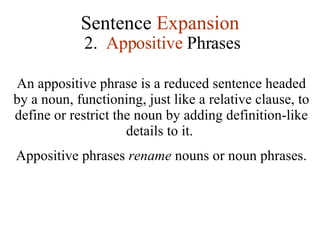
Sentence  Expansion 2.  Appositive  Phrases An appositive phrase is a reduced sentence headed by a noun, functioning, just like a relative clause, to define or restrict the noun by adding definition-like details to it.  Appositive phrases  rename  nouns or noun phrases.
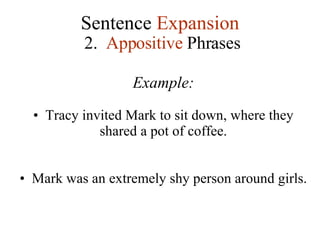
Sentence  Expansion 2.  Appositive  Phrases Example: Tracy invited Mark to sit down, where they shared a pot of coffee. Mark was an extremely shy person around girls.
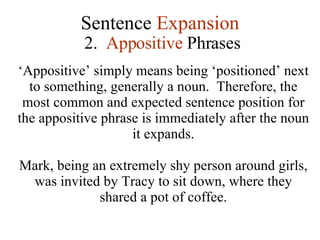
Sentence  Expansion 2.  Appositive  Phrases ‘ Appositive’ simply means being ‘positioned’ next to something, generally a noun.  Therefore, the most common and expected sentence position for the appositive phrase is immediately after the noun it expands. Mark, being an extremely shy person around girls, was invited by Tracy to sit down, where they shared a pot of coffee.
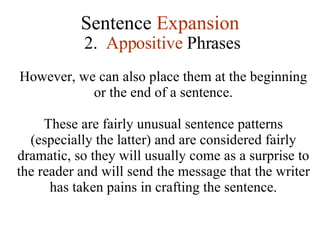
Sentence  Expansion 2.  Appositive  Phrases However, we can also place them at the beginning or the end of a sentence. These are fairly unusual sentence patterns (especially the latter) and are considered fairly dramatic, so they will usually come as a surprise to the reader and will send the message that the writer has taken pains in crafting the sentence.
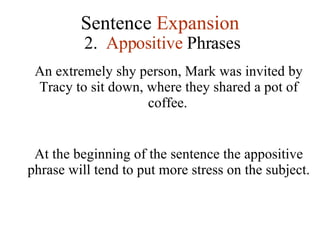
Sentence  Expansion 2.  Appositive  Phrases An extremely shy person, Mark was invited by Tracy to sit down, where they shared a pot of coffee.   At the beginning of the sentence the appositive phrase will tend to put more stress on the subject.
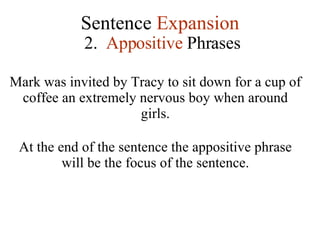
Sentence  Expansion 2.  Appositive  Phrases Mark was invited by Tracy to sit down for a cup of coffee an extremely nervous boy when around girls. At the end of the sentence the appositive phrase will be the focus of the sentence.
Sentence  Expansion 2.  Appositive  Phrases Introductory Appositive Series  Upset stomach, sweaty palms, and shaking leg syndrome — all these symptoms caused Mark to act very strangely.   The subject of the sentence is  all these symptoms ; the list of appositives names the symptoms.
Sentence  Expansion 3.   Adverbial  Clauses Adverbial clauses (subordinating) are clauses that modify verbs using a subordinator. Examples of subordinating words: if, since,when, while, although, even though, after, before as if, as long as, as soon as
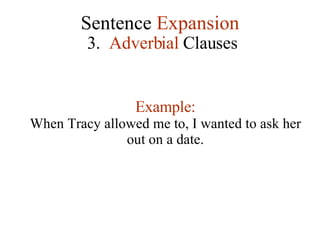
Sentence  Expansion 3.   Adverbial  Clauses Example: When Tracy allowed me to, I wanted to ask her out on a date.
Sentence  Expansion 3.   Adverbial  Clauses Two frequent problems with adverbial clauses: The wrong idea gets subordinated The meaning of the subordinator is imprecise
Sentence  Expansion 3.   Adverbial  Clauses The wrong idea gets subordinated Example: 1. When Tracy allowed me to, I wanted to ask her out on a date. 2.  Tracy allowed me to, when I wanted to ask her out on a date.
Sentence  Expansion 3.   Adverbial  Clauses 2.  The meaning of the subordinator is imprecise Example: 1.  When Tracy allowed me to, I wanted to take her out on a date. 2.  If Tracy allowed me to, I wanted to take her out on a date.
Sentence  Expansion 3.   Adverbial  Clauses Adverbial clauses can be placed in the beginning, middle, or end of a sentence.
Sentence  Expansion 3.   Adverbial  Clauses At the beginning of a sentence, adverbial clauses can function as a cohesive link between known and unknown information. When Tracy allowed me to, I wanted to take her out on a date. I wanted to take Tracy out on a date, when she allowed me to. Notice the change in focus when we change the position.
Sentence  Expansion 3.   Adverbial  Clauses Placing an adverbial clause in the middle of a sentence will interrupt the flow of the sentence and slow the reader down.  They add stress and length to the words they modify and changes the rhythm. I wanted, when Tracy allowed me, to take her out on a date.
Next   Week: Sentence Expansion & Sentence Combining
The  Reading   Assignment Preview Chapter 3, pgs 57-74 for next week’s class
The  Writing   Assignment Write one paragraph in which you describe your future career goals and intellectual interests to the faculty of the English Department. Write another paragraph in which you describe your future career goals and intellectual interests to a Canadian third-year university student.

Lesson 3 Sentence Expansion

  • 1.
  • 2.
    Dimensions ofLanguage Cultural Dimension Syntagmatic Dimension Paradigmatic Dimension
  • 3.
    1. Formal \ Informal 2. Standard \ Nonstandard 3. General \ Specific 4. In Group \ Out Group Word Categories
  • 4.
    Reference Tools Dictionarymerriam-webster.com Thesaurus
  • 5.
    The Writing Assignment Write one or two paragraphs in which you describe and/or explain to one of your classmates your like or dislike for writing in English. Length : 100 - 200 words Due at the beginning of next week’s class.
  • 6.
    Writing AdviceIn fact, I like it, but can’t do it well. To begin with, I don’t always know how to get started when I am asked to write an essay in English In fact, I pretty like it, but can’t do it well. To begin with, I always don’t know how to get start when I was asked to write an essay in English Don’t always started am
  • 7.
    Writing AdviceMany foreign teachers may feel surprised for the first time they teach in China. And I also heard some of them complaining. They want us to write whatever we can think of, anything, any style. And that is what most of us want. because they -- Page 12 as well. have Many foreign teachers feel surprised the first time they teach in China. I have also heard some of them complaining because they want us to write whatever we can think of--anything, any style. And that is what most of us want as well.
  • 8.
    Writing AdviceSometimes, I show great admiration for the great masterpieces. Actually, I don’t know how could a person writes such works Sometimes I show great admiration for the great masterpieces. I actually don’t know how a person could write such admirable works. I actually don’t know how a person could
  • 9.
  • 10.
    A sentence baseis the minimum required for a sentence. The most basic sentence contains a noun phrase (NP) and a verb phrase (VP). Sentence Bases
  • 11.
    Mark ate. NP+ VP Sentence Base
  • 12.
    Sentence BaseWe can also add the following optional third elements to the clause: an object (O) a complement (C) and/or an adverbial (AV). We add these elements to the clause to make a more informative sentence
  • 13.
    Sentence BaseObject Mark met Tracy .
  • 14.
    Sentence BaseComplement Tracy seemed to be older .
  • 15.
    Sentence BaseAdverbial Mark fell in love the first time he saw her .
  • 16.
    Sentence Expansion1. Coordination 2. Subordination
  • 17.
    Sentence ExpansionCoordination means “ being of equal structural rank.” Coordination occurs when we use a coordinator (or, and, but, nor, yet, so) to connect parts of a sentence together.
  • 18.
    Sentence ExpansionWe can use coordination to connect words or phrases: 1. Mark was excited but nervous. 2. He was excited about the feelings he had but nervous because of his personality.
  • 19.
    Sentence ExpansionWe can use coordinated elements in the subject or the predicate. Her beauty and excellent taste for food was too much to resist . . The opportunity was new and exciting.
  • 20.
    Sentence ExpansionSubordination means ‘being of lower structural rank.’ Words that are added to the bare sentence base are said to be subordinate because they are grammatically secondary to the main elements.
  • 21.
    Sentence ExpansionSubordinating elements modify the meaning of the sentence base. We call theses subordinating elements modifiers . Modifiers are absolutely essential to writing effectively because they provide vital, substantial, and specific information.
  • 22.
    Sentence ExpansionSubordination 1. Relative Clauses 2. Appositive Phrases 3. Adverbial Clauses 4. Participial Phrases 5. Absolute Phrases
  • 23.
    Sentence Expansion1. Relative Clauses Relative clauses enable the writer to embed a complete subject/predicate into a noun phrase. Relative = relationship Relative Clauses are introduced by either a relative pronoun (that, who, or which) or a relative adverb (where, when, why)
  • 24.
    Sentence Expansion1. Relative Clauses Example: 1. Tracy invited Mark to sit down. 2. They shared a pot of coffee. What is the relationship between these two sentences? How can we make the relationship more clear?
  • 25.
    Sentence Expansion1. Relative Clauses Combining the sentences requires the use of a relative clause: Tracy invited Mark to sit down where they shared a pot of coffee.
  • 26.
    Sentence Expansion2. Appositive Phrases An appositive phrase is a reduced sentence headed by a noun, functioning, just like a relative clause, to define or restrict the noun by adding definition-like details to it. Appositive phrases rename nouns or noun phrases.
  • 27.
    Sentence Expansion2. Appositive Phrases Example: Tracy invited Mark to sit down, where they shared a pot of coffee. Mark was an extremely shy person around girls.
  • 28.
    Sentence Expansion2. Appositive Phrases ‘ Appositive’ simply means being ‘positioned’ next to something, generally a noun. Therefore, the most common and expected sentence position for the appositive phrase is immediately after the noun it expands. Mark, being an extremely shy person around girls, was invited by Tracy to sit down, where they shared a pot of coffee.
  • 29.
    Sentence Expansion2. Appositive Phrases However, we can also place them at the beginning or the end of a sentence. These are fairly unusual sentence patterns (especially the latter) and are considered fairly dramatic, so they will usually come as a surprise to the reader and will send the message that the writer has taken pains in crafting the sentence.
  • 30.
    Sentence Expansion2. Appositive Phrases An extremely shy person, Mark was invited by Tracy to sit down, where they shared a pot of coffee. At the beginning of the sentence the appositive phrase will tend to put more stress on the subject.
  • 31.
    Sentence Expansion2. Appositive Phrases Mark was invited by Tracy to sit down for a cup of coffee an extremely nervous boy when around girls. At the end of the sentence the appositive phrase will be the focus of the sentence.
  • 32.
    Sentence Expansion2. Appositive Phrases Introductory Appositive Series Upset stomach, sweaty palms, and shaking leg syndrome — all these symptoms caused Mark to act very strangely. The subject of the sentence is all these symptoms ; the list of appositives names the symptoms.
  • 33.
    Sentence Expansion3. Adverbial Clauses Adverbial clauses (subordinating) are clauses that modify verbs using a subordinator. Examples of subordinating words: if, since,when, while, although, even though, after, before as if, as long as, as soon as
  • 34.
    Sentence Expansion3. Adverbial Clauses Example: When Tracy allowed me to, I wanted to ask her out on a date.
  • 35.
    Sentence Expansion3. Adverbial Clauses Two frequent problems with adverbial clauses: The wrong idea gets subordinated The meaning of the subordinator is imprecise
  • 36.
    Sentence Expansion3. Adverbial Clauses The wrong idea gets subordinated Example: 1. When Tracy allowed me to, I wanted to ask her out on a date. 2. Tracy allowed me to, when I wanted to ask her out on a date.
  • 37.
    Sentence Expansion3. Adverbial Clauses 2. The meaning of the subordinator is imprecise Example: 1. When Tracy allowed me to, I wanted to take her out on a date. 2. If Tracy allowed me to, I wanted to take her out on a date.
  • 38.
    Sentence Expansion3. Adverbial Clauses Adverbial clauses can be placed in the beginning, middle, or end of a sentence.
  • 39.
    Sentence Expansion3. Adverbial Clauses At the beginning of a sentence, adverbial clauses can function as a cohesive link between known and unknown information. When Tracy allowed me to, I wanted to take her out on a date. I wanted to take Tracy out on a date, when she allowed me to. Notice the change in focus when we change the position.
  • 40.
    Sentence Expansion3. Adverbial Clauses Placing an adverbial clause in the middle of a sentence will interrupt the flow of the sentence and slow the reader down. They add stress and length to the words they modify and changes the rhythm. I wanted, when Tracy allowed me, to take her out on a date.
  • 41.
    Next Week: Sentence Expansion & Sentence Combining
  • 42.
    The Reading Assignment Preview Chapter 3, pgs 57-74 for next week’s class
  • 43.
    The Writing Assignment Write one paragraph in which you describe your future career goals and intellectual interests to the faculty of the English Department. Write another paragraph in which you describe your future career goals and intellectual interests to a Canadian third-year university student.