JINKY MARIE C. MASINSIN
MAT- English
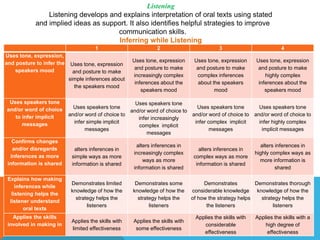
1 2 3 4
Uses tone, expression,
and posture to infer the
speakers mood
Uses tone, expression
and posture to make
simple inferences about
the speakers mood
Uses tone, expression
and posture to make
increasingly complex
inferences about the
speakers mood
Uses tone, expression
and posture to make
complex inferences
about the speakers
mood
Uses tone, expression
and posture to make
highly complex
inferences about the
speakers mood
Uses speakers tone
and/or word of choice
to infer implicit
messages
Uses speakers tone
and/or word of choice to
infer simple implicit
messages
Uses speakers tone
and/or word of choice to
infer increasingly
complex implicit
messages
Uses speakers tone
and/or word of choice to
infer complex implicit
messages
Uses speakers tone
and/or word of choice to
infer highly complex
implicit messages
Confirms changes
and/or disregards
inferences as more
information is shared
alters inferences in
simple ways as more
information is shared
alters inferences in
increasingly complex
ways as more
information is shared
alters inferences in
complex ways as more
information is shared
alters inferences in
highly complex ways as
more information is
shared
Explains how making
inferences while
listening helps the
listener understand
oral texts
Demonstrates limited
knowledge of how the
strategy helps the
listeners
Demonstrates some
knowledge of how the
strategy helps the
listeners
Demonstrates
considerable knowledge
of how the strategy helps
the listeners
Demonstrates thorough
knowledge of how the
strategy helps the
listeners
Applies the skills
involved in making in
Applies the skills with
limited effectiveness
Applies the skills with
some effectiveness
Applies the skills with
considerable
effectiveness
Applies the skills with a
high degree of
effectiveness
Listening
Listening develops and explains interpretation of oral texts using stated
and implied ideas as support. It also identifies helpful strategies to improve
communication skills.
Inferring while Listening
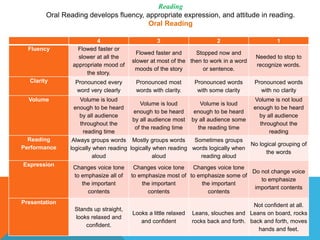
4 3 2 1
Fluency Flowed faster or
slower at all the
appropriate mood of
the story.
Flowed faster and
slower at most of the
moods of the story
Stopped now and
then to work in a word
or sentence.
Needed to stop to
recognize words.
Clarity Pronounced every
word very clearly
Pronounced most
words with clarity.
Pronounced words
with some clarity
Pronounced words
with no clarity
Volume Volume is loud
enough to be heard
by all audience
throughout the
reading time
Volume is loud
enough to be heard
by all audience most
of the reading time
Volume is loud
enough to be heard
by all audience some
the reading time
Volume is not loud
enough to be heard
by all audience
throughout the
reading
Reading
Performance
Always groups words
logically when reading
aloud
Mostly groups words
logically when reading
aloud
Sometimes groups
words logically when
reading aloud
No logical grouping of
the words
Expression
Changes voice tone
to emphasize all of
the important
contents
Changes voice tone
to emphasize most of
the important
contents
Changes voice tone
to emphasize some of
the important
contents
Do not change voice
to emphasize
important contents
Presentation
Stands up straight,
looks relaxed and
confident.
Looks a little relaxed
and confident
Leans, slouches and
rocks back and forth.
Not confident at all.
Leans on board, rocks
back and forth, moves
hands and feet.
Reading
Oral Reading develops fluency, appropriate expression, and attitude in reading.
Oral Reading
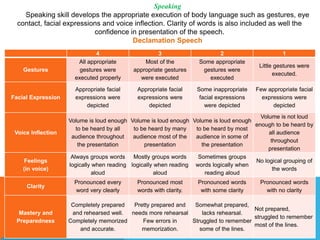
4 3 2 1
Gestures
All appropriate
gestures were
executed properly
Most of the
appropriate gestures
were executed
Some appropriate
gestures were
executed
Little gestures were
executed.
Facial Expression
Appropriate facial
expressions were
depicted
Appropriate facial
expressions were
depicted
Some inappropriate
facial expressions
were depicted
Few appropriate facial
expressions were
depicted
Voice Inflection
Volume is loud enough
to be heard by all
audience throughout
the presentation
Volume is loud enough
to be heard by many
audience most of the
presentation
Volume is loud enough
to be heard by most
audience in some of
the presentation
Volume is not loud
enough to be heard by
all audience
throughout
presentation
Feelings
(in voice)
Always groups words
logically when reading
aloud
Mostly groups words
logically when reading
aloud
Sometimes groups
words logically when
reading aloud
No logical grouping of
the words
Clarity
Pronounced every
word very clearly
Pronounced most
words with clarity.
Pronounced words
with some clarity
Pronounced words
with no clarity
Mastery and
Preparedness
Completely prepared
and rehearsed well.
Completely memorized
and accurate.
Pretty prepared and
needs more rehearsal
Few errors in
memorization.
Somewhat prepared,
lacks rehearsal.
Struggled to remember
some of the lines.
Not prepared,
struggled to remember
most of the lines.
Speaking
Speaking skill develops the appropriate execution of body language such as gestures, eye
contact, facial expressions and voice inflection. Clarity of words is also included as well the
confidence in presentation of the speech.
Declamation Speech
5 3 1
Coherence
There is coherence in each
line and stanza which
connects with the topic.
Most of the lines and
stanzas are coherent, some
ideas sway from the topic.
The poem lines and stanzas
sway from the topic.
Rhythm
All of the stanzas have
rhythm which benefits the
poetic tone.
Most of the stanzas have
rhythm which moderately
benefits the poetic tone.
Only few of the stanzas
have rhythm which
somehow benefits the poetic
tone.
Figurative Language
Uses clear representation of
figurative language
Uses some clear figurative
language
Uses few clear figurative
language
Tone and Mood
Tone and mood is clear and
consistent with the content
of the poem
Tone is clear but mood is
inconsistent.
Tone and mood is unclear.
Writing
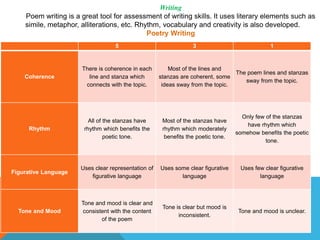
Poem writing is a great tool for assessment of writing skills. It uses literary elements such as
simile, metaphor, alliterations, etc. Rhythm, vocabulary and creativity is also developed.
Poetry Writing
5 3 1
Values
Identifies all of the values
presented in the viewed
film.
Identifies most of the values
presented in the viewed
film.
Identifies few of the values
presented in the viewed
film.
Connections
States clear connection
between information viewed
and personal experiences.
States slight connection
between information viewed
and personal experiences.
Does not state connection
between information viewed
and personal experiences.
Summary
Summarizes
comprehensively the
information conveyed.
Summarizes partially the
information conveyed.
Summarizes incompletely
the information conveyed.
Coherence
Coherence of the ideas is
presented well.
Coherence of the ideas is
presented
Some ideas are not
coherent.
Viewing
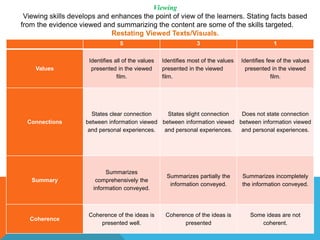
Viewing skills develops and enhances the point of view of the learners. Stating facts based
from the evidence viewed and summarizing the content are some of the skills targeted.
Restating Viewed Texts/Visuals.

Strategies and Assessment Tools

  • 1.
    JINKY MARIE C.MASINSIN MAT- English
  • 2.
    1 2 34 Uses tone, expression, and posture to infer the speakers mood Uses tone, expression and posture to make simple inferences about the speakers mood Uses tone, expression and posture to make increasingly complex inferences about the speakers mood Uses tone, expression and posture to make complex inferences about the speakers mood Uses tone, expression and posture to make highly complex inferences about the speakers mood Uses speakers tone and/or word of choice to infer implicit messages Uses speakers tone and/or word of choice to infer simple implicit messages Uses speakers tone and/or word of choice to infer increasingly complex implicit messages Uses speakers tone and/or word of choice to infer complex implicit messages Uses speakers tone and/or word of choice to infer highly complex implicit messages Confirms changes and/or disregards inferences as more information is shared alters inferences in simple ways as more information is shared alters inferences in increasingly complex ways as more information is shared alters inferences in complex ways as more information is shared alters inferences in highly complex ways as more information is shared Explains how making inferences while listening helps the listener understand oral texts Demonstrates limited knowledge of how the strategy helps the listeners Demonstrates some knowledge of how the strategy helps the listeners Demonstrates considerable knowledge of how the strategy helps the listeners Demonstrates thorough knowledge of how the strategy helps the listeners Applies the skills involved in making in Applies the skills with limited effectiveness Applies the skills with some effectiveness Applies the skills with considerable effectiveness Applies the skills with a high degree of effectiveness Listening Listening develops and explains interpretation of oral texts using stated and implied ideas as support. It also identifies helpful strategies to improve communication skills. Inferring while Listening
  • 3.
    4 3 21 Fluency Flowed faster or slower at all the appropriate mood of the story. Flowed faster and slower at most of the moods of the story Stopped now and then to work in a word or sentence. Needed to stop to recognize words. Clarity Pronounced every word very clearly Pronounced most words with clarity. Pronounced words with some clarity Pronounced words with no clarity Volume Volume is loud enough to be heard by all audience throughout the reading time Volume is loud enough to be heard by all audience most of the reading time Volume is loud enough to be heard by all audience some the reading time Volume is not loud enough to be heard by all audience throughout the reading Reading Performance Always groups words logically when reading aloud Mostly groups words logically when reading aloud Sometimes groups words logically when reading aloud No logical grouping of the words Expression Changes voice tone to emphasize all of the important contents Changes voice tone to emphasize most of the important contents Changes voice tone to emphasize some of the important contents Do not change voice to emphasize important contents Presentation Stands up straight, looks relaxed and confident. Looks a little relaxed and confident Leans, slouches and rocks back and forth. Not confident at all. Leans on board, rocks back and forth, moves hands and feet. Reading Oral Reading develops fluency, appropriate expression, and attitude in reading. Oral Reading
  • 4.
    4 3 21 Gestures All appropriate gestures were executed properly Most of the appropriate gestures were executed Some appropriate gestures were executed Little gestures were executed. Facial Expression Appropriate facial expressions were depicted Appropriate facial expressions were depicted Some inappropriate facial expressions were depicted Few appropriate facial expressions were depicted Voice Inflection Volume is loud enough to be heard by all audience throughout the presentation Volume is loud enough to be heard by many audience most of the presentation Volume is loud enough to be heard by most audience in some of the presentation Volume is not loud enough to be heard by all audience throughout presentation Feelings (in voice) Always groups words logically when reading aloud Mostly groups words logically when reading aloud Sometimes groups words logically when reading aloud No logical grouping of the words Clarity Pronounced every word very clearly Pronounced most words with clarity. Pronounced words with some clarity Pronounced words with no clarity Mastery and Preparedness Completely prepared and rehearsed well. Completely memorized and accurate. Pretty prepared and needs more rehearsal Few errors in memorization. Somewhat prepared, lacks rehearsal. Struggled to remember some of the lines. Not prepared, struggled to remember most of the lines. Speaking Speaking skill develops the appropriate execution of body language such as gestures, eye contact, facial expressions and voice inflection. Clarity of words is also included as well the confidence in presentation of the speech. Declamation Speech
  • 5.
    5 3 1 Coherence Thereis coherence in each line and stanza which connects with the topic. Most of the lines and stanzas are coherent, some ideas sway from the topic. The poem lines and stanzas sway from the topic. Rhythm All of the stanzas have rhythm which benefits the poetic tone. Most of the stanzas have rhythm which moderately benefits the poetic tone. Only few of the stanzas have rhythm which somehow benefits the poetic tone. Figurative Language Uses clear representation of figurative language Uses some clear figurative language Uses few clear figurative language Tone and Mood Tone and mood is clear and consistent with the content of the poem Tone is clear but mood is inconsistent. Tone and mood is unclear. Writing Poem writing is a great tool for assessment of writing skills. It uses literary elements such as simile, metaphor, alliterations, etc. Rhythm, vocabulary and creativity is also developed. Poetry Writing
  • 6.
    5 3 1 Values Identifiesall of the values presented in the viewed film. Identifies most of the values presented in the viewed film. Identifies few of the values presented in the viewed film. Connections States clear connection between information viewed and personal experiences. States slight connection between information viewed and personal experiences. Does not state connection between information viewed and personal experiences. Summary Summarizes comprehensively the information conveyed. Summarizes partially the information conveyed. Summarizes incompletely the information conveyed. Coherence Coherence of the ideas is presented well. Coherence of the ideas is presented Some ideas are not coherent. Viewing Viewing skills develops and enhances the point of view of the learners. Stating facts based from the evidence viewed and summarizing the content are some of the skills targeted. Restating Viewed Texts/Visuals.