1
ChE 512
Transport Effects in Chemical Reactors
PART 2
Module 1
Introduction to Heterogeneous Reactors
and Application Areas
P.A. Ramachandran
rama@wustl.edu
2
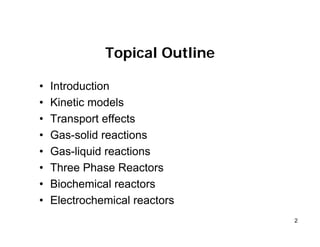
Topical Outline
• Introduction
• Kinetic models
• Transport effects
• Gas-solid reactions
• Gas-liquid reactions
• Three Phase Reactors
• Biochemical reactors
• Electrochemical reactors
3
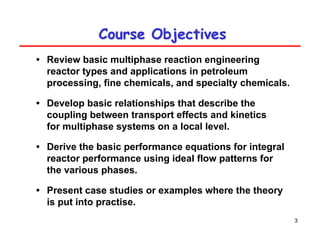
Course Objectives
Course Objectives
• Review basic multiphase reaction engineering
reactor types and applications in petroleum
processing, fine chemicals, and specialty chemicals.
• Develop basic relationships that describe the
coupling between transport effects and kinetics
for multiphase systems on a local level.
• Derive the basic performance equations for integral
reactor performance using ideal flow patterns for
the various phases.
• Present case studies or examples where the theory
is put into practise.
4
Module 1 Outline
• Industrial Applications and Examples
• Review of Common Reactor Types
• Guidelines for Reactor Selection
5
Starting References
Starting References
1. Doraiswamy L.K. and Sharma. M. M. Heterogenous
Reactions,
2. P. A. Ramachandran and R. V. Chaudhari,
Three-Phase Catalytic Reactors, Gordon & Breach,
London (1983).
3. P. L. Mills, P. A. Ramachandran, and R. V. Chaudhari,
Reviews in Chemical Engineering, 8, pp. 1-192 (1992).
4. P. L. Mills and R. V. Chaudhari, “Multiphase catalytic
reactor engineering and design for pharmaceuticals
and fine chemicals,” Catalysis Today, 37(4), pp. 367-404
(1997).
6
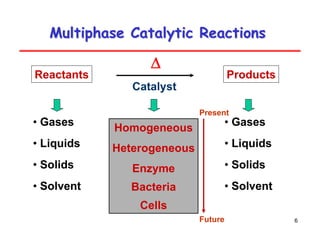
Multiphase Catalytic Reactions
Reactants Products
Catalyst
Δ
• Gases
• Liquids
• Solids
• Solvent
• Gases
• Liquids
• Solids
• Solvent
Homogeneous
Heterogeneous
Enzyme
Bacteria
Cells
Present
Future
7
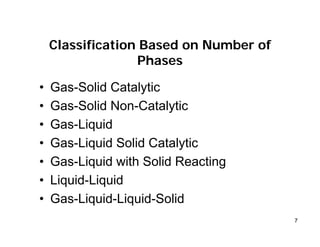
Classification Based on Number of
Phases
• Gas-Solid Catalytic
• Gas-Solid Non-Catalytic
• Gas-Liquid
• Gas-Liquid Solid Catalytic
• Gas-Liquid with Solid Reacting
• Liquid-Liquid
• Gas-Liquid-Liquid-Solid
8
Some Examples of
Some Examples of
Multiphase Catalytic Processes
• Hydrogenation of specialty chemicals
• Oxidation of glucose to gluconic acid
• Oxidation of n-paraffins to alcohols
• Methanol synthesis
• Fischer-Tropsch (FT) synthesis
• Hydrodesulfurization (HDS) of heavy
residuals
• Adiponitrile synthesis
• Production of animal cells
• Fermentation processes
9
Other Emerging
Other Emerging
Multiphase Catalytic Technologies
• Catalysis by water soluble metal complexes in
biphasic and nonionic liquid media
• Reactions in supercritical fluid media
• Asymmetric catalysis for chiral drugs/agrichemicals
• Polymerization with precipitating products
(e.g., Polyketones)
• Phase transfer catalysis
• Catalysis by adhesion of metal particles to
liquid-liquid interfaces
• Catalysis by nano-particles and encapsulation of
metal complexes
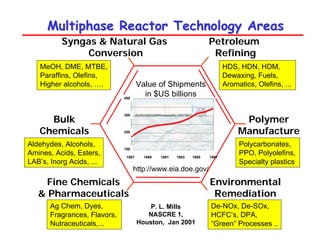
Multiphase Reactor Technology Areas
Petroleum
Refining
Polymer
Manufacture
Environmental
Remediation
Syngas & Natural Gas
Conversion
Bulk
Chemicals
Fine Chemicals
& Pharmaceuticals
HDS, HDN, HDM,
Dewaxing, Fuels,
Aromatics, Olefins, ...
MeOH, DME, MTBE,
Paraffins, Olefins,
Higher alcohols, ….
Aldehydes, Alcohols,
Amines, Acids, Esters,
LAB’s, Inorg Acids, ...
Ag Chem, Dyes,
Fragrances, Flavors,
Nutraceuticals,...
Polycarbonates,
PPO, Polyolefins,
Specialty plastics
De-NOx, De-SOx,
HCFC’s, DPA,
“Green” Processes ..
P. L. Mills
NASCRE 1,
Houston, Jan 2001
Value of Shipments
in $US billions
http://www.eia.doe.gov/
350
150
450
250
1987 1989 1995 1997
1991 1993
11
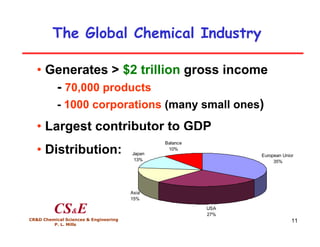
The Global Chemical Industry
CR&D Chemical Sciences & Engineering
P. L. Mills
CS&E
• Generates > $2 trillion gross income
- 70,000 products
- 1000 corporations (many small ones)
• Largest contributor to GDP
• Distribution: European Union
35%
USA
27%
Asia
15%
Japan
13%
Balance
10%
12
Multiphase Catalytic Reactions
-
- Business Drivers
Business Drivers -
-
• Increased globalization of markets
• Societal demands for higher environmental performance
• Financial market demands for increased profitabilty
and capital productivity
• Higher customer expectations
• Changing work force requirements
Technology Vision 2020, The US Chemical Industry, Dec. 1996
http://www.eere.energy.gov/industry/chemicals/pdfs/chem_vision.pdf
13
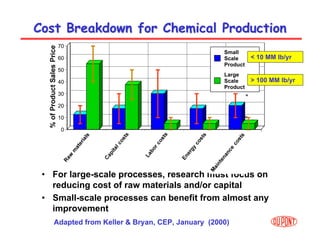
Cost Breakdown for Chemical Production
• For large-scale processes, research must focus on
reducing cost of raw materials and/or capital
• Small-scale processes can benefit from almost any
improvement
0
10
20
30
40
50
60
70
Small
Scale
Product
Large
Scale
Product
< 10 MM lb/yr
*
*
Adapted from Keller & Bryan, CEP, January (2000)
> 100 MM lb/yr
14
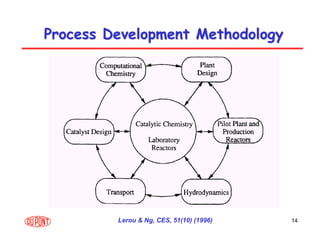
Process Development Methodology
Lerou & Ng, CES, 51(10) (1996)
15
Oxidation of
Oxidation of p
p-
-Xylene
Xylene to Terephthalic Acid
to Terephthalic Acid
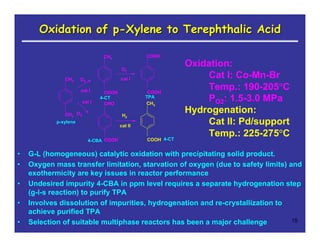
• G-L (homogeneous) catalytic oxidation with precipitating solid product.
• Oxygen mass transfer limitation, starvation of oxygen (due to safety limits) and
exothermicity are key issues in reactor performance
• Undesired impurity 4-CBA in ppm level requires a separate hydrogenation step
(g-l-s reaction) to purify TPA
• Involves dissolution of impurities, hydrogenation and re-crystallization to
achieve purified TPA
• Selection of suitable multiphase reactors has been a major challenge
CH3
COOH
CH3
CH3
CH3
COOH
CHO
COOH
COOH
COOH
O2
cat I
O2
cat I
O2
cat I
H2
cat II
p-xylene
4-CT
4-CBA
TPA
4-CT
Oxidation:
Cat I: Co-Mn-Br
Temp.: 190-205°C
PO2: 1.5-3.0 MPa
Hydrogenation:
Cat II: Pd/support
Temp.: 225-275°C
16
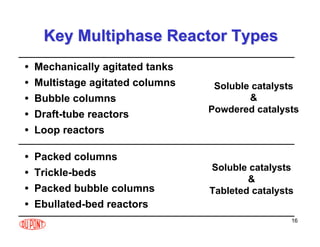
Key Multiphase Reactor Types
• Mechanically agitated tanks
• Multistage agitated columns
• Bubble columns
• Draft-tube reactors
• Loop reactors
Soluble catalysts
&
Powdered catalysts
Soluble catalysts
&
Tableted catalysts
• Packed columns
• Trickle-beds
• Packed bubble columns
• Ebullated-bed reactors
17
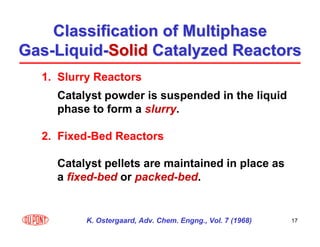
Classification of Multiphase
Gas
Gas-
-Liquid
Liquid-
-Solid
Solid Catalyzed Reactors
Catalyzed Reactors
1. Slurry Reactors
Catalyst powder is suspended in the liquid
phase to form a slurry.
2. Fixed-Bed Reactors
Catalyst pellets are maintained in place as
a fixed-bed or packed-bed.
K. Ostergaard, Adv. Chem. Engng., Vol. 7 (1968)
18
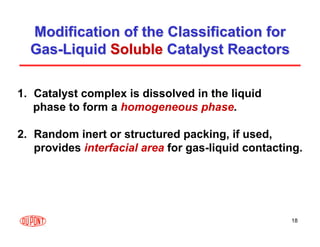
Modification of the Classification for
Gas
Gas-
-Liquid
Liquid Soluble
Soluble Catalyst Reactors
Catalyst Reactors
1. Catalyst complex is dissolved in the liquid
phase to form a homogeneous phase.
2. Random inert or structured packing, if used,
provides interfacial area for gas-liquid contacting.
19
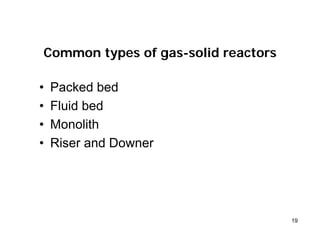
Common types of gas-solid reactors
• Packed bed
• Fluid bed
• Monolith
• Riser and Downer
20
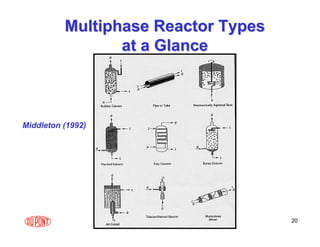
Multiphase Reactor Types
at a Glance
at a Glance
Middleton (1992)
21
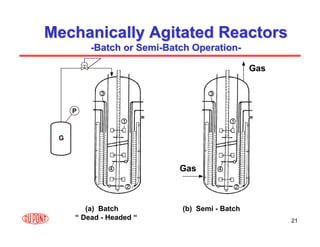
Mechanically Agitated Reactors
-
-Batch or Semi
Batch or Semi-
-Batch Operation
Batch Operation-
-
(a) Batch (b) Semi - Batch
“ Dead - Headed “
Gas
Gas
P
G
22
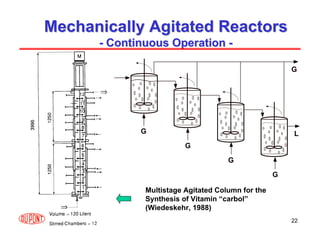
Mechanically Agitated Reactors
-
- Continuous Operation
Continuous Operation -
-
G
G
G
L
G
L
G
Multistage Agitated Column for the
Synthesis of Vitamin “carbol”
(Wiedeskehr, 1988)
23
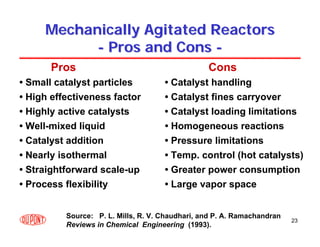
Mechanically Agitated Reactors
-
- Pros and Cons
Pros and Cons -
-
Pros Cons
• Small catalyst particles • Catalyst handling
• High effectiveness factor • Catalyst fines carryover
• Highly active catalysts • Catalyst loading limitations
• Well-mixed liquid • Homogeneous reactions
• Catalyst addition • Pressure limitations
• Nearly isothermal • Temp. control (hot catalysts)
• Straightforward scale-up • Greater power consumption
• Process flexibility • Large vapor space
Source: P. L. Mills, R. V. Chaudhari, and P. A. Ramachandran
Reviews in Chemical Engineering (1993).
24
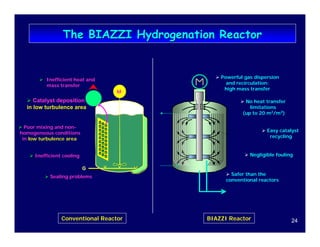
The BIAZZI Hydrogenation Reactor
G
G
M
¾ Inefficient cooling
¾ Catalyst deposition
in low turbulence area
¾ Sealing problems
¾ Poor mixing and non-
homogeneous conditions
in low turbulence area
¾ Inefficient heat and
mass transfer
¾ Powerful gas dispersion
and recirculation:
high mass transfer
¾ No heat transfer
limitations
(up to 20 m2
/m3
)
¾ Negligible fouling
¾ Safer than the
conventional reactors
¾ Easy catalyst
recycling
Conventional Reactor BIAZZI Reactor
25
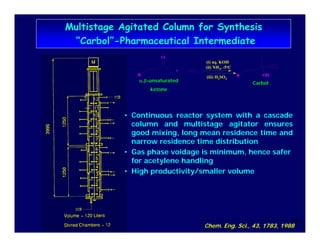
Multistage Agitated Column for Synthesis
“Carbol”
“Carbol”-
-Pharmaceutical Intermediate
Pharmaceutical Intermediate
• Continuous reactor system with a cascade
column and multistage agitator ensures
good mixing, long mean residence time and
narrow residence time distribution
• Gas phase voidage is minimum, hence safer
for acetylene handling
• High productivity/smaller volume
Chem. Eng. Sci., 43, 1783, 1988
R
O
+
(i) aq. KOH
(ii) NH3, -5oC
R OH
(iii) H2SO4
α,β-unsaturated
ketone
Carbol
26
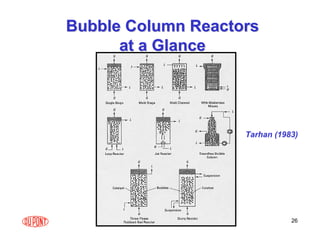
Bubble Column Reactors
at a Glance
at a Glance
Tarhan (1983)
27
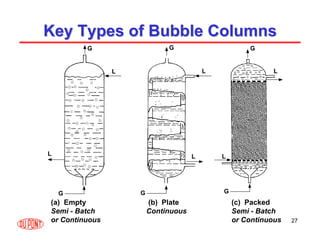
Key Types of Bubble Columns
G G G
G G G
L
L L L
L L
(a) Empty (b) Plate (c) Packed
Semi - Batch Continuous Semi - Batch
or Continuous or Continuous
28
Bubble Column Reactors
-
- Pros and Cons
Pros and Cons -
-
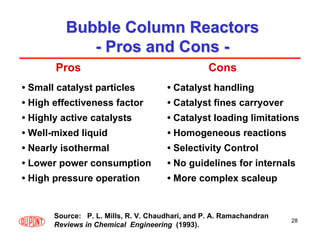
Pros Cons
• Small catalyst particles • Catalyst handling
• High effectiveness factor • Catalyst fines carryover
• Highly active catalysts • Catalyst loading limitations
• Well-mixed liquid • Homogeneous reactions
• Nearly isothermal • Selectivity Control
• Lower power consumption • No guidelines for internals
• High pressure operation • More complex scaleup
Source: P. L. Mills, R. V. Chaudhari, and P. A. Ramachandran
Reviews in Chemical Engineering (1993).
29
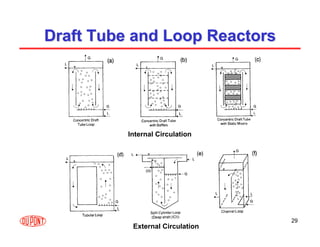
Draft Tube and Loop Reactors
Internal Circulation
External Circulation
30
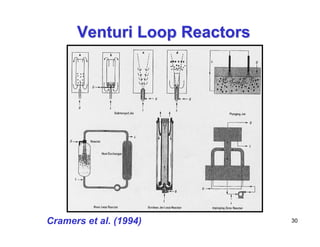
Venturi
Venturi Loop Reactors
Loop Reactors
Cramers et al. (1994)
31
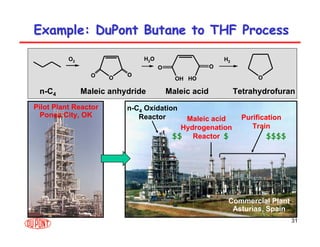
O
O
O
OH HO
O
O
O
O2
H2O H2
n-C4 Maleic anhydride Maleic acid Tetrahydrofuran
Example: DuPont Butane to THF Process
Pilot Plant Reactor
Ponca City, OK
n-C4 Oxidation
Reactor Maleic acid
Hydrogenation
Reactor
Purification
Train
Commercial Plant
Asturias, Spain
$$$$
$
$$
32
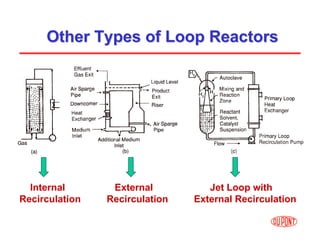
Other Types of Loop Reactors
Internal External Jet Loop with
Recirculation Recirculation External Recirculation
33
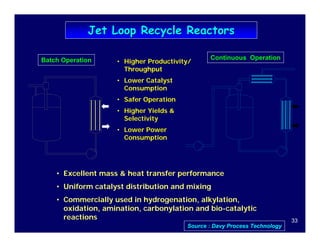
Jet Loop Recycle Reactors
Batch Operation Continuous Operation
• Excellent mass & heat transfer performance
• Uniform catalyst distribution and mixing
• Commercially used in hydrogenation, alkylation,
oxidation, amination, carbonylation and bio-catalytic
reactions
• Higher Productivity/
Throughput
• Lower Catalyst
Consumption
• Safer Operation
• Higher Yields &
Selectivity
• Lower Power
Consumption
Source : Davy Process Technology
34
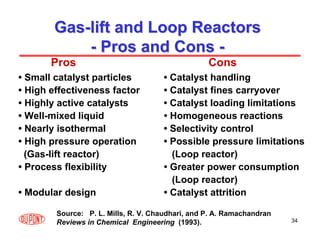
Gas
Gas-
-lift and Loop Reactors
lift and Loop Reactors
-
- Pros and Cons
Pros and Cons -
-
Pros Cons
• Small catalyst particles • Catalyst handling
• High effectiveness factor • Catalyst fines carryover
• Highly active catalysts • Catalyst loading limitations
• Well-mixed liquid • Homogeneous reactions
• Nearly isothermal • Selectivity control
• High pressure operation • Possible pressure limitations
(Gas-lift reactor) (Loop reactor)
• Process flexibility • Greater power consumption
(Loop reactor)
• Modular design • Catalyst attrition
Source: P. L. Mills, R. V. Chaudhari, and P. A. Ramachandran
Reviews in Chemical Engineering (1993).
35
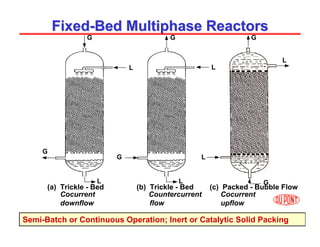
Fixed
Fixed-
-Bed Multiphase Reactors
Bed Multiphase Reactors
L L
L
L L
G
G G G
G
L
G
Semi-Batch or Continuous Operation; Inert or Catalytic Solid Packing
(a) Trickle - Bed (b) Trickle - Bed (c) Packed - Bubble Flow
Cocurrent Countercurrent Cocurrent
downflow flow upflow
36
Trickle Bed Reactors
-
- Advantages
Advantages -
-
• Plug flow of gas and liquid
• High catalyst / liquid ratio
• Stationary catalyst
• Minimal catalyst handling problems
• Operating mode flexibility
• High pressure operation
• Heat of reaction used to volatize liquid
• Large turndown ratio
• Low dissipated power
• Lower capital and operating costs
37
• Larger particles, low catalyst effectiveness
• Possible poor liquid - solid contacting
• High crushing strength required for small particles
• Potential for reactor runaway
• Long catalyst life required
• Inability to handle dirty feeds
• Potential for liquid maldistribution
• More difficult to scale - up
Trickle Bed Reactors
-
- Disadvantages
Disadvantages -
-
38
Packed Bubble Flow Reactors
-
- Advantages
Advantages -
-
• Complete liquid - solid contacting
• Higher liquid holdup
• Better temperature control
• Less problems with liquid maldisdribution
• Higher heat and mass transfer rates
39
Packed Bubble Flow Reactors
-
- Disadvantages
Disadvantages -
-
• Higher dissipated power than in TBR
• Throughput limited by bed fluidization velocity
• Increased potential for runaway
• Promotion of undesired homogeneous reactions
• Greater pressure drop
40
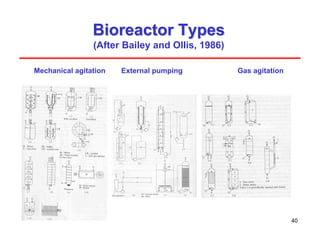
Bioreactor Types
Bioreactor Types
(After Bailey and Ollis, 1986)
Mechanical agitation External pumping Gas agitation
41
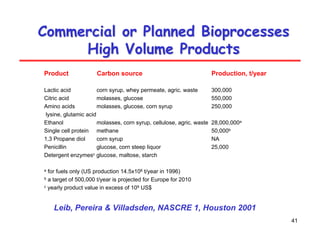
Commercial or Planned Bioprocesses
High Volume Products
Product Carbon source Production, t/year
Lactic acid corn syrup, whey permeate, agric. waste 300,000
Citric acid molasses, glucose 550,000
Amino acids molasses, glucose, corn syrup 250,000
lysine, glutamic acid
Ethanol molasses, corn syrup, cellulose, agric. waste 28,000,000a
Single cell protein methane 50,000b
1,3 Propane diol corn syrup NA
Penicillin glucose, corn steep liquor 25,000
Detergent enzymesc glucose, maltose, starch
a for fuels only (US production 14.5x10⁶ t/year in 1996)
b a target of 500,000 t/year is projected for Europe for 2010
c yearly product value in excess of 109 US$
Leib, Pereira & Villadsden, NASCRE 1, Houston 2001
42
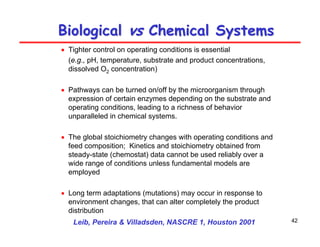
Biological
Biological vs
vs Chemical Systems
Chemical Systems
• Tighter control on operating conditions is essential
(e.g., pH, temperature, substrate and product concentrations,
dissolved O2 concentration)
• Pathways can be turned on/off by the microorganism through
expression of certain enzymes depending on the substrate and
operating conditions, leading to a richness of behavior
unparalleled in chemical systems.
• The global stoichiometry changes with operating conditions and
feed composition; Kinetics and stoichiometry obtained from
steady-state (chemostat) data cannot be used reliably over a
wide range of conditions unless fundamental models are
employed
• Long term adaptations (mutations) may occur in response to
environment changes, that can alter completely the product
distribution
Leib, Pereira & Villadsden, NASCRE 1, Houston 2001
43
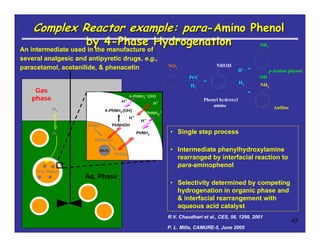
Complex Reactor example:
Complex Reactor example: para
para-
-Amino Phenol
Amino Phenol
by 4
by 4-
-Phase Hydrogenation
Phase Hydrogenation
• Single step process
• Intermediate phenylhydroxylamine
rearranged by interfacial reaction to
para-aminophenol
• Selectivity determined by competing
hydrogenation in organic phase and
& interfacial rearrangement with
aqueous acid catalyst
PhNH3
+
Aq. Phase
Org. Phase
Pt/C
Gas
phase
PhNO2
PhNHOH
PhNH2
PhNHOH
4-PhNH2(OH)
H+
H+
PhNH2
4-PhNH3
+(OH)
H+
H2
H2
H+
PhNH3
+
H+
H2
NO2
NHOH
NH2
NH2
OH
H2
Pt/C
Phenyl hydroxyl
amine
p-Amino phenol
Aniline
R.V. Chaudhari et al., CES, 56, 1299, 2001
An intermediate used in the manufacture of
several analgesic and antipyretic drugs, e.g.,
paracetamol, acetanilide, & phenacetin
P. L. Mills, CAMURE-5, June 2005
44
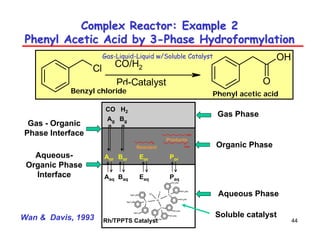
Complex Reactor: Example 2
Phenyl Acetic Acid by 3
Phenyl Acetic Acid by 3-
-Phase Hydroformylation
Phase Hydroformylation
CHO
CHO
Products
Reactant
CO H2
Rh
P
SO3Na
SO3Na
SO3Na
P
NaO3S
NaO3S
NaO 3S
P
SO3Na
SO3Na
SO3Na
OC
H
Rh/TPPTS Catalyst
Gas Phase
Aor Bor Eor Por
Ag Bg
Organic Phase
Aqueous Phase
Aaq Baq Eaq Paq
Gas - Organic
Phase Interface
Aqueous-
Organic Phase
Interface
Soluble catalyst
Cl CO/H2
Pd-Catalyst
OH
O
Benzyl chloride Phenyl acetic acid
Wan & Davis, 1993
Gas
Gas-
-Liquid
Liquid-
-Liquid w/Soluble Catalyst
Liquid w/Soluble Catalyst
45
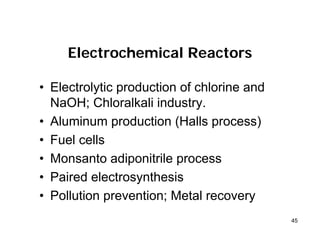
Electrochemical Reactors
• Electrolytic production of chlorine and
NaOH; Chloralkali industry.
• Aluminum production (Halls process)
• Fuel cells
• Monsanto adiponitrile process
• Paired electrosynthesis
• Pollution prevention; Metal recovery
46
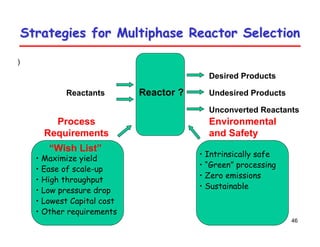
Strategies for Multiphase Reactor Selection
• Maximize yield
• Ease of scale-up
• High throughput
• Low pressure drop
• Lowest Capital cost
• Other requirements
Process
Requirements
Reactor ?
Reactants
• Intrinsically safe
• “Green” processing
• Zero emissions
• Sustainable
Desired Products
Undesired Products
Unconverted Reactants
Environmental
and Safety
)
“Wish List”
47
Summary: Distinguishing Features
of Multiphase Reactors
• Efficient contacting of reactive phases and
separation of product phases is key to safety,
operability and performance
• Various flow regimes exist, depending on phase
flow rates, phase properties, operating conditions,
and geometry
• Reaction and interphase transport time-scales, and
phase flow patterns dictate reactor type, geometry
and scale
• Gradual scale-up over several scales may be
required for reliable commercialization
48
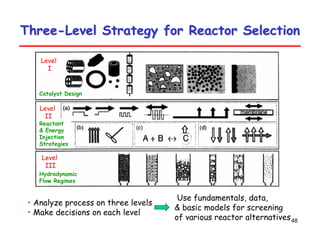
Three
Three-
-Level Strategy for Reactor Selection
Level Strategy for Reactor Selection
Level
I
Level
I
Level
II
Level
III
Catalyst Design
Reactant
& Energy
Injection
Strategies
Hydrodynamic
Flow Regimes
• Analyze process on three levels
• Make decisions on each level
Use fundamentals, data,
& basic models for screening
of various reactor alternatives
49
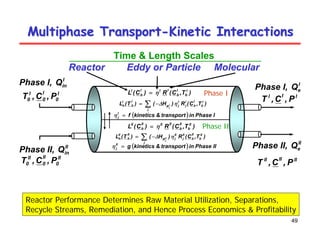
Multiphase Transport
Multiphase Transport-
-Kinetic Interactions
Kinetic Interactions
)
T
,
C
(
R
)
C
(
L I
b
I
b
I
I
I
b
I
η
=
∑ −
=
j
I
b
I
b
I
j
I
j
R
I
b
I
h )
T
,
C
(
R
)
H
(
)
T
(
L I
j
η
Δ
( ) I
Phase
in
transport
&
kinetics
f
I
j =
η
I
0
I
0
I
0 P
,
C
,
T
Time & Length Scales
Reactor Eddy or Particle Molecular
II
0
II
0
II
0 P
,
C
,
T
)
T
,
C
(
R
)
C
(
L II
b
II
b
II
II
II
b
II
η
=
∑ −
=
j
II
b
II
b
II
j
II
j
R
II
b
II
h )
T
,
C
(
R
)
H
(
)
T
(
L II
j
η
Δ
( ) II
Phase
in
transport
&
kinetics
g
II
j =
η
I
I
I
P
,
C
,
T
II
II
II
P
,
C
,
T
Phase II
Phase I
I
e
Q
I,
Phase
II
e
Q
II,
Phase
II
in
Q
II,
Phase
I
in
Q
I,
Phase
Reactor Performance Determines Raw Material Utilization, Separations,
Recycle Streams, Remediation, and Hence Process Economics & Profitability

Catalyrtic Reactors PPT.pdf

  • 1.
    1 ChE 512 Transport Effectsin Chemical Reactors PART 2 Module 1 Introduction to Heterogeneous Reactors and Application Areas P.A. Ramachandran rama@wustl.edu
  • 2.
    2 Topical Outline • Introduction •Kinetic models • Transport effects • Gas-solid reactions • Gas-liquid reactions • Three Phase Reactors • Biochemical reactors • Electrochemical reactors
  • 3.
    3 Course Objectives Course Objectives •Review basic multiphase reaction engineering reactor types and applications in petroleum processing, fine chemicals, and specialty chemicals. • Develop basic relationships that describe the coupling between transport effects and kinetics for multiphase systems on a local level. • Derive the basic performance equations for integral reactor performance using ideal flow patterns for the various phases. • Present case studies or examples where the theory is put into practise.
  • 4.
    4 Module 1 Outline •Industrial Applications and Examples • Review of Common Reactor Types • Guidelines for Reactor Selection
  • 5.
    5 Starting References Starting References 1.Doraiswamy L.K. and Sharma. M. M. Heterogenous Reactions, 2. P. A. Ramachandran and R. V. Chaudhari, Three-Phase Catalytic Reactors, Gordon & Breach, London (1983). 3. P. L. Mills, P. A. Ramachandran, and R. V. Chaudhari, Reviews in Chemical Engineering, 8, pp. 1-192 (1992). 4. P. L. Mills and R. V. Chaudhari, “Multiphase catalytic reactor engineering and design for pharmaceuticals and fine chemicals,” Catalysis Today, 37(4), pp. 367-404 (1997).
  • 6.
    6 Multiphase Catalytic Reactions MultiphaseCatalytic Reactions Reactants Products Catalyst Δ • Gases • Liquids • Solids • Solvent • Gases • Liquids • Solids • Solvent Homogeneous Heterogeneous Enzyme Bacteria Cells Present Future
  • 7.
    7 Classification Based onNumber of Phases • Gas-Solid Catalytic • Gas-Solid Non-Catalytic • Gas-Liquid • Gas-Liquid Solid Catalytic • Gas-Liquid with Solid Reacting • Liquid-Liquid • Gas-Liquid-Liquid-Solid
  • 8.
    8 Some Examples of SomeExamples of Multiphase Catalytic Processes Multiphase Catalytic Processes • Hydrogenation of specialty chemicals • Oxidation of glucose to gluconic acid • Oxidation of n-paraffins to alcohols • Methanol synthesis • Fischer-Tropsch (FT) synthesis • Hydrodesulfurization (HDS) of heavy residuals • Adiponitrile synthesis • Production of animal cells • Fermentation processes
  • 9.
    9 Other Emerging Other Emerging MultiphaseCatalytic Technologies Multiphase Catalytic Technologies • Catalysis by water soluble metal complexes in biphasic and nonionic liquid media • Reactions in supercritical fluid media • Asymmetric catalysis for chiral drugs/agrichemicals • Polymerization with precipitating products (e.g., Polyketones) • Phase transfer catalysis • Catalysis by adhesion of metal particles to liquid-liquid interfaces • Catalysis by nano-particles and encapsulation of metal complexes
  • 10.
    Multiphase Reactor TechnologyAreas Multiphase Reactor Technology Areas Petroleum Refining Polymer Manufacture Environmental Remediation Syngas & Natural Gas Conversion Bulk Chemicals Fine Chemicals & Pharmaceuticals HDS, HDN, HDM, Dewaxing, Fuels, Aromatics, Olefins, ... MeOH, DME, MTBE, Paraffins, Olefins, Higher alcohols, …. Aldehydes, Alcohols, Amines, Acids, Esters, LAB’s, Inorg Acids, ... Ag Chem, Dyes, Fragrances, Flavors, Nutraceuticals,... Polycarbonates, PPO, Polyolefins, Specialty plastics De-NOx, De-SOx, HCFC’s, DPA, “Green” Processes .. P. L. Mills NASCRE 1, Houston, Jan 2001 Value of Shipments in $US billions http://www.eia.doe.gov/ 350 150 450 250 1987 1989 1995 1997 1991 1993
  • 11.
    11 The Global ChemicalIndustry CR&D Chemical Sciences & Engineering P. L. Mills CS&E • Generates > $2 trillion gross income - 70,000 products - 1000 corporations (many small ones) • Largest contributor to GDP • Distribution: European Union 35% USA 27% Asia 15% Japan 13% Balance 10%
  • 12.
    12 Multiphase Catalytic Reactions MultiphaseCatalytic Reactions - - Business Drivers Business Drivers - - • Increased globalization of markets • Societal demands for higher environmental performance • Financial market demands for increased profitabilty and capital productivity • Higher customer expectations • Changing work force requirements Technology Vision 2020, The US Chemical Industry, Dec. 1996 http://www.eere.energy.gov/industry/chemicals/pdfs/chem_vision.pdf
  • 13.
    13 Cost Breakdown forChemical Production Cost Breakdown for Chemical Production • For large-scale processes, research must focus on reducing cost of raw materials and/or capital • Small-scale processes can benefit from almost any improvement 0 10 20 30 40 50 60 70 Small Scale Product Large Scale Product < 10 MM lb/yr * * Adapted from Keller & Bryan, CEP, January (2000) > 100 MM lb/yr
  • 14.
    14 Process Development Methodology ProcessDevelopment Methodology Lerou & Ng, CES, 51(10) (1996)
  • 15.
    15 Oxidation of Oxidation ofp p- -Xylene Xylene to Terephthalic Acid to Terephthalic Acid • G-L (homogeneous) catalytic oxidation with precipitating solid product. • Oxygen mass transfer limitation, starvation of oxygen (due to safety limits) and exothermicity are key issues in reactor performance • Undesired impurity 4-CBA in ppm level requires a separate hydrogenation step (g-l-s reaction) to purify TPA • Involves dissolution of impurities, hydrogenation and re-crystallization to achieve purified TPA • Selection of suitable multiphase reactors has been a major challenge CH3 COOH CH3 CH3 CH3 COOH CHO COOH COOH COOH O2 cat I O2 cat I O2 cat I H2 cat II p-xylene 4-CT 4-CBA TPA 4-CT Oxidation: Cat I: Co-Mn-Br Temp.: 190-205°C PO2: 1.5-3.0 MPa Hydrogenation: Cat II: Pd/support Temp.: 225-275°C
  • 16.
    16 Key Multiphase ReactorTypes Key Multiphase Reactor Types • Mechanically agitated tanks • Multistage agitated columns • Bubble columns • Draft-tube reactors • Loop reactors Soluble catalysts & Powdered catalysts Soluble catalysts & Tableted catalysts • Packed columns • Trickle-beds • Packed bubble columns • Ebullated-bed reactors
  • 17.
    17 Classification of Multiphase Classificationof Multiphase Gas Gas- -Liquid Liquid- -Solid Solid Catalyzed Reactors Catalyzed Reactors 1. Slurry Reactors Catalyst powder is suspended in the liquid phase to form a slurry. 2. Fixed-Bed Reactors Catalyst pellets are maintained in place as a fixed-bed or packed-bed. K. Ostergaard, Adv. Chem. Engng., Vol. 7 (1968)
  • 18.
    18 Modification of theClassification for Modification of the Classification for Gas Gas- -Liquid Liquid Soluble Soluble Catalyst Reactors Catalyst Reactors 1. Catalyst complex is dissolved in the liquid phase to form a homogeneous phase. 2. Random inert or structured packing, if used, provides interfacial area for gas-liquid contacting.
  • 19.
    19 Common types ofgas-solid reactors • Packed bed • Fluid bed • Monolith • Riser and Downer
  • 20.
    20 Multiphase Reactor Types MultiphaseReactor Types at a Glance at a Glance Middleton (1992)
  • 21.
    21 Mechanically Agitated Reactors MechanicallyAgitated Reactors - -Batch or Semi Batch or Semi- -Batch Operation Batch Operation- - (a) Batch (b) Semi - Batch “ Dead - Headed “ Gas Gas P G
  • 22.
    22 Mechanically Agitated Reactors MechanicallyAgitated Reactors - - Continuous Operation Continuous Operation - - G G G L G L G Multistage Agitated Column for the Synthesis of Vitamin “carbol” (Wiedeskehr, 1988)
  • 23.
    23 Mechanically Agitated Reactors MechanicallyAgitated Reactors - - Pros and Cons Pros and Cons - - Pros Cons • Small catalyst particles • Catalyst handling • High effectiveness factor • Catalyst fines carryover • Highly active catalysts • Catalyst loading limitations • Well-mixed liquid • Homogeneous reactions • Catalyst addition • Pressure limitations • Nearly isothermal • Temp. control (hot catalysts) • Straightforward scale-up • Greater power consumption • Process flexibility • Large vapor space Source: P. L. Mills, R. V. Chaudhari, and P. A. Ramachandran Reviews in Chemical Engineering (1993).
  • 24.
    24 The BIAZZI HydrogenationReactor The BIAZZI Hydrogenation Reactor G G M ¾ Inefficient cooling ¾ Catalyst deposition in low turbulence area ¾ Sealing problems ¾ Poor mixing and non- homogeneous conditions in low turbulence area ¾ Inefficient heat and mass transfer ¾ Powerful gas dispersion and recirculation: high mass transfer ¾ No heat transfer limitations (up to 20 m2 /m3 ) ¾ Negligible fouling ¾ Safer than the conventional reactors ¾ Easy catalyst recycling Conventional Reactor BIAZZI Reactor
  • 25.
    25 Multistage Agitated Columnfor Synthesis Multistage Agitated Column for Synthesis “Carbol” “Carbol”- -Pharmaceutical Intermediate Pharmaceutical Intermediate • Continuous reactor system with a cascade column and multistage agitator ensures good mixing, long mean residence time and narrow residence time distribution • Gas phase voidage is minimum, hence safer for acetylene handling • High productivity/smaller volume Chem. Eng. Sci., 43, 1783, 1988 R O + (i) aq. KOH (ii) NH3, -5oC R OH (iii) H2SO4 α,β-unsaturated ketone Carbol
  • 26.
    26 Bubble Column Reactors BubbleColumn Reactors at a Glance at a Glance Tarhan (1983)
  • 27.
    27 Key Types ofBubble Columns Key Types of Bubble Columns G G G G G G L L L L L L (a) Empty (b) Plate (c) Packed Semi - Batch Continuous Semi - Batch or Continuous or Continuous
  • 28.
    28 Bubble Column Reactors BubbleColumn Reactors - - Pros and Cons Pros and Cons - - Pros Cons • Small catalyst particles • Catalyst handling • High effectiveness factor • Catalyst fines carryover • Highly active catalysts • Catalyst loading limitations • Well-mixed liquid • Homogeneous reactions • Nearly isothermal • Selectivity Control • Lower power consumption • No guidelines for internals • High pressure operation • More complex scaleup Source: P. L. Mills, R. V. Chaudhari, and P. A. Ramachandran Reviews in Chemical Engineering (1993).
  • 29.
    29 Draft Tube andLoop Reactors Draft Tube and Loop Reactors Internal Circulation External Circulation
  • 30.
    30 Venturi Venturi Loop Reactors LoopReactors Cramers et al. (1994)
  • 31.
    31 O O O OH HO O O O O2 H2O H2 n-C4Maleic anhydride Maleic acid Tetrahydrofuran Example: DuPont Butane to THF Process Example: DuPont Butane to THF Process Pilot Plant Reactor Ponca City, OK n-C4 Oxidation Reactor Maleic acid Hydrogenation Reactor Purification Train Commercial Plant Asturias, Spain $$$$ $ $$
  • 32.
    32 Other Types ofLoop Reactors Other Types of Loop Reactors Internal External Jet Loop with Recirculation Recirculation External Recirculation
  • 33.
    33 Jet Loop RecycleReactors Jet Loop Recycle Reactors Batch Operation Continuous Operation • Excellent mass & heat transfer performance • Uniform catalyst distribution and mixing • Commercially used in hydrogenation, alkylation, oxidation, amination, carbonylation and bio-catalytic reactions • Higher Productivity/ Throughput • Lower Catalyst Consumption • Safer Operation • Higher Yields & Selectivity • Lower Power Consumption Source : Davy Process Technology
  • 34.
    34 Gas Gas- -lift and LoopReactors lift and Loop Reactors - - Pros and Cons Pros and Cons - - Pros Cons • Small catalyst particles • Catalyst handling • High effectiveness factor • Catalyst fines carryover • Highly active catalysts • Catalyst loading limitations • Well-mixed liquid • Homogeneous reactions • Nearly isothermal • Selectivity control • High pressure operation • Possible pressure limitations (Gas-lift reactor) (Loop reactor) • Process flexibility • Greater power consumption (Loop reactor) • Modular design • Catalyst attrition Source: P. L. Mills, R. V. Chaudhari, and P. A. Ramachandran Reviews in Chemical Engineering (1993).
  • 35.
    35 Fixed Fixed- -Bed Multiphase Reactors BedMultiphase Reactors L L L L L G G G G G L G Semi-Batch or Continuous Operation; Inert or Catalytic Solid Packing (a) Trickle - Bed (b) Trickle - Bed (c) Packed - Bubble Flow Cocurrent Countercurrent Cocurrent downflow flow upflow
  • 36.
    36 Trickle Bed Reactors TrickleBed Reactors - - Advantages Advantages - - • Plug flow of gas and liquid • High catalyst / liquid ratio • Stationary catalyst • Minimal catalyst handling problems • Operating mode flexibility • High pressure operation • Heat of reaction used to volatize liquid • Large turndown ratio • Low dissipated power • Lower capital and operating costs
  • 37.
    37 • Larger particles,low catalyst effectiveness • Possible poor liquid - solid contacting • High crushing strength required for small particles • Potential for reactor runaway • Long catalyst life required • Inability to handle dirty feeds • Potential for liquid maldistribution • More difficult to scale - up Trickle Bed Reactors Trickle Bed Reactors - - Disadvantages Disadvantages - -
  • 38.
    38 Packed Bubble FlowReactors Packed Bubble Flow Reactors - - Advantages Advantages - - • Complete liquid - solid contacting • Higher liquid holdup • Better temperature control • Less problems with liquid maldisdribution • Higher heat and mass transfer rates
  • 39.
    39 Packed Bubble FlowReactors Packed Bubble Flow Reactors - - Disadvantages Disadvantages - - • Higher dissipated power than in TBR • Throughput limited by bed fluidization velocity • Increased potential for runaway • Promotion of undesired homogeneous reactions • Greater pressure drop
  • 40.
    40 Bioreactor Types Bioreactor Types (AfterBailey and Ollis, 1986) Mechanical agitation External pumping Gas agitation
  • 41.
    41 Commercial or PlannedBioprocesses Commercial or Planned Bioprocesses High Volume Products High Volume Products Product Carbon source Production, t/year Lactic acid corn syrup, whey permeate, agric. waste 300,000 Citric acid molasses, glucose 550,000 Amino acids molasses, glucose, corn syrup 250,000 lysine, glutamic acid Ethanol molasses, corn syrup, cellulose, agric. waste 28,000,000a Single cell protein methane 50,000b 1,3 Propane diol corn syrup NA Penicillin glucose, corn steep liquor 25,000 Detergent enzymesc glucose, maltose, starch a for fuels only (US production 14.5x10⁶ t/year in 1996) b a target of 500,000 t/year is projected for Europe for 2010 c yearly product value in excess of 109 US$ Leib, Pereira & Villadsden, NASCRE 1, Houston 2001
  • 42.
    42 Biological Biological vs vs ChemicalSystems Chemical Systems • Tighter control on operating conditions is essential (e.g., pH, temperature, substrate and product concentrations, dissolved O2 concentration) • Pathways can be turned on/off by the microorganism through expression of certain enzymes depending on the substrate and operating conditions, leading to a richness of behavior unparalleled in chemical systems. • The global stoichiometry changes with operating conditions and feed composition; Kinetics and stoichiometry obtained from steady-state (chemostat) data cannot be used reliably over a wide range of conditions unless fundamental models are employed • Long term adaptations (mutations) may occur in response to environment changes, that can alter completely the product distribution Leib, Pereira & Villadsden, NASCRE 1, Houston 2001
  • 43.
    43 Complex Reactor example: ComplexReactor example: para para- -Amino Phenol Amino Phenol by 4 by 4- -Phase Hydrogenation Phase Hydrogenation • Single step process • Intermediate phenylhydroxylamine rearranged by interfacial reaction to para-aminophenol • Selectivity determined by competing hydrogenation in organic phase and & interfacial rearrangement with aqueous acid catalyst PhNH3 + Aq. Phase Org. Phase Pt/C Gas phase PhNO2 PhNHOH PhNH2 PhNHOH 4-PhNH2(OH) H+ H+ PhNH2 4-PhNH3 +(OH) H+ H2 H2 H+ PhNH3 + H+ H2 NO2 NHOH NH2 NH2 OH H2 Pt/C Phenyl hydroxyl amine p-Amino phenol Aniline R.V. Chaudhari et al., CES, 56, 1299, 2001 An intermediate used in the manufacture of several analgesic and antipyretic drugs, e.g., paracetamol, acetanilide, & phenacetin P. L. Mills, CAMURE-5, June 2005
  • 44.
    44 Complex Reactor: Example2 Complex Reactor: Example 2 Phenyl Acetic Acid by 3 Phenyl Acetic Acid by 3- -Phase Hydroformylation Phase Hydroformylation CHO CHO Products Reactant CO H2 Rh P SO3Na SO3Na SO3Na P NaO3S NaO3S NaO 3S P SO3Na SO3Na SO3Na OC H Rh/TPPTS Catalyst Gas Phase Aor Bor Eor Por Ag Bg Organic Phase Aqueous Phase Aaq Baq Eaq Paq Gas - Organic Phase Interface Aqueous- Organic Phase Interface Soluble catalyst Cl CO/H2 Pd-Catalyst OH O Benzyl chloride Phenyl acetic acid Wan & Davis, 1993 Gas Gas- -Liquid Liquid- -Liquid w/Soluble Catalyst Liquid w/Soluble Catalyst
  • 45.
    45 Electrochemical Reactors • Electrolyticproduction of chlorine and NaOH; Chloralkali industry. • Aluminum production (Halls process) • Fuel cells • Monsanto adiponitrile process • Paired electrosynthesis • Pollution prevention; Metal recovery
  • 46.
    46 Strategies for MultiphaseReactor Selection Strategies for Multiphase Reactor Selection • Maximize yield • Ease of scale-up • High throughput • Low pressure drop • Lowest Capital cost • Other requirements Process Requirements Reactor ? Reactants • Intrinsically safe • “Green” processing • Zero emissions • Sustainable Desired Products Undesired Products Unconverted Reactants Environmental and Safety ) “Wish List”
  • 47.
    47 Summary: Distinguishing Features Summary:Distinguishing Features of Multiphase Reactors of Multiphase Reactors • Efficient contacting of reactive phases and separation of product phases is key to safety, operability and performance • Various flow regimes exist, depending on phase flow rates, phase properties, operating conditions, and geometry • Reaction and interphase transport time-scales, and phase flow patterns dictate reactor type, geometry and scale • Gradual scale-up over several scales may be required for reliable commercialization
  • 48.
    48 Three Three- -Level Strategy forReactor Selection Level Strategy for Reactor Selection Level I Level I Level II Level III Catalyst Design Reactant & Energy Injection Strategies Hydrodynamic Flow Regimes • Analyze process on three levels • Make decisions on each level Use fundamentals, data, & basic models for screening of various reactor alternatives
  • 49.
    49 Multiphase Transport Multiphase Transport- -KineticInteractions Kinetic Interactions ) T , C ( R ) C ( L I b I b I I I b I η = ∑ − = j I b I b I j I j R I b I h ) T , C ( R ) H ( ) T ( L I j η Δ ( ) I Phase in transport & kinetics f I j = η I 0 I 0 I 0 P , C , T Time & Length Scales Reactor Eddy or Particle Molecular II 0 II 0 II 0 P , C , T ) T , C ( R ) C ( L II b II b II II II b II η = ∑ − = j II b II b II j II j R II b II h ) T , C ( R ) H ( ) T ( L II j η Δ ( ) II Phase in transport & kinetics g II j = η I I I P , C , T II II II P , C , T Phase II Phase I I e Q I, Phase II e Q II, Phase II in Q II, Phase I in Q I, Phase Reactor Performance Determines Raw Material Utilization, Separations, Recycle Streams, Remediation, and Hence Process Economics & Profitability