
Introduction to Multiphase
ModelsFirst Part
Hamed Hoorijani
M.Sc. Student At the university of Tehran
Linked :linkedin.com/in/hamed-hoorijani/
: Hamed Hoorijani
Hoorijani@ut.ac.ir
Hoorijani.h@gmail.com
July 2019
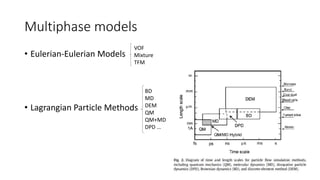
Multiphase models
• Eulerian-Eulerian Models
• Lagrangian Particle Methods
VOF
Mixture
TFM
BD
MD
DEM
QM
QM+MD
DPD …
TFM model(Two-Fluid Model)
• The Eulerian multiphase allows for the modeling of multiple separate,
yet interacting phases.
• The phases can be liquids, gases, or solids in nearly any combination.
• An Eulerian treatment is used for each phase, in contrast to the
Eulerian-Lagrangian treatment that is used for the discrete phase
model.
TFM Main Equations
Volume Fraction Equation
Conservation Equations
TFM Main Equations
Conservation of Momentum
TFM Main Equations
Conservation of Momentum
Conservation of Energy
Equations:
TFM Main Equations
Fluid-Fluid Momentum Equations
Fluid-Solid Momentum Equations
TFM Main Equations
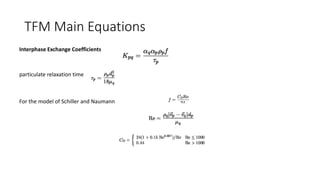
Interphase Exchange Coefficients
particulate relaxation time
For the model of Schiller and Naumann
• The mixture model is a simplified multiphase model that can be used in different ways.
• It can be used to model multiphase flows where the phases move at different velocities,
but assume local equilibrium over short spatial length scales.
• It can be used to model homogeneous multiphase flows with very strong coupling and
phases moving at the same velocity and lastly, the mixture models are used to calculate
non-Newtonian viscosity.
• The mixture model can model phases (fluid or particulate) by solving the momentum,
continuity, and energy equations for the mixture, the volume fraction equations for the
secondary phases, and algebraic expressions for the relative velocities.
• Typical applications include sedimentation, cyclone separators, particle-laden flows with
low loading, and bubbly flows where the gas volume fraction remains low.
Mixture Model
The mixture model is a good substitute for the full Eulerian multiphase model in
several cases:
1. A full multiphase model may not be feasible when there is a wide distribution of
the particulate phase
2. when the interphase laws are unknown or their reliability can be questioned.
A simpler model like the mixture model can perform as well as a full multiphase
model while solving a smaller number of variables than the full multiphase model.
The mixture model allows you to select granular phases and calculates all properties
of the granular phases.
This is applicable for liquid-solid flows
Mixture Model
Mixture Main Equations
Continuity Equation
Momentum Equation
Mixture Main Equations
Momentum Equation
Mixture Main Equations
Energy Equation
Relative (Slip) Velocity and the Drift Velocity
Mixture Main Equations
Relative (Slip) Velocity and the Drift Velocity
Volume Fraction Equation for the Secondary Phases
Mixture Main Equations
Granular Properties
Kinetic Viscosity
Collisional Viscosity
Since the concentration of particles is an important factor in the calculation of the
effective viscosity for the mixture, we may use the granular viscosity to get a value for the
viscosity of the suspension. The volume weighted averaged for the viscosity would now
contain shear viscosity arising from particle momentum exchange due to translation
and collision.
Gidaspow
Syamlal
Mixture Main Equations
Granular Temperature
Solids Pressure
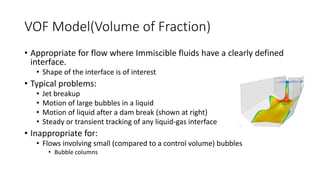
VOF Model(Volume of Fraction)
• Appropriate for flow where Immiscible fluids have a clearly defined
interface.
• Shape of the interface is of interest
• Typical problems:
• Jet breakup
• Motion of large bubbles in a liquid
• Motion of liquid after a dam break (shown at right)
• Steady or transient tracking of any liquid-gas interface
• Inappropriate for:
• Flows involving small (compared to a control volume) bubbles
• Bubble columns
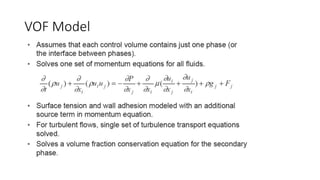
VOF Model
VOF Model
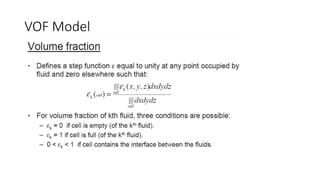
VOF Model
VOF Model

Multiphase models

  • 1.
    Introduction to Multiphase ModelsFirstPart Hamed Hoorijani M.Sc. Student At the university of Tehran Linked :linkedin.com/in/hamed-hoorijani/ : Hamed Hoorijani Hoorijani@ut.ac.ir Hoorijani.h@gmail.com July 2019
  • 5.
    Multiphase models • Eulerian-EulerianModels • Lagrangian Particle Methods VOF Mixture TFM BD MD DEM QM QM+MD DPD …
  • 7.
    TFM model(Two-Fluid Model) •The Eulerian multiphase allows for the modeling of multiple separate, yet interacting phases. • The phases can be liquids, gases, or solids in nearly any combination. • An Eulerian treatment is used for each phase, in contrast to the Eulerian-Lagrangian treatment that is used for the discrete phase model.
  • 8.
    TFM Main Equations VolumeFraction Equation Conservation Equations
  • 9.
  • 10.
    TFM Main Equations Conservationof Momentum Conservation of Energy Equations:
  • 11.
    TFM Main Equations Fluid-FluidMomentum Equations Fluid-Solid Momentum Equations
  • 12.
    TFM Main Equations InterphaseExchange Coefficients particulate relaxation time For the model of Schiller and Naumann
  • 13.
    • The mixturemodel is a simplified multiphase model that can be used in different ways. • It can be used to model multiphase flows where the phases move at different velocities, but assume local equilibrium over short spatial length scales. • It can be used to model homogeneous multiphase flows with very strong coupling and phases moving at the same velocity and lastly, the mixture models are used to calculate non-Newtonian viscosity. • The mixture model can model phases (fluid or particulate) by solving the momentum, continuity, and energy equations for the mixture, the volume fraction equations for the secondary phases, and algebraic expressions for the relative velocities. • Typical applications include sedimentation, cyclone separators, particle-laden flows with low loading, and bubbly flows where the gas volume fraction remains low. Mixture Model
  • 14.
    The mixture modelis a good substitute for the full Eulerian multiphase model in several cases: 1. A full multiphase model may not be feasible when there is a wide distribution of the particulate phase 2. when the interphase laws are unknown or their reliability can be questioned. A simpler model like the mixture model can perform as well as a full multiphase model while solving a smaller number of variables than the full multiphase model. The mixture model allows you to select granular phases and calculates all properties of the granular phases. This is applicable for liquid-solid flows Mixture Model
  • 15.
    Mixture Main Equations ContinuityEquation Momentum Equation
  • 16.
  • 17.
    Mixture Main Equations EnergyEquation Relative (Slip) Velocity and the Drift Velocity
  • 18.
    Mixture Main Equations Relative(Slip) Velocity and the Drift Velocity Volume Fraction Equation for the Secondary Phases
  • 19.
    Mixture Main Equations GranularProperties Kinetic Viscosity Collisional Viscosity Since the concentration of particles is an important factor in the calculation of the effective viscosity for the mixture, we may use the granular viscosity to get a value for the viscosity of the suspension. The volume weighted averaged for the viscosity would now contain shear viscosity arising from particle momentum exchange due to translation and collision. Gidaspow Syamlal
  • 20.
    Mixture Main Equations GranularTemperature Solids Pressure
  • 21.
    VOF Model(Volume ofFraction) • Appropriate for flow where Immiscible fluids have a clearly defined interface. • Shape of the interface is of interest • Typical problems: • Jet breakup • Motion of large bubbles in a liquid • Motion of liquid after a dam break (shown at right) • Steady or transient tracking of any liquid-gas interface • Inappropriate for: • Flows involving small (compared to a control volume) bubbles • Bubble columns
  • 22.
  • 23.
  • 24.
  • 25.