Modeling and simulation of
Mutiphase flows
(CFD tips)
Pouriya Niknam
Supervisor: Dr. Daniele Fiaschi
Multiphse flow introduction, definition and types
Tips on multiphase simulation
Outline
2
Definitions
Multiphase flow is simultaneous flow of:
Materials with different states or phases (i.e. gas, liquid or solid).
Materials with different chemical properties but in the same state or phase
(i.e. liquid-liquid systems such as oil droplets in water).
The primary and secondary phases:
One of the phases is continuous (primary) while the other(s) (secondary) are
dispersed within the continuous phase.
A diameter has to be assigned for each secondary phase to calculate its
interaction (drag) with the primary phase.
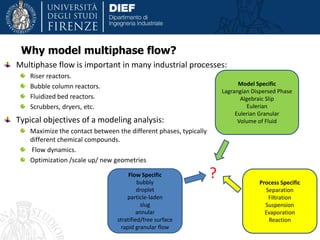
Multiphase flow is important in many industrial processes:
Riser reactors.
Bubble column reactors.
Fluidized bed reactors.
Scrubbers, dryers, etc.
Typical objectives of a modeling analysis:
Maximize the contact between the different phases, typically
different chemical compounds.
Flow dynamics.
Optimization /scale up/ new geometries
Why model multiphase flow?
Flow Specific
bubbly
droplet
particle-laden
slug
annular
stratified/free surface
rapid granular flow
Model Specific
Lagrangian Dispersed Phase
Algebraic Slip
Eulerian
Eulerian Granular
Volume of Fluid
Process Specific
Separation
Filtration
Suspension
Evaporation
Reaction
?
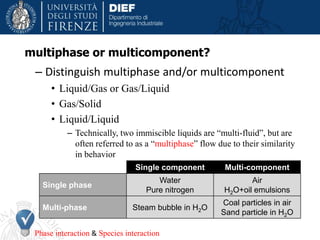
multiphase or multicomponent?
– Distinguish multiphase and/or multicomponent
• Liquid/Gas or Gas/Liquid
• Gas/Solid
• Liquid/Liquid
– Technically, two immiscible liquids are “multi-fluid”, but are
often referred to as a “multiphase” flow due to their similarity
in behavior
Single component Multi-component
Single phase
Water
Pure nitrogen
Air
H2O+oil emulsions
Multi-phase Steam bubble in H2O
Coal particles in air
Sand particle in H2O
Phase interaction & Species interaction
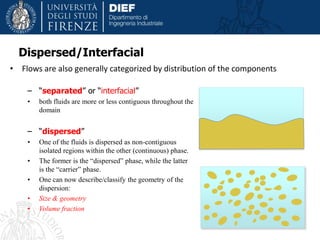
Dispersed/Interfacial
• Flows are also generally categorized by distribution of the components
– “separated” or “interfacial”
• both fluids are more or less contiguous throughout the
domain
– “dispersed”
• One of the fluids is dispersed as non-contiguous
isolated regions within the other (continuous) phase.
• The former is the “dispersed” phase, while the latter
is the “carrier” phase.
• One can now describe/classify the geometry of the
dispersion:
• Size & geometry
• Volume fraction
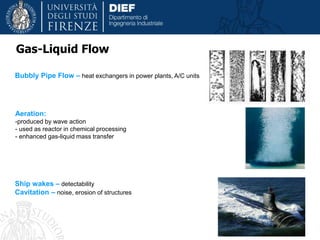
Bubbly Pipe Flow – heat exchangers in power plants, A/C units
Gas-Liquid Flow
Aeration:
-produced by wave action
- used as reactor in chemical processing
- enhanced gas-liquid mass transfer
Ship wakes – detectability
Cavitation – noise, erosion of structures
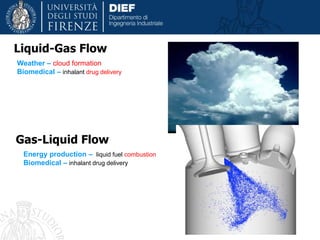
Weather – cloud formation
Biomedical – inhalant drug delivery
Liquid-Gas Flow
Gas-Liquid Flow
Energy production – liquid fuel combustion
Biomedical – inhalant drug delivery
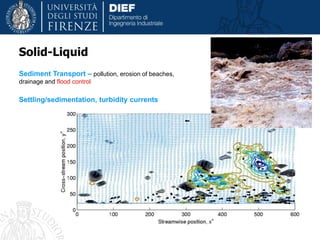
Environmental – avalanche, pyroclastic flow, ash
plume, turbidity currents
Gas-Solid Flow
Granular Flow – collision dominated
dynamics; chemical processing
Chemical production – mixing and reaction of immiscible liquids
Liquid-Liquid
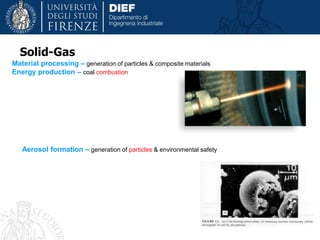
Sediment Transport – pollution, erosion of beaches,
drainage and flood control
Solid-Liquid
Settling/sedimentation, turbidity currents
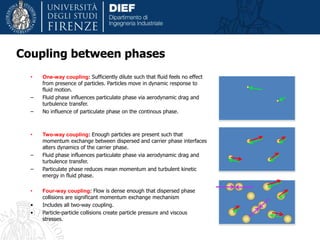
Material processing – generation of particles & composite materials
Energy production – coal combustion
Solid-Gas
Aerosol formation – generation of particles & environmental safety
• One-way coupling: Sufficiently dilute such that fluid feels no effect
from presence of particles. Particles move in dynamic response to
fluid motion.
– Fluid phase influences particulate phase via aerodynamic drag and
turbulence transfer.
– No influence of particulate phase on the continous phase.
• Two-way coupling: Enough particles are present such that
momentum exchange between dispersed and carrier phase interfaces
alters dynamics of the carrier phase.
– Fluid phase influences particulate phase via aerodynamic drag and
turbulence transfer.
– Particulate phase reduces mean momentum and turbulent kinetic
energy in fluid phase.
• Four-way coupling: Flow is dense enough that dispersed phase
collisions are significant momentum exchange mechanism
• Includes all two-way coupling.
• Particle-particle collisions create particle pressure and viscous
stresses.
Coupling between phases
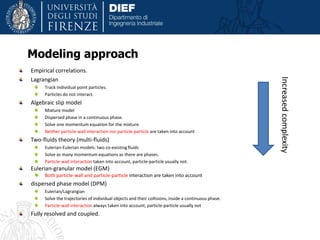
Empirical correlations.
Lagrangian
Track individual point particles.
Particles do not interact.
Algebraic slip model
Mixture model
Dispersed phase in a continuous phase.
Solve one momentum equation for the mixture.
Neither particle-wall interaction nor particle-particle are taken into account
Two-fluids theory (multi-fluids)
Eulerian-Eulerian models: two co-existing fluids
Solve as many momentum equations as there are phases.
Particle-wall interaction taken into account, particle-particle usually not.
Eulerian-granular model (EGM)
Both particle-wall and particle-particle interaction are taken into account
dispersed phase model (DPM)
Eulerian/Lagrangian
Solve the trajectories of individual objects and their collisions, inside a continuous phase.
Particle-wall interaction always taken into account, particle-particle usually not
Fully resolved and coupled.
Increasedcomplexity
Modeling approach
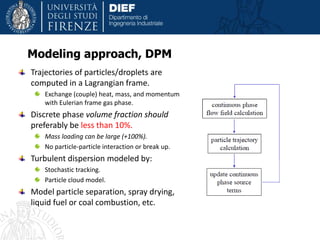
Trajectories of particles/droplets are
computed in a Lagrangian frame.
Exchange (couple) heat, mass, and momentum
with Eulerian frame gas phase.
Discrete phase volume fraction should
preferably be less than 10%.
Mass loading can be large (+100%).
No particle-particle interaction or break up.
Turbulent dispersion modeled by:
Stochastic tracking.
Particle cloud model.
Model particle separation, spray drying,
liquid fuel or coal combustion, etc.
Modeling approach, DPM
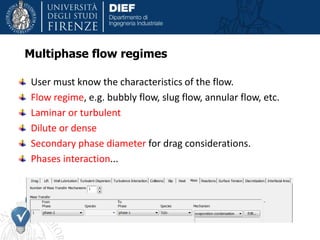
User must know the characteristics of the flow.
Flow regime, e.g. bubbly flow, slug flow, annular flow, etc.
Laminar or turbulent
Dilute or dense
Secondary phase diameter for drag considerations.
Phases interaction...
Multiphase flow regimes
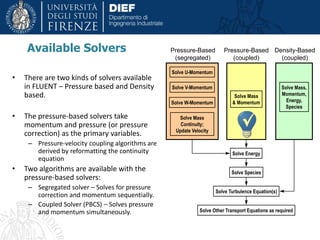
Available Solvers
• There are two kinds of solvers available
in FLUENT – Pressure based and Density
based.
• The pressure-based solvers take
momentum and pressure (or pressure
correction) as the primary variables.
– Pressure-velocity coupling algorithms are
derived by reformatting the continuity
equation
• Two algorithms are available with the
pressure-based solvers:
– Segregated solver – Solves for pressure
correction and momentum sequentially.
– Coupled Solver (PBCS) – Solves pressure
and momentum simultaneously.
Pressure-Based
(segregated)
Density-Based
(coupled)
Solve Mass
Continuity;
Update Velocity
Solve U-Momentum
Solve V-Momentum
Solve W-Momentum
Pressure-Based
(coupled)
Solve Turbulence Equation(s)
Solve Species
Solve Energy
Solve Other Transport Equations as required
Solve Mass
& Momentum
Solve Mass,
Momentum,
Energy,
Species
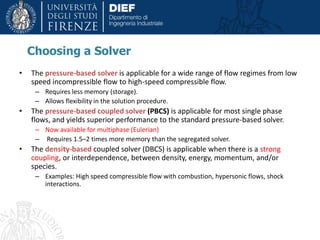
Choosing a Solver
• The pressure-based solver is applicable for a wide range of flow regimes from low
speed incompressible flow to high-speed compressible flow.
– Requires less memory (storage).
– Allows flexibility in the solution procedure.
• The pressure-based coupled solver (PBCS) is applicable for most single phase
flows, and yields superior performance to the standard pressure-based solver.
– Now available for multiphase (Eulerian)
– Requires 1.5–2 times more memory than the segregated solver.
• The density-based coupled solver (DBCS) is applicable when there is a strong
coupling, or interdependence, between density, energy, momentum, and/or
species.
– Examples: High speed compressible flow with combustion, hypersonic flows, shock
interactions.
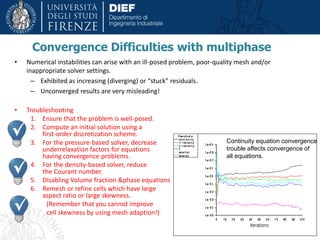
Convergence Difficulties with multiphase
• Numerical instabilities can arise with an ill-posed problem, poor-quality mesh and/or
inappropriate solver settings.
– Exhibited as increasing (diverging) or “stuck” residuals.
– Unconverged results are very misleading!
• Troubleshooting
1. Ensure that the problem is well-posed.
2. Compute an initial solution using a
first-order discretization scheme.
3. For the pressure-based solver, decrease
underrelaxation factors for equations
having convergence problems.
4. For the density-based solver, reduce
the Courant number.
5. Disabling Volume fraction &phase equations
6. Remesh or refine cells which have large
aspect ratio or large skewness.
(Remember that you cannot improve
cell skewness by using mesh adaption!)
Continuity equation convergence
trouble affects convergence of
all equations.
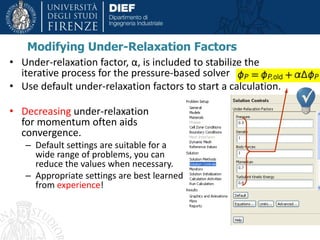
Modifying Under-Relaxation Factors
• Under-relaxation factor, α, is included to stabilize the
iterative process for the pressure-based solver
• Use default under-relaxation factors to start a calculation.
• Decreasing under-relaxation
for momentum often aids
convergence.
– Default settings are suitable for a
wide range of problems, you can
reduce the values when necessary.
– Appropriate settings are best learned
from experience!
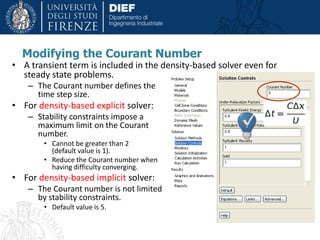
Modifying the Courant Number
• A transient term is included in the density-based solver even for
steady state problems.
– The Courant number defines the
time step size.
• For density-based explicit solver:
– Stability constraints impose a
maximum limit on the Courant
number.
• Cannot be greater than 2
(default value is 1).
• Reduce the Courant number when
having difficulty converging.
• For density-based implicit solver:
– The Courant number is not limited
by stability constraints.
• Default value is 5.
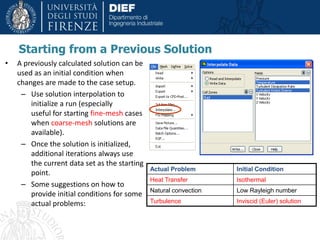
Starting from a Previous Solution
• A previously calculated solution can be
used as an initial condition when
changes are made to the case setup.
– Use solution interpolation to
initialize a run (especially
useful for starting fine-mesh cases
when coarse-mesh solutions are
available).
– Once the solution is initialized,
additional iterations always use
the current data set as the starting
point.
– Some suggestions on how to
provide initial conditions for some
actual problems:
Actual Problem Initial Condition
Heat Transfer Isothermal
Natural convection Low Rayleigh number
Turbulence Inviscid (Euler) solution
Steady or Unsteady
• Nearly all flows in nature are transient!
– Steady-state assumption is possible if we:
• Ignore unsteady fluctuations
• Employ ensemble/time-averaging to remove unsteadiness (this is
what is done in modeling turbulence)
• In CFD, steady-state methods are preferred
– Lower computational cost
– Easier to postprocess and analyze
• Many applications require resolution of transient flow:
– Aerodynamics (aircraft, land vehicles,etc.) – vortex shedding
– Rotating Machinery – rotor/stator interaction, stall, surge
– Multiphase Flows – free surfaces, bubble dynamics
– Deforming Domains – in-cylinder combustion, store separation
– Unsteady Heat Transfer – transient heating and cooling
– Many more
• Typically, compressible analyses are executed in
a transient or pseudo-transient fashion since
the problem is no longer elliptic: downstream
boundary conditions cannot be felt upstream in
a supersonic analysis.
– Pseudo Transient: Use of Inertial Relaxation.
Pseudo Transient
improve multiphase convergency
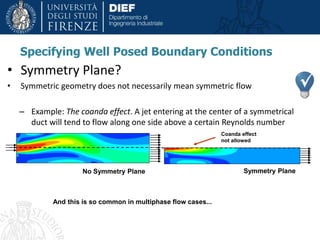
• Symmetry Plane?
• Symmetric geometry does not necessarily mean symmetric flow
– Example: The coanda effect. A jet entering at the center of a symmetrical
duct will tend to flow along one side above a certain Reynolds number
Specifying Well Posed Boundary Conditions
No Symmetry Plane Symmetry Plane
Coanda effect
not allowed
And this is so common in multiphase flow cases...
Ex. 2: Preference= 100,000 Pa
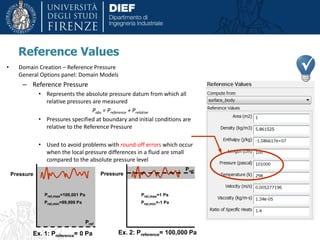
• Domain Creation – Reference Pressure
General Options panel: Domain Models
– Reference Pressure
• Represents the absolute pressure datum from which all
relative pressures are measured
Pabs = Preference + Prelative
• Pressures specified at boundary and initial conditions are
relative to the Reference Pressure
• Used to avoid problems with round-off errors which occur
when the local pressure differences in a fluid are small
compared to the absolute pressure level
PressurePressure
Ex. 1: Preference= 0 Pa
Pref
Prel,max=100,001 Pa
Prel,min=99,999 Pa
Prel,max=1 Pa
Prel,min=-1 Pa
Pref
Reference Values
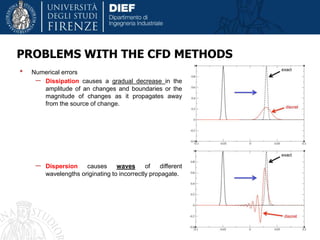
PROBLEMS WITH THE CFD METHODS
• Numerical errors
– Dissipation causes a gradual decrease in the
amplitude of an changes and boundaries or the
magnitude of changes as it propagates away
from the source of change.
– Dispersion causes waves of different
wavelengths originating to incorrectly propagate.
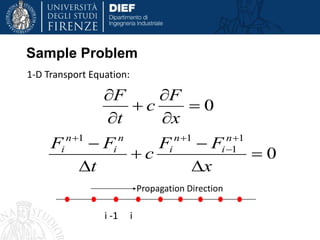
Sample Problem
1-D Transport Equation:
0





x
F
c
t
F
0
1
1
11





 


x
FF
c
t
FF n
i
n
i
n
i
n
i
Propagation Direction
i -1 i
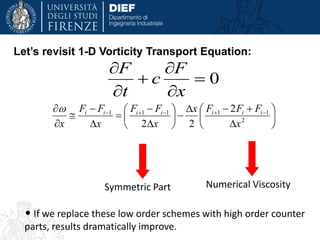
Let’s revisit 1-D Vorticity Transport Equation:
0





x
F
c
t
F
Symmetric Part Numerical Viscosity
• If we replace these low order schemes with high order counter
parts, results dramatically improve.





















 
2
1 2
22 x
FFFx
x
FF
x
FF
x
iiiiiii



x
F
x
FF 2/1i2/1i

 
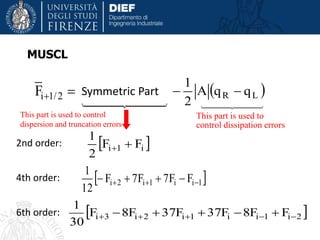
 2/1iF Symmetric Part + Numerical viscosity
Second order
Fourth order
Sixth order
Eighth order
First order
Third order(MUSCL)
Fifth order (WENO)
(Base Scheme) (Filter)
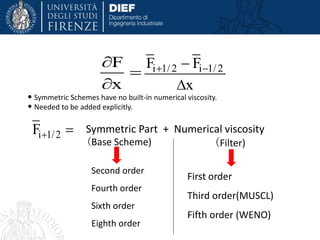
• Symmetric Schemes have no built-in numerical viscosity.
• Needed to be added explicitly.
 2/1iF Symmetric Part
 i1i FF
2
1

 1ii1i2i FF7F7F
12
1
 
 2i1ii1i2i3i FF8F37F37F8F
30
1
 
 LR qqA
2
1

2nd order:
4th order:
6th order:
This part is used to
control dissipation errors
This part is used to control
dispersion and truncation errors
MUSCL
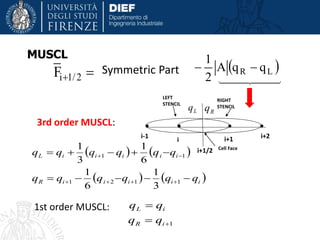
 2/1iF Symmetric Part  LR qqA
2
1

3rd order MUSCL:
LEFT
STENCIL
RIGHT
STENCIL
RqLq
i-1
i
i+1/2
i+1 i+2
Cell Face
1st order MUSCL:
   
   iiiiiR
iiiiiL
qqqqqq
qqqqqq




1121
11
3
1
6
1
6
1
3
1
   
   iiiiiR
iiiiiL
qqqqqq
qqqqqq




1121
11
11
6
1
3
1
   
   iiiiiR
iiiiiL
qqqqqq
qqqqqq




1121
11
3
1
6
1
6
1
3
1
MUSCL
33
Question?

multiphase flow modeling and simulation ,Pouriya Niknam , UNIFI

  • 1.
    Modeling and simulationof Mutiphase flows (CFD tips) Pouriya Niknam Supervisor: Dr. Daniele Fiaschi
  • 2.
    Multiphse flow introduction,definition and types Tips on multiphase simulation Outline 2
  • 3.
    Definitions Multiphase flow issimultaneous flow of: Materials with different states or phases (i.e. gas, liquid or solid). Materials with different chemical properties but in the same state or phase (i.e. liquid-liquid systems such as oil droplets in water). The primary and secondary phases: One of the phases is continuous (primary) while the other(s) (secondary) are dispersed within the continuous phase. A diameter has to be assigned for each secondary phase to calculate its interaction (drag) with the primary phase.
  • 4.
    Multiphase flow isimportant in many industrial processes: Riser reactors. Bubble column reactors. Fluidized bed reactors. Scrubbers, dryers, etc. Typical objectives of a modeling analysis: Maximize the contact between the different phases, typically different chemical compounds. Flow dynamics. Optimization /scale up/ new geometries Why model multiphase flow? Flow Specific bubbly droplet particle-laden slug annular stratified/free surface rapid granular flow Model Specific Lagrangian Dispersed Phase Algebraic Slip Eulerian Eulerian Granular Volume of Fluid Process Specific Separation Filtration Suspension Evaporation Reaction ?
  • 5.
    multiphase or multicomponent? –Distinguish multiphase and/or multicomponent • Liquid/Gas or Gas/Liquid • Gas/Solid • Liquid/Liquid – Technically, two immiscible liquids are “multi-fluid”, but are often referred to as a “multiphase” flow due to their similarity in behavior Single component Multi-component Single phase Water Pure nitrogen Air H2O+oil emulsions Multi-phase Steam bubble in H2O Coal particles in air Sand particle in H2O Phase interaction & Species interaction
  • 6.
    Dispersed/Interfacial • Flows arealso generally categorized by distribution of the components – “separated” or “interfacial” • both fluids are more or less contiguous throughout the domain – “dispersed” • One of the fluids is dispersed as non-contiguous isolated regions within the other (continuous) phase. • The former is the “dispersed” phase, while the latter is the “carrier” phase. • One can now describe/classify the geometry of the dispersion: • Size & geometry • Volume fraction
  • 7.
    Bubbly Pipe Flow– heat exchangers in power plants, A/C units Gas-Liquid Flow Aeration: -produced by wave action - used as reactor in chemical processing - enhanced gas-liquid mass transfer Ship wakes – detectability Cavitation – noise, erosion of structures
  • 8.
    Weather – cloudformation Biomedical – inhalant drug delivery Liquid-Gas Flow Gas-Liquid Flow Energy production – liquid fuel combustion Biomedical – inhalant drug delivery
  • 9.
    Environmental – avalanche,pyroclastic flow, ash plume, turbidity currents Gas-Solid Flow Granular Flow – collision dominated dynamics; chemical processing
  • 10.
    Chemical production –mixing and reaction of immiscible liquids Liquid-Liquid
  • 11.
    Sediment Transport –pollution, erosion of beaches, drainage and flood control Solid-Liquid Settling/sedimentation, turbidity currents
  • 12.
    Material processing –generation of particles & composite materials Energy production – coal combustion Solid-Gas Aerosol formation – generation of particles & environmental safety
  • 13.
    • One-way coupling:Sufficiently dilute such that fluid feels no effect from presence of particles. Particles move in dynamic response to fluid motion. – Fluid phase influences particulate phase via aerodynamic drag and turbulence transfer. – No influence of particulate phase on the continous phase. • Two-way coupling: Enough particles are present such that momentum exchange between dispersed and carrier phase interfaces alters dynamics of the carrier phase. – Fluid phase influences particulate phase via aerodynamic drag and turbulence transfer. – Particulate phase reduces mean momentum and turbulent kinetic energy in fluid phase. • Four-way coupling: Flow is dense enough that dispersed phase collisions are significant momentum exchange mechanism • Includes all two-way coupling. • Particle-particle collisions create particle pressure and viscous stresses. Coupling between phases
  • 14.
    Empirical correlations. Lagrangian Track individualpoint particles. Particles do not interact. Algebraic slip model Mixture model Dispersed phase in a continuous phase. Solve one momentum equation for the mixture. Neither particle-wall interaction nor particle-particle are taken into account Two-fluids theory (multi-fluids) Eulerian-Eulerian models: two co-existing fluids Solve as many momentum equations as there are phases. Particle-wall interaction taken into account, particle-particle usually not. Eulerian-granular model (EGM) Both particle-wall and particle-particle interaction are taken into account dispersed phase model (DPM) Eulerian/Lagrangian Solve the trajectories of individual objects and their collisions, inside a continuous phase. Particle-wall interaction always taken into account, particle-particle usually not Fully resolved and coupled. Increasedcomplexity Modeling approach
  • 15.
    Trajectories of particles/dropletsare computed in a Lagrangian frame. Exchange (couple) heat, mass, and momentum with Eulerian frame gas phase. Discrete phase volume fraction should preferably be less than 10%. Mass loading can be large (+100%). No particle-particle interaction or break up. Turbulent dispersion modeled by: Stochastic tracking. Particle cloud model. Model particle separation, spray drying, liquid fuel or coal combustion, etc. Modeling approach, DPM
  • 16.
    User must knowthe characteristics of the flow. Flow regime, e.g. bubbly flow, slug flow, annular flow, etc. Laminar or turbulent Dilute or dense Secondary phase diameter for drag considerations. Phases interaction... Multiphase flow regimes
  • 17.
    Available Solvers • Thereare two kinds of solvers available in FLUENT – Pressure based and Density based. • The pressure-based solvers take momentum and pressure (or pressure correction) as the primary variables. – Pressure-velocity coupling algorithms are derived by reformatting the continuity equation • Two algorithms are available with the pressure-based solvers: – Segregated solver – Solves for pressure correction and momentum sequentially. – Coupled Solver (PBCS) – Solves pressure and momentum simultaneously. Pressure-Based (segregated) Density-Based (coupled) Solve Mass Continuity; Update Velocity Solve U-Momentum Solve V-Momentum Solve W-Momentum Pressure-Based (coupled) Solve Turbulence Equation(s) Solve Species Solve Energy Solve Other Transport Equations as required Solve Mass & Momentum Solve Mass, Momentum, Energy, Species
  • 18.
    Choosing a Solver •The pressure-based solver is applicable for a wide range of flow regimes from low speed incompressible flow to high-speed compressible flow. – Requires less memory (storage). – Allows flexibility in the solution procedure. • The pressure-based coupled solver (PBCS) is applicable for most single phase flows, and yields superior performance to the standard pressure-based solver. – Now available for multiphase (Eulerian) – Requires 1.5–2 times more memory than the segregated solver. • The density-based coupled solver (DBCS) is applicable when there is a strong coupling, or interdependence, between density, energy, momentum, and/or species. – Examples: High speed compressible flow with combustion, hypersonic flows, shock interactions.
  • 19.
    Convergence Difficulties withmultiphase • Numerical instabilities can arise with an ill-posed problem, poor-quality mesh and/or inappropriate solver settings. – Exhibited as increasing (diverging) or “stuck” residuals. – Unconverged results are very misleading! • Troubleshooting 1. Ensure that the problem is well-posed. 2. Compute an initial solution using a first-order discretization scheme. 3. For the pressure-based solver, decrease underrelaxation factors for equations having convergence problems. 4. For the density-based solver, reduce the Courant number. 5. Disabling Volume fraction &phase equations 6. Remesh or refine cells which have large aspect ratio or large skewness. (Remember that you cannot improve cell skewness by using mesh adaption!) Continuity equation convergence trouble affects convergence of all equations.
  • 20.
    Modifying Under-Relaxation Factors •Under-relaxation factor, α, is included to stabilize the iterative process for the pressure-based solver • Use default under-relaxation factors to start a calculation. • Decreasing under-relaxation for momentum often aids convergence. – Default settings are suitable for a wide range of problems, you can reduce the values when necessary. – Appropriate settings are best learned from experience!
  • 21.
    Modifying the CourantNumber • A transient term is included in the density-based solver even for steady state problems. – The Courant number defines the time step size. • For density-based explicit solver: – Stability constraints impose a maximum limit on the Courant number. • Cannot be greater than 2 (default value is 1). • Reduce the Courant number when having difficulty converging. • For density-based implicit solver: – The Courant number is not limited by stability constraints. • Default value is 5.
  • 22.
    Starting from aPrevious Solution • A previously calculated solution can be used as an initial condition when changes are made to the case setup. – Use solution interpolation to initialize a run (especially useful for starting fine-mesh cases when coarse-mesh solutions are available). – Once the solution is initialized, additional iterations always use the current data set as the starting point. – Some suggestions on how to provide initial conditions for some actual problems: Actual Problem Initial Condition Heat Transfer Isothermal Natural convection Low Rayleigh number Turbulence Inviscid (Euler) solution
  • 23.
    Steady or Unsteady •Nearly all flows in nature are transient! – Steady-state assumption is possible if we: • Ignore unsteady fluctuations • Employ ensemble/time-averaging to remove unsteadiness (this is what is done in modeling turbulence) • In CFD, steady-state methods are preferred – Lower computational cost – Easier to postprocess and analyze • Many applications require resolution of transient flow: – Aerodynamics (aircraft, land vehicles,etc.) – vortex shedding – Rotating Machinery – rotor/stator interaction, stall, surge – Multiphase Flows – free surfaces, bubble dynamics – Deforming Domains – in-cylinder combustion, store separation – Unsteady Heat Transfer – transient heating and cooling – Many more
  • 24.
    • Typically, compressibleanalyses are executed in a transient or pseudo-transient fashion since the problem is no longer elliptic: downstream boundary conditions cannot be felt upstream in a supersonic analysis. – Pseudo Transient: Use of Inertial Relaxation. Pseudo Transient improve multiphase convergency
  • 25.
    • Symmetry Plane? •Symmetric geometry does not necessarily mean symmetric flow – Example: The coanda effect. A jet entering at the center of a symmetrical duct will tend to flow along one side above a certain Reynolds number Specifying Well Posed Boundary Conditions No Symmetry Plane Symmetry Plane Coanda effect not allowed And this is so common in multiphase flow cases...
  • 26.
    Ex. 2: Preference=100,000 Pa • Domain Creation – Reference Pressure General Options panel: Domain Models – Reference Pressure • Represents the absolute pressure datum from which all relative pressures are measured Pabs = Preference + Prelative • Pressures specified at boundary and initial conditions are relative to the Reference Pressure • Used to avoid problems with round-off errors which occur when the local pressure differences in a fluid are small compared to the absolute pressure level PressurePressure Ex. 1: Preference= 0 Pa Pref Prel,max=100,001 Pa Prel,min=99,999 Pa Prel,max=1 Pa Prel,min=-1 Pa Pref Reference Values
  • 27.
    PROBLEMS WITH THECFD METHODS • Numerical errors – Dissipation causes a gradual decrease in the amplitude of an changes and boundaries or the magnitude of changes as it propagates away from the source of change. – Dispersion causes waves of different wavelengths originating to incorrectly propagate.
  • 28.
    Sample Problem 1-D TransportEquation: 0      x F c t F 0 1 1 11          x FF c t FF n i n i n i n i Propagation Direction i -1 i
  • 29.
    Let’s revisit 1-DVorticity Transport Equation: 0      x F c t F Symmetric Part Numerical Viscosity • If we replace these low order schemes with high order counter parts, results dramatically improve.                        2 1 2 22 x FFFx x FF x FF x iiiiiii
  • 30.
       x F x FF 2/1i2/1i    2/1iF Symmetric Part + Numerical viscosity Second order Fourth order Sixth order Eighth order First order Third order(MUSCL) Fifth order (WENO) (Base Scheme) (Filter) • Symmetric Schemes have no built-in numerical viscosity. • Needed to be added explicitly.
  • 31.
     2/1iF SymmetricPart  i1i FF 2 1   1ii1i2i FF7F7F 12 1    2i1ii1i2i3i FF8F37F37F8F 30 1    LR qqA 2 1  2nd order: 4th order: 6th order: This part is used to control dissipation errors This part is used to control dispersion and truncation errors MUSCL
  • 32.
     2/1iF SymmetricPart  LR qqA 2 1  3rd order MUSCL: LEFT STENCIL RIGHT STENCIL RqLq i-1 i i+1/2 i+1 i+2 Cell Face 1st order MUSCL:        iiiiiR iiiiiL qqqqqq qqqqqq     1121 11 3 1 6 1 6 1 3 1        iiiiiR iiiiiL qqqqqq qqqqqq     1121 11 11 6 1 3 1        iiiiiR iiiiiL qqqqqq qqqqqq     1121 11 3 1 6 1 6 1 3 1 MUSCL
  • 33.