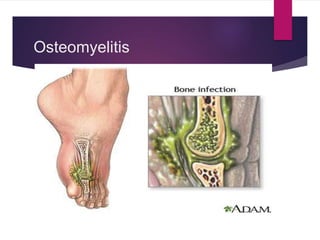
Osteomyelitis
Introduction
 Nelaton (1834) : coined osteomyelitis
The root words are
-osteon (bone)
-myelo (marrow)
 these are combined with itis
(inflammation) to define the clinical state
in which bone is infected with
microorganisms.
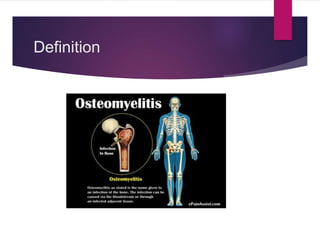
Definition
Classification
Attempts to classify are based on:
(1) the duration and type of symptoms
(2)the mechanism of infection
(3)the type of host response
Based on the duration and type of
symptom
Classified according to
mechanism
1.Hematogenous
2. Contiguous
3. Vascular insufficiency
Based on host response
1.Pyogenic 2. non-
pyogenic
Most common sites
Causative Organisms
 Infants
– Staph. aureus most common
– Streptococcus group B
– Coliform organisms
 6 months to 4 years
– Staph. Aureus
– H. influenza
Continue
 Sickle cell disease – Salmonella paratyphi
 IV drug abusers - pseudomonas
 Fungal osteomyelitis
Etiology
1. Disease is common in active bone growth
2. Male > female
3. Poor nutrition
4. Trauma
5. Skin, dental, respiratory, GI, urinary tract infection
6. Burns
7. Iv drug abuse
8. Sickle cell anemia
9. Immuno compromised state
10.Old age, debilitated state
Video
Pathophysiology
Entry of microbe(infection)
initial response
Inflammation
Increased
vascularity edema
Continue
Entry of microbe(infection)
after 2-3 days
Thrombosis of local blood vessels
Ischemia with bone necrosis
Continue
Infection extends into the meduallary cavity and under the
periosteium and may spread into adjacent soft tissues and
joints
Bone abscess formation
sequestrum involucrum
Chronic Osteomyelitis
Assessment
 Physical examination
Neonates
– have a thin periosteium that is easily
penetrated by infection
– will present with swelling at the
affected site & adjacent joint and
irritability on movement of the limb.
continue
Older children
– due to thicker metaphyseal cortex and
densely adherent periosteium
– will have point tenderness
In infants , elderly and immunocompro-
-mised pts clinical findings may be minimal
Investigations
MRI
Bone scan
PET Scan
Scintigraphy
Sinogram
Treatment
Medical
management
Surgical
management
Nursing
management
Medical treatment
Pathogen First line drug
Staph. Aureus
(methicillin –sensitive)
Oxacillin 2gm IV 6hrs or clindamycin
phosphate 900mg IV 8hrs
S. aureus (methicillin resistant) Vancomycin 1g IV 12hrs plus
rifampicin
Streptococcus pneumoniae Penicillin G, 4million units IV 6hrs
Intermediate penicillin-resistant
S.pneumoniae
Ceftriaxone 2g IV 24hrs
Enterococcus species Ampicillin 2g IV 6hrs or vancomycin
1g IV 12hrs
Enteric gram-negative rods Fluoroquuionolone
Pseudomonas aeruginosa Levofloxacin 500mg IV 24rs
Surgical treatment
THE GOALS OF SURGERY
 Eradication of infection by achieving a viable & vascular
environment
 Radical debridement
 Prevent recurrence
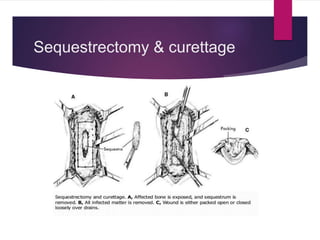
Sequestrectomy & curettage
Bone grafting
PMMA bead chains
Ilizarov’s technique
COMPLICATIONS
Growth disturbances
 Pathological fractures
 Muscle contractures
 Secondary septicemia
 Epithelioma
 Malignant changes( Squamous cell ca,Reticulum cell ca,
Fibrosarcoma)
 Joint stiffness
 Amyloidosis
Nursing management
Diagnosis
 Acute pain related to inflammation and edema
 Impaired physical mobility related to pain and weight bearing limitations
 Risk for infection :bone abscess formation
 Deficient knowledge related to the treatment regimen
Nursing interventions
 Date :20-nov-2017
 Venue : room no.204
 Time : 12:15 p.m
Osteomyelitis ppt
Osteomyelitis ppt
Osteomyelitis ppt
Osteomyelitis ppt

Osteomyelitis ppt