SEMINAR ON
INFECTION OF BONE
PRESENTED BY
om verma
DEFINITION
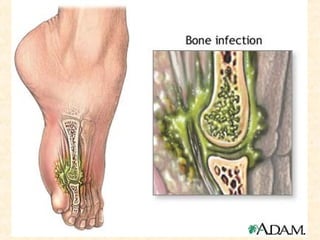
 a bone. Infections can reach a bone by
traveling through the bloodstream or
spreading from nearby
tissue. Infections can also begin in
the bone itself if an injury exposes
the bone to germs. In children,
osteomyelitis most commonly affects the
long bones of the legs and upper 
SKELETAL SYSTEM
The skeletal system comprises the bony framework of
the body. It consist of 206 individual bones in the adult.
Some bones are hinged and others are focused to one
another.
FUNCTIONS:-
 > It supports body structure and provide shape to the
body
 > It protects the soft and delicate internal organs
 >It allows movement and anchorage of muscles .
 > It provides mineral storage
 > It is the site for hemopoiesis
STRUCTURE AND FORMATION OF
BONES
Bone consist of microscopic cells called “osteocytes”
(from the Greek word osteon,meaning bone”) .An
osteocyte is a mature bone cell. Bone is made up
of 35% organic material,65%in organic mineral
salts and water
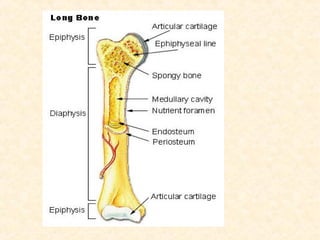
 .A typical long bone consist of the following
parts:-
 The diaphysis (growing between)is the bones
shaft or body the long
 The epiphyses (growing over ) are the distal ends
of the bone
CONT………………………..
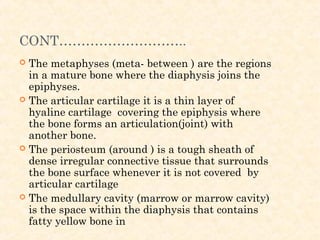
 The metaphyses (meta- between ) are the regions
in a mature bone where the diaphysis joins the
epiphyses.
 The articular cartilage it is a thin layer of
hyaline cartilage covering the epiphysis where
the bone forms an articulation(joint) with
another bone.
 The periosteum (around ) is a tough sheath of
dense irregular connective tissue that surrounds
the bone surface whenever it is not covered by
articular cartilage
 The medullary cavity (marrow or marrow cavity)
is the space within the diaphysis that contains
fatty yellow bone in
CONT…………….
 The Endosterm is a thin membrane that lines the
medullary cavity.
BLOOD AND NERVE SUPPLY
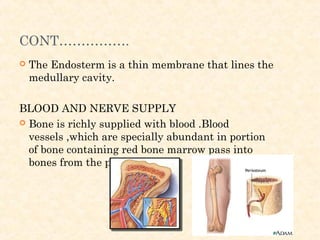
 Bone is richly supplied with blood .Blood
vessels ,which are specially abundant in portion
of bone containing red bone marrow pass into
bones from the periosteum.
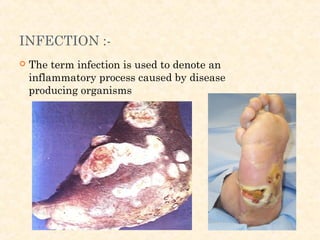
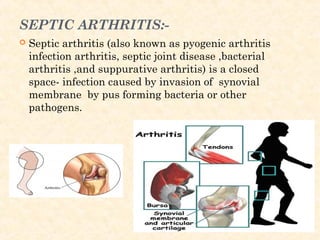
INFECTION :-
 The term infection is used to denote an
inflammatory process caused by disease
producing organisms
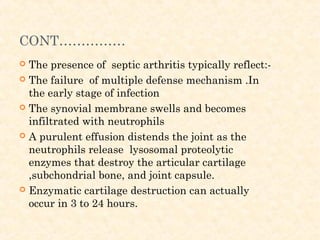
SEPTIC ARTHRITIS:-
 Septic arthritis (also known as pyogenic arthritis
infection arthritis, septic joint disease ,bacterial
arthritis ,and suppurative arthritis) is a closed
space- infection caused by invasion of synovial
membrane by pus forming bacteria or other
pathogens.
CONT……………
 The presence of septic arthritis typically reflect:-
 The failure of multiple defense mechanism .In
the early stage of infection
 The synovial membrane swells and becomes
infiltrated with neutrophils
 A purulent effusion distends the joint as the
neutrophils release lysosomal proteolytic
enzymes that destroy the articular cartilage
,subchondrial bone, and joint capsule.
 Enzymatic cartilage destruction can actually
occur in 3 to 24 hours.
ASSESMENT FOCUS ON :-
 Diagnostic procedures.
 IV drug abuse.
 Systemic disease
 Initial laboratory studies
MANAGEMENT:-
 Antibiotic therapy is a critical part of effective
treatment of septic arthritis
 Open synovectomy and debridement or repeated joint
aspiration and irrigation may be performed
 Anthroscopic drainage and debridement have also
been successful
OSTEOMYELITIS
 Osteomyelitis is an inflammation or swelling of bone
tissue that is usually the result of an infection.
Osteomyelitis, or bone infection, may occur for many
different reasons and can affect children or adults
 Some of the causes of osteomyelitis include the
following
 Osteomyelitis may occur as a result of a bacterial
bloodstream infection, sometimes called bacteremia,

or sepsis, that spreads to the bone.
 
 Osteomyelitis can also occur from a nearby infection
due to a traumatic injury, frequent medication
injections, a surgical procedure, or use of a
prosthetic device.
CONT…………
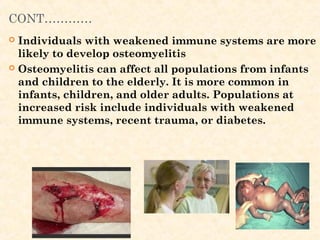
 Individuals with weakened immune systems are more
likely to develop osteomyelitis
 Osteomyelitis can affect all populations from infants
and children to the elderly. It is more common in
infants, children, and older adults. Populations at
increased risk include individuals with weakened
immune systems, recent trauma, or diabetes.
Contiguous-focus OsteomyelitisContiguous-focus Osteomyelitis
Clinical setting:Clinical setting:
Postoperative infectionPostoperative infection
Contamination of boneContamination of bone
Contiguous soft tissue infectionContiguous soft tissue infection
Puncture woundsPuncture wounds
Contiguous-focus OsteomyelitisContiguous-focus Osteomyelitis
Microbiologic featuresMicrobiologic features
STAPHYLOCOCCISTAPHYLOCOCCI  AUREUS, EPIDERMIDISAUREUS, EPIDERMIDIS
GRAM-NEGATIVE BACTERIAGRAM-NEGATIVE BACTERIA
ANAEROBIC INFECTIONANAEROBIC INFECTION
UNUSUAL ORGANISMSUNUSUAL ORGANISMS CLOSTRIDIA, NOCARDIACLOSTRIDIA, NOCARDIA
HEMATOGENOUS OSTEOMYELITISHEMATOGENOUS OSTEOMYELITIS
Clinical manifestationClinical manifestation
Classic presentation: Sudden onsetClassic presentation: Sudden onset
Usually presentation: Slow, insidiousUsually presentation: Slow, insidious
High fever, Night sweatsHigh fever, Night sweats
Fatigue, Anorexia, Weight lossFatigue, Anorexia, Weight loss
Restriction of movementRestriction of movement
LOCAL EDEMA, ERYTHEMA, & TENDERRNESSLOCAL EDEMA, ERYTHEMA, & TENDERRNESS
HEMATOGENOUS OSTEOMYELITISHEMATOGENOUS OSTEOMYELITIS
Microbiologic featuresMicrobiologic features
StaphylococciStaphylococci  Aureus, EpidermidisAureus, Epidermidis
StreptococciStreptococci  Group A & BGroup A & B
Haemophilus influenzaeHaemophilus influenzae
Gram-negative enteric bacilliGram-negative enteric bacilli
AnaerobesAnaerobes
PolymicrobialPolymicrobial
MycobacterialMycobacterial
FungiFungi
HEMATOGENOUS OSTEOMYELITISHEMATOGENOUS OSTEOMYELITIS
Special considerationSpecial consideration
Sickle cell diseaseSickle cell disease
Injection drug users (IDUs)Injection drug users (IDUs)
HemodialysisHemodialysis
HIV/AIDSHIV/AIDS
ImmunosuppressionImmunosuppression
Prosthetic orthopedic deviceProsthetic orthopedic device
PATHOPHYSIOLOGYPATHOPHYSIOLOGY
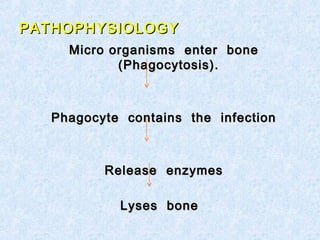
Micro organisms enter boneMicro organisms enter bone
(Phagocytosis).(Phagocytosis).
Phagocyte contains the infectionPhagocyte contains the infection
Release enzymesRelease enzymes
Lyses boneLyses bone
CONTD…………..
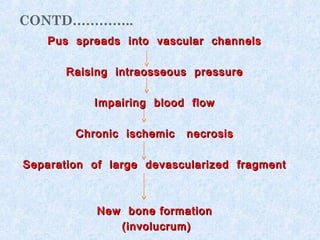
Pus spreads into vascular channelsPus spreads into vascular channels
Raising intraosseous pressureRaising intraosseous pressure
Impairing blood flowImpairing blood flow
Chronic ischemic necrosisChronic ischemic necrosis
Separation of large devascularized fragmentSeparation of large devascularized fragment
New bone formationNew bone formation
(involucrum)(involucrum)
THE SYMPTOMS OF
OSTEOMYELITIS?
 Fever (the fever may be high when osteomyelitis occurs as
the result of a blood infection)
 Pain and tenderness in the affected area
 Irritability
 Feeling ill
 Swelling of the affected area
 Redness in the affected area
 Warmth in the affected area
 Difficulty moving joints near affected area
 Difficulty bearing weight or walking
 A new limp
 A stiff back (with vertebral involvement)
HOW IS OSTEOMYELITIS
DIAGNOSED
 Blood tests
 Complete blood count (CBC)
 Erythrocyte sedimentation rate (ESR)
 Reactive protein (CRP)
 Needle aspiration or bone biopsy
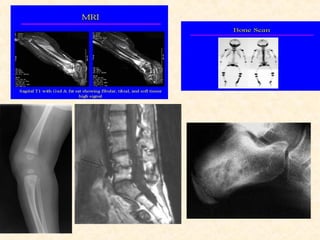
 X-ray –
 Radionuclide bone scans
 Computed tomography scan (Also called CT or CAT
scan.)
 Magnetic resonance imaging (MRI
 Ultrasound -
TREATMENT FOR
OSTEOMYELITIS:
 your age, overall health, and medical history
 extent of the condition
 your tolerance for specific medications, procedures, and therapies
 expectation for the course of the condition
 your opinion or preference
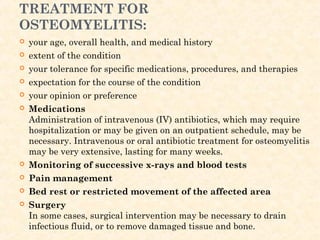
 Medications
Administration of intravenous (IV) antibiotics, which may require
hospitalization or may be given on an outpatient schedule, may be
necessary. Intravenous or oral antibiotic treatment for osteomyelitis
may be very extensive, lasting for many weeks.
 Monitoring of successive x-rays and blood tests
 Pain management
 Bed rest or restricted movement of the affected area
 Surgery
In some cases, surgical intervention may be necessary to drain
infectious fluid, or to remove damaged tissue and bone.
LONG-TERM CONSIDERATIONS FOR
OSTEOMYELITIS:
Osteomyelitis requires long-term care to
prevent further complications, including
care to prevent the following:
fractures of the affected bone
stunted growth in children (if the
infection has involved the growth plate)
gangrene infection in the affected area
SPECIFIC CLINICAL CONDITIONS:-
 VERTERBRAL OSTEOMYELITIS:-
 Vertebral osteomyelitis is most frequently of the
hematogenous type and usually involves the lower
dorsal and lumbar spine, occasional involvement
of the cervical spine has described
 OSTEOMYELITIS IN OTHER UNUSUAL
LOCATIONS:-
 Involvement of the sternoclavicular joint are has
been described intravenous drug abuses and in
patient with in dwelling intravenous devices.
ANAEROBIC OSTEOMYLITIS:-
Osteomylitis due to anaerobic organisms has been
described in a variety of clinical situation
OSTEOMYELITIS IN SICKLE CELL
ANEMIA:-
 Patients with homozygous sickle cell disease
who under all circumstances are subject to serve
salmonella infection often suffer from
osteomyelitis due to this organisms
CONT………….
 OSTEOMYELITIS IN DRUG ADDICTS:-
 Septic arthritis and osteomyelitis of long bones
are frequently found in drug addicts
 TUBERCULOSIS:-
 Osteomyelitis of long bones due to
mycobacterium tuberculosis has become a rarity
in industrialized countries but still has been
considered in patient with the combination of
localized bone destruction ,fistula and negative
bone cultures.
CONT……………
 BRODIE ABSCESS:-
Brodie abscess is characterized
by bone pain, low grade fever if
any, and a radio graphic pictures
of a central destruction and
rounded by sclerosis.75% of
cases occur in the lower
extremities ,
CONT………..
When conservative modalities fail to
control the infection ,surgical
intervention is indicated .Many
types of surgery are possible from
simple debridements to amputation.
Nursing Management of the patient
with osteomyelitis include the
following
 Use Aseptic technique during dressing
changes.
 Observing the patient for signs and
symptoms of systematic infection.
 Encouraging range of motion exercise to
prevent contractures ,and flexion
deformities.
 Administering antibiotics on time as
prescribed.
 Administering analgesics and /or
antipyretics as prescribed and monitoring
patient for effectiveness.
 Promoting rest of affected joint or limb
CONTD……………
 NURSING PRIORITIES:-
 
Bone pain.
Fever.
Nausea and Malaise.
Alteration in elimination.
Knowledge deficit.
Coping pattern.
Image disturbance.
Infection of bone

Infection of bone

  • 1.
    SEMINAR ON INFECTION OFBONE PRESENTED BY om verma
  • 2.
    DEFINITION  a bone. Infections can reacha bone by traveling through the bloodstream or spreading from nearby tissue. Infections can also begin in the bone itself if an injury exposes the bone to germs. In children, osteomyelitis most commonly affects the long bones of the legs and upper 
  • 4.
    SKELETAL SYSTEM The skeletalsystem comprises the bony framework of the body. It consist of 206 individual bones in the adult. Some bones are hinged and others are focused to one another. FUNCTIONS:-  > It supports body structure and provide shape to the body  > It protects the soft and delicate internal organs  >It allows movement and anchorage of muscles .  > It provides mineral storage  > It is the site for hemopoiesis
  • 5.
    STRUCTURE AND FORMATIONOF BONES Bone consist of microscopic cells called “osteocytes” (from the Greek word osteon,meaning bone”) .An osteocyte is a mature bone cell. Bone is made up of 35% organic material,65%in organic mineral salts and water  .A typical long bone consist of the following parts:-  The diaphysis (growing between)is the bones shaft or body the long  The epiphyses (growing over ) are the distal ends of the bone
  • 7.
    CONT………………………..  The metaphyses(meta- between ) are the regions in a mature bone where the diaphysis joins the epiphyses.  The articular cartilage it is a thin layer of hyaline cartilage covering the epiphysis where the bone forms an articulation(joint) with another bone.  The periosteum (around ) is a tough sheath of dense irregular connective tissue that surrounds the bone surface whenever it is not covered by articular cartilage  The medullary cavity (marrow or marrow cavity) is the space within the diaphysis that contains fatty yellow bone in
  • 8.
    CONT…………….  The Endostermis a thin membrane that lines the medullary cavity. BLOOD AND NERVE SUPPLY  Bone is richly supplied with blood .Blood vessels ,which are specially abundant in portion of bone containing red bone marrow pass into bones from the periosteum.
  • 9.
    INFECTION :-  Theterm infection is used to denote an inflammatory process caused by disease producing organisms
  • 10.
    SEPTIC ARTHRITIS:-  Septicarthritis (also known as pyogenic arthritis infection arthritis, septic joint disease ,bacterial arthritis ,and suppurative arthritis) is a closed space- infection caused by invasion of synovial membrane by pus forming bacteria or other pathogens.
  • 11.
    CONT……………  The presenceof septic arthritis typically reflect:-  The failure of multiple defense mechanism .In the early stage of infection  The synovial membrane swells and becomes infiltrated with neutrophils  A purulent effusion distends the joint as the neutrophils release lysosomal proteolytic enzymes that destroy the articular cartilage ,subchondrial bone, and joint capsule.  Enzymatic cartilage destruction can actually occur in 3 to 24 hours.
  • 12.
    ASSESMENT FOCUS ON:-  Diagnostic procedures.  IV drug abuse.  Systemic disease  Initial laboratory studies MANAGEMENT:-  Antibiotic therapy is a critical part of effective treatment of septic arthritis  Open synovectomy and debridement or repeated joint aspiration and irrigation may be performed  Anthroscopic drainage and debridement have also been successful
  • 13.
    OSTEOMYELITIS  Osteomyelitis isan inflammation or swelling of bone tissue that is usually the result of an infection. Osteomyelitis, or bone infection, may occur for many different reasons and can affect children or adults  Some of the causes of osteomyelitis include the following  Osteomyelitis may occur as a result of a bacterial bloodstream infection, sometimes called bacteremia, or sepsis, that spreads to the bone.    Osteomyelitis can also occur from a nearby infection due to a traumatic injury, frequent medication injections, a surgical procedure, or use of a prosthetic device.
  • 14.
    CONT…………  Individuals withweakened immune systems are more likely to develop osteomyelitis  Osteomyelitis can affect all populations from infants and children to the elderly. It is more common in infants, children, and older adults. Populations at increased risk include individuals with weakened immune systems, recent trauma, or diabetes.
  • 15.
    Contiguous-focus OsteomyelitisContiguous-focus Osteomyelitis Clinicalsetting:Clinical setting: Postoperative infectionPostoperative infection Contamination of boneContamination of bone Contiguous soft tissue infectionContiguous soft tissue infection Puncture woundsPuncture wounds
  • 16.
    Contiguous-focus OsteomyelitisContiguous-focus Osteomyelitis MicrobiologicfeaturesMicrobiologic features STAPHYLOCOCCISTAPHYLOCOCCI  AUREUS, EPIDERMIDISAUREUS, EPIDERMIDIS GRAM-NEGATIVE BACTERIAGRAM-NEGATIVE BACTERIA ANAEROBIC INFECTIONANAEROBIC INFECTION UNUSUAL ORGANISMSUNUSUAL ORGANISMS CLOSTRIDIA, NOCARDIACLOSTRIDIA, NOCARDIA
  • 17.
    HEMATOGENOUS OSTEOMYELITISHEMATOGENOUS OSTEOMYELITIS ClinicalmanifestationClinical manifestation Classic presentation: Sudden onsetClassic presentation: Sudden onset Usually presentation: Slow, insidiousUsually presentation: Slow, insidious High fever, Night sweatsHigh fever, Night sweats Fatigue, Anorexia, Weight lossFatigue, Anorexia, Weight loss Restriction of movementRestriction of movement LOCAL EDEMA, ERYTHEMA, & TENDERRNESSLOCAL EDEMA, ERYTHEMA, & TENDERRNESS
  • 18.
    HEMATOGENOUS OSTEOMYELITISHEMATOGENOUS OSTEOMYELITIS MicrobiologicfeaturesMicrobiologic features StaphylococciStaphylococci  Aureus, EpidermidisAureus, Epidermidis StreptococciStreptococci  Group A & BGroup A & B Haemophilus influenzaeHaemophilus influenzae Gram-negative enteric bacilliGram-negative enteric bacilli AnaerobesAnaerobes PolymicrobialPolymicrobial MycobacterialMycobacterial FungiFungi
  • 19.
    HEMATOGENOUS OSTEOMYELITISHEMATOGENOUS OSTEOMYELITIS SpecialconsiderationSpecial consideration Sickle cell diseaseSickle cell disease Injection drug users (IDUs)Injection drug users (IDUs) HemodialysisHemodialysis HIV/AIDSHIV/AIDS ImmunosuppressionImmunosuppression Prosthetic orthopedic deviceProsthetic orthopedic device
  • 20.
    PATHOPHYSIOLOGYPATHOPHYSIOLOGY Micro organisms enterboneMicro organisms enter bone (Phagocytosis).(Phagocytosis). Phagocyte contains the infectionPhagocyte contains the infection Release enzymesRelease enzymes Lyses boneLyses bone
  • 21.
    CONTD………….. Pus spreads intovascular channelsPus spreads into vascular channels Raising intraosseous pressureRaising intraosseous pressure Impairing blood flowImpairing blood flow Chronic ischemic necrosisChronic ischemic necrosis Separation of large devascularized fragmentSeparation of large devascularized fragment New bone formationNew bone formation (involucrum)(involucrum)
  • 22.
    THE SYMPTOMS OF OSTEOMYELITIS? Fever (the fever may be high when osteomyelitis occurs as the result of a blood infection)  Pain and tenderness in the affected area  Irritability  Feeling ill  Swelling of the affected area  Redness in the affected area  Warmth in the affected area  Difficulty moving joints near affected area  Difficulty bearing weight or walking  A new limp  A stiff back (with vertebral involvement)
  • 23.
    HOW IS OSTEOMYELITIS DIAGNOSED Blood tests  Complete blood count (CBC)  Erythrocyte sedimentation rate (ESR)  Reactive protein (CRP)  Needle aspiration or bone biopsy  X-ray –  Radionuclide bone scans  Computed tomography scan (Also called CT or CAT scan.)  Magnetic resonance imaging (MRI  Ultrasound -
  • 25.
    TREATMENT FOR OSTEOMYELITIS:  yourage, overall health, and medical history  extent of the condition  your tolerance for specific medications, procedures, and therapies  expectation for the course of the condition  your opinion or preference  Medications Administration of intravenous (IV) antibiotics, which may require hospitalization or may be given on an outpatient schedule, may be necessary. Intravenous or oral antibiotic treatment for osteomyelitis may be very extensive, lasting for many weeks.  Monitoring of successive x-rays and blood tests  Pain management  Bed rest or restricted movement of the affected area  Surgery In some cases, surgical intervention may be necessary to drain infectious fluid, or to remove damaged tissue and bone.
  • 26.
    LONG-TERM CONSIDERATIONS FOR OSTEOMYELITIS: Osteomyelitisrequires long-term care to prevent further complications, including care to prevent the following: fractures of the affected bone stunted growth in children (if the infection has involved the growth plate) gangrene infection in the affected area
  • 27.
    SPECIFIC CLINICAL CONDITIONS:- VERTERBRAL OSTEOMYELITIS:-  Vertebral osteomyelitis is most frequently of the hematogenous type and usually involves the lower dorsal and lumbar spine, occasional involvement of the cervical spine has described  OSTEOMYELITIS IN OTHER UNUSUAL LOCATIONS:-  Involvement of the sternoclavicular joint are has been described intravenous drug abuses and in patient with in dwelling intravenous devices.
  • 28.
    ANAEROBIC OSTEOMYLITIS:- Osteomylitis dueto anaerobic organisms has been described in a variety of clinical situation OSTEOMYELITIS IN SICKLE CELL ANEMIA:-  Patients with homozygous sickle cell disease who under all circumstances are subject to serve salmonella infection often suffer from osteomyelitis due to this organisms
  • 29.
    CONT………….  OSTEOMYELITIS INDRUG ADDICTS:-  Septic arthritis and osteomyelitis of long bones are frequently found in drug addicts  TUBERCULOSIS:-  Osteomyelitis of long bones due to mycobacterium tuberculosis has become a rarity in industrialized countries but still has been considered in patient with the combination of localized bone destruction ,fistula and negative bone cultures.
  • 30.
    CONT……………  BRODIE ABSCESS:- Brodieabscess is characterized by bone pain, low grade fever if any, and a radio graphic pictures of a central destruction and rounded by sclerosis.75% of cases occur in the lower extremities ,
  • 31.
    CONT……….. When conservative modalitiesfail to control the infection ,surgical intervention is indicated .Many types of surgery are possible from simple debridements to amputation. Nursing Management of the patient with osteomyelitis include the following
  • 32.
     Use Aseptictechnique during dressing changes.  Observing the patient for signs and symptoms of systematic infection.  Encouraging range of motion exercise to prevent contractures ,and flexion deformities.  Administering antibiotics on time as prescribed.  Administering analgesics and /or antipyretics as prescribed and monitoring patient for effectiveness.  Promoting rest of affected joint or limb
  • 33.
    CONTD……………  NURSING PRIORITIES:-   Bonepain. Fever. Nausea and Malaise. Alteration in elimination. Knowledge deficit. Coping pattern. Image disturbance.