Cryogenic Rocket Engine
 SHAILENDRA GAUTAM
 B. Tech 3rd year ME-B
 Roll No.- 36
CONTENTS
 MEANING OF CRYOGENICS
 INTRODUCTION
 HISTORY
 CRYOGENIC PROPELLANT
 PRINCIPLE
 CONSTRUCTION
 WORKING
 ADVANTAGES
 DRAWBACKS
 CONCLUSION
MEANING OF CRYOGENICS
 Cryogenics originated from two Greek words “Kyros”
which means cold or freezing and “genes” which
means born or produced
 Cryogenics is the study of very low temperatures or
the production of the same
 In physics, cryogenics is the study of the
operations at very low temperature (below −150 °C,
−238 °F or 123 K) and the behaviour of materials at
these temperatures.
CRYOGENIC TECHNOLOGY IN
ROCKET ENGINE
 Cryogenic technology involves the use of rocket
propellants at extremely low temperatures.
 The combination:- Liquid Oxygen (LOX) & Liquid
Hydrogen (LH2) offers the highest energy
efficiency for rocket engines.
 Oxygen remains at liquid only at temperatures
below -183 ° C and hydrogen below - 253 ° C.
INTRODUCTION
 Basically Rocket engines are Reaction engines.
 Use of cryogenic propellants (cryogenic fuel or
oxidizer) to produce thrust.
 Needs High mass flow rate of propellants.
 The liquid oxygen (LOx) oxidizer and liquid
hydrogen (LH2) fuel combination is one of the
most widely used.
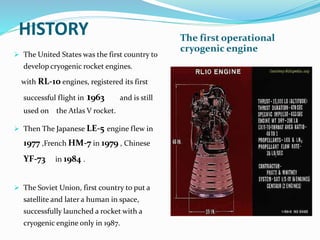
HISTORY The first operational
cryogenic engine
 The United States was the first country to
develop cryogenic rocket engines.
with RL-10 engines, registered its first
successful flight in 1963 and is still
used on the Atlas V rocket.
 Then The Japanese LE-5 engine flew in
1977 ,French HM-7 in 1979 , Chinese
YF-73 in 1984 .
 The Soviet Union, first country to put a
satellite and later a human in space,
successfully launched a rocket with a
cryogenic engine only in 1987.
Cont…….
(AMERICAN) - ATLAS V
(Russian) - N 1 [1969]
Cont….
 To India the U.S., Japan and France would either not provide the technology or do
so only at an exorbitant price.
 The 11D56 cryogenic engine had been developed for one of the upper stages of the
mammoth N1 rocket, the Soviet equivalent of Saturn V. But after four successive
launch failures, the N1 project was scrapped and its engines were mothballed.
 The deal violated the Missile Technology Control Regime, which was intended to
prevent the spread of missile-related technology, and fell foul of the U.S. laws
meant to enforce its provisions. Despite warnings from within the organization,
ISRO opted to go ahead with the import. In May 1992, the U.S. imposed sanctions
on ISRO and Glavkosmos. A year later, Russia, which received the contract
after the break-up of the Soviet Union, backed out of the deal.
Cont….
 ISRO then had no option but to develop the technology on its own.
 At the time, ISRO gave the impression that much of the technology
had already been acquired and further development would be quick.
 A GSLV with an indigenous cryogenic engine would be ready to fly in
about four years, Chairman U.R. Rao told in July 1993. Instead, it has
taken 16 years.
CRYOGENIC PROPELLANT
 In a cryogenic propellant the fuel and the oxidizer are
in the form of very cold, liquefied gases.
 Liquification done by cooling and compressing them
below cryogenic temperatures.
 We can vastly increase their density and make it
possible to store them in large quantities in smaller
tanks.
 The propellant combination used is that of LOx &
LH2.
 Liquid oxygen being the oxidizer and liquid hydrogen
being the fuel.
PRINCIPLE
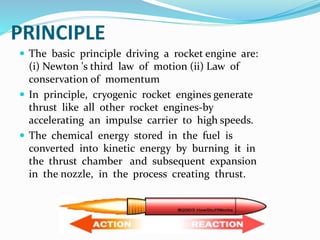
 The basic principle driving a rocket engine are:
(i) Newton 's third law of motion (ii) Law of
conservation of momentum
 In principle, cryogenic rocket engines generate
thrust like all other rocket engines-by
accelerating an impulse carrier to high speeds.
 The chemical energy stored in the fuel is
converted into kinetic energy by burning it in
the thrust chamber and subsequent expansion
in the nozzle, in the process creating thrust.
CONSTRUCTION
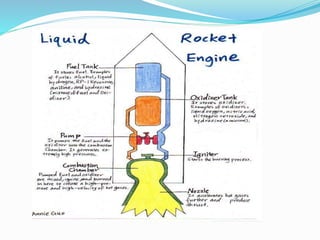
 The major components of a
cryogenic rocket engine
are:
 Combustion chamber
 Pyrotechnic igniters
 Fuel injector
 Fuel turbo-pumps
 Gas turbine
 Cryovalves
 Regulators
 External fuel tanks
 Nozzle
1.Rocket Engine Nozzle
A rocket engine nozzle is a propelling nozzle
used in a rocket engine to expand and accelerate
the combustion gases produced by burning
propellants so that the exhaust gases exit the nozzle
at hypersonic velocities.
2.Pyrotechnic igniter
A pyrotechnic initiator (also initiator or igniter) is
a device containing a pyrotechnic composition
used primarily to ignite other, more difficult-to-
ignite materials. Pyrotechnic initiators are often
controlled electrically (called electro-pyrotechnic
initiators)
3. THRUST CHEMBER
 The thrust chamber is the key subassembly of a rocket
engine.
 Here the liquid propellants are metered, injected, atomized,
vaporized, mixed, and burned to form hot reaction gas
products, which in turn are accelerated and ejected at high
velocity.
 A rocket thrust chamber assembly has an injector, a
combustion chamber, a supersonic nozzle, and mounting
provisions. All have to withstand the extreme heat of
combustion and the various forces, including the
transmission of the thrust force to the vehicle.
4.Cooling system
 Regenerative cooling curtain cooling or film cooling,
are employed to give longer nozzle and chamber life.
 5.CRYOPUMP
 A cryopump is a turbo pump powered by a flow
of fuel through gas turbines. Looking at this
aspect, engines can be differentiated into two:
i. Main Flow Configuration
ii. Bypass Flow Configuration
 6.CRYOGENIC VALVES
 There are 5 propellant valves in a CRE. The y are:
iOxidizer preburner oxidizer
ii. Fuel preburner oxidizer
iii. Main fuel
iv. Main oxidizer
v. Chamber coolant
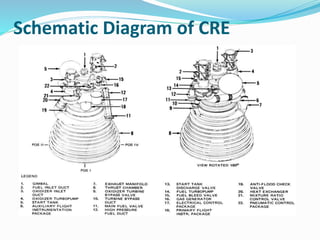
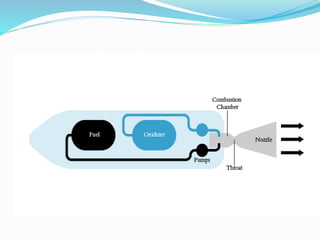
Schematic Diagram of CRE
WORKING
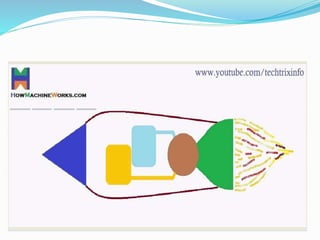
 Fuel and oxidizer from the external tank enters the orbiter
 orbiter's main propulsion system feed lines the fuel and
oxidizer each branch out into three parallel paths, to each
engine.
 An Oxidizer system provides regular supply of LOX . A
Hydrogen fuel system provides regular supply of LH2.
Pre-burners and thrust control system
 LH2 partially burnt with a little LOX in a gas generator.
The hot gases drive a turbo – pump and are then injected at
high pressure into the thrust chamber where the rest of
oxygen is introduced and full combustion takes place.
 Before going to the gas generator, the incredibly chilly
liquid hydrogen is used to cool the thrust chamber
ADVANTEGES
 High Energy per unit mass:
 Propellants like oxygen and hydrogen in liquid form
give very high amounts of energy per unit mass due
to which the amount of fuel to be carried aboard the
rockets decreases.
 Clean Fuels:
 Hydrogen and oxygen are extremely clean fuels. When
they combine, they give out only water. This water is
thrown out of the nozzle in form of very hot vapour
 Economical:
 Use of oxygen and and hydrogen as fuels is very
economical, as liquid oxygen costs be less than
gasoline.
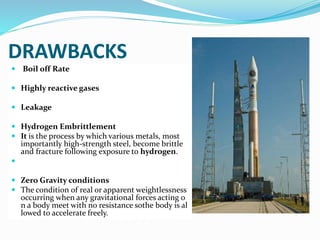
DRAWBACKS
 Boil off Rate
 Highly reactive gases
 Leakage
 Hydrogen Embrittlement
 It is the process by which various metals, most
importantly high-strength steel, become brittle
and fracture following exposure to hydrogen.

 Zero Gravity conditions
 The condition of real or apparent weightlessness
occurring when any gravitational forces acting o
n a body meet with no resistance sothe body is al
lowed to accelerate freely.
BOIL OFF RATE
 The "Boil off rate" usually refers to the amount of
liquid vaporized by heat leaking into the tank per unit
time.
 Anyway it indicates that to maintain the same
pressure in the tank you need to vent at least this
amount of equivalent liquid or vapor. Less and you
will build pressure, more will result in a drop in
pressure in the tank, unless you have a vaporizer.
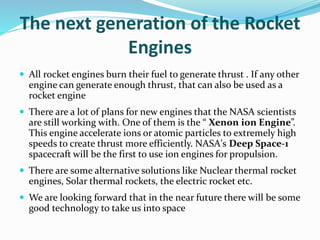
The next generation of the Rocket
Engines
 All rocket engines burn their fuel to generate thrust . If any other
engine can generate enough thrust, that can also be used as a
rocket engine
 There are a lot of plans for new engines that the NASA scientists
are still working with. One of them is the “ Xenon ion Engine”.
This engine accelerate ions or atomic particles to extremely high
speeds to create thrust more efficiently. NASA's Deep Space-1
spacecraft will be the first to use ion engines for propulsion.
 There are some alternative solutions like Nuclear thermal rocket
engines, Solar thermal rockets, the electric rocket etc.
 We are looking forward that in the near future there will be some
good technology to take us into space
REFERENCES
 w w w . g o o g l e . c o . i n / i m a g e s /cryogenicrocketengine
 http://en.wikipedia.org/wiki/Cryogenic_rocket_engine
 http://functionspace.org/topic/148/How-does-a-cryogenic-engine-
works-
http://ijmerr.com/ijmerradmin/upload/ijmerr_524d2de3c3ea4.pdf
Cryogenic rocket engine

Cryogenic rocket engine

  • 1.
    Cryogenic Rocket Engine SHAILENDRA GAUTAM  B. Tech 3rd year ME-B  Roll No.- 36
  • 2.
    CONTENTS  MEANING OFCRYOGENICS  INTRODUCTION  HISTORY  CRYOGENIC PROPELLANT  PRINCIPLE  CONSTRUCTION  WORKING  ADVANTAGES  DRAWBACKS  CONCLUSION
  • 3.
    MEANING OF CRYOGENICS Cryogenics originated from two Greek words “Kyros” which means cold or freezing and “genes” which means born or produced  Cryogenics is the study of very low temperatures or the production of the same  In physics, cryogenics is the study of the operations at very low temperature (below −150 °C, −238 °F or 123 K) and the behaviour of materials at these temperatures.
  • 4.
    CRYOGENIC TECHNOLOGY IN ROCKETENGINE  Cryogenic technology involves the use of rocket propellants at extremely low temperatures.  The combination:- Liquid Oxygen (LOX) & Liquid Hydrogen (LH2) offers the highest energy efficiency for rocket engines.  Oxygen remains at liquid only at temperatures below -183 ° C and hydrogen below - 253 ° C.
  • 5.
    INTRODUCTION  Basically Rocketengines are Reaction engines.  Use of cryogenic propellants (cryogenic fuel or oxidizer) to produce thrust.  Needs High mass flow rate of propellants.  The liquid oxygen (LOx) oxidizer and liquid hydrogen (LH2) fuel combination is one of the most widely used.
  • 6.
    HISTORY The firstoperational cryogenic engine  The United States was the first country to develop cryogenic rocket engines. with RL-10 engines, registered its first successful flight in 1963 and is still used on the Atlas V rocket.  Then The Japanese LE-5 engine flew in 1977 ,French HM-7 in 1979 , Chinese YF-73 in 1984 .  The Soviet Union, first country to put a satellite and later a human in space, successfully launched a rocket with a cryogenic engine only in 1987.
  • 7.
    Cont……. (AMERICAN) - ATLASV (Russian) - N 1 [1969]
  • 8.
    Cont….  To Indiathe U.S., Japan and France would either not provide the technology or do so only at an exorbitant price.  The 11D56 cryogenic engine had been developed for one of the upper stages of the mammoth N1 rocket, the Soviet equivalent of Saturn V. But after four successive launch failures, the N1 project was scrapped and its engines were mothballed.  The deal violated the Missile Technology Control Regime, which was intended to prevent the spread of missile-related technology, and fell foul of the U.S. laws meant to enforce its provisions. Despite warnings from within the organization, ISRO opted to go ahead with the import. In May 1992, the U.S. imposed sanctions on ISRO and Glavkosmos. A year later, Russia, which received the contract after the break-up of the Soviet Union, backed out of the deal.
  • 9.
    Cont….  ISRO thenhad no option but to develop the technology on its own.  At the time, ISRO gave the impression that much of the technology had already been acquired and further development would be quick.  A GSLV with an indigenous cryogenic engine would be ready to fly in about four years, Chairman U.R. Rao told in July 1993. Instead, it has taken 16 years.
  • 10.
    CRYOGENIC PROPELLANT  Ina cryogenic propellant the fuel and the oxidizer are in the form of very cold, liquefied gases.  Liquification done by cooling and compressing them below cryogenic temperatures.  We can vastly increase their density and make it possible to store them in large quantities in smaller tanks.  The propellant combination used is that of LOx & LH2.  Liquid oxygen being the oxidizer and liquid hydrogen being the fuel.
  • 11.
    PRINCIPLE  The basicprinciple driving a rocket engine are: (i) Newton 's third law of motion (ii) Law of conservation of momentum  In principle, cryogenic rocket engines generate thrust like all other rocket engines-by accelerating an impulse carrier to high speeds.  The chemical energy stored in the fuel is converted into kinetic energy by burning it in the thrust chamber and subsequent expansion in the nozzle, in the process creating thrust.
  • 13.
    CONSTRUCTION  The majorcomponents of a cryogenic rocket engine are:  Combustion chamber  Pyrotechnic igniters  Fuel injector  Fuel turbo-pumps  Gas turbine  Cryovalves  Regulators  External fuel tanks  Nozzle
  • 14.
    1.Rocket Engine Nozzle Arocket engine nozzle is a propelling nozzle used in a rocket engine to expand and accelerate the combustion gases produced by burning propellants so that the exhaust gases exit the nozzle at hypersonic velocities. 2.Pyrotechnic igniter A pyrotechnic initiator (also initiator or igniter) is a device containing a pyrotechnic composition used primarily to ignite other, more difficult-to- ignite materials. Pyrotechnic initiators are often controlled electrically (called electro-pyrotechnic initiators)
  • 15.
    3. THRUST CHEMBER The thrust chamber is the key subassembly of a rocket engine.  Here the liquid propellants are metered, injected, atomized, vaporized, mixed, and burned to form hot reaction gas products, which in turn are accelerated and ejected at high velocity.  A rocket thrust chamber assembly has an injector, a combustion chamber, a supersonic nozzle, and mounting provisions. All have to withstand the extreme heat of combustion and the various forces, including the transmission of the thrust force to the vehicle. 4.Cooling system  Regenerative cooling curtain cooling or film cooling, are employed to give longer nozzle and chamber life.
  • 16.
     5.CRYOPUMP  Acryopump is a turbo pump powered by a flow of fuel through gas turbines. Looking at this aspect, engines can be differentiated into two: i. Main Flow Configuration ii. Bypass Flow Configuration  6.CRYOGENIC VALVES  There are 5 propellant valves in a CRE. The y are: iOxidizer preburner oxidizer ii. Fuel preburner oxidizer iii. Main fuel iv. Main oxidizer v. Chamber coolant
  • 17.
  • 18.
    WORKING  Fuel andoxidizer from the external tank enters the orbiter  orbiter's main propulsion system feed lines the fuel and oxidizer each branch out into three parallel paths, to each engine.  An Oxidizer system provides regular supply of LOX . A Hydrogen fuel system provides regular supply of LH2. Pre-burners and thrust control system  LH2 partially burnt with a little LOX in a gas generator. The hot gases drive a turbo – pump and are then injected at high pressure into the thrust chamber where the rest of oxygen is introduced and full combustion takes place.  Before going to the gas generator, the incredibly chilly liquid hydrogen is used to cool the thrust chamber
  • 21.
    ADVANTEGES  High Energyper unit mass:  Propellants like oxygen and hydrogen in liquid form give very high amounts of energy per unit mass due to which the amount of fuel to be carried aboard the rockets decreases.  Clean Fuels:  Hydrogen and oxygen are extremely clean fuels. When they combine, they give out only water. This water is thrown out of the nozzle in form of very hot vapour  Economical:  Use of oxygen and and hydrogen as fuels is very economical, as liquid oxygen costs be less than gasoline.
  • 22.
    DRAWBACKS  Boil offRate  Highly reactive gases  Leakage  Hydrogen Embrittlement  It is the process by which various metals, most importantly high-strength steel, become brittle and fracture following exposure to hydrogen.   Zero Gravity conditions  The condition of real or apparent weightlessness occurring when any gravitational forces acting o n a body meet with no resistance sothe body is al lowed to accelerate freely.
  • 23.
    BOIL OFF RATE The "Boil off rate" usually refers to the amount of liquid vaporized by heat leaking into the tank per unit time.  Anyway it indicates that to maintain the same pressure in the tank you need to vent at least this amount of equivalent liquid or vapor. Less and you will build pressure, more will result in a drop in pressure in the tank, unless you have a vaporizer.
  • 24.
    The next generationof the Rocket Engines  All rocket engines burn their fuel to generate thrust . If any other engine can generate enough thrust, that can also be used as a rocket engine  There are a lot of plans for new engines that the NASA scientists are still working with. One of them is the “ Xenon ion Engine”. This engine accelerate ions or atomic particles to extremely high speeds to create thrust more efficiently. NASA's Deep Space-1 spacecraft will be the first to use ion engines for propulsion.  There are some alternative solutions like Nuclear thermal rocket engines, Solar thermal rockets, the electric rocket etc.  We are looking forward that in the near future there will be some good technology to take us into space
  • 26.
    REFERENCES  w ww . g o o g l e . c o . i n / i m a g e s /cryogenicrocketengine  http://en.wikipedia.org/wiki/Cryogenic_rocket_engine  http://functionspace.org/topic/148/How-does-a-cryogenic-engine- works- http://ijmerr.com/ijmerradmin/upload/ijmerr_524d2de3c3ea4.pdf