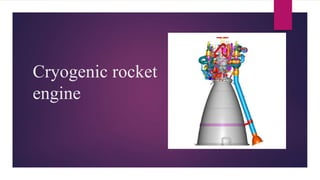
Cryogenic rocket
engine
CONTENTS
1. Cryogenic
2. Introduction
3. History of cryogenic
4. Construction
5. Working principle
6. Application
7. Advantage
8. Disadvantage
9. Conclusions
CRYOGENIC
Cryogenic is derived from greek , Kryos means cold , genes means
production.
Cryogenic is the study of production and behavior of materials at very
low temperature (Below 150*C ,123*K,-238*F)
 Oxygen liquefies at -183*C
 Hydrogen liquefies at -253*C
INTRODUCTION
1. A cryogenic rocket engine is a engine which use cryogenic fuel.
2. Cryogenic fuel are fuel that requires storage at extremely low
temperature in order to maintain the in a liquid state.
3. Various cryogenic fuel-oxidizer combination have been fired but
the combination of liquid hydrogen (LH2), and the liquid oxygen
(LOX) oxidizer is most used.
RL-10
 The RL-10 was the first liquid Hydrogen
Cryogenic engine to nr built in the
United States, and development of the
engine by Marshall Space Flight Center
and Pratt & Whitney began in the 1950s,
with the first flight occurring in 1961
 These engines were one of the main
factors of NASA's success in reaching
the Moon by the Saturn V rocket
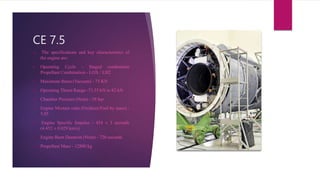
CE 7.5
 The specifications and key characteristics of
the engine are:
 Operating Cycle - Staged combustion
Propellant Combination - LOX / LH2
 Maximum thrust (Vacuum) - 75 KN
 Operating Thrust Range -73.55 kN to 82 kN
 Chamber Pressure (Nom) - 58 bar
 Engine Mixture ratio (Oxidizer/Fuel by mass) -
5.05
 Engine Specific Impulse - 454 ± 3 seconds
(4.452 ± 0.029 km/s)
 Engine Burn Duration (Nom) - 720 seconds
 Propellant Mass - 12800 kg
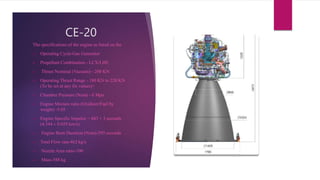
CE-20
The specifications of the engine as listed on the
 Operating Cycle-Gas Generator
 Propellant Combination - LCX/LHE
 Thrust Nominal (Vacuum) - 200 KN
 Operating Thrust Range - 180 KN to 220 KN
(To be set at any fix values)>
 Chamber Pressure (Nom) - 6 Mpa
 Engine Mixture ratio (Oxidizer/Fuel by
weight) -5.05
 Engine Specific Impulse = 443 + 3 seconds
(4.344 ± 0.029 km/s)
 Engine Burn Duration (Nom)-595 seconds
 Total Flow rate-462 kg/s
 Nozzle Area ratio-100
 Mass-588 kg
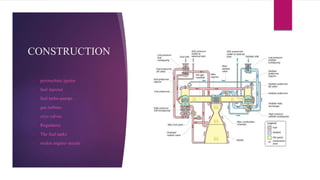
CONSTRUCTION
 pyrotechnic igniter
 fuel injector
 fuel turbo-pumps
 gas turbine-
 cryo valves
 Regulators
 The fuel tanks
 rocket engine- nozzle

Cryogenic rocket engine.pptx

  • 1.
  • 2.
    CONTENTS 1. Cryogenic 2. Introduction 3.History of cryogenic 4. Construction 5. Working principle 6. Application 7. Advantage 8. Disadvantage 9. Conclusions
  • 3.
    CRYOGENIC Cryogenic is derivedfrom greek , Kryos means cold , genes means production. Cryogenic is the study of production and behavior of materials at very low temperature (Below 150*C ,123*K,-238*F)  Oxygen liquefies at -183*C  Hydrogen liquefies at -253*C
  • 4.
    INTRODUCTION 1. A cryogenicrocket engine is a engine which use cryogenic fuel. 2. Cryogenic fuel are fuel that requires storage at extremely low temperature in order to maintain the in a liquid state. 3. Various cryogenic fuel-oxidizer combination have been fired but the combination of liquid hydrogen (LH2), and the liquid oxygen (LOX) oxidizer is most used.
  • 5.
    RL-10  The RL-10was the first liquid Hydrogen Cryogenic engine to nr built in the United States, and development of the engine by Marshall Space Flight Center and Pratt & Whitney began in the 1950s, with the first flight occurring in 1961  These engines were one of the main factors of NASA's success in reaching the Moon by the Saturn V rocket
  • 6.
    CE 7.5  Thespecifications and key characteristics of the engine are:  Operating Cycle - Staged combustion Propellant Combination - LOX / LH2  Maximum thrust (Vacuum) - 75 KN  Operating Thrust Range -73.55 kN to 82 kN  Chamber Pressure (Nom) - 58 bar  Engine Mixture ratio (Oxidizer/Fuel by mass) - 5.05  Engine Specific Impulse - 454 ± 3 seconds (4.452 ± 0.029 km/s)  Engine Burn Duration (Nom) - 720 seconds  Propellant Mass - 12800 kg
  • 7.
    CE-20 The specifications ofthe engine as listed on the  Operating Cycle-Gas Generator  Propellant Combination - LCX/LHE  Thrust Nominal (Vacuum) - 200 KN  Operating Thrust Range - 180 KN to 220 KN (To be set at any fix values)>  Chamber Pressure (Nom) - 6 Mpa  Engine Mixture ratio (Oxidizer/Fuel by weight) -5.05  Engine Specific Impulse = 443 + 3 seconds (4.344 ± 0.029 km/s)  Engine Burn Duration (Nom)-595 seconds  Total Flow rate-462 kg/s  Nozzle Area ratio-100  Mass-588 kg
  • 9.
    CONSTRUCTION  pyrotechnic igniter fuel injector  fuel turbo-pumps  gas turbine-  cryo valves  Regulators  The fuel tanks  rocket engine- nozzle