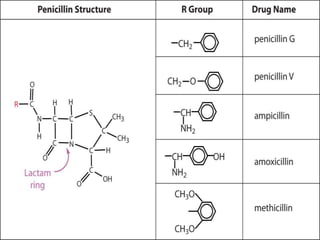

PENICILLINS
S.SEETARAM SWAMY, M.Pharm.,
Asst. professor,
Dept. of Pharmaceutical Chemistry,
Chilkur Balaji College of Pharmacy.
E-mail:seetaram.443@gmail.com
INTRODUCTION
HISTORY
MECHANISM OF ACTION
CHEMISTRY
CLASSIFICATION
STRUCTURAL ACTIVITY RELATIONSHIP
ADVERSE EFFECTS
USES
CONTENTS
INTRODUCTION
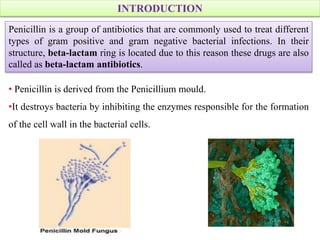
• Penicillin is derived from the Penicillium mould.
•It destroys bacteria by inhibiting the enzymes responsible for the formation
of the cell wall in the bacterial cells.
Penicillin is a group of antibiotics that are commonly used to treat different
types of gram positive and gram negative bacterial infections. In their
structure, beta-lactam ring is located due to this reason these drugs are also
called as beta-lactam antibiotics.
HISTORY
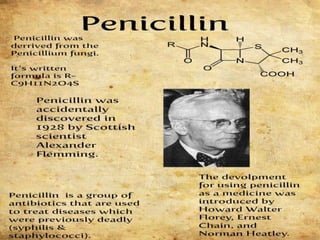
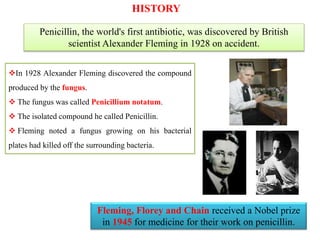
Penicillin, the world's first antibiotic, was discovered by British
scientist Alexander Fleming in 1928 on accident.
In 1928 Alexander Fleming discovered the compound
produced by the fungus.
 The fungus was called Penicillium notatum.
 The isolated compound he called Penicillin.
 Fleming noted a fungus growing on his bacterial
plates had killed off the surrounding bacteria.
Fleming, Florey and Chain received a Nobel prize
in 1945 for medicine for their work on penicillin.
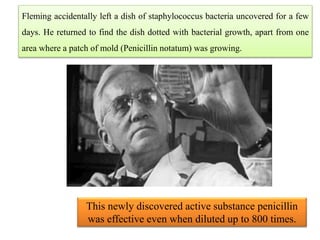
Fleming accidentally left a dish of staphylococcus bacteria uncovered for a few
days. He returned to find the dish dotted with bacterial growth, apart from one
area where a patch of mold (Penicillin notatum) was growing.
This newly discovered active substance penicillin
was effective even when diluted up to 800 times.
Penicillins as well as cephalosporins are called beta-lactam antibiotics
and are characterized by three fundamental structural requirements:
The fused beta-lactam & Thiazolidine ring structure.
A free carboxyl acid group.
One or more substituted amino acid side chains.
STRUCTURE
CHEMISTRY OF PENICILLINS
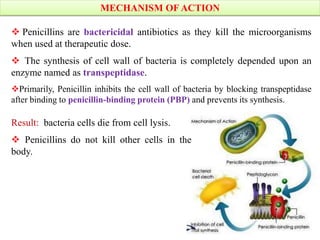
Result: bacteria cells die from cell lysis.
 Penicillins do not kill other cells in the
body.
MECHANISM OF ACTION
 Penicillins are bactericidal antibiotics as they kill the microorganisms
when used at therapeutic dose.
 The synthesis of cell wall of bacteria is completely depended upon an
enzyme named as transpeptidase.
Primarily, Penicillin inhibits the cell wall of bacteria by blocking transpeptidase
after binding to penicillin-binding protein (PBP) and prevents its synthesis.
N
S
NH
COOH
O
COR
1
2
34
56
7
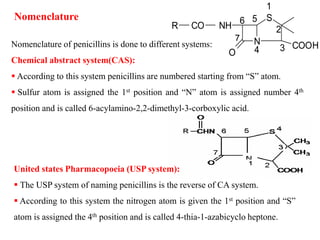
Nomenclature of penicillins is done to different systems:
Chemical abstract system(CAS):
 According to this system penicillins are numbered starting from “S” atom.
 Sulfur atom is assigned the 1st position and “N” atom is assigned number 4th
position and is called 6-acylamino-2,2-dimethyl-3-corboxylic acid.
Nomenclature
United states Pharmacopoeia (USP system):
 The USP system of naming penicillins is the reverse of CA system.
 According to this system the nitrogen atom is given the 1st position and “S”
atom is assigned the 4th position and is called 4-thia-1-azabicyclo heptone.
N
S
O
H
NC
O
R
Penicillin
CH3
CH3
COOH
N
S
Penillic acid
CH3
CH3
COOH
H
C
N
HOOC
C
R
Dilute acid
H / HgCl2
HN
S
COOH
H
NC
O
R
Penicilloic acid
CH3
CH3
COOH
HN
S
COOCH3
H
NC
O
R
Penicilloic acid
CH3
CH3
COOH
HN
S
H
NC
O
R
Penilloic acid
CH3
CH3
COOH
H2
C
CHO
H2N
HS
H
C
COOCH3
H
NC
O
R
Methylpenaldate
CH3
CH3
COOH
Penicillamine
Acidic PH
A
lkaline
PH
N
aO
H
lactam
ase
/Pencillinase
CH3
O
H
Decarboxylation
HgCl2
N
S
O
H2N
6-APA
CH3
CH3
COOH
Am
idase
Penilloaldehyde Penicillamine
CHEMICAL
DEGRADATION OF
PENICILLINS
CLASSIFICATION OF PENICILLINS ON THE BASIS OF
SOURCE ROUTE OF
ADMINISTRATION
SPECTRUM OF
ACTIVITY
RESISTANCE TO
ENZYMES
RESISTANCE
TO ACIDS
NATURAL
Penicillin-G
Penicillin-V
SEMI-
SYNTHETIC
Oxacillin
Cloxacillin
Dicloxacillin
Methicillin
Nafcillin
Ampicillin
Amoxycillin
Carbencillin
Piperacillin
ORAL
Ampicillin
Amoxycillin
Penicillin-V
Oxacillin
Cloxacillin
Dicloxacillin
PARENTERAL
Penicillin-G
Methicillin
Nafcillin
Carbencillin
Piperacillin
Ticarcillin
NARROW
SPECTRUM
Methicillin
Oxacillin
Nafcillin
Dicloxacillin
BROAD
SPECTRUM
Ampicillin
Amoxycillin
INTERMEDIATE
SPECTRUM
Penicillin-G
Penicillin-V
EXTENDED
SPECTRUM
Carbencillin
Ticarcillin
Piperacillin
Mezlocillin
RESISTANCE TO
β-LACTAMASE
Methicillin
Nafcillin
Oxacillin
Cloxacillin
Dicloxacillin
NON-
RESISTANCE TO
β-LACTAMASE
Penicillin-G
Penicillin-V
Ampicillin
Amoxycillin
Carbencillin
ACID
STABLE
Penicillin-V
Ampicillin
Amoxycillin
Oxacillin
Cloxacillin
Dicloxacillin
ACID
UNSTABLE
Penicillin-G
Methicillin
Nafcillin
Carbencillin
Piperacillin
Ticarcillin
Position 1 – When the sulfur atom of the Thiazolidine ring is oxidized to
a sulfone or sulfoxide, it improves acid stability, but decreases the activity of
the agent.
Position 2 – No substitutions allow at this position, any change will lower
activity. The methyl groups are necessary
Position 3 – The carboxylic acid of the Thiazolidine is required for activity. If
it is changed to an alcohol or ester, activity is decreased.
Position 4 – The nitrogen is a must.
Position 5 – No substitutions allowed.
Structural Activity Relationship (SAR)
N
S CH3
CH3
O
H
COOH
N
O
R
H
B A
1
2
3
5
4
6
7
Position 7 – The carbonyl on the Beta-lactam ring is a must.
Position 6 – Substitutions are allowed on the side chain of the amide.
An electron withdrawing group added at this position will give the
compound better acid stability because this substitution will make the
amide oxygen less nucleophillic.
A bulky group added close to the ring will make the compound more
resistant to Beta-lactamases.
Steric hindrance provides protect to the Beta-lactam ring.
N
S
HH
O
COOH
N
H
H
O
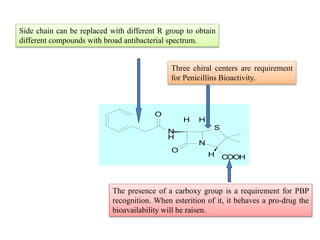
The presence of a carboxy group is a requirement for PBP
recognition. When esterition of it, it behaves a pro-drug the
bioavailability will be raisen.
Side chain can be replaced with different R group to obtain
different compounds with broad antibacterial spectrum.
Three chiral centers are requirement
for Penicillins Bioactivity.
N
S
O
H
NC
O
R
Penicillin
CH3
CH3
COOH
N
S
O
H2N
6-APA
CH3
CH3
COOH
Penicillin acylase /
Penicillin amidase
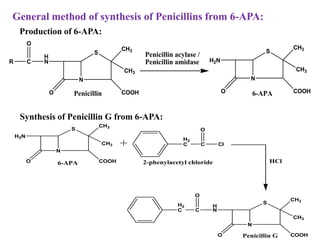
General method of synthesis of Penicillins from 6-APA:
Production of 6-APA:
Synthesis of Penicillin G from 6-APA:
N
S
O
H2N
6-APA
CH3
CH3
COOH
H2
C C
O
Cl
2-phenylacetyl chloride
N
S
O
H
NC
O
H2
C
Penicillin G
CH3
CH3
COOH
HCl
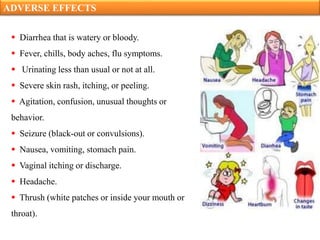
ADVERSE EFFECTS
 Diarrhea that is watery or bloody.
 Fever, chills, body aches, flu symptoms.
 Urinating less than usual or not at all.
 Severe skin rash, itching, or peeling.
 Agitation, confusion, unusual thoughts or
behavior.
 Seizure (black-out or convulsions).
 Nausea, vomiting, stomach pain.
 Vaginal itching or discharge.
 Headache.
 Thrush (white patches or inside your mouth or
throat).
 Pneumococcal Infections.
A) Pneumococcal Meningitis
B) Pneumococcal Pneumonia
 Streptococcal Infections.
Streptococcal Pharyngitis (including Scarlet Fever)
 Streptococcal Pneumonia, Arthritis, Meningitis, and
Endocarditis.
 Staphylococcal Infections.
 Meningococcal Infections.
 Gonococcal Infections.
 Syphilis.
 Diphtheria.
 Anthrax.
 Clostridia Infections.
 Surgical Procedures in Patients with Valvular Heart Disease.
THERAPEUTIC USES
Penicillins

Penicillins

  • 1.
    PENICILLINS S.SEETARAM SWAMY, M.Pharm., Asst.professor, Dept. of Pharmaceutical Chemistry, Chilkur Balaji College of Pharmacy. E-mail:seetaram.443@gmail.com
  • 2.
  • 4.
    INTRODUCTION • Penicillin isderived from the Penicillium mould. •It destroys bacteria by inhibiting the enzymes responsible for the formation of the cell wall in the bacterial cells. Penicillin is a group of antibiotics that are commonly used to treat different types of gram positive and gram negative bacterial infections. In their structure, beta-lactam ring is located due to this reason these drugs are also called as beta-lactam antibiotics.
  • 5.
    HISTORY Penicillin, the world'sfirst antibiotic, was discovered by British scientist Alexander Fleming in 1928 on accident. In 1928 Alexander Fleming discovered the compound produced by the fungus.  The fungus was called Penicillium notatum.  The isolated compound he called Penicillin.  Fleming noted a fungus growing on his bacterial plates had killed off the surrounding bacteria. Fleming, Florey and Chain received a Nobel prize in 1945 for medicine for their work on penicillin.
  • 6.
    Fleming accidentally lefta dish of staphylococcus bacteria uncovered for a few days. He returned to find the dish dotted with bacterial growth, apart from one area where a patch of mold (Penicillin notatum) was growing. This newly discovered active substance penicillin was effective even when diluted up to 800 times.
  • 8.
    Penicillins as wellas cephalosporins are called beta-lactam antibiotics and are characterized by three fundamental structural requirements: The fused beta-lactam & Thiazolidine ring structure. A free carboxyl acid group. One or more substituted amino acid side chains. STRUCTURE CHEMISTRY OF PENICILLINS
  • 9.
    Result: bacteria cellsdie from cell lysis.  Penicillins do not kill other cells in the body. MECHANISM OF ACTION  Penicillins are bactericidal antibiotics as they kill the microorganisms when used at therapeutic dose.  The synthesis of cell wall of bacteria is completely depended upon an enzyme named as transpeptidase. Primarily, Penicillin inhibits the cell wall of bacteria by blocking transpeptidase after binding to penicillin-binding protein (PBP) and prevents its synthesis.
  • 10.
    N S NH COOH O COR 1 2 34 56 7 Nomenclature of penicillinsis done to different systems: Chemical abstract system(CAS):  According to this system penicillins are numbered starting from “S” atom.  Sulfur atom is assigned the 1st position and “N” atom is assigned number 4th position and is called 6-acylamino-2,2-dimethyl-3-corboxylic acid. Nomenclature United states Pharmacopoeia (USP system):  The USP system of naming penicillins is the reverse of CA system.  According to this system the nitrogen atom is given the 1st position and “S” atom is assigned the 4th position and is called 4-thia-1-azabicyclo heptone.
  • 11.
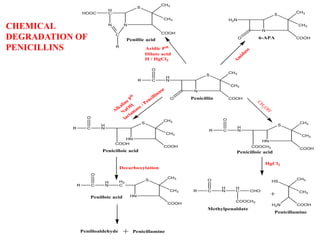
    N S O H NC O R Penicillin CH3 CH3 COOH N S Penillic acid CH3 CH3 COOH H C N HOOC C R Dilute acid H/ HgCl2 HN S COOH H NC O R Penicilloic acid CH3 CH3 COOH HN S COOCH3 H NC O R Penicilloic acid CH3 CH3 COOH HN S H NC O R Penilloic acid CH3 CH3 COOH H2 C CHO H2N HS H C COOCH3 H NC O R Methylpenaldate CH3 CH3 COOH Penicillamine Acidic PH A lkaline PH N aO H lactam ase /Pencillinase CH3 O H Decarboxylation HgCl2 N S O H2N 6-APA CH3 CH3 COOH Am idase Penilloaldehyde Penicillamine CHEMICAL DEGRADATION OF PENICILLINS
  • 12.
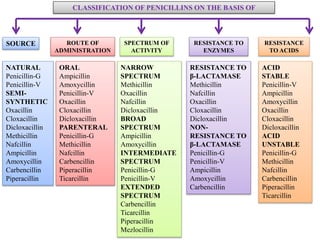
    CLASSIFICATION OF PENICILLINSON THE BASIS OF SOURCE ROUTE OF ADMINISTRATION SPECTRUM OF ACTIVITY RESISTANCE TO ENZYMES RESISTANCE TO ACIDS NATURAL Penicillin-G Penicillin-V SEMI- SYNTHETIC Oxacillin Cloxacillin Dicloxacillin Methicillin Nafcillin Ampicillin Amoxycillin Carbencillin Piperacillin ORAL Ampicillin Amoxycillin Penicillin-V Oxacillin Cloxacillin Dicloxacillin PARENTERAL Penicillin-G Methicillin Nafcillin Carbencillin Piperacillin Ticarcillin NARROW SPECTRUM Methicillin Oxacillin Nafcillin Dicloxacillin BROAD SPECTRUM Ampicillin Amoxycillin INTERMEDIATE SPECTRUM Penicillin-G Penicillin-V EXTENDED SPECTRUM Carbencillin Ticarcillin Piperacillin Mezlocillin RESISTANCE TO β-LACTAMASE Methicillin Nafcillin Oxacillin Cloxacillin Dicloxacillin NON- RESISTANCE TO β-LACTAMASE Penicillin-G Penicillin-V Ampicillin Amoxycillin Carbencillin ACID STABLE Penicillin-V Ampicillin Amoxycillin Oxacillin Cloxacillin Dicloxacillin ACID UNSTABLE Penicillin-G Methicillin Nafcillin Carbencillin Piperacillin Ticarcillin
  • 14.
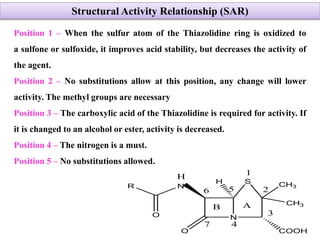
    Position 1 –When the sulfur atom of the Thiazolidine ring is oxidized to a sulfone or sulfoxide, it improves acid stability, but decreases the activity of the agent. Position 2 – No substitutions allow at this position, any change will lower activity. The methyl groups are necessary Position 3 – The carboxylic acid of the Thiazolidine is required for activity. If it is changed to an alcohol or ester, activity is decreased. Position 4 – The nitrogen is a must. Position 5 – No substitutions allowed. Structural Activity Relationship (SAR) N S CH3 CH3 O H COOH N O R H B A 1 2 3 5 4 6 7
  • 15.
    Position 7 –The carbonyl on the Beta-lactam ring is a must. Position 6 – Substitutions are allowed on the side chain of the amide. An electron withdrawing group added at this position will give the compound better acid stability because this substitution will make the amide oxygen less nucleophillic. A bulky group added close to the ring will make the compound more resistant to Beta-lactamases. Steric hindrance provides protect to the Beta-lactam ring.
  • 16.
    N S HH O COOH N H H O The presence ofa carboxy group is a requirement for PBP recognition. When esterition of it, it behaves a pro-drug the bioavailability will be raisen. Side chain can be replaced with different R group to obtain different compounds with broad antibacterial spectrum. Three chiral centers are requirement for Penicillins Bioactivity.
  • 17.
    N S O H NC O R Penicillin CH3 CH3 COOH N S O H2N 6-APA CH3 CH3 COOH Penicillin acylase / Penicillinamidase General method of synthesis of Penicillins from 6-APA: Production of 6-APA: Synthesis of Penicillin G from 6-APA: N S O H2N 6-APA CH3 CH3 COOH H2 C C O Cl 2-phenylacetyl chloride N S O H NC O H2 C Penicillin G CH3 CH3 COOH HCl
  • 18.
    ADVERSE EFFECTS  Diarrheathat is watery or bloody.  Fever, chills, body aches, flu symptoms.  Urinating less than usual or not at all.  Severe skin rash, itching, or peeling.  Agitation, confusion, unusual thoughts or behavior.  Seizure (black-out or convulsions).  Nausea, vomiting, stomach pain.  Vaginal itching or discharge.  Headache.  Thrush (white patches or inside your mouth or throat).
  • 19.
     Pneumococcal Infections. A)Pneumococcal Meningitis B) Pneumococcal Pneumonia  Streptococcal Infections. Streptococcal Pharyngitis (including Scarlet Fever)  Streptococcal Pneumonia, Arthritis, Meningitis, and Endocarditis.  Staphylococcal Infections.  Meningococcal Infections.  Gonococcal Infections.  Syphilis.  Diphtheria.  Anthrax.  Clostridia Infections.  Surgical Procedures in Patients with Valvular Heart Disease. THERAPEUTIC USES