MEDICINAL CHEMISTRY-III (BP-601T) - B Pharmacy - VI Sem
ARUNAI COLLEGE OF PHARMACY - Tiruvannamalai
Unit 1 - ANTIBIOTIC Part 3 – PENICILLIN’S
Approved by PHARMACY COUNCIL OF INDIA – New delhi
Affiliated to THE TAMILNADU DR MGR MEDICAL UNIVERSITY - Chennai
Prepared & Lecture by
Mr. Murugan
(Associate professor)
Syllabus:
Historical background, Nomenclature, Stereochemistry, Structure activity relationship, Chemical
degradation, classification and important products of the following classes.
Penicillin
Penicillin
Penicillin
Penicillin
Pervious The Tamilnadu Dr MGR Medical university exam question
Sep – 2021 Write about the nomenclature, classification and degradation of penicillin (10 mark)
Jan – 2022 Mechanism of Penicillin (2 mark)
May – 2022 Write the classification and SAR of penicillin antibiotics (5 mark)
May – 2022 Any two β - lactamase resistant penicillin (2 mark)
Mar – 2023 Write a note on semi-synthetic penicillin and also brief out the advantages of semi-
synthetic penicillin over natural penicillin (5 mark)
Dec – 2023 MOA of penicillin (2 mark)
May – 2024 Write the classification and SAR of penicillin antibiotics (5mark)
1928 Alexander Fleming discovered Penicillin.
LaterA group of researchers at Oxford University isolated penicillin (F, G, K, O, V, X)
1930 Florey and Chain isolated penicillin using freeze drying technique.
1942 Penicillin was first used in patient: World War-II penicillin saved 12-15% of lives.
1945 D. Hodgkin's elucidated the chemical structure of penicillin.
1957 Sheehan develops synthetic route for production of penicillin
1958 Beechams isolates 6 aminopenicillanic acid (6-APA) to use as intermediate for semi-synthetic
penicillin derivatives.
1959 British scientists reported the isolation of 6-APA from a culture of P. chrysogenum
1971 Sheehan and Ferris converted a natural penicillin to an Intermediate, from acyl side chain has
been cleaved and then can be treated to form biologically active
1975 Beechams isolates natural product called, Clavulanic acid that is effective in preventing enzymatic
digestion of penicillin in resistant-strains of bacteria.
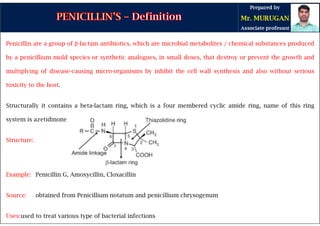
Penicillin are a group of β-lactam antibiotics, which are microbial metabolites / chemical substances produced
by a penicillium mold species or synthetic analogues, in small doses, that destroy or prevent the growth and
multiplying of disease-causing micro-organisms by inhibit the cell wall synthesis and also without serious
toxicity to the host.
Structurally it contains a beta-lactam ring, which is a four membered cyclic amide ring, name of this ring
system is azetidinone
Structure:
Example: Penicillin G, Amoxycillin, Cloxacillin
Source: obtained from Penicillium notatum and penicillium chrysogenum
Uses:used to treat various type of bacterial infections
•The nomenclature of penicillin is somewhat complex
•Two systems as follows. Chemical abstract system
United State Pharmacopeia system
•The Chemical Abstracts system initiates the numbering assigns with 1-
position sulfur atom and the ring nitrogen the 4-position. Thus, penicillin are
named as 4-thia-l-azabicyclo[3.2.0]heptane, according to this system.
•The numbering system adopted by the USP is the reverse of the Chemical
Abstracts procedure; which initiates the numbering assigns with 1-position
nitrogen atom and the ring Sulphur the 4-position. Thus, penicillin are named
as 1-thia-4-azabicyclo[3.2.0]heptane,
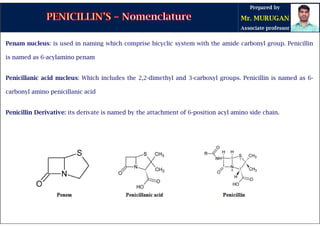
Penam nucleus: is used in naming which comprise bicyclic system with the amide carbonyl group. Penicillin
is named as 6-acylamino penam
Penicillanic acid nucleus: Which includes the 2,2-dimethyl and 3-carboxyl groups. Penicillin is named as 6-
carbonyl amino penicillanic acid
Penicillin Derivative: its derivate is named by the attachment of 6-position acyl amino side chain.
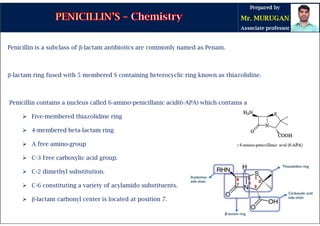
Penicillin is a subclass of β-lactam antibiotics are commonly named as Penam.
β-lactam ring fused with 5 membered S containing heterocyclic ring known as thiazolidine.
Penicillin contains a nucleus called 6-amino-penicillanic acid(6-APA) which contains a
 Five-membered thiazolidine ring
 4-membered beta-lactam ring
 A free amino-group
 C-3 Free carboxylic acid group.
 C-2 dimethyl substitution.
 C-6 constituting a variety of acylamido substituents.
 β-lactam carbonyl center is located at position 7.
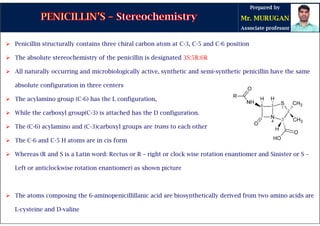
 Penicillin structurally contains three chiral carbon atom at C-3, C-5 and C-6 position
 The absolute stereochemistry of the penicillin is designated 3S:5R:6R
 All naturally occurring and microbiologically active, synthetic and semi-synthetic penicillin have the same
absolute configuration in three centers
 The acylamino group (C-6) has the L configuration,
 While the carboxyl group(C-3) is attached has the D configuration.
 The (C-6) acylamino and (C-3)carboxyl groups are trans to each other
 The C-6 and C-5 H atoms are in cis form
 Whereas (R and S is a Latin word: Rectus or R – right or clock wise rotation enantiomer and Sinister or S –
Left or anticlockwise rotation enantiomer) as shown picture
 The atoms composing the 6-aminopenicillillanic acid are biosynthetically derived from two amino acids are
L-cysteine and D-valine
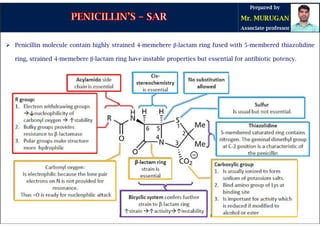
 Penicillin molecule contain highly strained 4-memebere β-lactam ring fused with 5-membered thiazolidine
ring, strained 4-memebere β-lactam ring have instable properties but essential for antibiotic potency.
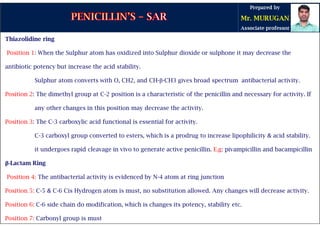
Thiazolidine ring
Position 1: When the Sulphur atom has oxidized into Sulphur dioxide or sulphone it may decrease the
antibiotic potency but increase the acid stability.
Sulphur atom converts with O, CH2, and CH-β-CH3 gives broad spectrum antibacterial activity.
Position 2: The dimethyl group at C-2 position is a characteristic of the penicillin and necessary for activity. If
any other changes in this position may decrease the activity.
Position 3: The C-3 carboxylic acid functional is essential for activity.
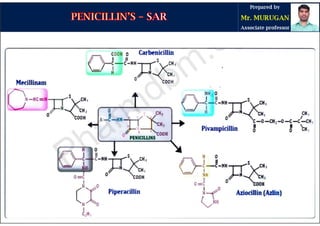
C-3 carboxyl group converted to esters, which is a prodrug to increase lipophilicity & acid stability.
it undergoes rapid cleavage in vivo to generate active penicillin. E.g: pivampicillin and bacampicillin
β-Lactam Ring
Position 4: The antibacterial activity is evidenced by N-4 atom at ring junction
Position 5: C-5 & C-6 Cis Hydrogen atom is must, no substitution allowed. Any changes will decrease activity.
Position 6: C-6 side chain do modification, which is changes its potency, stability etc.
Position 7: Carbonyl group is must
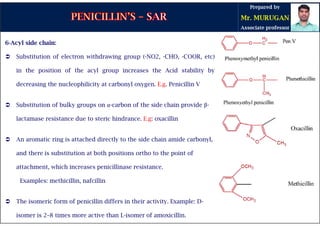
6-Acyl side chain:
 Substitution of electron withdrawing group (-NO2, -CHO, -COOR, etc)
in the position of the acyl group increases the Acid stability by
decreasing the nucleophilicity at carbonyl oxygen. E.g. Penicillin V
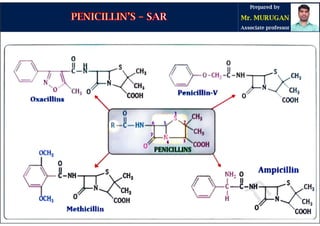
 Substitution of bulky groups on α-carbon of the side chain provide β-
lactamase resistance due to steric hindrance. E.g: oxacillin
 An aromatic ring is attached directly to the side chain amide carbonyl,
and there is substitution at both positions ortho to the point of
attachment, which increases penicillinase resistance.
Examples: methicillin, nafcillin
 The isomeric form of penicillin differs in their activity. Example: D-
isomer is 2–8 times more active than L-isomer of amoxicillin.
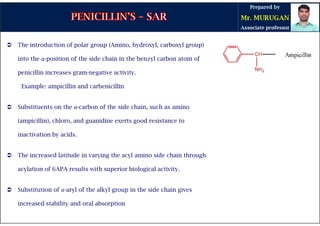
 The introduction of polar group (Amino, hydroxyl, carboxyl group)
into the α-position of the side chain in the benzyl carbon atom of
penicillin increases gram-negative activity.
Example: ampicillin and carbenicillin
 Substituents on the α-carbon of the side chain, such as amino
(ampicillin), chloro, and guanidine exerts good resistance to
inactivation by acids.
 The increased latitude in varying the acyl amino side chain through
acylation of 6APA results with superior biological activity.
 Substitution of α-aryl of the alkyl group in the side chain gives
increased stability and oral absorption
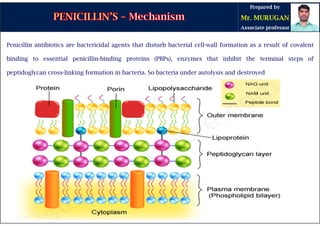
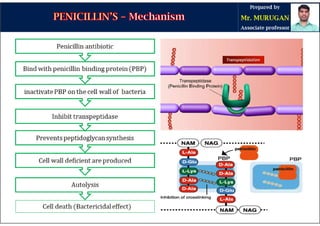
Penicillin antibiotics are bactericidal agents that disturb bacterial cell-wall formation as a result of covalent
binding to essential penicillin-binding proteins (PBPs), enzymes that inhibit the terminal steps of
peptidoglycan cross-linking formation in bacteria. So bacteria under autolysis and destroyed
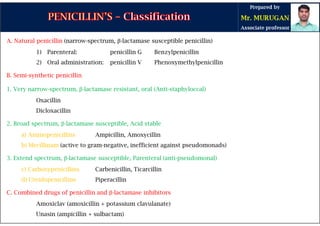
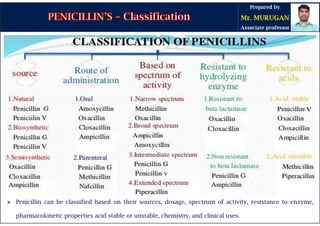
A. Natural penicillin (narrow-spectrum, β-lactamase susceptible penicillin)
1) Parenteral: penicillin G Benzylpenicillin
2) Oral administration: penicillin V Phenoxymethylpenicillin
B. Semi-synthetic penicillin
1. Very narrow-spectrum, β-lactamase resistant, oral (Anti-staphyloccal)
Oxacillin
Dicloxacillin
2. Broad spectrum, β-lactamase susceptible, Acid stable
a) Aminopenicillins Ampicillin, Amoxycillin
b) Mecillinam (active to gram-negative, inefficient against pseudomonads)
3. Extend spectrum, β-lactamase susceptible, Parenteral (anti-pseudomonal)
c) Carboxypenicillins Carbenicillin, Ticarcillin
d) Ureidopenicillins Piperacillin
C. Combined drugs of penicillin and β-lactamase inhibitors
Amoxiclav (amoxicillin + potassium clavulanate)
Unasin (ampicillin + sulbactam)
 Penicillin can be classified based on their sources, dosage, spectrum of activity, resistance to enzyme,
pharmacokinetic properties acid stable or unstable, chemistry, and clinical uses.
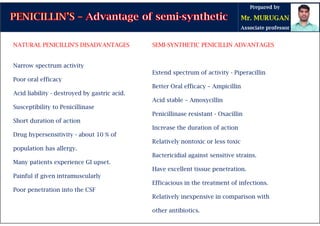
SEMI-SYNTHETIC PENICILLIN ADVANTAGES
Extend spectrum of activity - Piperacillin
Better Oral efficacy – Ampicillin
Acid stable – Amoxycillin
Penicillinase resistant - Oxacillin
Increase the duration of action
Relatively nontoxic or less toxic
Bactericidial against sensitive strains.
Have excellent tissue penetration.
Efficacious in the treatment of infections.
Relatively inexpensive in comparison with
other antibiotics.
NATURAL PENICILLIN'S DISADVANTAGES
Narrow spectrum activity
Poor oral efficacy
Acid liability - destroyed by gastric acid.
Susceptibility to Penicillinase
Short duration of action
Drug hypersensitivity - about 10 % of
population has allergy.
Many patients experience GI upset.
Painful if given intramuscularly
Poor penetration into the CSF
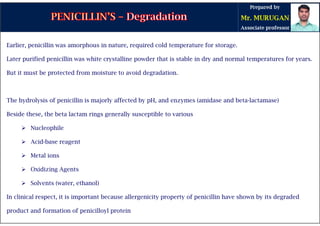
Earlier, penicillin was amorphous in nature, required cold temperature for storage.
Later purified penicillin was white crystalline powder that is stable in dry and normal temperatures for years.
But it must be protected from moisture to avoid degradation.
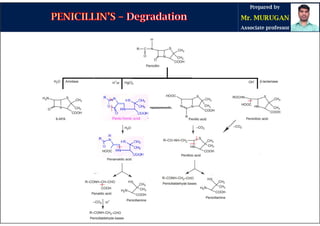
The hydrolysis of penicillin is majorly affected by pH, and enzymes (amidase and beta-lactamase)
Beside these, the beta lactam rings generally susceptible to various
 Nucleophile
 Acid-base reagent
 Metal ions
 Oxidizing Agents
 Solvents (water, ethanol)
In clinical respect, it is important because allergenicity property of penicillin have shown by its degraded
product and formation of penicilloyl protein
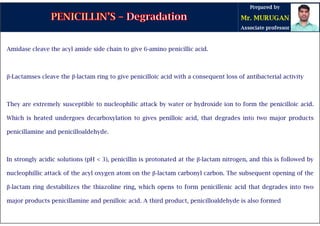
Amidase cleave the acyl amide side chain to give 6-amino penicillic acid.
β-Lactamses cleave the β-lactam ring to give penicilloic acid with a consequent loss of antibacterial activity
They are extremely susceptible to nucleophilic attack by water or hydroxide ion to form the penicilloic acid.
Which is heated undergoes decarboxylation to gives penilloic acid, that degrades into two major products
penicillamine and penicilloaldehyde.
In strongly acidic solutions (pH < 3), penicillin is protonated at the β-lactam nitrogen, and this is followed by
nucleophillic attack of the acyl oxygen atom on the β-lactam carbonyl carbon. The subsequent opening of the
β-lactam ring destabilizes the thiazoline ring, which opens to form penicillenic acid that degrades into two
major products penicillamine and penilloic acid. A third product, penicilloaldehyde is also formed
 Penicillin’s may be used to treat infections such as urinary tract infections.
 abdominal infection, respiratory infections, ear, nose and throat infections.
 Skin and Soft tissue infections.
penicillin therapy include
 Streptococcal infections
 Pneumococcal infections
 Meningococcal infections
 Gonorrhea
 Syphilis
 Diphtheria
 Anaerobic anthrax
 Actinomycosis
 Trench mouth
 Rat bite fever etc

MC - III, Unit - 1, Part 3 - Penicillin.pdf

  • 1.
    MEDICINAL CHEMISTRY-III (BP-601T)- B Pharmacy - VI Sem ARUNAI COLLEGE OF PHARMACY - Tiruvannamalai Unit 1 - ANTIBIOTIC Part 3 – PENICILLIN’S Approved by PHARMACY COUNCIL OF INDIA – New delhi Affiliated to THE TAMILNADU DR MGR MEDICAL UNIVERSITY - Chennai Prepared & Lecture by Mr. Murugan (Associate professor)
  • 2.
    Syllabus: Historical background, Nomenclature,Stereochemistry, Structure activity relationship, Chemical degradation, classification and important products of the following classes. Penicillin Penicillin Penicillin Penicillin Pervious The Tamilnadu Dr MGR Medical university exam question Sep – 2021 Write about the nomenclature, classification and degradation of penicillin (10 mark) Jan – 2022 Mechanism of Penicillin (2 mark) May – 2022 Write the classification and SAR of penicillin antibiotics (5 mark) May – 2022 Any two β - lactamase resistant penicillin (2 mark) Mar – 2023 Write a note on semi-synthetic penicillin and also brief out the advantages of semi- synthetic penicillin over natural penicillin (5 mark) Dec – 2023 MOA of penicillin (2 mark) May – 2024 Write the classification and SAR of penicillin antibiotics (5mark)
  • 3.
    1928 Alexander Flemingdiscovered Penicillin. LaterA group of researchers at Oxford University isolated penicillin (F, G, K, O, V, X) 1930 Florey and Chain isolated penicillin using freeze drying technique. 1942 Penicillin was first used in patient: World War-II penicillin saved 12-15% of lives. 1945 D. Hodgkin's elucidated the chemical structure of penicillin. 1957 Sheehan develops synthetic route for production of penicillin 1958 Beechams isolates 6 aminopenicillanic acid (6-APA) to use as intermediate for semi-synthetic penicillin derivatives. 1959 British scientists reported the isolation of 6-APA from a culture of P. chrysogenum 1971 Sheehan and Ferris converted a natural penicillin to an Intermediate, from acyl side chain has been cleaved and then can be treated to form biologically active 1975 Beechams isolates natural product called, Clavulanic acid that is effective in preventing enzymatic digestion of penicillin in resistant-strains of bacteria.
  • 4.
    Penicillin are agroup of β-lactam antibiotics, which are microbial metabolites / chemical substances produced by a penicillium mold species or synthetic analogues, in small doses, that destroy or prevent the growth and multiplying of disease-causing micro-organisms by inhibit the cell wall synthesis and also without serious toxicity to the host. Structurally it contains a beta-lactam ring, which is a four membered cyclic amide ring, name of this ring system is azetidinone Structure: Example: Penicillin G, Amoxycillin, Cloxacillin Source: obtained from Penicillium notatum and penicillium chrysogenum Uses:used to treat various type of bacterial infections
  • 5.
    •The nomenclature ofpenicillin is somewhat complex •Two systems as follows. Chemical abstract system United State Pharmacopeia system •The Chemical Abstracts system initiates the numbering assigns with 1- position sulfur atom and the ring nitrogen the 4-position. Thus, penicillin are named as 4-thia-l-azabicyclo[3.2.0]heptane, according to this system. •The numbering system adopted by the USP is the reverse of the Chemical Abstracts procedure; which initiates the numbering assigns with 1-position nitrogen atom and the ring Sulphur the 4-position. Thus, penicillin are named as 1-thia-4-azabicyclo[3.2.0]heptane,
  • 6.
    Penam nucleus: isused in naming which comprise bicyclic system with the amide carbonyl group. Penicillin is named as 6-acylamino penam Penicillanic acid nucleus: Which includes the 2,2-dimethyl and 3-carboxyl groups. Penicillin is named as 6- carbonyl amino penicillanic acid Penicillin Derivative: its derivate is named by the attachment of 6-position acyl amino side chain.
  • 7.
    Penicillin is asubclass of β-lactam antibiotics are commonly named as Penam. β-lactam ring fused with 5 membered S containing heterocyclic ring known as thiazolidine. Penicillin contains a nucleus called 6-amino-penicillanic acid(6-APA) which contains a  Five-membered thiazolidine ring  4-membered beta-lactam ring  A free amino-group  C-3 Free carboxylic acid group.  C-2 dimethyl substitution.  C-6 constituting a variety of acylamido substituents.  β-lactam carbonyl center is located at position 7.
  • 8.
     Penicillin structurallycontains three chiral carbon atom at C-3, C-5 and C-6 position  The absolute stereochemistry of the penicillin is designated 3S:5R:6R  All naturally occurring and microbiologically active, synthetic and semi-synthetic penicillin have the same absolute configuration in three centers  The acylamino group (C-6) has the L configuration,  While the carboxyl group(C-3) is attached has the D configuration.  The (C-6) acylamino and (C-3)carboxyl groups are trans to each other  The C-6 and C-5 H atoms are in cis form  Whereas (R and S is a Latin word: Rectus or R – right or clock wise rotation enantiomer and Sinister or S – Left or anticlockwise rotation enantiomer) as shown picture  The atoms composing the 6-aminopenicillillanic acid are biosynthetically derived from two amino acids are L-cysteine and D-valine
  • 9.
     Penicillin moleculecontain highly strained 4-memebere β-lactam ring fused with 5-membered thiazolidine ring, strained 4-memebere β-lactam ring have instable properties but essential for antibiotic potency.
  • 10.
    Thiazolidine ring Position 1:When the Sulphur atom has oxidized into Sulphur dioxide or sulphone it may decrease the antibiotic potency but increase the acid stability. Sulphur atom converts with O, CH2, and CH-β-CH3 gives broad spectrum antibacterial activity. Position 2: The dimethyl group at C-2 position is a characteristic of the penicillin and necessary for activity. If any other changes in this position may decrease the activity. Position 3: The C-3 carboxylic acid functional is essential for activity. C-3 carboxyl group converted to esters, which is a prodrug to increase lipophilicity & acid stability. it undergoes rapid cleavage in vivo to generate active penicillin. E.g: pivampicillin and bacampicillin β-Lactam Ring Position 4: The antibacterial activity is evidenced by N-4 atom at ring junction Position 5: C-5 & C-6 Cis Hydrogen atom is must, no substitution allowed. Any changes will decrease activity. Position 6: C-6 side chain do modification, which is changes its potency, stability etc. Position 7: Carbonyl group is must
  • 11.
    6-Acyl side chain: Substitution of electron withdrawing group (-NO2, -CHO, -COOR, etc) in the position of the acyl group increases the Acid stability by decreasing the nucleophilicity at carbonyl oxygen. E.g. Penicillin V  Substitution of bulky groups on α-carbon of the side chain provide β- lactamase resistance due to steric hindrance. E.g: oxacillin  An aromatic ring is attached directly to the side chain amide carbonyl, and there is substitution at both positions ortho to the point of attachment, which increases penicillinase resistance. Examples: methicillin, nafcillin  The isomeric form of penicillin differs in their activity. Example: D- isomer is 2–8 times more active than L-isomer of amoxicillin.
  • 12.
     The introductionof polar group (Amino, hydroxyl, carboxyl group) into the α-position of the side chain in the benzyl carbon atom of penicillin increases gram-negative activity. Example: ampicillin and carbenicillin  Substituents on the α-carbon of the side chain, such as amino (ampicillin), chloro, and guanidine exerts good resistance to inactivation by acids.  The increased latitude in varying the acyl amino side chain through acylation of 6APA results with superior biological activity.  Substitution of α-aryl of the alkyl group in the side chain gives increased stability and oral absorption
  • 15.
    Penicillin antibiotics arebactericidal agents that disturb bacterial cell-wall formation as a result of covalent binding to essential penicillin-binding proteins (PBPs), enzymes that inhibit the terminal steps of peptidoglycan cross-linking formation in bacteria. So bacteria under autolysis and destroyed
  • 17.
    A. Natural penicillin(narrow-spectrum, β-lactamase susceptible penicillin) 1) Parenteral: penicillin G Benzylpenicillin 2) Oral administration: penicillin V Phenoxymethylpenicillin B. Semi-synthetic penicillin 1. Very narrow-spectrum, β-lactamase resistant, oral (Anti-staphyloccal) Oxacillin Dicloxacillin 2. Broad spectrum, β-lactamase susceptible, Acid stable a) Aminopenicillins Ampicillin, Amoxycillin b) Mecillinam (active to gram-negative, inefficient against pseudomonads) 3. Extend spectrum, β-lactamase susceptible, Parenteral (anti-pseudomonal) c) Carboxypenicillins Carbenicillin, Ticarcillin d) Ureidopenicillins Piperacillin C. Combined drugs of penicillin and β-lactamase inhibitors Amoxiclav (amoxicillin + potassium clavulanate) Unasin (ampicillin + sulbactam)
  • 18.
     Penicillin canbe classified based on their sources, dosage, spectrum of activity, resistance to enzyme, pharmacokinetic properties acid stable or unstable, chemistry, and clinical uses.
  • 19.
    SEMI-SYNTHETIC PENICILLIN ADVANTAGES Extendspectrum of activity - Piperacillin Better Oral efficacy – Ampicillin Acid stable – Amoxycillin Penicillinase resistant - Oxacillin Increase the duration of action Relatively nontoxic or less toxic Bactericidial against sensitive strains. Have excellent tissue penetration. Efficacious in the treatment of infections. Relatively inexpensive in comparison with other antibiotics. NATURAL PENICILLIN'S DISADVANTAGES Narrow spectrum activity Poor oral efficacy Acid liability - destroyed by gastric acid. Susceptibility to Penicillinase Short duration of action Drug hypersensitivity - about 10 % of population has allergy. Many patients experience GI upset. Painful if given intramuscularly Poor penetration into the CSF
  • 20.
    Earlier, penicillin wasamorphous in nature, required cold temperature for storage. Later purified penicillin was white crystalline powder that is stable in dry and normal temperatures for years. But it must be protected from moisture to avoid degradation. The hydrolysis of penicillin is majorly affected by pH, and enzymes (amidase and beta-lactamase) Beside these, the beta lactam rings generally susceptible to various  Nucleophile  Acid-base reagent  Metal ions  Oxidizing Agents  Solvents (water, ethanol) In clinical respect, it is important because allergenicity property of penicillin have shown by its degraded product and formation of penicilloyl protein
  • 21.
    Amidase cleave theacyl amide side chain to give 6-amino penicillic acid. β-Lactamses cleave the β-lactam ring to give penicilloic acid with a consequent loss of antibacterial activity They are extremely susceptible to nucleophilic attack by water or hydroxide ion to form the penicilloic acid. Which is heated undergoes decarboxylation to gives penilloic acid, that degrades into two major products penicillamine and penicilloaldehyde. In strongly acidic solutions (pH < 3), penicillin is protonated at the β-lactam nitrogen, and this is followed by nucleophillic attack of the acyl oxygen atom on the β-lactam carbonyl carbon. The subsequent opening of the β-lactam ring destabilizes the thiazoline ring, which opens to form penicillenic acid that degrades into two major products penicillamine and penilloic acid. A third product, penicilloaldehyde is also formed
  • 23.
     Penicillin’s maybe used to treat infections such as urinary tract infections.  abdominal infection, respiratory infections, ear, nose and throat infections.  Skin and Soft tissue infections. penicillin therapy include  Streptococcal infections  Pneumococcal infections  Meningococcal infections  Gonorrhea  Syphilis  Diphtheria  Anaerobic anthrax  Actinomycosis  Trench mouth  Rat bite fever etc