Incorporating digital and social technologies
into social work education
Laurel Iverson Hitchcock, PhD
University of Alabama at Birmingham
Melanie Sage, PhD
University of North Dakota
Nancy J. Smyth, PhD
University at Buffalo
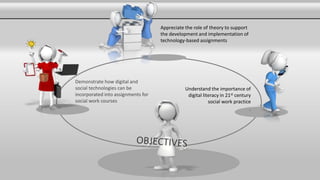
Demonstrate how digital and
social technologies can be
incorporated into assignments for
social work courses
Understand the importance of
digital literacy in 21st century
social work practice
.
Appreciate the role of theory to support
the development and implementation of
technology-based assignments
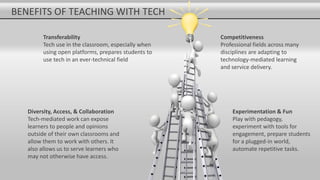
BENEFITS OF TEACHING WITH TECH
Diversity, Access, & Collaboration
Tech-mediated work can expose
learners to people and opinions
outside of their own classrooms and
allow them to work with others. It
also allows us to serve learners who
may not otherwise have access.
Transferability
Tech use in the classroom, especially when
using open platforms, prepares students to
use tech in an ever-technical field
Competitiveness
Professional fields across many
disciplines are adapting to
technology-mediated learning
and service delivery.
Experimentation & Fun
Play with pedagogy,
experiment with tools for
engagement, prepare students
for a plugged-in world,
automate repetitive tasks.
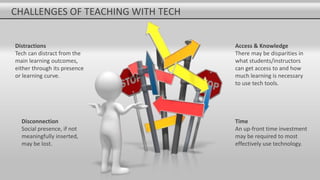
CHALLENGES OF TEACHING WITH TECH
Disconnection
Social presence, if not
meaningfully inserted,
may be lost.
Distractions
Tech can distract from the
main learning outcomes,
either through its presence
or learning curve.
Access & Knowledge
There may be disparities in
what students/instructors
can get access to and how
much learning is necessary
to use tech tools.
Time
An up-front time investment
may be required to most
effectively use technology.
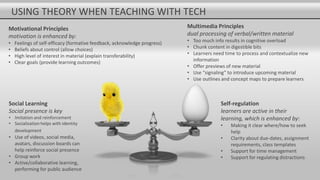
USING THEORY WHEN TEACHING WITH TECH
Social Learning
Social presence is key
• Imitation and reinforcement
• Socialization helps with identity
development
• Use of videos, social media,
avatars, discussion boards can
help reinforce social presence
• Group work
• Active/collaborative learning,
performing for public audience
Motivational Principles
motivation is enhanced by:
• Feelings of self-efficacy (formative feedback, acknowledge progress)
• Beliefs about control (allow choices)
• High level of interest in material (explain transferability)
• Clear goals (provide learning outcomes)
Multimedia Principles
dual processing of verbal/written material
• Too much info results in cognitive overload
• Chunk content in digestible bits
• Learners need time to process and contextualize new
information
• Offer previews of new material
• Use “signaling” to introduce upcoming material
• Use outlines and concept maps to prepare learners
Self-regulation
learners are active in their
learning, which is enhanced by:
• Making it clear where/how to seek
help
• Clarity about due-dates, assignment
requirements, class templates
• Support for time management
• Support for regulating distractions
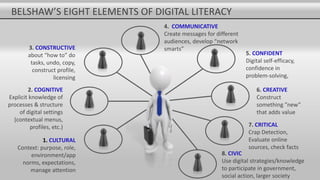
BELSHAW’S EIGHT ELEMENTS OF DIGITAL LITERACY
1. CULTURAL
Context: purpose, role,
environment/app
norms, expectations,
manage attention
3. CONSTRUCTIVE
about “how to” do
tasks, undo, copy,
construct profile,
licensing
2. COGNITIVE
Explicit knowledge of
processes & structure
of digital settings
(contextual menus,
profiles, etc.)
5. CONFIDENT
Digital self-efficacy,
confidence in
problem-solving,
7. CRITICAL
Crap Detection,
Evaluate online
sources, check facts
6. CREATIVE
Construct
something ”new”
that adds value
4. COMMUNICATIVE
Create messages for different
audiences, develop “network
smarts”
8. CIVIC
Use digital strategies/knowledge
to participate in government,
social action, larger society
Understanding Literacies in Action
Foreground
Midground
Background
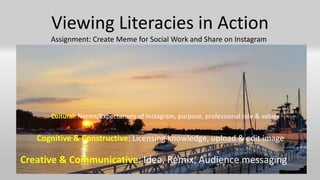
Viewing Literacies in Action
Assignment: Create Meme for Social Work and Share on Instagram
Cultural: Norms/Expectations of Instagram, purpose, professional role & values
Cognitive & Constructive: Licensing knowledge, upload & edit image
Creative & Communicative: Idea, Remix, Audience messaging
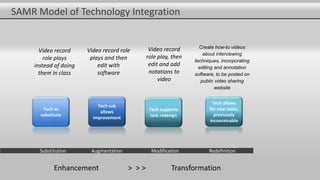
SAMR Model of Technology Integration
Augmentation
Video record role
plays and then
edit with
software
Tech sub
allows
improvement
Substitution
Video record
role plays
instead of doing
them in class
Tech as
substitute
Redefinition
Create how-to videos
about interviewing
techniques, incorporating
editing and annotation
software, to be posted on
public video sharing
website
Modification
Tech supports
task redesign
Video record
role play, then
edit and add
notations to
video
Tech allows
for new tasks,
previously
inconceivable
Enhancement > > > Transformation
List of Competency-Based
Learning Activities for Technology
From CSWE’s EPAS….
“...use technology ethically and appropriately to facilitate practice
outcomes (p. 7).”
- Connected to practice behaviors from EPAS (skills dimension)
Competency-Based Learning Activities
Example Activity:
Search for information about yourself on the Internet
including websites, social media accounts and other online
resources, and review the content, including words and
images, for quantity, quality, and accuracy. Write down
what you find in a brief 300-word reflection.
Tech-enhanced assignments: Twitter
Digital Literacies Needed:
• Confident
• Communicative
• Cognitive
Learning Task:
Participate in a live Twitter
chat with other social workers
or professionals about a topic
of interest to you (i.e.
#MacroSW).
SAMR:
Redefinition
Competency 6: Engage with Individuals, Families, Groups, Organizations, and Communities - Use
empathy, reflection, and interpersonal skills to effectively engage diverse clients and constituencies.
Tech-enhanced assignments: Infographics
Learning Task:
Create an infographic for your
agency’s annual report about
the number and types of
clients served, services
provided and other key data
indicators.
Competency 9: Evaluate Practice with Individuals, Families, Groups, Organizations, and Communities -
Apply evaluation findings to improve practice effectiveness at the micro, mezzo, and macro levels.
Digital Literacies Needed:
• Cognitive
• Civic
• Creative
• Communicative SAMR:
Augmentation
Tech-enhanced assignments: Creating Videos
Digital Literacies Needed:
• Cultural
• Confident
• Communicative
• Cognitive
• Constructive
• Creative
Learning Task:
Create a YouTube video that
informs social workers about
best practices for verbal and
non-verbal communication
with a client via a face-to-face
video conference call.
SAMR: Redefinition
(assuming prior learning task
had been class presentation or
paper)
Competency 6: Engage with Individuals, Families, Groups, Organizations, and Communities - Use
empathy, reflection, and interpersonal skills to effectively engage diverse clients and constituencies.
Resources
Belshaw, D. (2014). The essential elements of
digital literacies. http://digitalliteraci.es/
#MacroSW. (n.d.). #MacroSW: Where Macro
Social Workers Come to Connect. Retrieved April
7, 2016, from http://macrosw.com/
Puentedura, R. (n.d.). Introduction to the SAMR
Model. Retrieved April 7, 2016, from
https://www.commonsensemedia.org/videos/int
roduction-to-the-samr-model
Questions?
Laurel Iverson Hitchcock, PhD
University of Alabama at Birmingham
lihitch@uab.edu
twitter: @laurelhitchcock
Melanie Sage, PhD
University of North Dakota
Melanie.Sage@und.edu
twitter: @melaniesage
Nancy J. Smyth, PhD
University at Buffalo
email: sw-dean@buffalo.edu
twitter: @njsmyth

Incorporating digital and social technologies into social work education

  • 1.
    Incorporating digital andsocial technologies into social work education Laurel Iverson Hitchcock, PhD University of Alabama at Birmingham Melanie Sage, PhD University of North Dakota Nancy J. Smyth, PhD University at Buffalo
  • 2.
    Demonstrate how digitaland social technologies can be incorporated into assignments for social work courses Understand the importance of digital literacy in 21st century social work practice . Appreciate the role of theory to support the development and implementation of technology-based assignments
  • 3.
    BENEFITS OF TEACHINGWITH TECH Diversity, Access, & Collaboration Tech-mediated work can expose learners to people and opinions outside of their own classrooms and allow them to work with others. It also allows us to serve learners who may not otherwise have access. Transferability Tech use in the classroom, especially when using open platforms, prepares students to use tech in an ever-technical field Competitiveness Professional fields across many disciplines are adapting to technology-mediated learning and service delivery. Experimentation & Fun Play with pedagogy, experiment with tools for engagement, prepare students for a plugged-in world, automate repetitive tasks.
  • 4.
    CHALLENGES OF TEACHINGWITH TECH Disconnection Social presence, if not meaningfully inserted, may be lost. Distractions Tech can distract from the main learning outcomes, either through its presence or learning curve. Access & Knowledge There may be disparities in what students/instructors can get access to and how much learning is necessary to use tech tools. Time An up-front time investment may be required to most effectively use technology.
  • 5.
    USING THEORY WHENTEACHING WITH TECH Social Learning Social presence is key • Imitation and reinforcement • Socialization helps with identity development • Use of videos, social media, avatars, discussion boards can help reinforce social presence • Group work • Active/collaborative learning, performing for public audience Motivational Principles motivation is enhanced by: • Feelings of self-efficacy (formative feedback, acknowledge progress) • Beliefs about control (allow choices) • High level of interest in material (explain transferability) • Clear goals (provide learning outcomes) Multimedia Principles dual processing of verbal/written material • Too much info results in cognitive overload • Chunk content in digestible bits • Learners need time to process and contextualize new information • Offer previews of new material • Use “signaling” to introduce upcoming material • Use outlines and concept maps to prepare learners Self-regulation learners are active in their learning, which is enhanced by: • Making it clear where/how to seek help • Clarity about due-dates, assignment requirements, class templates • Support for time management • Support for regulating distractions
  • 6.
    BELSHAW’S EIGHT ELEMENTSOF DIGITAL LITERACY 1. CULTURAL Context: purpose, role, environment/app norms, expectations, manage attention 3. CONSTRUCTIVE about “how to” do tasks, undo, copy, construct profile, licensing 2. COGNITIVE Explicit knowledge of processes & structure of digital settings (contextual menus, profiles, etc.) 5. CONFIDENT Digital self-efficacy, confidence in problem-solving, 7. CRITICAL Crap Detection, Evaluate online sources, check facts 6. CREATIVE Construct something ”new” that adds value 4. COMMUNICATIVE Create messages for different audiences, develop “network smarts” 8. CIVIC Use digital strategies/knowledge to participate in government, social action, larger society
  • 7.
    Understanding Literacies inAction Foreground Midground Background
  • 8.
    Viewing Literacies inAction Assignment: Create Meme for Social Work and Share on Instagram Cultural: Norms/Expectations of Instagram, purpose, professional role & values Cognitive & Constructive: Licensing knowledge, upload & edit image Creative & Communicative: Idea, Remix, Audience messaging
  • 9.
    SAMR Model ofTechnology Integration Augmentation Video record role plays and then edit with software Tech sub allows improvement Substitution Video record role plays instead of doing them in class Tech as substitute Redefinition Create how-to videos about interviewing techniques, incorporating editing and annotation software, to be posted on public video sharing website Modification Tech supports task redesign Video record role play, then edit and add notations to video Tech allows for new tasks, previously inconceivable Enhancement > > > Transformation
  • 10.
    List of Competency-Based LearningActivities for Technology From CSWE’s EPAS…. “...use technology ethically and appropriately to facilitate practice outcomes (p. 7).” - Connected to practice behaviors from EPAS (skills dimension) Competency-Based Learning Activities Example Activity: Search for information about yourself on the Internet including websites, social media accounts and other online resources, and review the content, including words and images, for quantity, quality, and accuracy. Write down what you find in a brief 300-word reflection.
  • 11.
    Tech-enhanced assignments: Twitter DigitalLiteracies Needed: • Confident • Communicative • Cognitive Learning Task: Participate in a live Twitter chat with other social workers or professionals about a topic of interest to you (i.e. #MacroSW). SAMR: Redefinition Competency 6: Engage with Individuals, Families, Groups, Organizations, and Communities - Use empathy, reflection, and interpersonal skills to effectively engage diverse clients and constituencies.
  • 12.
    Tech-enhanced assignments: Infographics LearningTask: Create an infographic for your agency’s annual report about the number and types of clients served, services provided and other key data indicators. Competency 9: Evaluate Practice with Individuals, Families, Groups, Organizations, and Communities - Apply evaluation findings to improve practice effectiveness at the micro, mezzo, and macro levels. Digital Literacies Needed: • Cognitive • Civic • Creative • Communicative SAMR: Augmentation
  • 13.
    Tech-enhanced assignments: CreatingVideos Digital Literacies Needed: • Cultural • Confident • Communicative • Cognitive • Constructive • Creative Learning Task: Create a YouTube video that informs social workers about best practices for verbal and non-verbal communication with a client via a face-to-face video conference call. SAMR: Redefinition (assuming prior learning task had been class presentation or paper) Competency 6: Engage with Individuals, Families, Groups, Organizations, and Communities - Use empathy, reflection, and interpersonal skills to effectively engage diverse clients and constituencies.
  • 14.
    Resources Belshaw, D. (2014).The essential elements of digital literacies. http://digitalliteraci.es/ #MacroSW. (n.d.). #MacroSW: Where Macro Social Workers Come to Connect. Retrieved April 7, 2016, from http://macrosw.com/ Puentedura, R. (n.d.). Introduction to the SAMR Model. Retrieved April 7, 2016, from https://www.commonsensemedia.org/videos/int roduction-to-the-samr-model
  • 15.
    Questions? Laurel Iverson Hitchcock,PhD University of Alabama at Birmingham lihitch@uab.edu twitter: @laurelhitchcock Melanie Sage, PhD University of North Dakota Melanie.Sage@und.edu twitter: @melaniesage Nancy J. Smyth, PhD University at Buffalo email: sw-dean@buffalo.edu twitter: @njsmyth

Editor's Notes