DELTA Distance Education and Learning Technology Applications
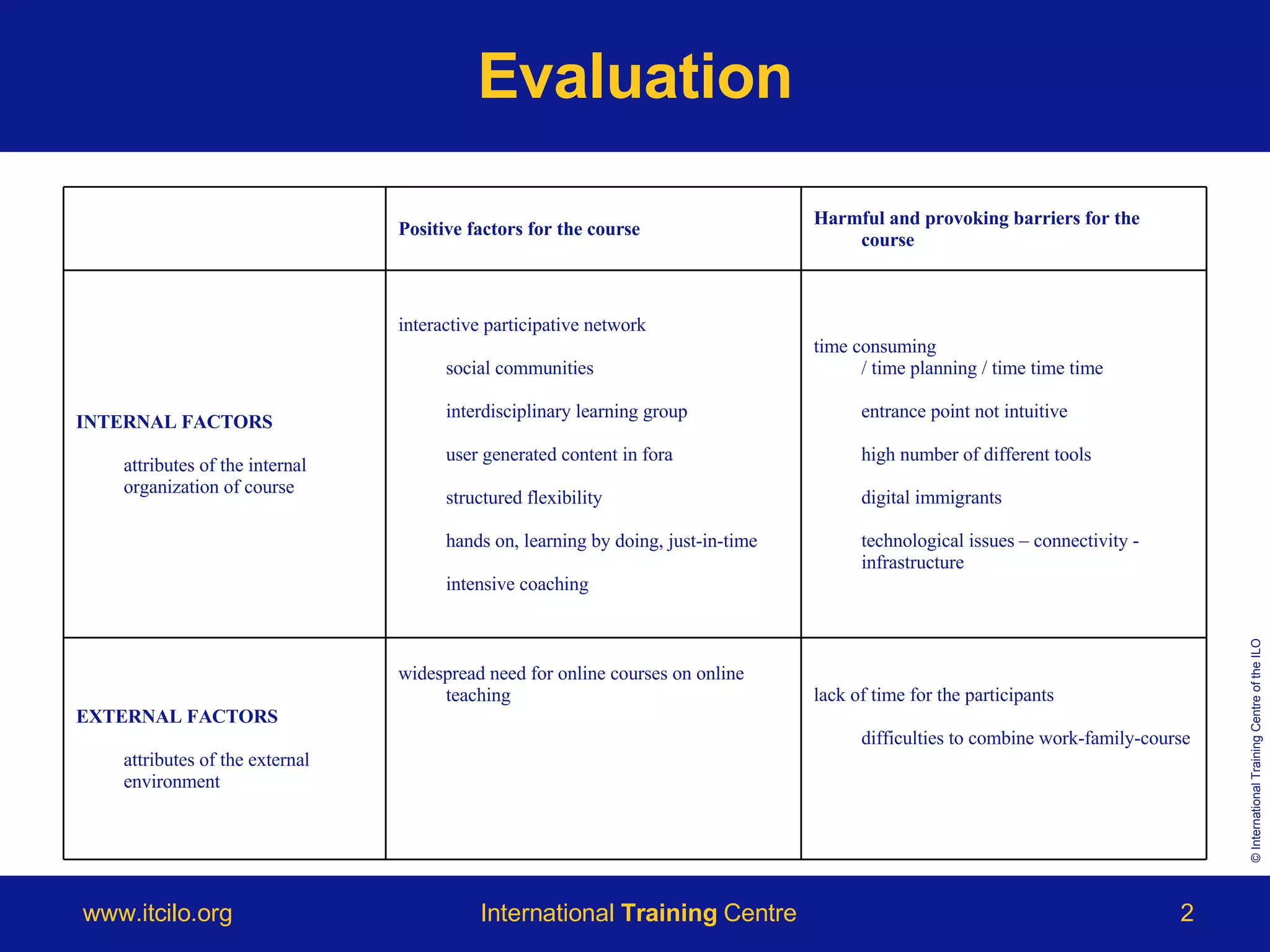
Evaluation lack of time for the participants difficulties to combine work-family-course  widespread need for online courses on online teaching EXTERNAL FACTORS attributes of the external environment time consuming / time planning / time time time entrance point not intuitive high number of different tools  digital immigrants technological issues – connectivity - infrastructure interactive participative network social communities interdisciplinary learning group user generated content in fora structured flexibility hands on, learning by doing, just-in-time intensive coaching INTERNAL FACTORS attributes of the internal organization of course Harmful and provoking barriers for the  course Positive factors for the course
In search of good practices in Lifelong E-Learning Round table based on assignments and mindmaps of the participants (initial discussions)


For  Etienne Wenger ,  learning  is central to human  identity .  A primary focus of Wenger’s work is on learning as social participation – the individual as an active participant in the practices of social communities, and in the construction of his/her identity through these communities.  From this understanding develops the concept of the  community of practice : a group of individuals participating in communal activity, and experiencing/continuously creating their shared identity through engaging in and contributing to the practices of their communities.
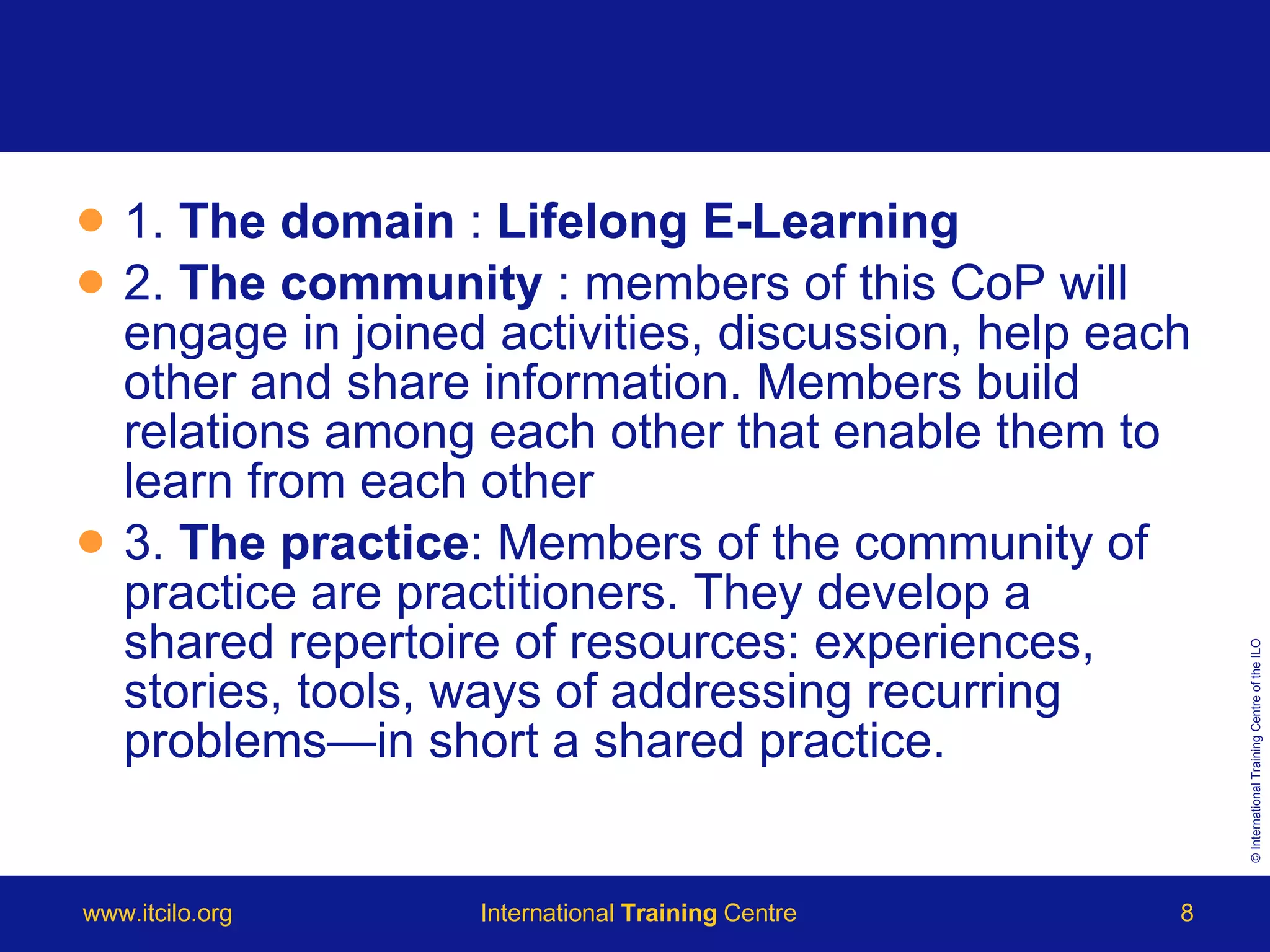
1.  The domain  :  Lifelong E-Learning 2.  The community  : members of this CoP will engage in joined activities, discussion, help each other and share information. Members build relations among each other that enable them to learn from each other 3.  The practice : Members of the community of practice are practitioners. They develop a shared repertoire of resources: experiences, stories, tools, ways of addressing recurring problems—in short a shared practice.
 
A virtual community of practice Virtual collaboration if you can’t work side by side
finding the right group of people (skills, personalities, knowledge, work-styles, and chemistry), ensuring they share commitment to the collaboration task at hand, and providing them with an environment, tools, knowledge, training, process and facilitation to ensure they work together effectively.  This is challenging enough face-to-face in real-time. It's doubly difficult virtually and asynchronously.
 
Case 1
 
Case 2
 
 
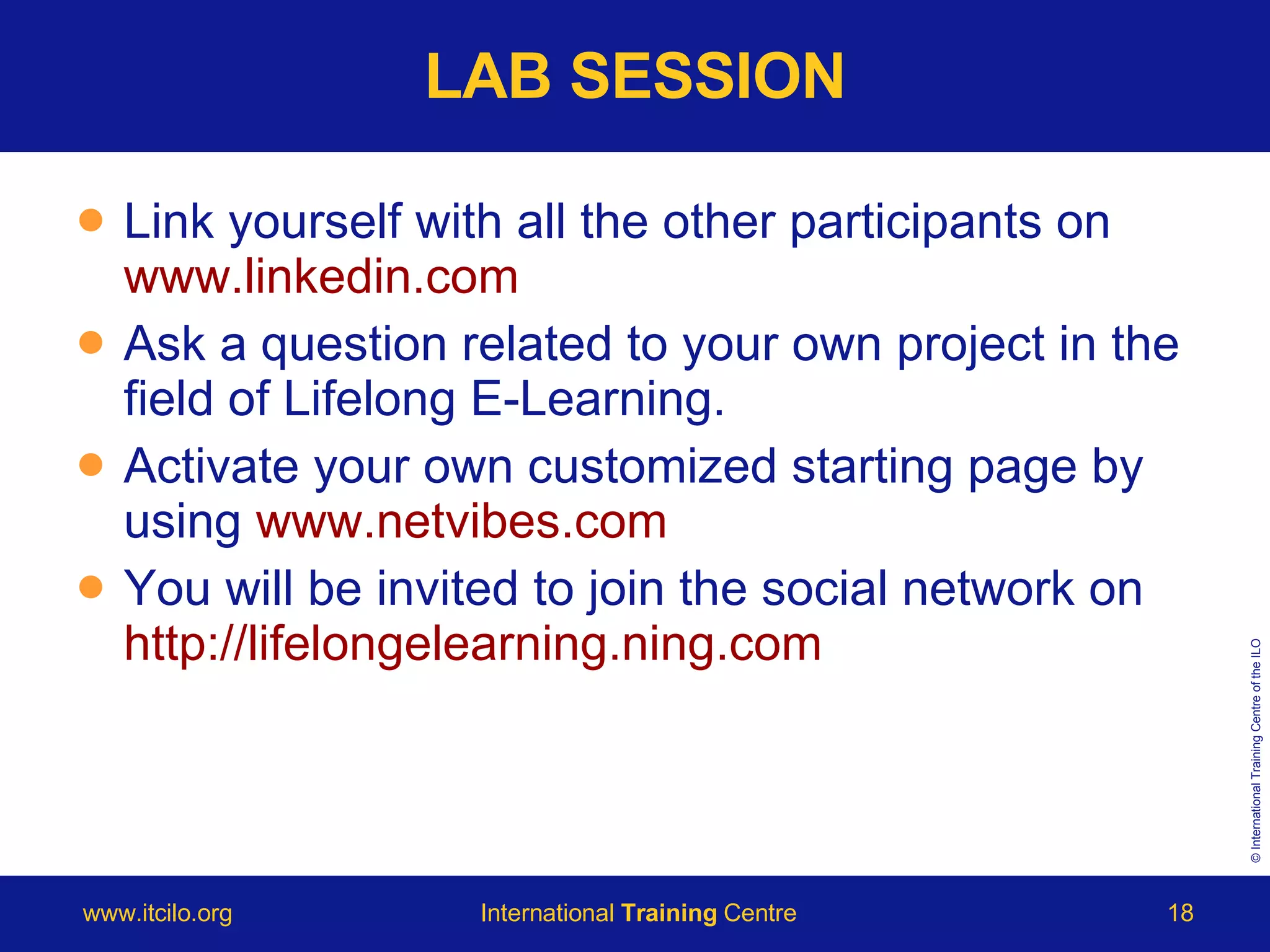
LAB SESSION Link yourself with all the other participants on  www.linkedin.com Ask a question related to your own project in the field of Lifelong E-Learning.  Activate your own customized starting page by using  www.netvibes.com You will be invited to join the social network on  http://lifelongelearning.ning.com

Communityof Practice

  • 1.
    DELTA Distance Educationand Learning Technology Applications
  • 2.
    Evaluation lack oftime for the participants difficulties to combine work-family-course widespread need for online courses on online teaching EXTERNAL FACTORS attributes of the external environment time consuming / time planning / time time time entrance point not intuitive high number of different tools digital immigrants technological issues – connectivity - infrastructure interactive participative network social communities interdisciplinary learning group user generated content in fora structured flexibility hands on, learning by doing, just-in-time intensive coaching INTERNAL FACTORS attributes of the internal organization of course Harmful and provoking barriers for the course Positive factors for the course
  • 3.
    In search ofgood practices in Lifelong E-Learning Round table based on assignments and mindmaps of the participants (initial discussions)
  • 4.
  • 5.
  • 6.
  • 7.
    For EtienneWenger , learning is central to human identity . A primary focus of Wenger’s work is on learning as social participation – the individual as an active participant in the practices of social communities, and in the construction of his/her identity through these communities. From this understanding develops the concept of the community of practice : a group of individuals participating in communal activity, and experiencing/continuously creating their shared identity through engaging in and contributing to the practices of their communities.
  • 8.
    1. Thedomain : Lifelong E-Learning 2. The community : members of this CoP will engage in joined activities, discussion, help each other and share information. Members build relations among each other that enable them to learn from each other 3. The practice : Members of the community of practice are practitioners. They develop a shared repertoire of resources: experiences, stories, tools, ways of addressing recurring problems—in short a shared practice.
  • 9.
  • 10.
    A virtual communityof practice Virtual collaboration if you can’t work side by side
  • 11.
    finding the rightgroup of people (skills, personalities, knowledge, work-styles, and chemistry), ensuring they share commitment to the collaboration task at hand, and providing them with an environment, tools, knowledge, training, process and facilitation to ensure they work together effectively. This is challenging enough face-to-face in real-time. It's doubly difficult virtually and asynchronously.
  • 12.
  • 13.
  • 14.
  • 15.
  • 16.
  • 17.
  • 18.
    LAB SESSION Linkyourself with all the other participants on www.linkedin.com Ask a question related to your own project in the field of Lifelong E-Learning. Activate your own customized starting page by using www.netvibes.com You will be invited to join the social network on http://lifelongelearning.ning.com