Helping Social Work Students
develop a Professional Online
Presence for Interprofessional
Communication
2018 CSWE Field Institute
Mary Jacque Carroll, LICSW (@MJCarroll_SWK)
Allison M. Curington, LMSW (@amcuring)
Laurel Iverson Hitchcock, PhD, LICSW (@laurelhitchcock)
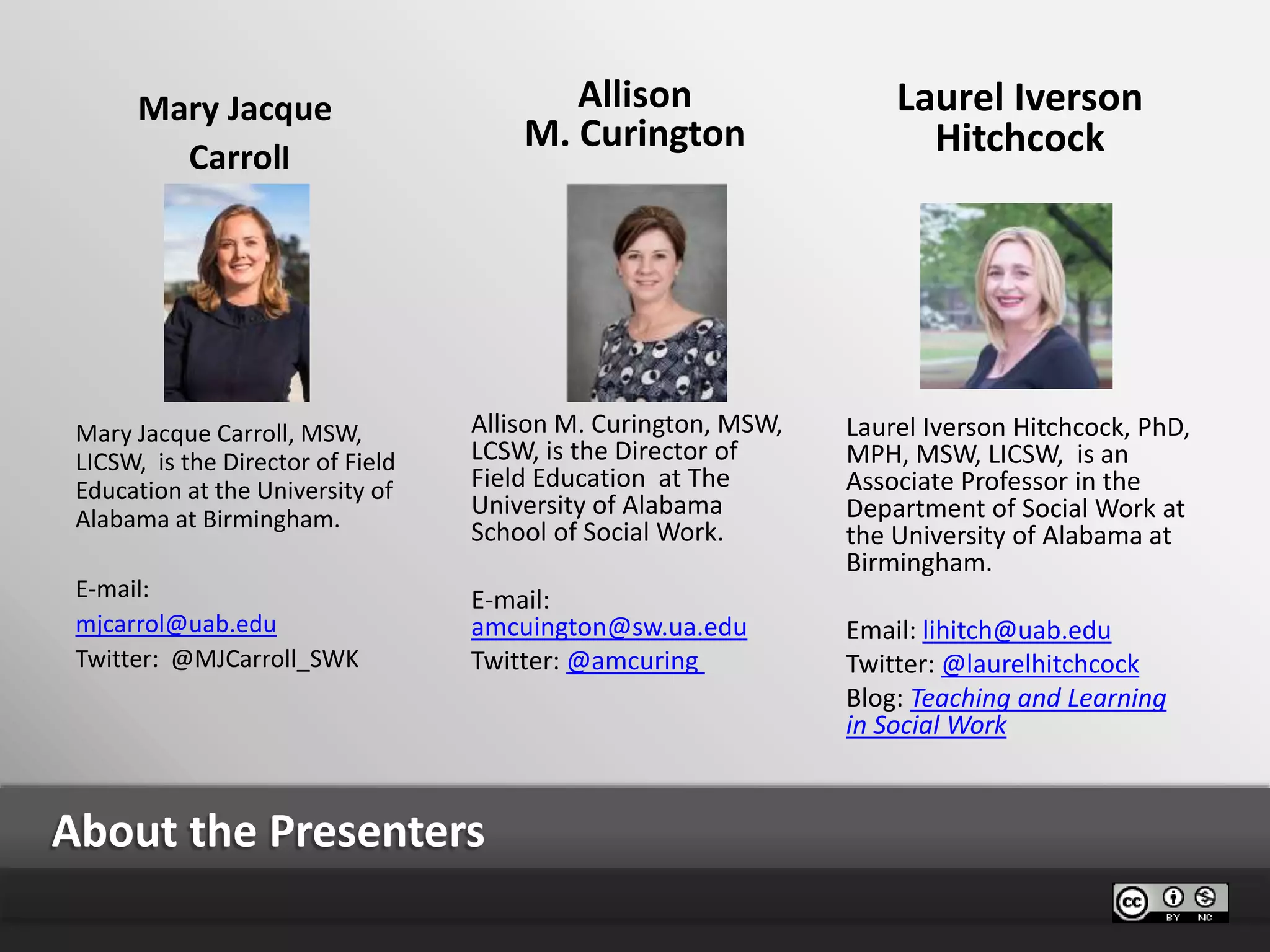
About the Presenters
Allison
M. Curington
Allison M. Curington, MSW,
LCSW, is the Director of
Field Education at The
University of Alabama
School of Social Work.
E-mail:
amcuington@sw.ua.edu
Twitter: @amcuring
Laurel Iverson
Hitchcock
Laurel Iverson Hitchcock, PhD,
MPH, MSW, LICSW, is an
Associate Professor in the
Department of Social Work at
the University of Alabama at
Birmingham.
Email: lihitch@uab.edu
Twitter: @laurelhitchcock
Blog: Teaching and Learning
in Social Work
Mary Jacque
Carroll
Mary Jacque Carroll, MSW,
LICSW, is the Director of Field
Education at the University of
Alabama at Birmingham.
E-mail:
mjcarrol@uab.edu
Twitter: @MJCarroll_SWK
C. I get anxious when I don’t have my cell
phone.
A. I feel that I get more accomplished because
of technology.
Reflection
Which one of these statements best reflects you?
Which one of these statements
best reflects your relationship to
technology?
B. I feel that technology makes people
waste too much time.
1. Demonstrate an understanding of information and
tools that field directors can use to guide curricular
development of learning approaches and
assessment strategies to achieve practice outcomes
around interprofessional communication with
digital and social technologies.
2. Develop their own professional online presence to
support interprofessional communication.
3. Create activities for students in field to increase
understanding of the interprofessional and ethical
use of social and digital media in social work
practice.
Learning Objectives
By the end of this presentation, participants
will be able to:
Why do you need to be in this session?
Why do social workers
need to be aware of
their online,
professional presence?
• Most adults in US use social media, but varies by age
and gender
• Health care professionals and helping practitioners are
engaged users of social media
• Child welfare workers using social media with clients
without informing supervisors (Sage & Sage, 2015)
• Personal use of social media among students doesn’t
translate to e-professionalism (Karpman & Drisko,
2016)
• How are professionals using social media?
• Professional Learning Networks
• Dissemination of Research
• Branding & Professional Identity
Who is using social media and how?
• CSWE 2015 EPAS: “Social workers understand emerging
forms of technology and the ethical use of technology in
social work practice.”
• NASW’s Standards for Technology in Social Work
Practice: 12 standards for Social Work Education and
Continue Education
• Revisions to NASW Code of Ethics that address the use of
technology in practice (2018)
• IPEC 2016 Competencies: “communication tools and
techniques, including information systems and
communication technologies, to facilitate discussions and
interactions that enhance team function.”
Why is this important for Field Educators?
Understanding Digital & Social Technology
NASW Code of Ethics: 2018 Updates about Technology
Includes New Language & Standards related to
technology in social work practice
Ethical Concerns: Privacy & Confidentiality,
Boundaries & Professional Presentation of Self
New Language:
“Technology-assisted social work services”:
• Involving the use of computers, mobile or landline
telephones, tablets, video technology, or other
electronic or digital technologies
• Includes all aspects of social work practice
All values, principles and standards can be applied
equally to in-person and online interactions.
Understanding Ethical Standards & Policies in Social Work
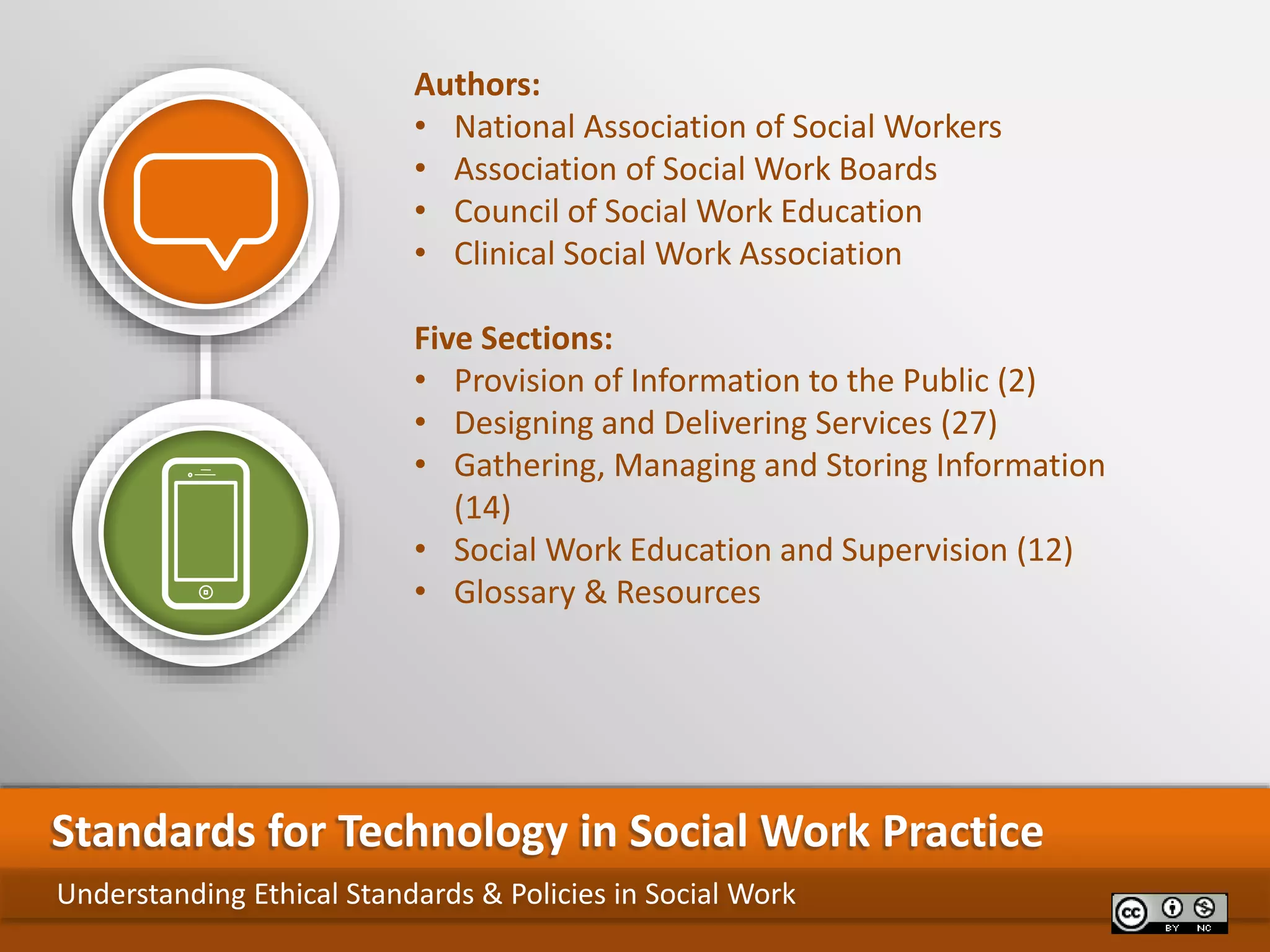
Standards for Technology in Social Work Practice
Authors:
• National Association of Social Workers
• Association of Social Work Boards
• Council of Social Work Education
• Clinical Social Work Association
Five Sections:
• Provision of Information to the Public (2)
• Designing and Delivering Services (27)
• Gathering, Managing and Storing Information
(14)
• Social Work Education and Supervision (12)
• Glossary & Resources
Understanding Digital & Social Technology
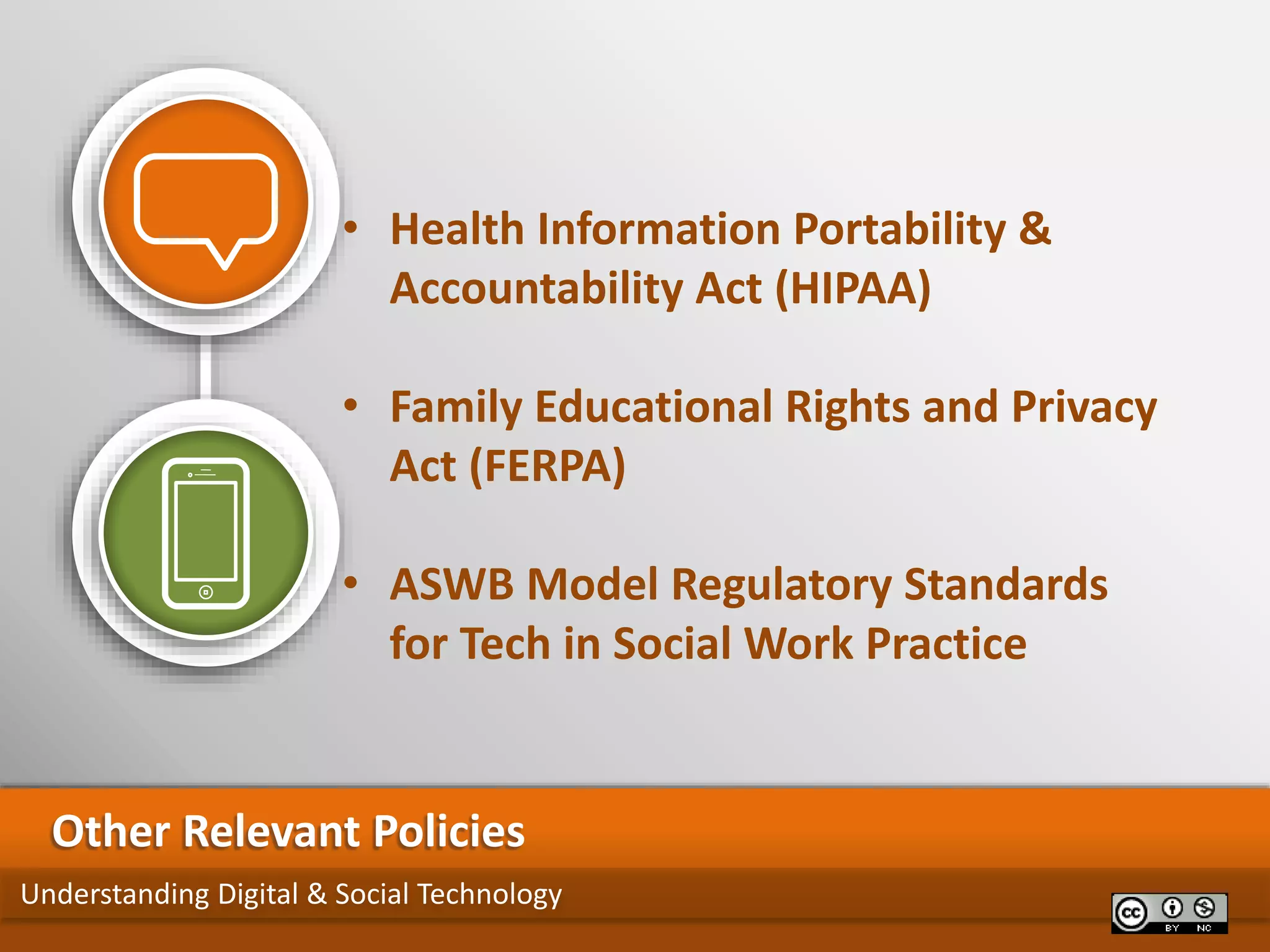
Other Relevant Policies
• Health Information Portability &
Accountability Act (HIPAA)
• Family Educational Rights and Privacy
Act (FERPA)
• ASWB Model Regulatory Standards
for Tech in Social Work Practice
Best Practices
Professional Practice with Social & Digital Technology
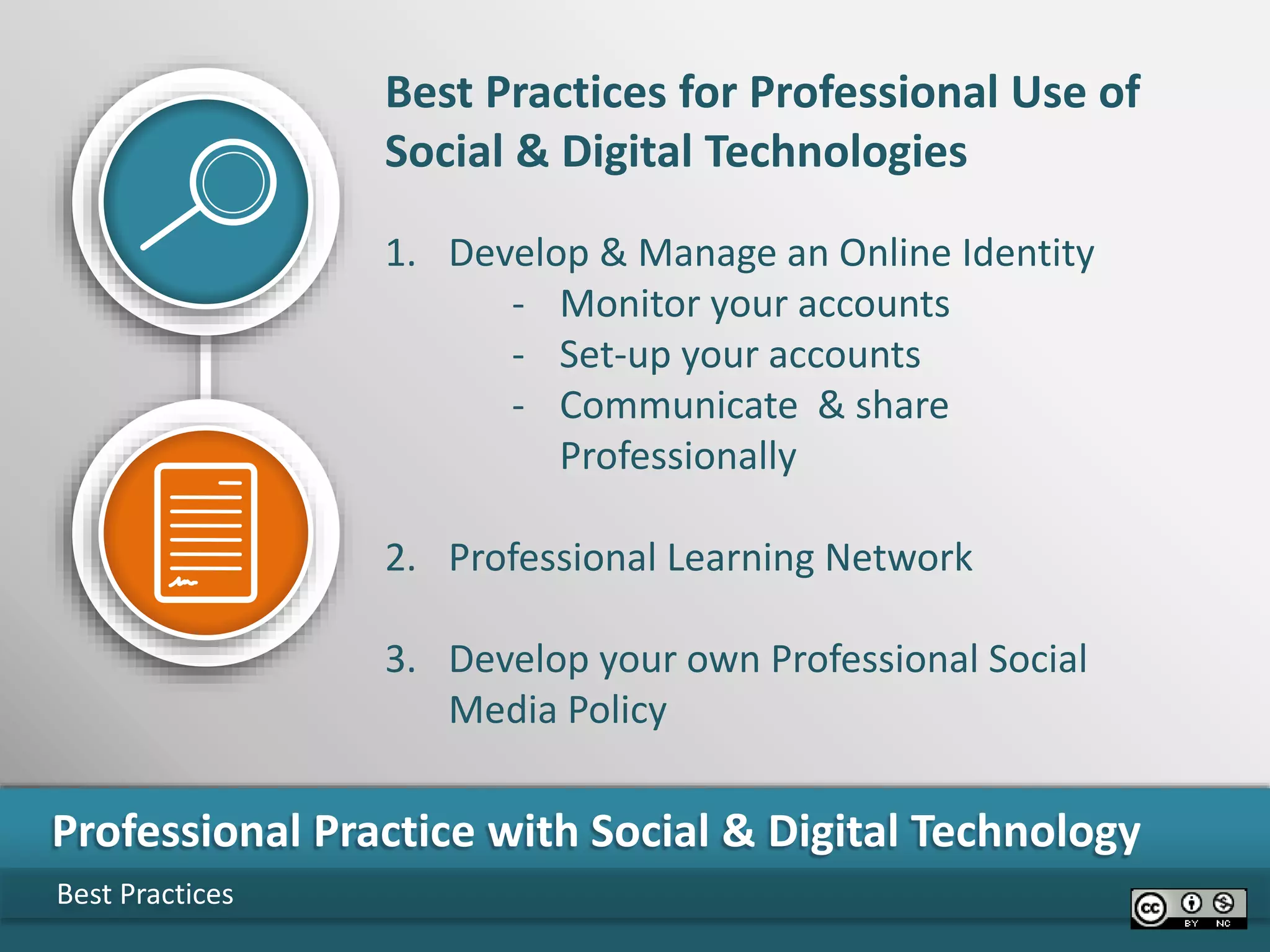
Best Practices for Professional Use of
Social & Digital Technologies
1. Develop & Manage an Online Identity
- Monitor your accounts
- Set-up your accounts
- Communicate & share
Professionally
2. Professional Learning Network
3. Develop your own Professional Social
Media Policy
One best practice is to self-assess one’s
social media accounts for the quantity and
quality of content as well as basic metrics
such as who is following you and who is re-
posting your comments.
There are several ways to do self-assess and
we have included three examples :
• Single Social Media Account Self- Audit
• Multiple Social Media Account Self-Audit
• Practitioner Self-Audit
How to monitor one’s Social Media Accounts:
Conducting Self-Audits
Developing and Managing an Online Identity
Best Practices
There are four steps to help develop and
manage an online identity:
1. Assess your current online status.
2. Decide when to use your real name
and image.
3. Set-up your online accounts for
appropriate use.
4. Find social media platforms to fit
your different roles.
Dennen (2014)
Developing and Managing an Online Identity:
Set-up your online accounts for appropriate use (Best Practice)
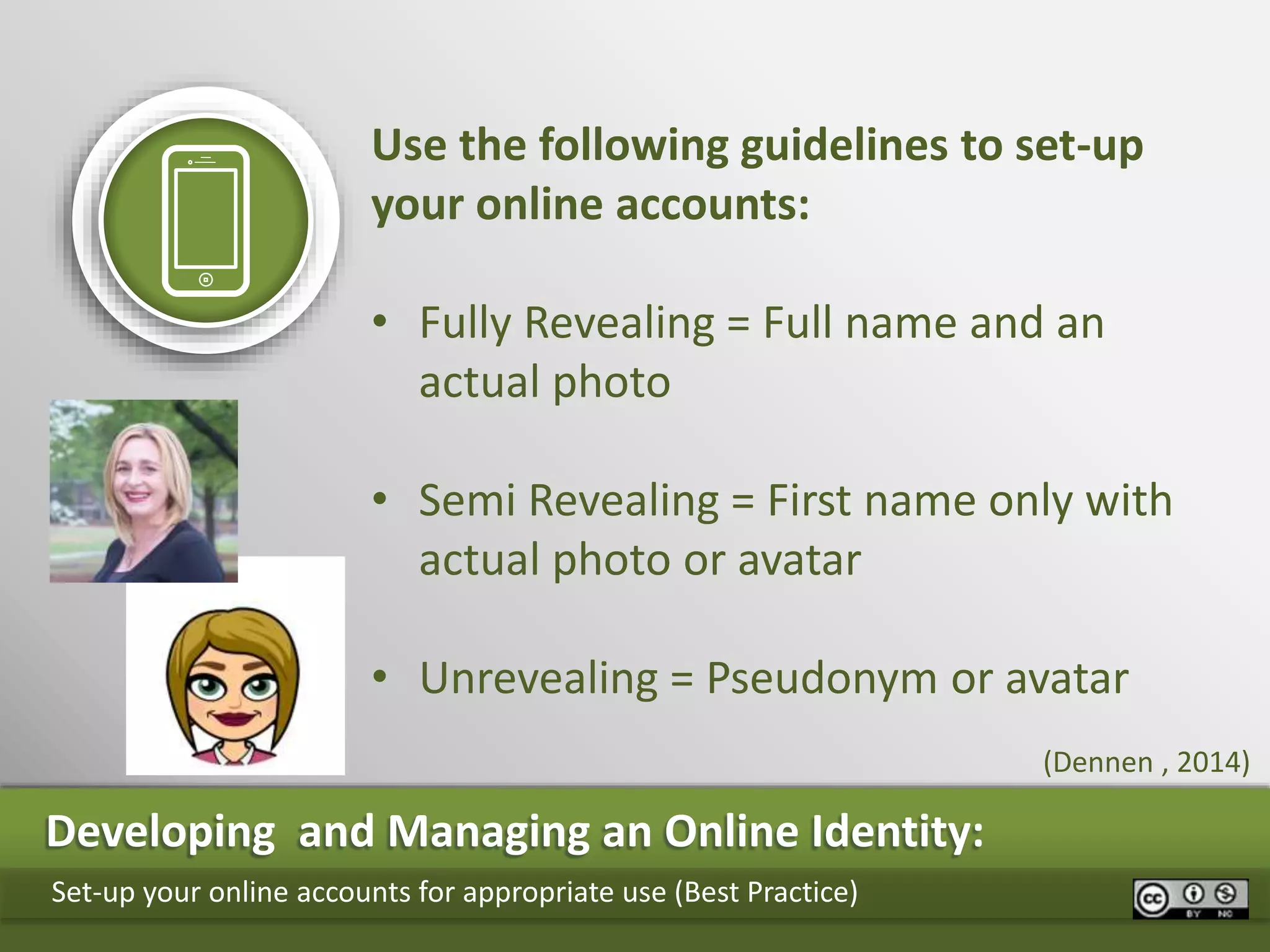
Use the following guidelines to set-up
your online accounts:
• Fully Revealing = Full name and an
actual photo
• Semi Revealing = First name only with
actual photo or avatar
• Unrevealing = Pseudonym or avatar
(Dennen , 2014)
Best Practices
Share Professionally on Social Media
Social workers consider the following five questions as a
guide for posting information on social media:
1. What information do you want to share?
2. Why do you want to share this information?
3. Who needs to see this information?
4. Where do you want to share this information?
5. How does the NASW Code of Ethics or other organizational
policies guide sharing this information?
Kimball & Kim (2013)
Best Practices
Communicate Professionally via Social Media or Texting
These tools have the benefit of being convenient and cannot
guarantee client privacy or confidentiality.
Ethical practices include:
1. Seek guidance from your supervisor and/or agency.
2. Obtain a client’s permission to communicate via social
media or texting.
3. Avoid disclosing personal health information.
4. Use HIPAA or FERPA compliant communication tools.
5. Always use password protection on your devices.
6. Have a plan to lock and deactivate your mobile device in
the event of loss or theft.
7. Do not share your digital devices.
8. Advocate for HIPAA or FERPA compliant digital
communication tools at your agency.
Best Practices
Whys & Whats of a Professional Learning Network
Why?
• Life-long or Career Learning
• Ethical practice for Social Workers
• Rapid pace of change requires active strategies to
stay up-to-date
What?
• Technology-based tools & processes to network,
disseminate and stay informed
• Building professional relationships in digital spaces
Best Practices
Steps to creating a Professional Learning Network
Answer the following questions:
• What do you want to learn?
• How do you want to participate?
• What digital tools do you want to use?
• How will you manage it?
• How will you connect it with your face-to-face network?
Worksheet
• Professional Learning Network (PLN) Worksheet
What?
• Technology-based tools & processes to network,
disseminate and stay informed
• Building professional relationships in digital spaces
Best Practices
How to write your own Social Media Policy
Why do you need a
professional social
media policy?
Best Practices
What are social media policies?
Social Media Policies/Guidelines
 Outlines a Code of Conduct
 Discusses Best Practices
 Makes Recommendations
Allison’s Social Media Policy
In considering the salient points in this document I relied on
the following resources to guide me:
NASW Code of the Ethics
NASW & ASWB Standards for Technology and Social Work
Practice
UA Social Media Guidelines
Family Education Rights and Privacy Act (FERPA)
• Privacy and confidentiality
• Boundaries
• Friending
• Use of Search Engines
• E-mail
Full policy available at: http://www.laureliversonhitchcock.org/2016/02/12/my-guidelines-for-using-digital-social-tech-
in-the-classroom-and-beyond/
Laurel’s Social Media Policy
My policy addresses the following ethical concerns:
• Maintain and model virtual boundaries
• Keep information and content private and confidential
• Promote integrity and accountability
• Be accessible and model professional digital
communication
Here are some course and classroom specific guidelines for
students:
• What is okay in the classroom?
• What is not okay in the classroom?
• What is the best way to use email as part of this course?
• What is the best way to use text messages as part of this
course?
Full policy available at: http://www.laureliversonhitchcock.org/2016/02/12/my-guidelines-for-using-digital-social-tech-
in-the-classroom-and-beyond/
Best Practice
Professional Social Media Policy
How to write your own Social Media Policy
Consider the following questions:
• What sources or standards do you need to
consider?
• Who are you informing with your policy?
• What ethical concerns does your policy need to
address?
• How do you want to engage in common online
activities?
Resources:
• Professional Social Media Policy Worksheet
• Social Media Policy Checklist for Social Workers
Worksheet
To obtain your free copy of the Social Media
Toolkit for Social Work Field Educators, Second
Edition
Educator’s Guide:
https://doi.org/10.6084/m9.figshare.7287053.v1
Slide Deck:
https://doi.org/10.6084/m9.figshare.7288007.v1
Contains:
• Ethical Considerations for Social Media Use in Social Work Practice
• Reflecting on Social Media Use in Social Work Practice
• Engaging and Self-Assessment with Social Media
• Professional Practice with Social Media
• Case Studies for Students & Field Educators
• Social Media Learning Activities for Field Education
Social Media Toolkit for Field Educations, Second Edition
Resource
Questions and Comments
Allison M. Curington, LCSW
Director of Field Education
University of Alabama
amcurington@sw.ua.edu
@amcuring
Laurel Iverson Hitchcock , PhD, LCSW
Associate Professor of Social Work
University of Alabama at Birmingham (UAB)
lihitch@uab.edu
@laurelhitchcock
Mary Jacque Carroll
Director of Field Education
University of Alabama at Birmingham
mjcarrol@uab.edu
@MJCarroll_SWK
References
Broden, L. M. (2015). Social Media Communication with Military Spouses. Minneapolis, MN: Military REACH. Retrieved from
https://reachmilitaryfamilies.umn.edu/sites/default/files/rdoc/Social%20Media%20Communication%20with%20Military%20
Spouses.pdf
Curington, A.M. & Hitchcock, L.I. (2017, July 28). The Social Media Toolkit for Social Work Field Educators. Retrieved from
http://www.laureliversonhitchcock.org/2017/07/28/social-media-toolkit-for-social-work-field-educators-get-your-free-copy/
Dennen, V. (2014). Florida State University, Massively Open Online Course titled Social Media for Active Learning, Spring 2014.
Retrieved from: http://meme.coe.fsu.edu/smooc/
Kimball, E., & Kim, J. (2013). Virtual Boundaries: Ethical Considerations for Use of Social Media in Social Work. Social Work, 58(2),
185–188. http://doi.org/10.1093/sw/swt005
Goldkind, L., Wolf, L., & Jones, J. (2016). Late Adapters? How Social Workers Acquire Knowledge and Skills About Technology Tools.
Journal of Technology in Human Services, 34(4), 338–358. https://doi.org/10.1080/15228835.2016.1250027
Hitchcock, L.I., & Curington, A. (2016). My Guidelines for using Digital & Social Tech in the Classroom and Beyond. Retrieved from:
http://www.laureliversonhitchcock.org/2016/02/12/my-guidelines-for-using-digital-social-tech-in-the-classroom-and-
beyond/
Hitchcock, L.I., Sage, M., & Smyth, N.J. (2016). Technology-Based Learning Task List for Social Work Education (Version 1.1 –
6/13/16). Retrieved from: http://www.laureliversonhitchcock.org/2016/06/13/revised-technology-based-learning-task-list-
for-social-work-education/
Hitchcock, L. I. (2015, July 2). Personal Learning Networks for Social Workers. Retrieved from
http://www.laureliversonhitchcock.org/2015/07/01/personal-learning-networks-for-social-workers/
References
Karpman, H. E., & Drisko, J. (2016). Social Media Policy in Social Work Education: A Review and Recommendations. Journal of Social
Work Education, 0(0), 1–11. https://doi.org/10.1080/10437797.2016.1202164
Michaeli, D. (2015, November 15). Personal Learning Network Twitter Cheat Sheet. Retrieved February 8, 2017, from
http://www.socialwork.career/2015/11/personal-learning-network-twitter-cheat-sheet.html
Richardson, W., & Mancabelli, R. (2011). Personal learning networks: Using the power of connections to transform education.
Bloomington, IN: Solution Tree Press.
Robb, M. (2011). Pause Before Posting — Using Social Media Responsibly. Social Work Today, 11(1), 8.
Sage, M., & Sage, T. (2016). Social Media and E-professionalism in Child Welfare: Policy and Practice. Journal of Public Child
Welfare, 10(1), 79–95. https://doi.org/10.1080/15548732.2015.1099589
Smyth, N. J. (2016, October 14). Online Connections for Professional Learning. Retrieved from
https://socialworksynergy.org/2016/10/14/online-connections-for-professional-learning/
Whitby, T. (2013, November 18). How Do I Get a PLN? Retrieved April 5, 2017, from https://www.edutopia.org/blog/how-do-i-get-a-
pln-tom-whitby
National Association of Social Workers. (2017). NASW, ABSW, CSWE & CSWA Standards for Technology in Social Work Practice.
Washington, D.C.: National Association of Social Workers. Retrieved from
http://www.socialworkers.org/includes/newIncludes/homepage/PRA-BRO-33617.TechStandards_FINAL_POSTING.pdf

Helping Social Work Students develop a Professional Online Presence for Interprofessional Communication

  • 1.
    Helping Social WorkStudents develop a Professional Online Presence for Interprofessional Communication 2018 CSWE Field Institute Mary Jacque Carroll, LICSW (@MJCarroll_SWK) Allison M. Curington, LMSW (@amcuring) Laurel Iverson Hitchcock, PhD, LICSW (@laurelhitchcock)
  • 2.
    About the Presenters Allison M.Curington Allison M. Curington, MSW, LCSW, is the Director of Field Education at The University of Alabama School of Social Work. E-mail: amcuington@sw.ua.edu Twitter: @amcuring Laurel Iverson Hitchcock Laurel Iverson Hitchcock, PhD, MPH, MSW, LICSW, is an Associate Professor in the Department of Social Work at the University of Alabama at Birmingham. Email: lihitch@uab.edu Twitter: @laurelhitchcock Blog: Teaching and Learning in Social Work Mary Jacque Carroll Mary Jacque Carroll, MSW, LICSW, is the Director of Field Education at the University of Alabama at Birmingham. E-mail: mjcarrol@uab.edu Twitter: @MJCarroll_SWK
  • 3.
    C. I getanxious when I don’t have my cell phone. A. I feel that I get more accomplished because of technology. Reflection Which one of these statements best reflects you? Which one of these statements best reflects your relationship to technology? B. I feel that technology makes people waste too much time.
  • 4.
    1. Demonstrate anunderstanding of information and tools that field directors can use to guide curricular development of learning approaches and assessment strategies to achieve practice outcomes around interprofessional communication with digital and social technologies. 2. Develop their own professional online presence to support interprofessional communication. 3. Create activities for students in field to increase understanding of the interprofessional and ethical use of social and digital media in social work practice. Learning Objectives By the end of this presentation, participants will be able to:
  • 5.
    Why do youneed to be in this session? Why do social workers need to be aware of their online, professional presence?
  • 6.
    • Most adultsin US use social media, but varies by age and gender • Health care professionals and helping practitioners are engaged users of social media • Child welfare workers using social media with clients without informing supervisors (Sage & Sage, 2015) • Personal use of social media among students doesn’t translate to e-professionalism (Karpman & Drisko, 2016) • How are professionals using social media? • Professional Learning Networks • Dissemination of Research • Branding & Professional Identity Who is using social media and how?
  • 7.
    • CSWE 2015EPAS: “Social workers understand emerging forms of technology and the ethical use of technology in social work practice.” • NASW’s Standards for Technology in Social Work Practice: 12 standards for Social Work Education and Continue Education • Revisions to NASW Code of Ethics that address the use of technology in practice (2018) • IPEC 2016 Competencies: “communication tools and techniques, including information systems and communication technologies, to facilitate discussions and interactions that enhance team function.” Why is this important for Field Educators?
  • 8.
    Understanding Digital &Social Technology NASW Code of Ethics: 2018 Updates about Technology Includes New Language & Standards related to technology in social work practice Ethical Concerns: Privacy & Confidentiality, Boundaries & Professional Presentation of Self New Language: “Technology-assisted social work services”: • Involving the use of computers, mobile or landline telephones, tablets, video technology, or other electronic or digital technologies • Includes all aspects of social work practice All values, principles and standards can be applied equally to in-person and online interactions.
  • 9.
    Understanding Ethical Standards& Policies in Social Work Standards for Technology in Social Work Practice Authors: • National Association of Social Workers • Association of Social Work Boards • Council of Social Work Education • Clinical Social Work Association Five Sections: • Provision of Information to the Public (2) • Designing and Delivering Services (27) • Gathering, Managing and Storing Information (14) • Social Work Education and Supervision (12) • Glossary & Resources
  • 10.
    Understanding Digital &Social Technology Other Relevant Policies • Health Information Portability & Accountability Act (HIPAA) • Family Educational Rights and Privacy Act (FERPA) • ASWB Model Regulatory Standards for Tech in Social Work Practice
  • 11.
    Best Practices Professional Practicewith Social & Digital Technology Best Practices for Professional Use of Social & Digital Technologies 1. Develop & Manage an Online Identity - Monitor your accounts - Set-up your accounts - Communicate & share Professionally 2. Professional Learning Network 3. Develop your own Professional Social Media Policy
  • 12.
    One best practiceis to self-assess one’s social media accounts for the quantity and quality of content as well as basic metrics such as who is following you and who is re- posting your comments. There are several ways to do self-assess and we have included three examples : • Single Social Media Account Self- Audit • Multiple Social Media Account Self-Audit • Practitioner Self-Audit How to monitor one’s Social Media Accounts: Conducting Self-Audits
  • 13.
    Developing and Managingan Online Identity Best Practices There are four steps to help develop and manage an online identity: 1. Assess your current online status. 2. Decide when to use your real name and image. 3. Set-up your online accounts for appropriate use. 4. Find social media platforms to fit your different roles. Dennen (2014)
  • 14.
    Developing and Managingan Online Identity: Set-up your online accounts for appropriate use (Best Practice) Use the following guidelines to set-up your online accounts: • Fully Revealing = Full name and an actual photo • Semi Revealing = First name only with actual photo or avatar • Unrevealing = Pseudonym or avatar (Dennen , 2014)
  • 15.
    Best Practices Share Professionallyon Social Media Social workers consider the following five questions as a guide for posting information on social media: 1. What information do you want to share? 2. Why do you want to share this information? 3. Who needs to see this information? 4. Where do you want to share this information? 5. How does the NASW Code of Ethics or other organizational policies guide sharing this information? Kimball & Kim (2013)
  • 16.
    Best Practices Communicate Professionallyvia Social Media or Texting These tools have the benefit of being convenient and cannot guarantee client privacy or confidentiality. Ethical practices include: 1. Seek guidance from your supervisor and/or agency. 2. Obtain a client’s permission to communicate via social media or texting. 3. Avoid disclosing personal health information. 4. Use HIPAA or FERPA compliant communication tools. 5. Always use password protection on your devices. 6. Have a plan to lock and deactivate your mobile device in the event of loss or theft. 7. Do not share your digital devices. 8. Advocate for HIPAA or FERPA compliant digital communication tools at your agency.
  • 17.
    Best Practices Whys &Whats of a Professional Learning Network Why? • Life-long or Career Learning • Ethical practice for Social Workers • Rapid pace of change requires active strategies to stay up-to-date What? • Technology-based tools & processes to network, disseminate and stay informed • Building professional relationships in digital spaces
  • 18.
    Best Practices Steps tocreating a Professional Learning Network Answer the following questions: • What do you want to learn? • How do you want to participate? • What digital tools do you want to use? • How will you manage it? • How will you connect it with your face-to-face network? Worksheet • Professional Learning Network (PLN) Worksheet What? • Technology-based tools & processes to network, disseminate and stay informed • Building professional relationships in digital spaces
  • 19.
    Best Practices How towrite your own Social Media Policy Why do you need a professional social media policy?
  • 20.
    Best Practices What aresocial media policies? Social Media Policies/Guidelines  Outlines a Code of Conduct  Discusses Best Practices  Makes Recommendations
  • 21.
    Allison’s Social MediaPolicy In considering the salient points in this document I relied on the following resources to guide me: NASW Code of the Ethics NASW & ASWB Standards for Technology and Social Work Practice UA Social Media Guidelines Family Education Rights and Privacy Act (FERPA) • Privacy and confidentiality • Boundaries • Friending • Use of Search Engines • E-mail Full policy available at: http://www.laureliversonhitchcock.org/2016/02/12/my-guidelines-for-using-digital-social-tech- in-the-classroom-and-beyond/
  • 22.
    Laurel’s Social MediaPolicy My policy addresses the following ethical concerns: • Maintain and model virtual boundaries • Keep information and content private and confidential • Promote integrity and accountability • Be accessible and model professional digital communication Here are some course and classroom specific guidelines for students: • What is okay in the classroom? • What is not okay in the classroom? • What is the best way to use email as part of this course? • What is the best way to use text messages as part of this course? Full policy available at: http://www.laureliversonhitchcock.org/2016/02/12/my-guidelines-for-using-digital-social-tech- in-the-classroom-and-beyond/
  • 23.
    Best Practice Professional SocialMedia Policy How to write your own Social Media Policy Consider the following questions: • What sources or standards do you need to consider? • Who are you informing with your policy? • What ethical concerns does your policy need to address? • How do you want to engage in common online activities? Resources: • Professional Social Media Policy Worksheet • Social Media Policy Checklist for Social Workers Worksheet
  • 24.
    To obtain yourfree copy of the Social Media Toolkit for Social Work Field Educators, Second Edition Educator’s Guide: https://doi.org/10.6084/m9.figshare.7287053.v1 Slide Deck: https://doi.org/10.6084/m9.figshare.7288007.v1 Contains: • Ethical Considerations for Social Media Use in Social Work Practice • Reflecting on Social Media Use in Social Work Practice • Engaging and Self-Assessment with Social Media • Professional Practice with Social Media • Case Studies for Students & Field Educators • Social Media Learning Activities for Field Education Social Media Toolkit for Field Educations, Second Edition Resource
  • 25.
    Questions and Comments AllisonM. Curington, LCSW Director of Field Education University of Alabama amcurington@sw.ua.edu @amcuring Laurel Iverson Hitchcock , PhD, LCSW Associate Professor of Social Work University of Alabama at Birmingham (UAB) lihitch@uab.edu @laurelhitchcock Mary Jacque Carroll Director of Field Education University of Alabama at Birmingham mjcarrol@uab.edu @MJCarroll_SWK
  • 26.
    References Broden, L. M.(2015). Social Media Communication with Military Spouses. Minneapolis, MN: Military REACH. Retrieved from https://reachmilitaryfamilies.umn.edu/sites/default/files/rdoc/Social%20Media%20Communication%20with%20Military%20 Spouses.pdf Curington, A.M. & Hitchcock, L.I. (2017, July 28). The Social Media Toolkit for Social Work Field Educators. Retrieved from http://www.laureliversonhitchcock.org/2017/07/28/social-media-toolkit-for-social-work-field-educators-get-your-free-copy/ Dennen, V. (2014). Florida State University, Massively Open Online Course titled Social Media for Active Learning, Spring 2014. Retrieved from: http://meme.coe.fsu.edu/smooc/ Kimball, E., & Kim, J. (2013). Virtual Boundaries: Ethical Considerations for Use of Social Media in Social Work. Social Work, 58(2), 185–188. http://doi.org/10.1093/sw/swt005 Goldkind, L., Wolf, L., & Jones, J. (2016). Late Adapters? How Social Workers Acquire Knowledge and Skills About Technology Tools. Journal of Technology in Human Services, 34(4), 338–358. https://doi.org/10.1080/15228835.2016.1250027 Hitchcock, L.I., & Curington, A. (2016). My Guidelines for using Digital & Social Tech in the Classroom and Beyond. Retrieved from: http://www.laureliversonhitchcock.org/2016/02/12/my-guidelines-for-using-digital-social-tech-in-the-classroom-and- beyond/ Hitchcock, L.I., Sage, M., & Smyth, N.J. (2016). Technology-Based Learning Task List for Social Work Education (Version 1.1 – 6/13/16). Retrieved from: http://www.laureliversonhitchcock.org/2016/06/13/revised-technology-based-learning-task-list- for-social-work-education/ Hitchcock, L. I. (2015, July 2). Personal Learning Networks for Social Workers. Retrieved from http://www.laureliversonhitchcock.org/2015/07/01/personal-learning-networks-for-social-workers/
  • 27.
    References Karpman, H. E.,& Drisko, J. (2016). Social Media Policy in Social Work Education: A Review and Recommendations. Journal of Social Work Education, 0(0), 1–11. https://doi.org/10.1080/10437797.2016.1202164 Michaeli, D. (2015, November 15). Personal Learning Network Twitter Cheat Sheet. Retrieved February 8, 2017, from http://www.socialwork.career/2015/11/personal-learning-network-twitter-cheat-sheet.html Richardson, W., & Mancabelli, R. (2011). Personal learning networks: Using the power of connections to transform education. Bloomington, IN: Solution Tree Press. Robb, M. (2011). Pause Before Posting — Using Social Media Responsibly. Social Work Today, 11(1), 8. Sage, M., & Sage, T. (2016). Social Media and E-professionalism in Child Welfare: Policy and Practice. Journal of Public Child Welfare, 10(1), 79–95. https://doi.org/10.1080/15548732.2015.1099589 Smyth, N. J. (2016, October 14). Online Connections for Professional Learning. Retrieved from https://socialworksynergy.org/2016/10/14/online-connections-for-professional-learning/ Whitby, T. (2013, November 18). How Do I Get a PLN? Retrieved April 5, 2017, from https://www.edutopia.org/blog/how-do-i-get-a- pln-tom-whitby National Association of Social Workers. (2017). NASW, ABSW, CSWE & CSWA Standards for Technology in Social Work Practice. Washington, D.C.: National Association of Social Workers. Retrieved from http://www.socialworkers.org/includes/newIncludes/homepage/PRA-BRO-33617.TechStandards_FINAL_POSTING.pdf

Editor's Notes

  • #2 Mary Jacque Why we started this conversation?
  • #3 Mary Jacque
  • #4 Mary Jacque A – Have positive attitudes toward tech B – Have negative attitudes toward tech C – Anxious/dependent on tech Rosen, L. D., Whaling, K., Carrier, L. M., Cheever, N. A., & Rokkum, J. (2013). The Media and Technology Usage and Attitudes Scale: An empirical investigation. Computers in Human Behavior, 29(6), 2501–2511.
  • #5 Mary Jacque
  • #6 Laurel -Why you need to do this first? Modelling and understanding
  • #7 Laurel Women were more likely to use than men Social media associated higher education levels and household income No differences based on race and ethnicity Residents of urban & suburban communities more likely to use Most adults and teens own a mobile phone 73% of all US Adults use internet for health & well-being information Social Media = forms of electronic communication Digital Media = digitized content Mobile Devices
  • #8 Laurel - Why is this important for Field Educators? Obligations to inform our students and our field instructors, liaisons and supervisors
  • #9 Laurel - For the purposes of this Code, “technology-assisted social work services” include any social work services that involve the use of computers, mobile or landline telephones, tablets, video technology, or other electronic or digital technologies; this includes the use of various electronic or digital platforms, such as the Internet, online social media, chat rooms, text messaging, e-mail, and emerging digital applications. Technology-assisted social work services encompass all aspects of social work practice, including psychotherapy; individual, family, or group counseling; community organization; administration; advocacy; mediation; education; supervision; research; evaluation; and other social work services. Social workers should keep apprised of emerging technological developments that may be used in social work practice and how various ethical standards apply to them. Privacy Plug the ethics training
  • #10 Laurel - My remaining concerns are (1) disparities about directives (i.e. things that one must do if teaching/practicing using technology with no matching standards/expectations about teaching/practicing in traditional ways, and (2) that the standards are especially conservative about issues related to online presence of social workers. The people who they added to their technology advisory sub-committee, from my understanding, did not represent those who have online presence or use social media professionally. I believe authentic professional online presence helps one choose a therapist, helps social workers develop their "brands", and helps promote the profession. These standards discourage online social presence in my view.
  • #11 Laurel - HIPAA - Provides data privacy and security provisions for safeguarding medical information Common examples of violations in relation to social networks: Posting about a patient to unauthorized individuals even if the name is not disclosed; Sharing photographs or any PHI without written consent from patient; A mistaken belief that posts are private or have been deleted when they are still visible to the public; Sharing of seemingly innocent comments or pictures, such as a workplace lunch which happen to have visible files underneath FERPA - Gives students access to their education records; Allows students to have an opportunity to have the records amended; Allows some control over the disclosure of information from the records
  • #12 Mary Jacque
  • #13 After reflecting one’s values related to social media, the next step is self-assess one’s social media accounts for the quantity and quality of content as well as basic metrics such as followers, re-posts of comments, and privacy settings. The goal of self-assessment is to understand how, when and what one is doing with social media. There are several ways to do self-assess and we have included three examples:   Single social media account audit: This type of audit focuses on just one social media account and requires an in-depth review of one’s post and images associated with the account (Teaching Sam & Scout, 2014). Criteria for assessment include the quality of language used in posts, level of professionalism in posts, and types of photos connected with the account.   Multiple social media accounts audit: This audit considers multiple accounts and asks one to assess for trends in their social media use and then compare with other users.   Self-assessment checklist for a practitioner: Adapted from Visser, Huiskes, and Korevaar (2012) this checklist provides a series of questions related to ethical and professional practice. Criteria include accessibility of personal information, and quality of network connections and posts.   While these assessments are designed to be completed by the user of a social media account, they can be adapted to be used by another student to complete a peer assessment or by a field supervisor with a student or employee. Quick peer assessments in the classroom (such Google a classmate and review the first page of search results and repeat for images) can provide information and awareness for classroom discussions. A worksheet for each self-assessment is available in the Handout Appendix.
  • #14 Mary Jacque - An online identity is a social identity used to access and interact with others via social media platforms. It includes personally identifiable information such as name, photo, place of employment, and professional status. To create a professional online identity, a student or social worker must determine what personally identifiable information about themselves should be shared with other users of the platform. Dennen (2014) offers the following steps to help develop and manage your online identity.
  • #15  MJC
  • #16 Laurel How to Post on Social Media: Kimball and Kim (2013) suggest that social workers consider the following five questions as a guide for posting information on social media; Questions 1-3. What information do you want to share? - Consider the type of information to be shared. Is it public or private information? Text, data or images? Is it fact-based, a professional judgement or personal opinion? Why do you want to share this information? - Think about the reasons for sharing this information. What are the benefits or deterrents of sharing? Is there an expected outcome from sharing this information? Who needs to see this information? - This is when you consider the audience or reader. Who will read this information and how will they benefit from it? If personal, will clients or supervisors see this information? Where do you want to share this information? - Reflect on which social media platform would be the best venue for sharing or if you want to share across multiple platforms such as Twitter and LinkedIn. How does the NASW Code of Ethics or other organizational policies guide sharing this information? -Always examine and reflect on the NASW Code of Ethics and other policies that may affect the sharing of this information.
  • #17 Laurel Seek guidance from your supervisor and/or agency about organizational-level policies related to communicating via social media and texting. Obtain a client’s permission to communicate via social media or texting, using informed consent to explain the benefits and risks as well as setting parameters for how the communication will work (i.e. limited time periods such as between 8 AM – 5 PM, what topics are appropriate for texting). Avoid disclosing personal health information or any other sensitive content about the client in your messages. Use HIPAA (Health Insurance Portability and Accountability Act) or FERPA (Family Educational Rights and Privacy Act) compliant communication tools or apps for your communication. Examples include Tiger Connect (https://www.tigerconnect.com/), TextUp (https://www.textup.org/) or Remind (https://www.remind.com/). There are many other tools available and social workers should explore all the options. Have a plan to lock and deactivate your mobile device in the event of loss or theft. Advocate for HIPAA or FERPA compliant digital communication tools at your agency.
  • #18 Laurel Self-Reflection on Current Strategies What topics do you need to stay abreast of? How do you current keep up on new developments? When you need to know something, to whom to you go?
  • #19 Laurel
  • #20 Allison – why you need to do this first? Modelling and understanding Develop your own Professional Social Media Guidelines: The purpose of a social media policy is to inform clients, constituents, colleagues and others about when, how and why you use social media in a professional capacity. This is not a policy for your agency, but one that you employ as a practitioner, professional, and/or educator. This is a recommended practice by the National Association of Social Workers (New Standards) and fits with the NASW Code of Ethics standards of informed consent with clients. While there are no set standards for what should be included in a social media policy or how it should be communicated with clients, colleagues of constituents, we encourage students, educators, and practitioners to include the benefits of social media as well as potential challenges. Informed Consent Boundary Setting Standards 2.10, 2.27, 3.01 & 4.04 from NASW Tech Standards
  • #21 Allison and that they “use technology ethically and appropriately to facilitate practice outcomes” (p. 7).
  • #22 Allison
  • #23 Laurel
  • #24 Allison - The purpose of a social media policy is to inform clients, constituents, colleagues and others about when, how and why you use social media in a professional capacity.
  • #25 Allison
  • #26 Allison
  • #27 Allison
  • #28 Allison