END USER
DEVELOPM
ENT
Presentation By- Sanmitra A. Bhatkar.
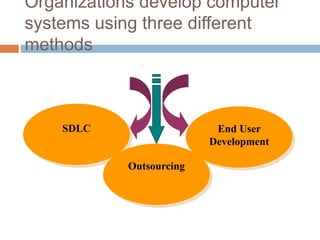
Organizations develop computer
systems using three different
methods
End User
Development
SDLC
Outsourcing
End User
In information technology, the term end
user is used to distinguish the person for
whom a hardware or software product is
designed from the developers, installers, and
servicers of the product. The "end" part of the
term probably derives from the fact that most
information technologies involve a chain of
interconnected product components at the end
of which is the "user."
Definition of End User
Development
 End-user development (EUD) or end-
user programming (EUP) refers to activities
and tools that allow end-users – people who
are not professional software developers – to
program computers.
Artefacts
 end users may be objects describing some
automated behaviour or control sequence, such
as database requests or grammar rules, which
can be described with programming paradigms
such as programming by
demonstration, programming with
examples, visual programming,
or macro generation. They can also be
parameters that choose between alternative
predefined behaviours of an application.
 end-user development may also refer to the
creation of user-generated content such as
annotations, which may be or not computationally
interpretable (i.e. can be processed by associated
automated functions).
Examples
Examples of end-user development include
the creation and modification of:
 3D models created with end-user oriented
tools and apps such as Sketchup.
 Game modifications to introduce users' own
characters, environments, etc. — many recent
games are distributed with modification in
mind
 Web Mashups in the form of visual languages
such as Yahoo! Pipes.
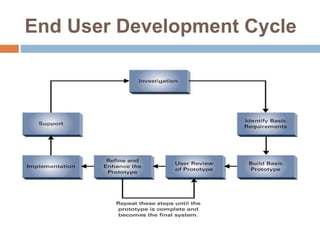
End User Development Cycle
Characteristics
 End user as the
developer and
maintainer.
Characteristics
 The developer
is the client,
therefore there
are no
communication
issues
Characteristics
 Small budget
and/or short
time period for
development
Advantages of End User
Development
 Encourages active user participation
 Improves requirements determination
 Strengthens user sense of ownership
 Increases speed of systems development
Disadvantages of End User
Development
 Inadequate expertise leads to underdeveloped
systems
 Lack of organizational focus creates
"privatized" system
 Insufficient analysis and design leads to
subpar systems
 Lack of documentation of a system may lead
to its being short lived
End user development

End user development

  • 1.
  • 2.
    Organizations develop computer systemsusing three different methods End User Development SDLC Outsourcing
  • 3.
    End User In informationtechnology, the term end user is used to distinguish the person for whom a hardware or software product is designed from the developers, installers, and servicers of the product. The "end" part of the term probably derives from the fact that most information technologies involve a chain of interconnected product components at the end of which is the "user."
  • 4.
    Definition of EndUser Development  End-user development (EUD) or end- user programming (EUP) refers to activities and tools that allow end-users – people who are not professional software developers – to program computers.
  • 5.
    Artefacts  end usersmay be objects describing some automated behaviour or control sequence, such as database requests or grammar rules, which can be described with programming paradigms such as programming by demonstration, programming with examples, visual programming, or macro generation. They can also be parameters that choose between alternative predefined behaviours of an application.  end-user development may also refer to the creation of user-generated content such as annotations, which may be or not computationally interpretable (i.e. can be processed by associated automated functions).
  • 6.
    Examples Examples of end-userdevelopment include the creation and modification of:  3D models created with end-user oriented tools and apps such as Sketchup.  Game modifications to introduce users' own characters, environments, etc. — many recent games are distributed with modification in mind  Web Mashups in the form of visual languages such as Yahoo! Pipes.
  • 7.
  • 8.
    Characteristics  End useras the developer and maintainer.
  • 9.
    Characteristics  The developer isthe client, therefore there are no communication issues
  • 10.
    Characteristics  Small budget and/orshort time period for development
  • 11.
    Advantages of EndUser Development  Encourages active user participation  Improves requirements determination  Strengthens user sense of ownership  Increases speed of systems development
  • 12.
    Disadvantages of EndUser Development  Inadequate expertise leads to underdeveloped systems  Lack of organizational focus creates "privatized" system  Insufficient analysis and design leads to subpar systems  Lack of documentation of a system may lead to its being short lived