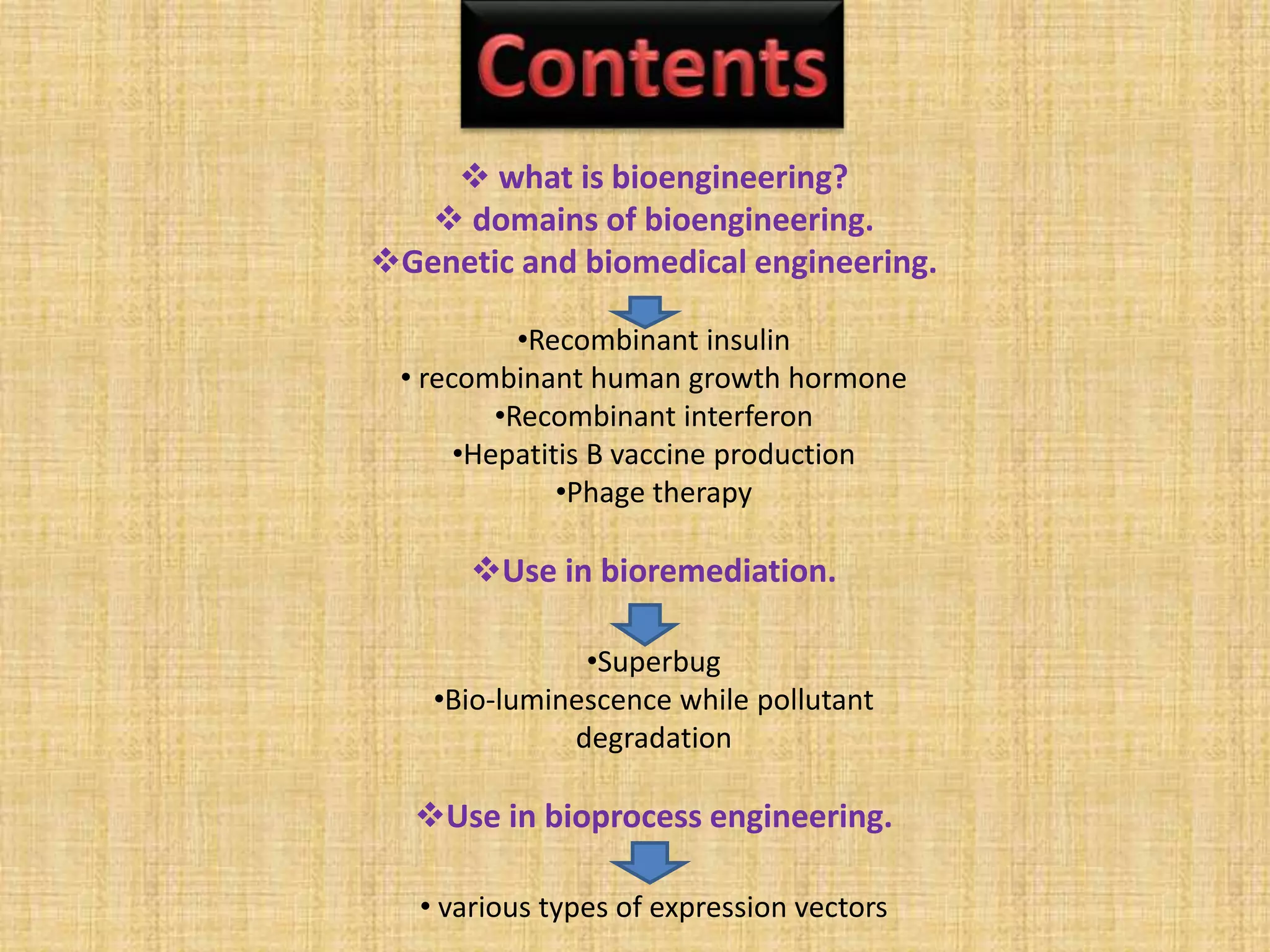
 what is bioengineering?
 domains of bioengineering.
Genetic and biomedical engineering.
•Recombinant insulin
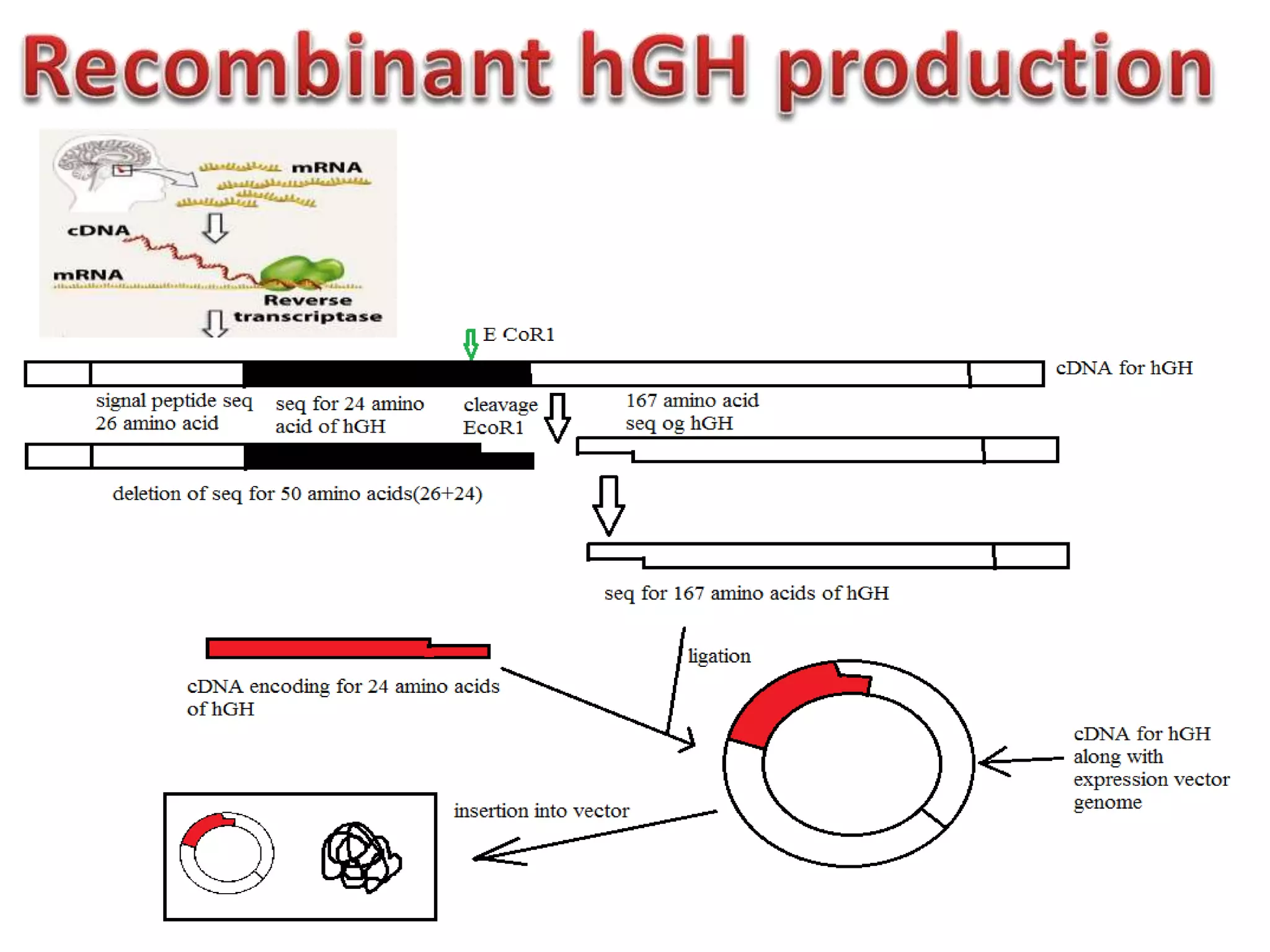
• recombinant human growth hormone
•Recombinant interferon
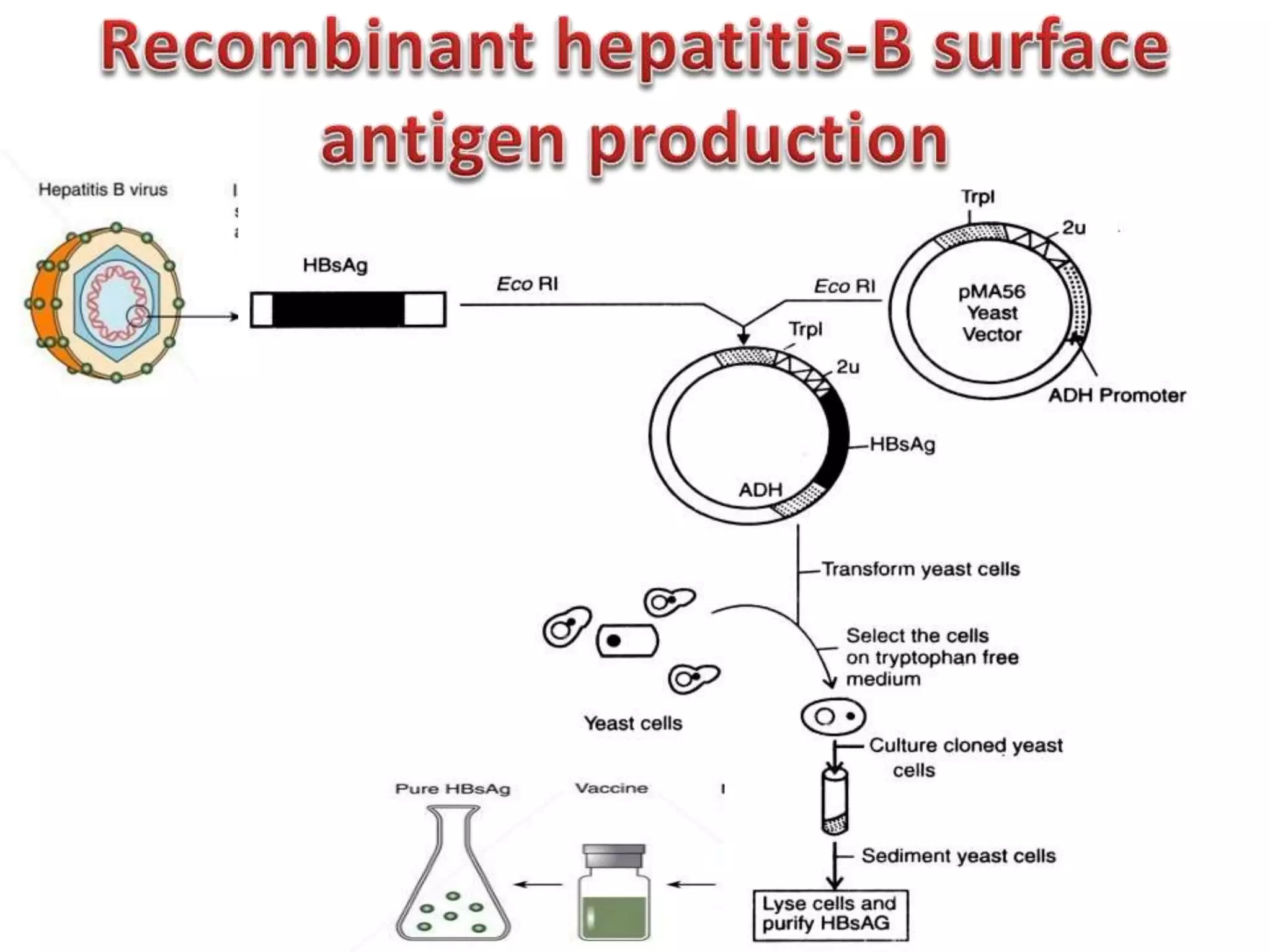
•Hepatitis B vaccine production
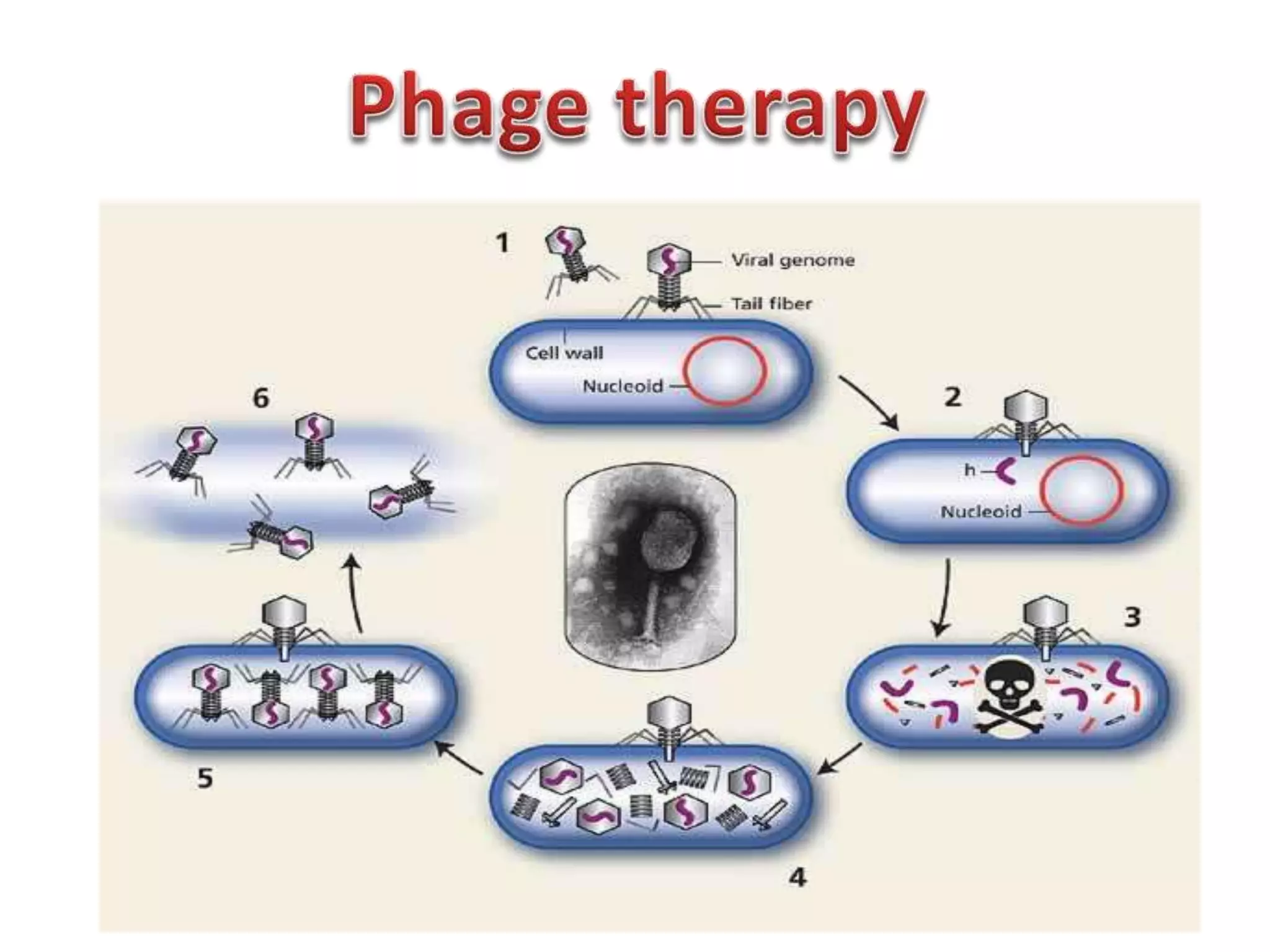
•Phage therapy
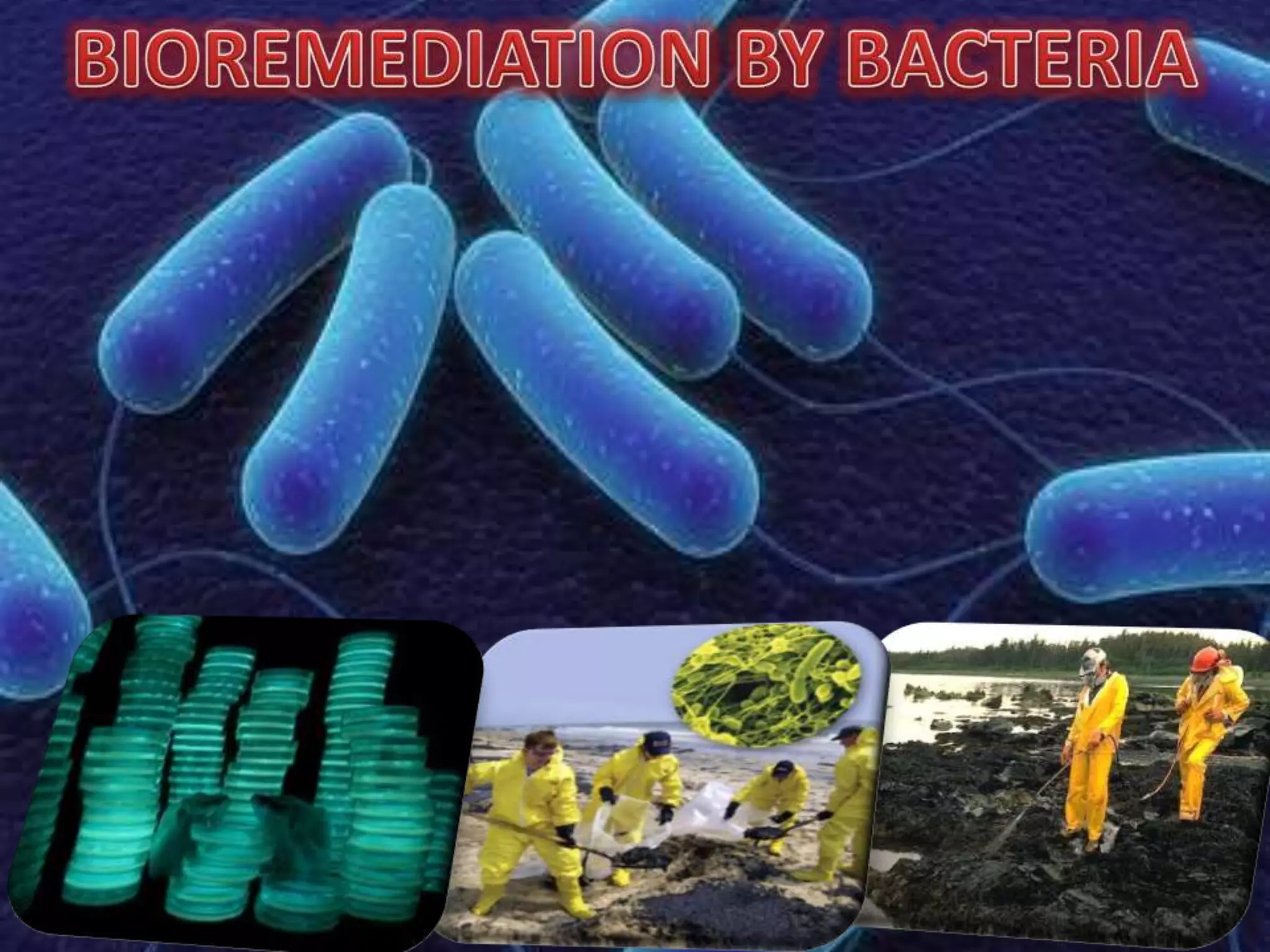
Use in bioremediation.
•Superbug
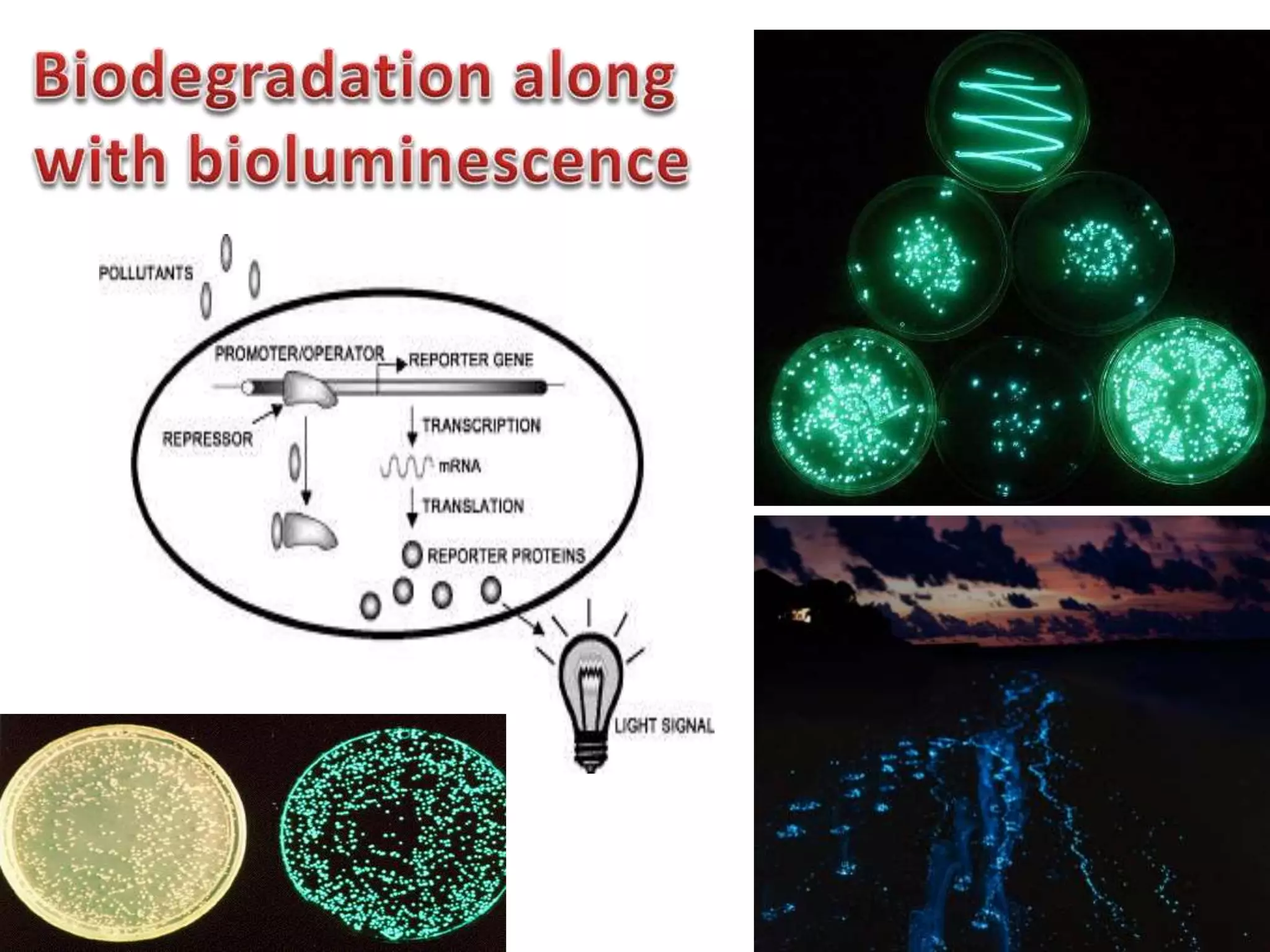
•Bio-luminescence while pollutant
degradation
Use in bioprocess engineering.
• various types of expression vectors
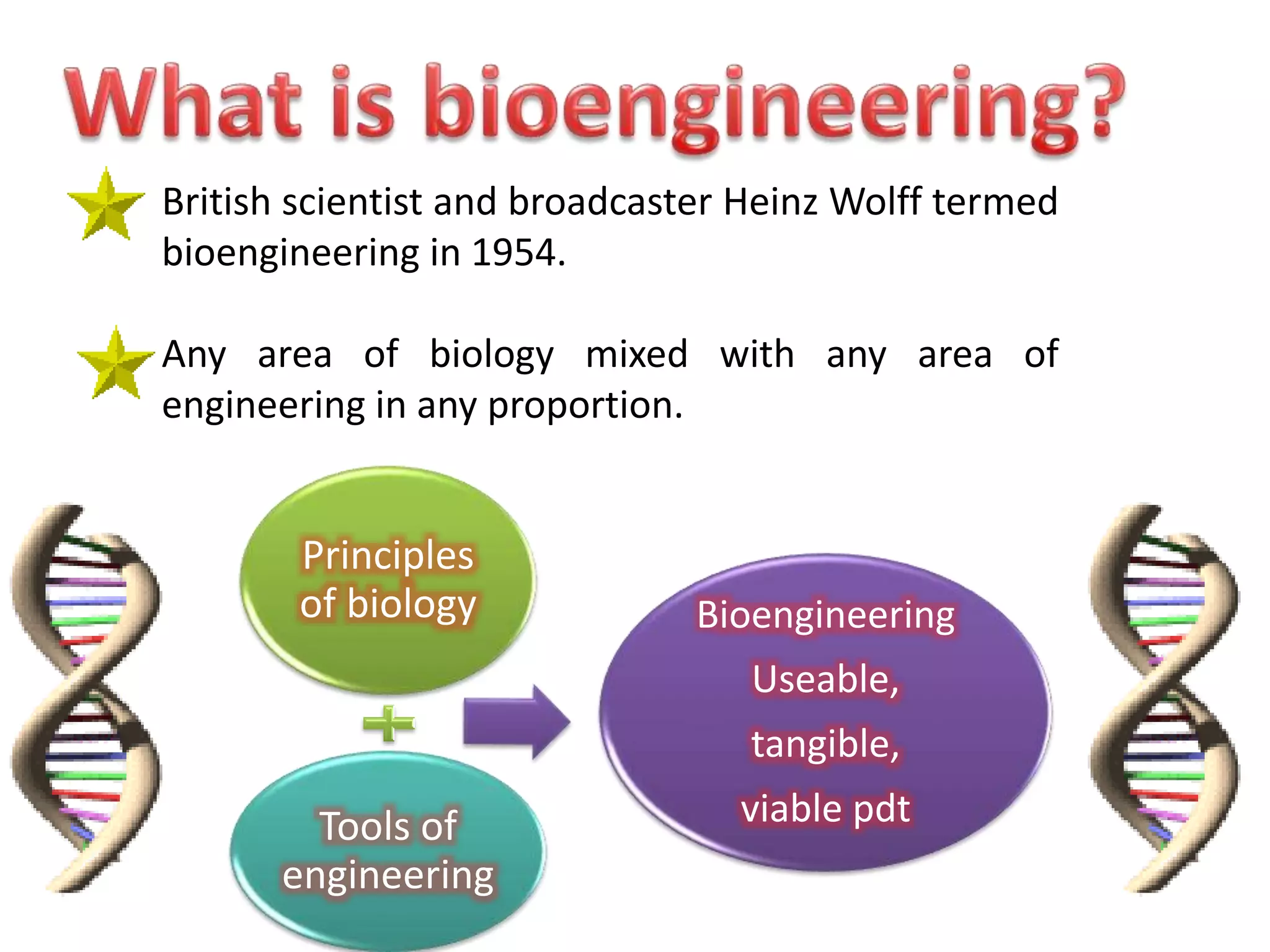
British scientist and broadcaster Heinz Wolff termed
bioengineering in 1954.
Any area of biology mixed with any area of
engineering in any proportion.
Principles
of biology
Tools of
engineering
Bioengineering
Useable,
tangible,
viable pdt
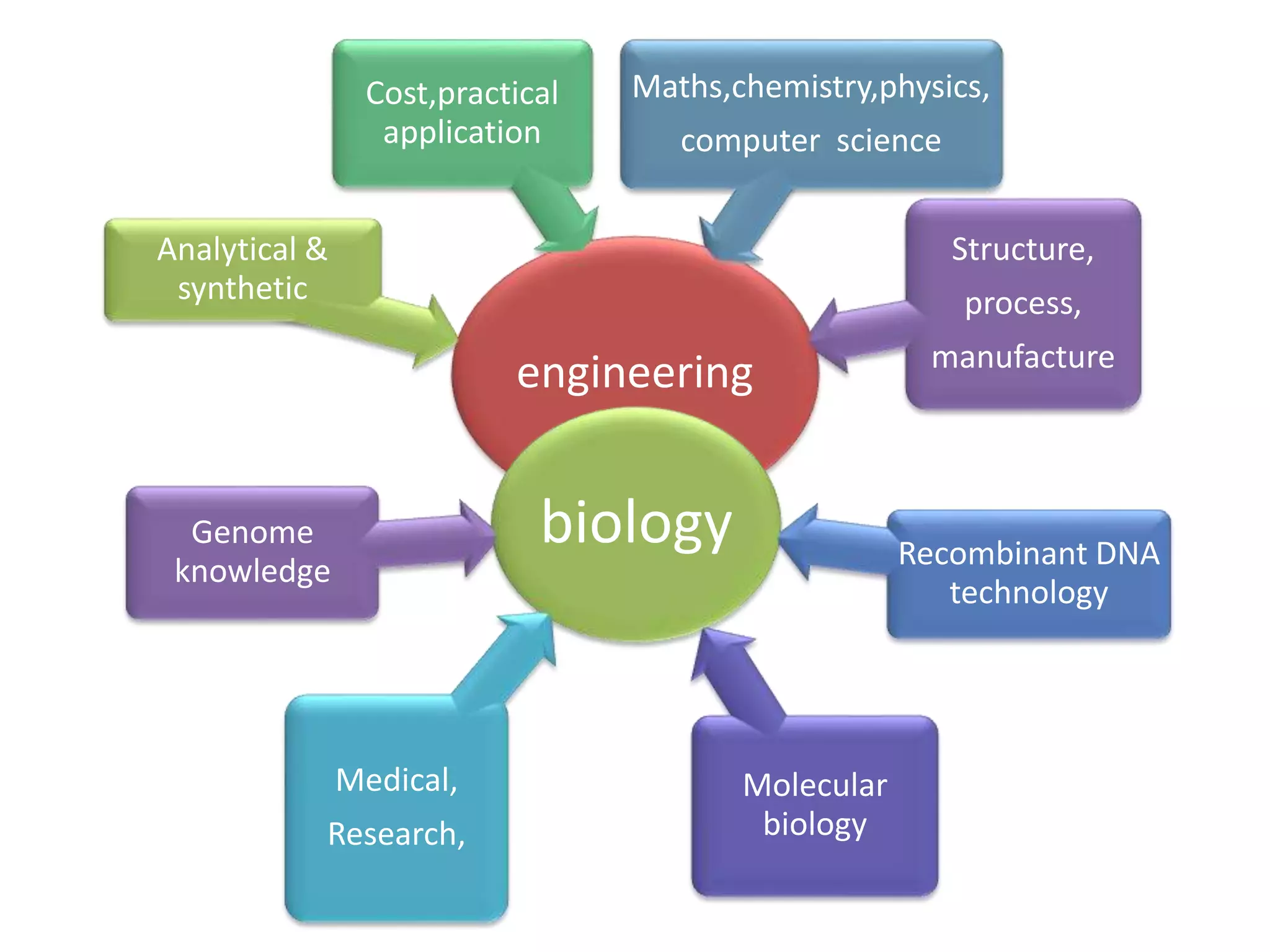
engineering
Analytical &
synthetic
Cost,practical
application
Maths,chemistry,physics,
computer science
Structure,
process,
manufacture
biologyGenome
knowledge
Molecular
biology
Recombinant DNA
technology
Medical,
Research,
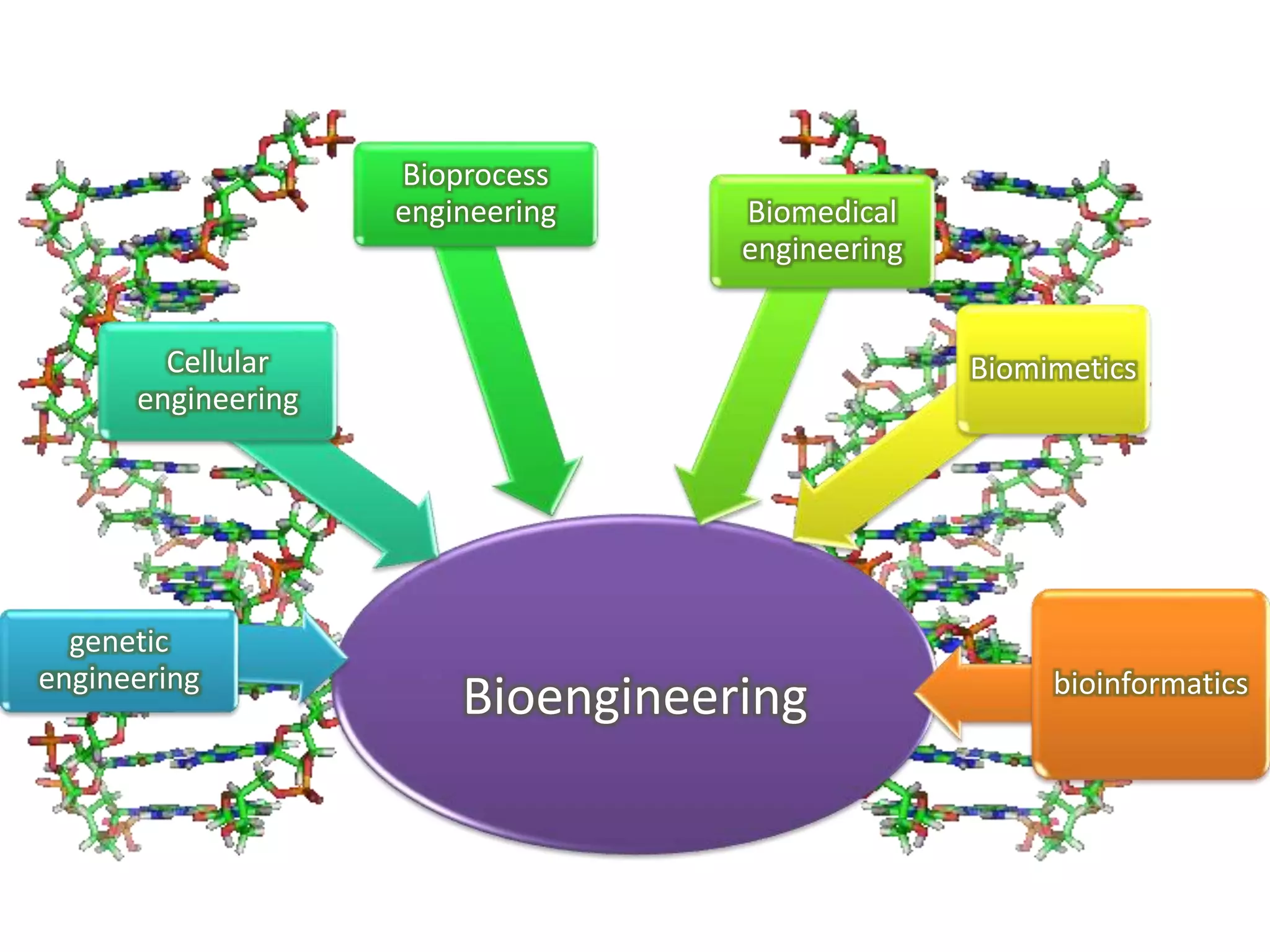
Bioengineering
genetic
engineering
Cellular
engineering
Bioprocess
engineering Biomedical
engineering
Biomimetics
bioinformatics
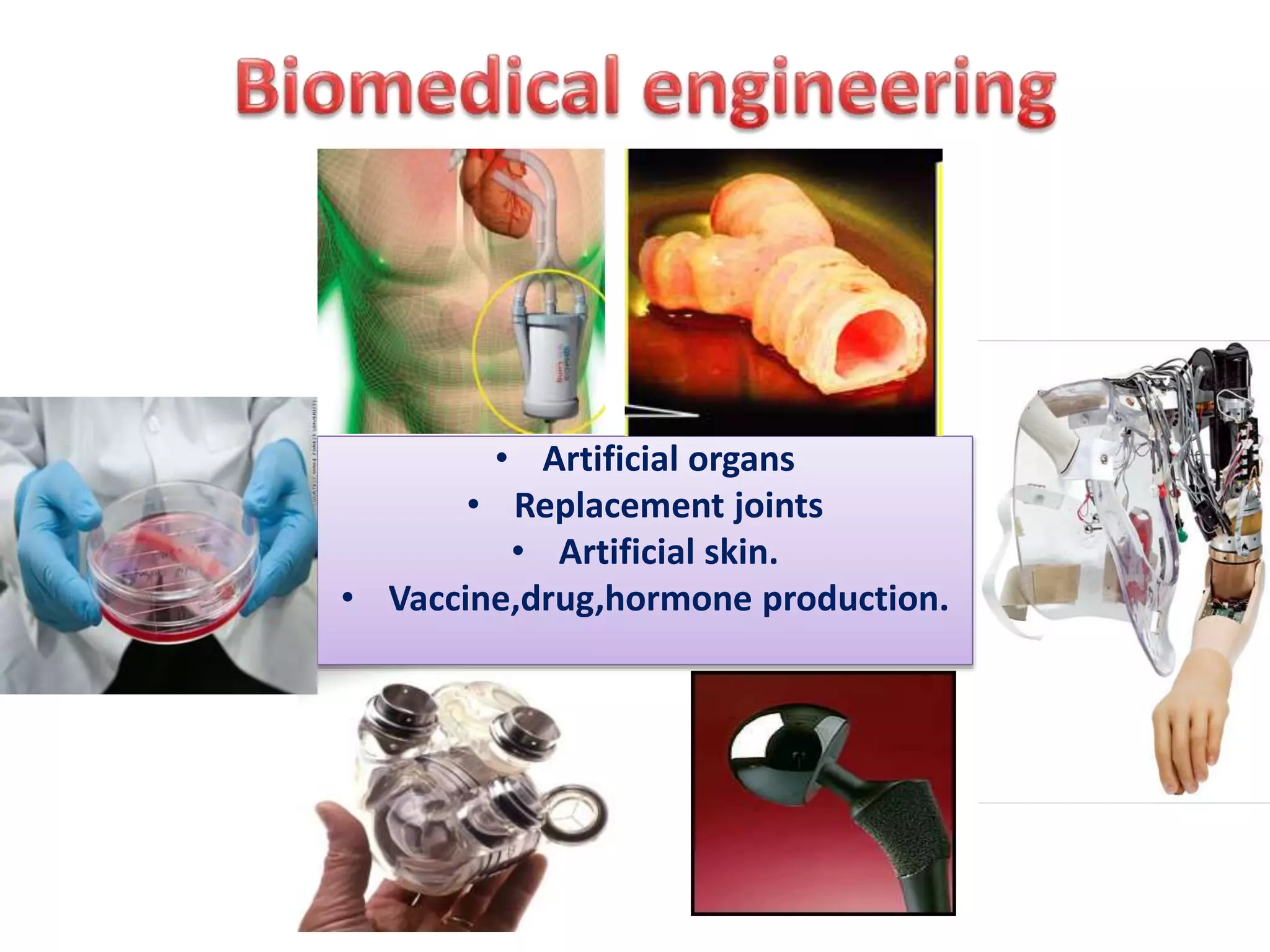
• Artificial organs
• Replacement joints
• Artificial skin.
• Vaccine,drug,hormone production.
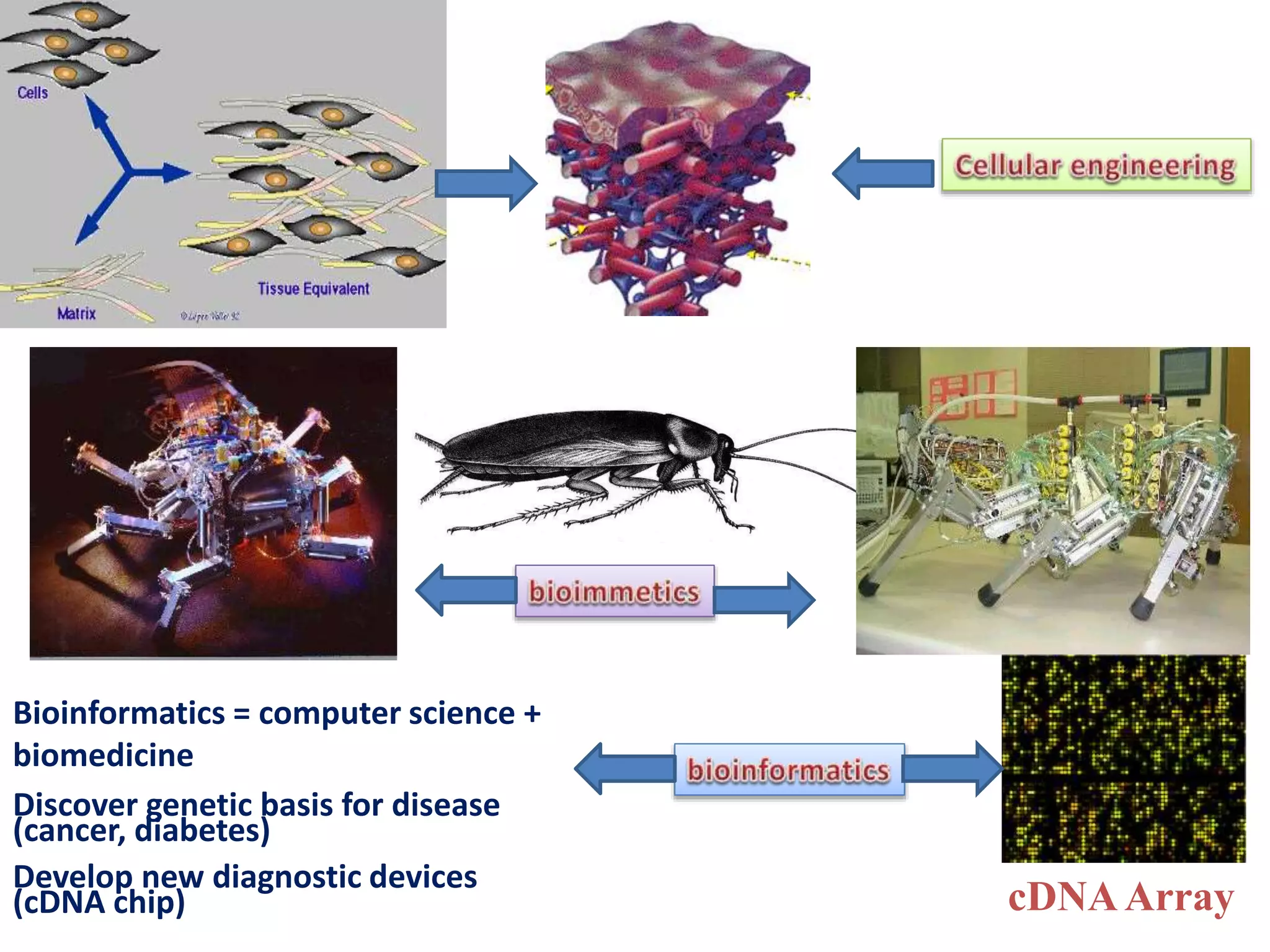
Bioinformatics = computer science +
biomedicine
Discover genetic basis for disease
(cancer, diabetes)
Develop new diagnostic devices
(cDNA chip) cDNAArray
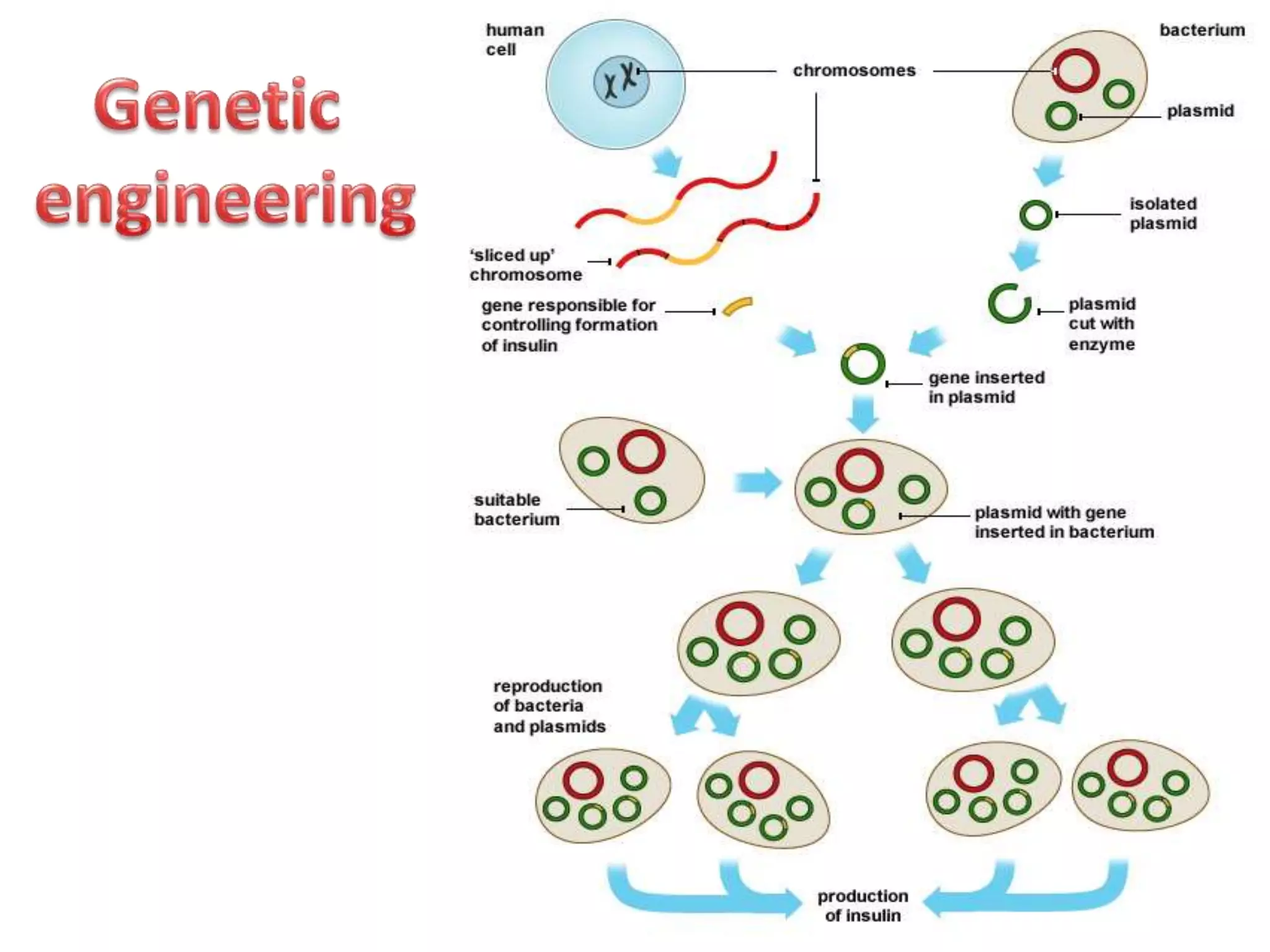
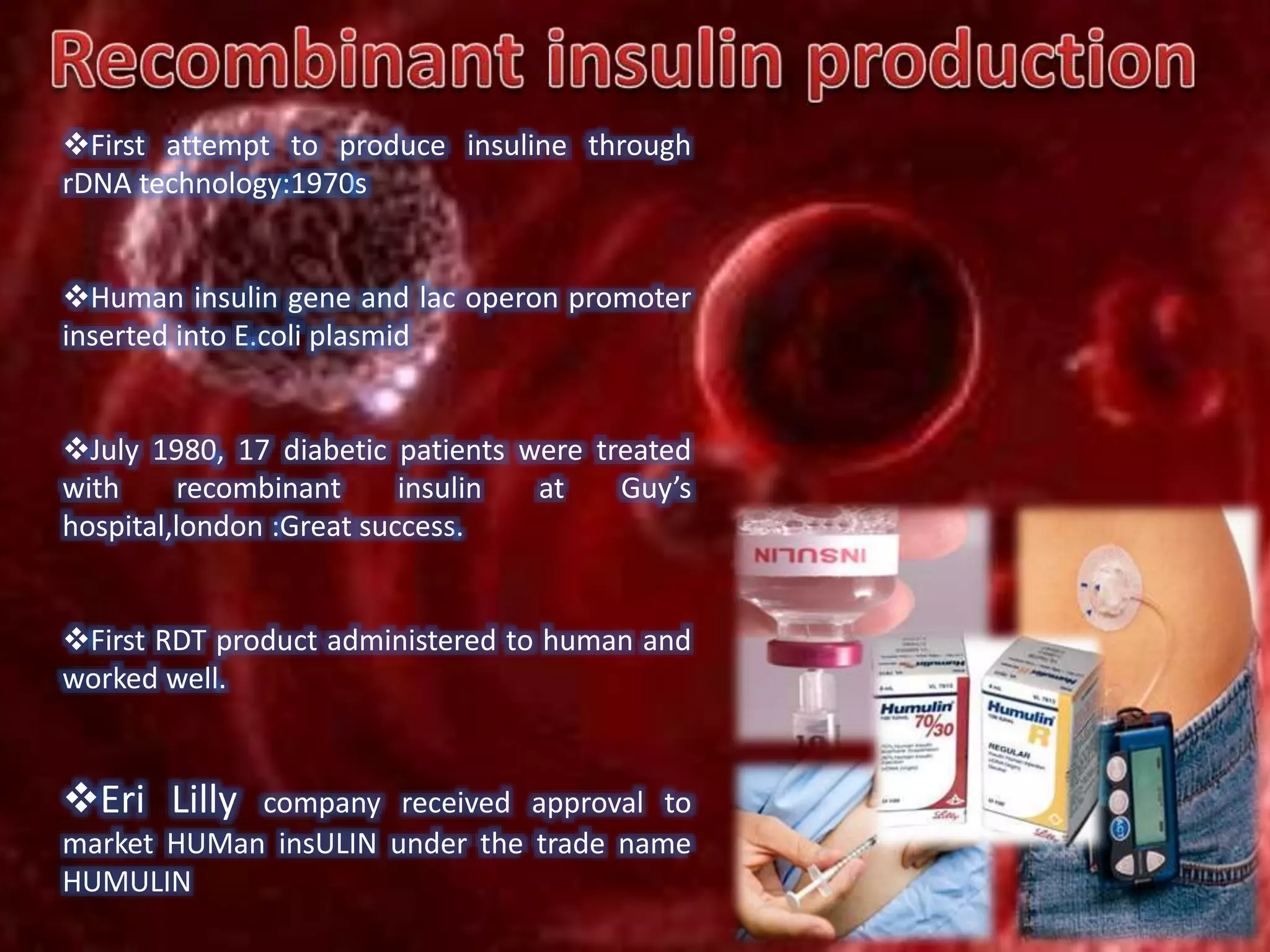
First attempt to produce insuline through
rDNA technology:1970s
Human insulin gene and lac operon promoter
inserted into E.coli plasmid
July 1980, 17 diabetic patients were treated
with recombinant insulin at Guy’s
hospital,london :Great success.
First RDT product administered to human and
worked well.
Eri Lilly company received approval to
market HUMan insULIN under the trade name
HUMULIN
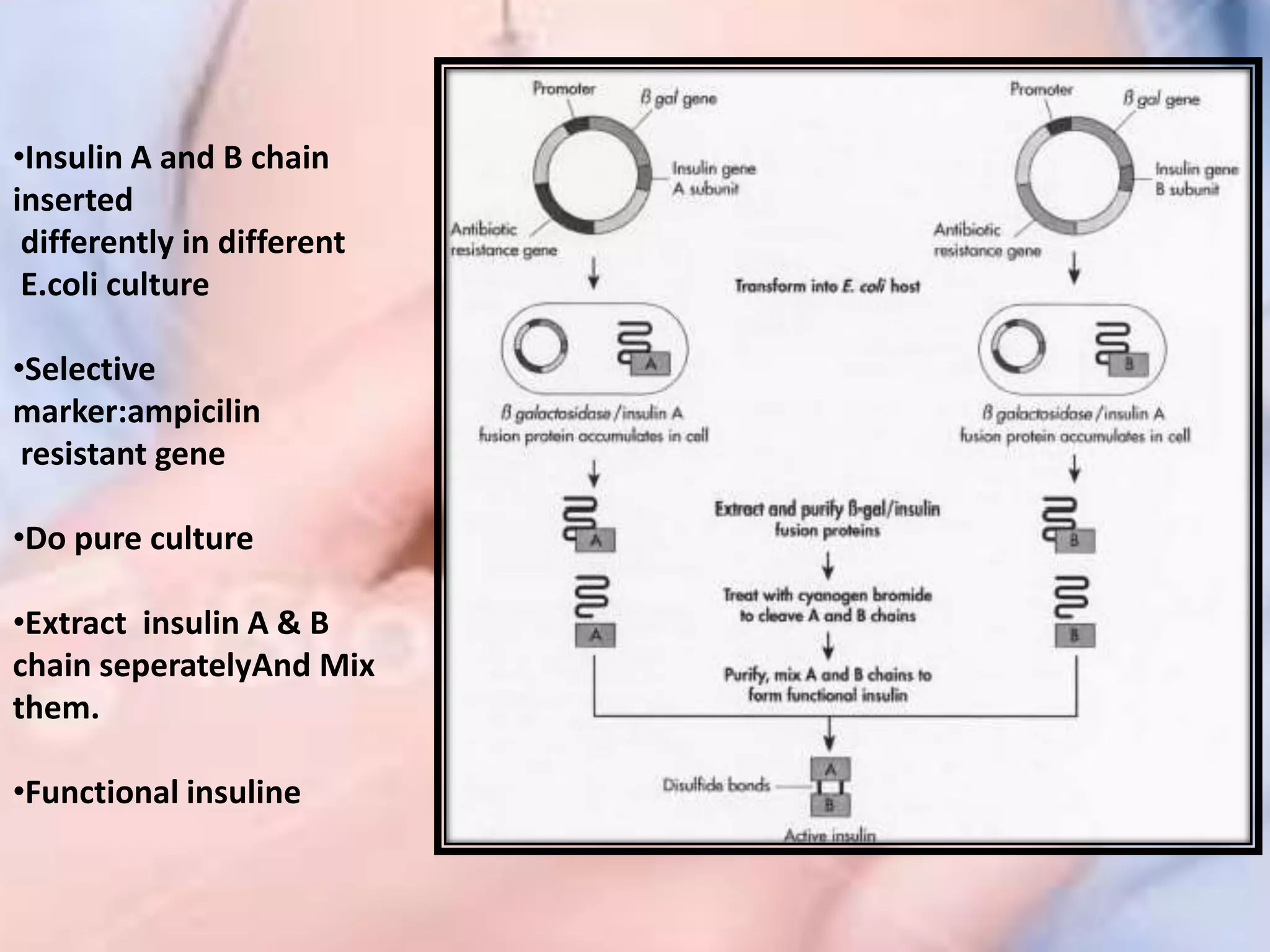
•Insulin A and B chain
inserted
differently in different
E.coli culture
•Selective
marker:ampicilin
resistant gene
•Do pure culture
•Extract insulin A & B
chain seperatelyAnd Mix
them.
•Functional insuline
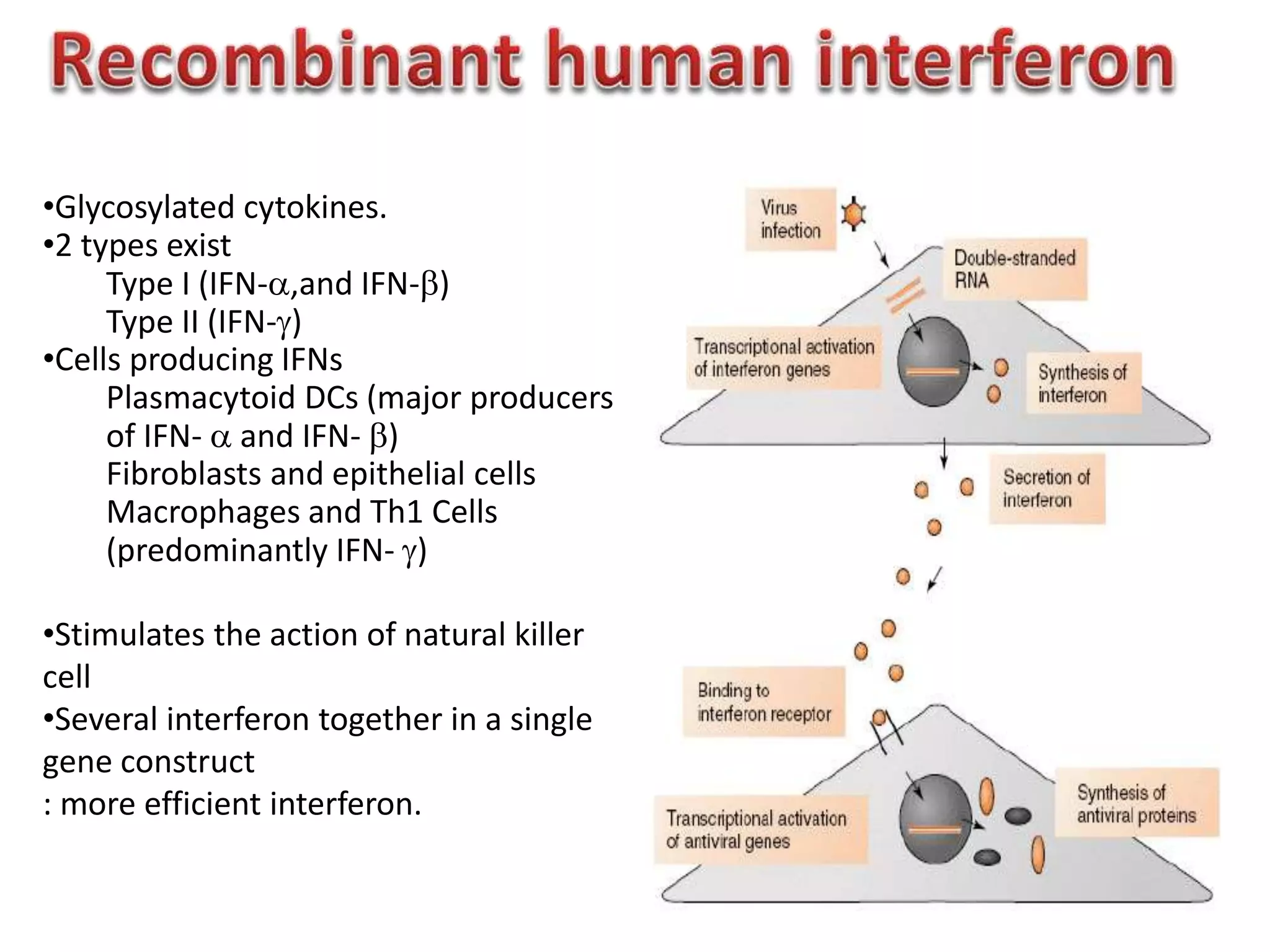
•Glycosylated cytokines.
•2 types exist
Type I (IFN-,and IFN-)
Type II (IFN-)
•Cells producing IFNs
Plasmacytoid DCs (major producers
of IFN-  and IFN- )
Fibroblasts and epithelial cells
Macrophages and Th1 Cells
(predominantly IFN- )
•Stimulates the action of natural killer
cell
•Several interferon together in a single
gene construct
: more efficient interferon.
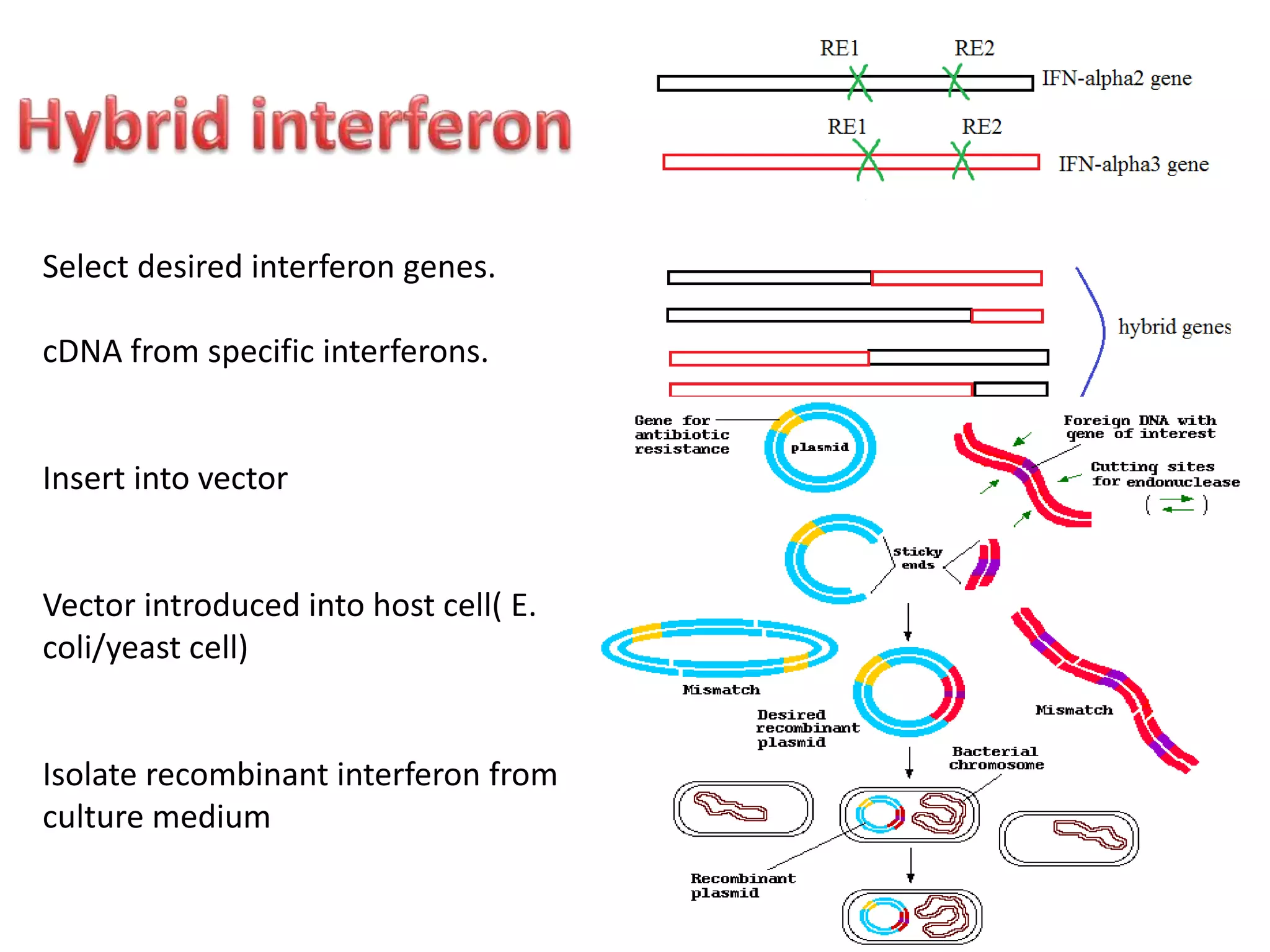
Select desired interferon genes.
cDNA from specific interferons.
Insert into vector
Vector introduced into host cell( E.
coli/yeast cell)
Isolate recombinant interferon from
culture medium
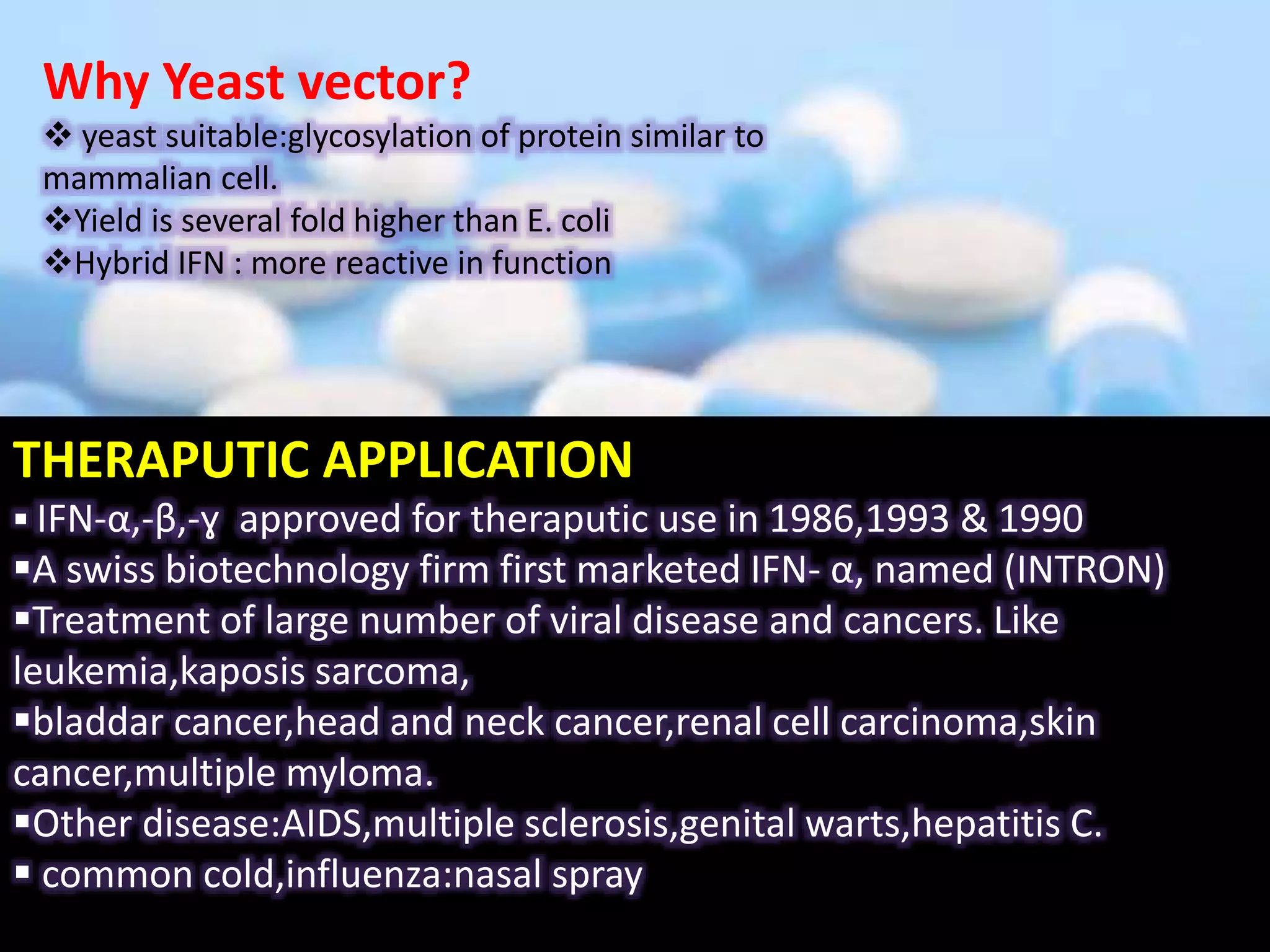
Why Yeast vector?
 yeast suitable:glycosylation of protein similar to
mammalian cell.
Yield is several fold higher than E. coli
Hybrid IFN : more reactive in function
THERAPUTIC APPLICATION
 IFN-α,-β,-ɣ approved for theraputic use in 1986,1993 & 1990
A swiss biotechnology firm first marketed IFN- α, named (INTRON)
Treatment of large number of viral disease and cancers. Like
leukemia,kaposis sarcoma,
bladdar cancer,head and neck cancer,renal cell carcinoma,skin
cancer,multiple myloma.
Other disease:AIDS,multiple sclerosis,genital warts,hepatitis C.
 common cold,influenza:nasal spray
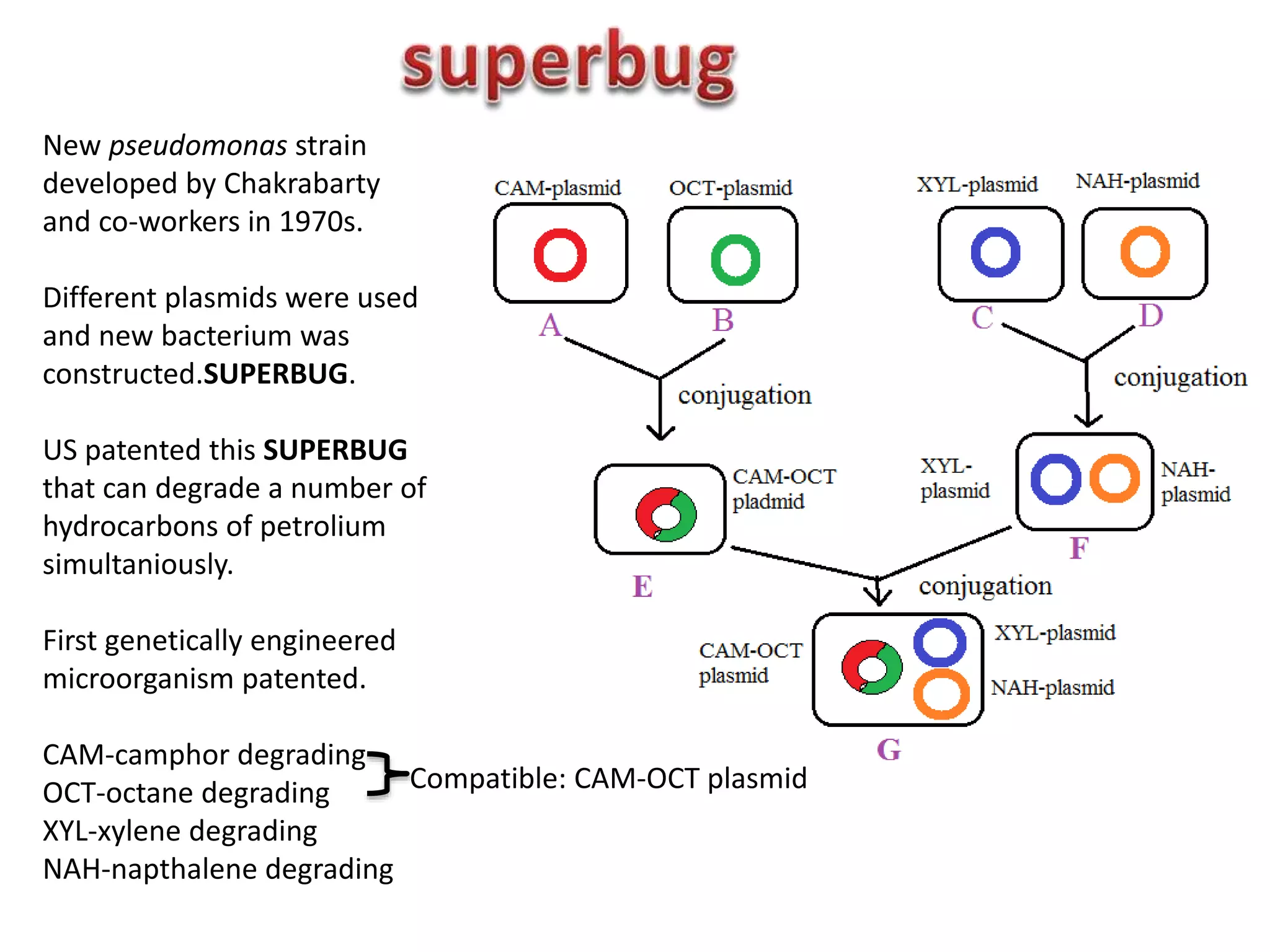
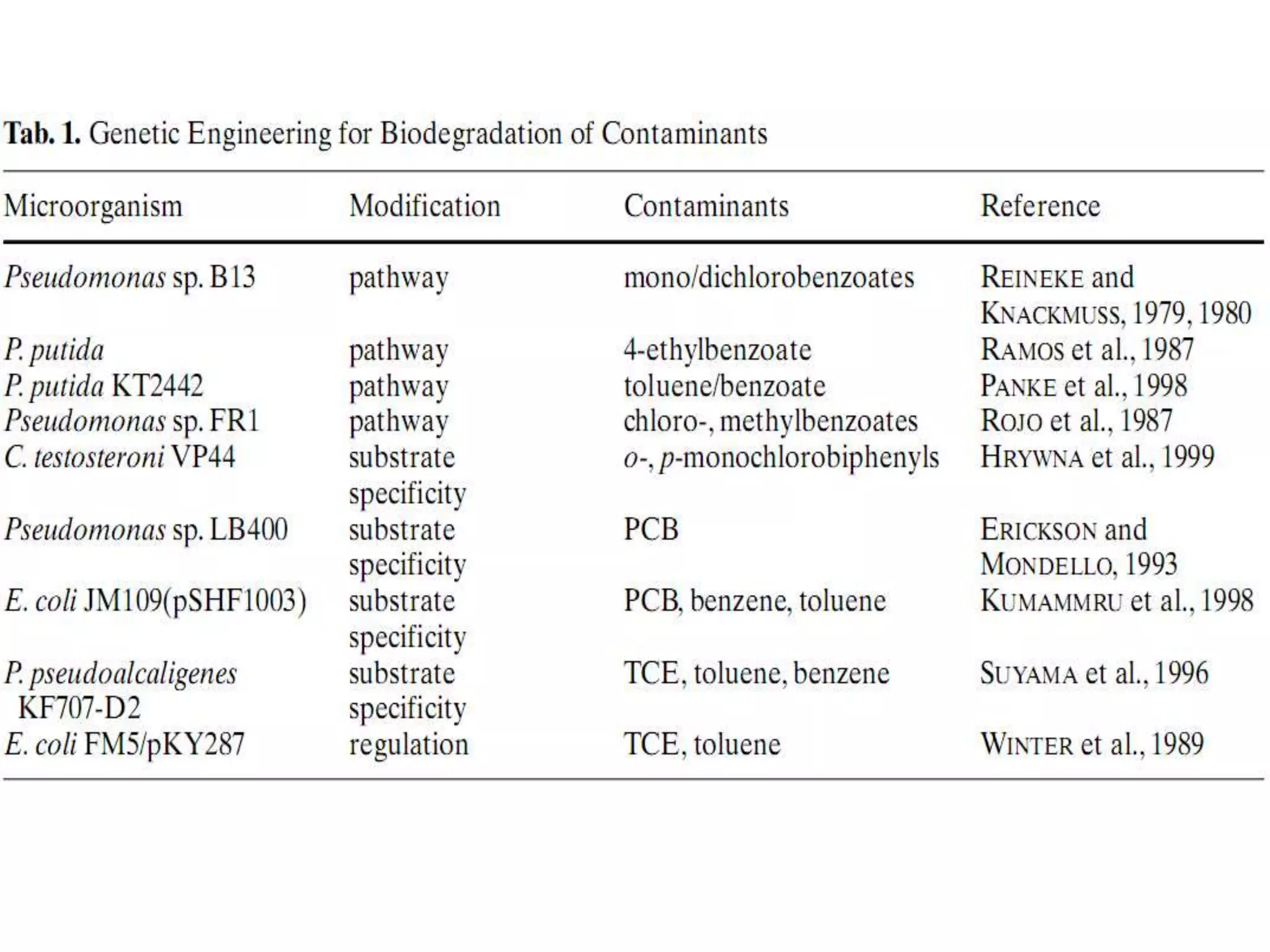
New pseudomonas strain
developed by Chakrabarty
and co-workers in 1970s.
Different plasmids were used
and new bacterium was
constructed.SUPERBUG.
US patented this SUPERBUG
that can degrade a number of
hydrocarbons of petrolium
simultaniously.
First genetically engineered
microorganism patented.
CAM-camphor degrading
OCT-octane degrading
XYL-xylene degrading
NAH-napthalene degrading
Compatible: CAM-OCT plasmid
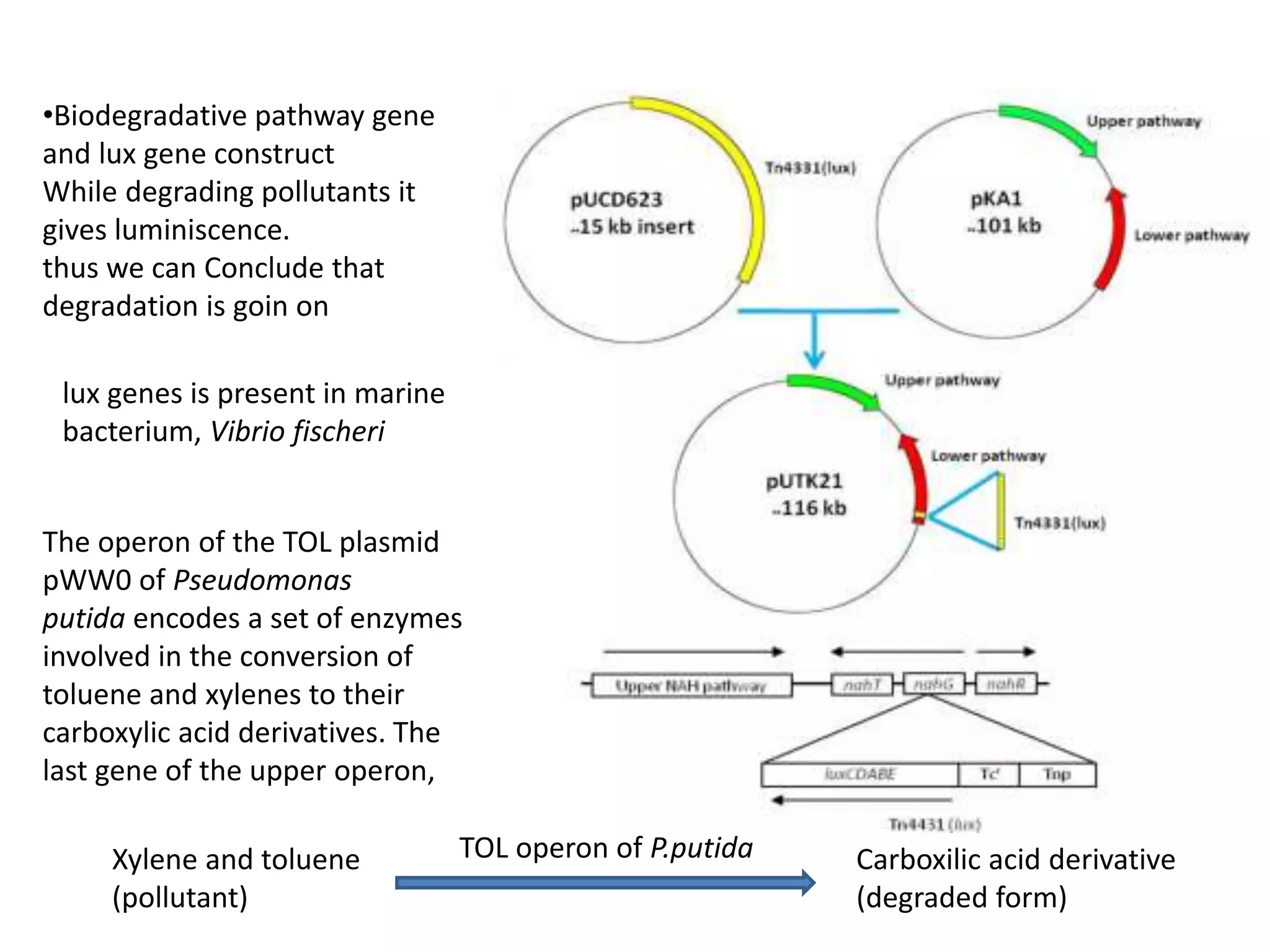
•Biodegradative pathway gene
and lux gene construct
While degrading pollutants it
gives luminiscence.
thus we can Conclude that
degradation is goin on
The operon of the TOL plasmid
pWW0 of Pseudomonas
putida encodes a set of enzymes
involved in the conversion of
toluene and xylenes to their
carboxylic acid derivatives. The
last gene of the upper operon,
Xylene and toluene
(pollutant)
TOL operon of P.putida Carboxilic acid derivative
(degraded form)
lux genes is present in marine
bacterium, Vibrio fischeri
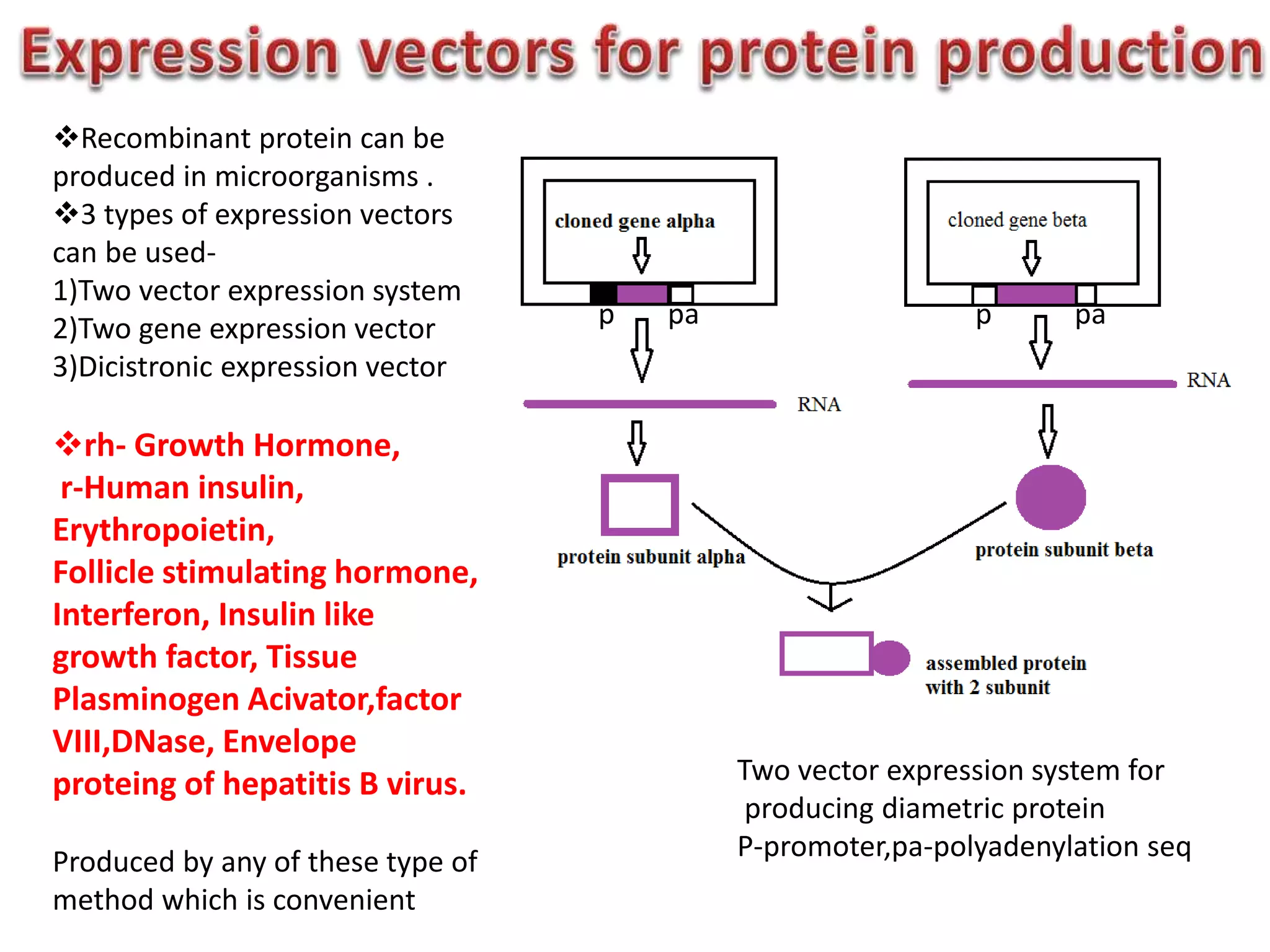
p ppa pa
Two vector expression system for
producing diametric protein
P-promoter,pa-polyadenylation seq
Recombinant protein can be
produced in microorganisms .
3 types of expression vectors
can be used-
1)Two vector expression system
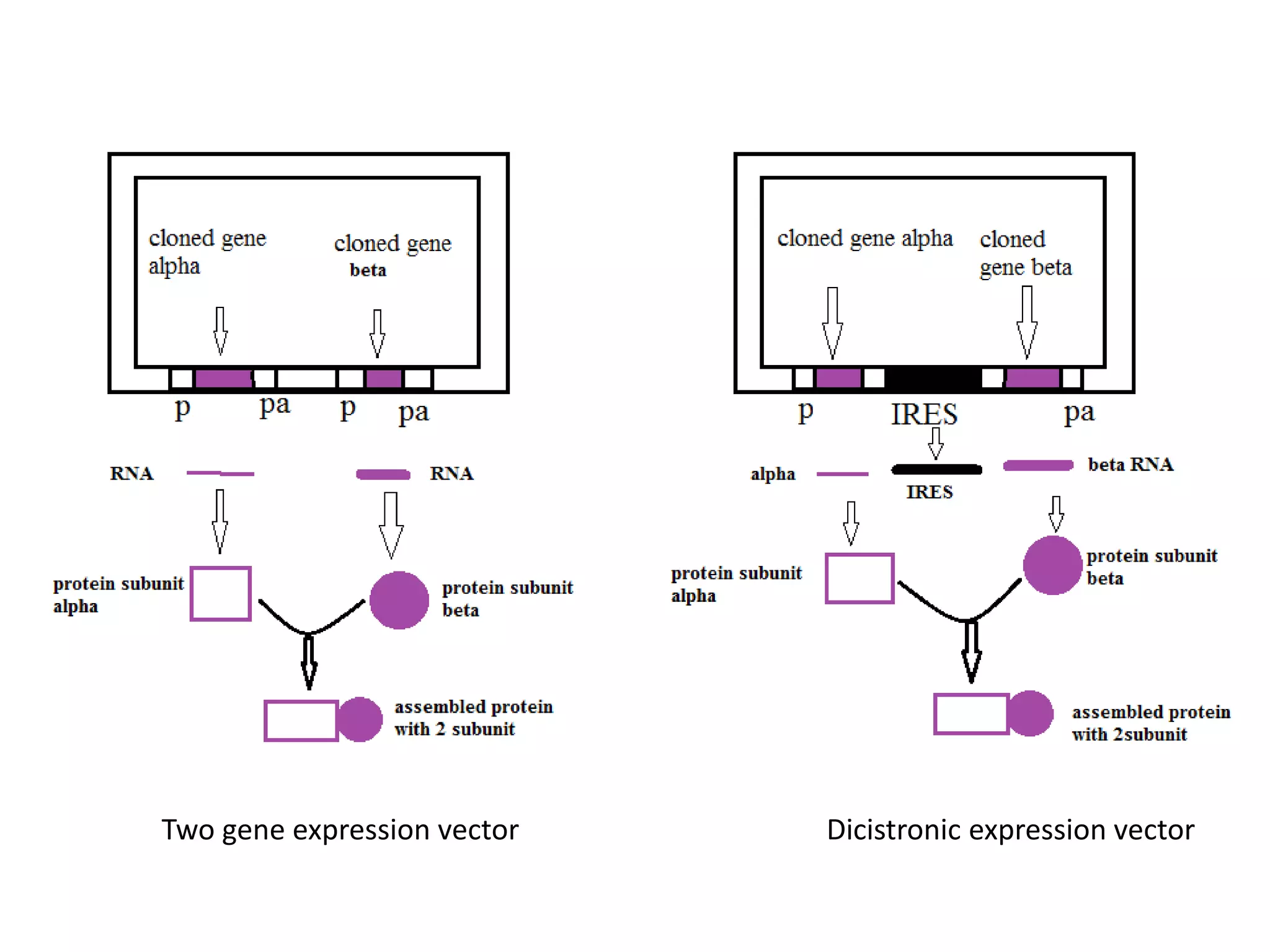
2)Two gene expression vector
3)Dicistronic expression vector
rh- Growth Hormone,
r-Human insulin,
Erythropoietin,
Follicle stimulating hormone,
Interferon, Insulin like
growth factor, Tissue
Plasminogen Acivator,factor
VIII,DNase, Envelope
proteing of hepatitis B virus.
Produced by any of these type of
method which is convenient
Two gene expression vector Dicistronic expression vector
6)http://en.wikipedia.org/wiki/Biological
_engineering
7)http://www.biopharminternational.co
m/biopharm/article/articleDetail.jsp?id=3
01979
8)http://www.wiley-
vch.de/books/biotech/pdf/v11b_gene.pdf
1)U.Satyanarayana;biotechnology;books and allied (p) ltd,p-144,191,192,197,201
2)http://bioengineering.stanford.edu/
3)http://www.biotecharticles.com/Biotechnology-products-Article/Production-
of-Recombinant-Human-Growth-Hormone-Somatotropin-367.html
4)www.littletree.com.au/dna.htm
Bioengineering custom microbes, genetic engineering,bioremediation,bioprocess,biomedical engineering

Bioengineering custom microbes, genetic engineering,bioremediation,bioprocess,biomedical engineering

  • 2.
     what isbioengineering?  domains of bioengineering. Genetic and biomedical engineering. •Recombinant insulin • recombinant human growth hormone •Recombinant interferon •Hepatitis B vaccine production •Phage therapy Use in bioremediation. •Superbug •Bio-luminescence while pollutant degradation Use in bioprocess engineering. • various types of expression vectors
  • 3.
    British scientist andbroadcaster Heinz Wolff termed bioengineering in 1954. Any area of biology mixed with any area of engineering in any proportion. Principles of biology Tools of engineering Bioengineering Useable, tangible, viable pdt
  • 4.
  • 5.
  • 6.
    • Artificial organs •Replacement joints • Artificial skin. • Vaccine,drug,hormone production.
  • 7.
    Bioinformatics = computerscience + biomedicine Discover genetic basis for disease (cancer, diabetes) Develop new diagnostic devices (cDNA chip) cDNAArray
  • 11.
    First attempt toproduce insuline through rDNA technology:1970s Human insulin gene and lac operon promoter inserted into E.coli plasmid July 1980, 17 diabetic patients were treated with recombinant insulin at Guy’s hospital,london :Great success. First RDT product administered to human and worked well. Eri Lilly company received approval to market HUMan insULIN under the trade name HUMULIN
  • 12.
    •Insulin A andB chain inserted differently in different E.coli culture •Selective marker:ampicilin resistant gene •Do pure culture •Extract insulin A & B chain seperatelyAnd Mix them. •Functional insuline
  • 14.
    •Glycosylated cytokines. •2 typesexist Type I (IFN-,and IFN-) Type II (IFN-) •Cells producing IFNs Plasmacytoid DCs (major producers of IFN-  and IFN- ) Fibroblasts and epithelial cells Macrophages and Th1 Cells (predominantly IFN- ) •Stimulates the action of natural killer cell •Several interferon together in a single gene construct : more efficient interferon.
  • 15.
    Select desired interferongenes. cDNA from specific interferons. Insert into vector Vector introduced into host cell( E. coli/yeast cell) Isolate recombinant interferon from culture medium
  • 16.
    Why Yeast vector? yeast suitable:glycosylation of protein similar to mammalian cell. Yield is several fold higher than E. coli Hybrid IFN : more reactive in function THERAPUTIC APPLICATION  IFN-α,-β,-ɣ approved for theraputic use in 1986,1993 & 1990 A swiss biotechnology firm first marketed IFN- α, named (INTRON) Treatment of large number of viral disease and cancers. Like leukemia,kaposis sarcoma, bladdar cancer,head and neck cancer,renal cell carcinoma,skin cancer,multiple myloma. Other disease:AIDS,multiple sclerosis,genital warts,hepatitis C.  common cold,influenza:nasal spray
  • 20.
    New pseudomonas strain developedby Chakrabarty and co-workers in 1970s. Different plasmids were used and new bacterium was constructed.SUPERBUG. US patented this SUPERBUG that can degrade a number of hydrocarbons of petrolium simultaniously. First genetically engineered microorganism patented. CAM-camphor degrading OCT-octane degrading XYL-xylene degrading NAH-napthalene degrading Compatible: CAM-OCT plasmid
  • 21.
    •Biodegradative pathway gene andlux gene construct While degrading pollutants it gives luminiscence. thus we can Conclude that degradation is goin on The operon of the TOL plasmid pWW0 of Pseudomonas putida encodes a set of enzymes involved in the conversion of toluene and xylenes to their carboxylic acid derivatives. The last gene of the upper operon, Xylene and toluene (pollutant) TOL operon of P.putida Carboxilic acid derivative (degraded form) lux genes is present in marine bacterium, Vibrio fischeri
  • 25.
    p ppa pa Twovector expression system for producing diametric protein P-promoter,pa-polyadenylation seq Recombinant protein can be produced in microorganisms . 3 types of expression vectors can be used- 1)Two vector expression system 2)Two gene expression vector 3)Dicistronic expression vector rh- Growth Hormone, r-Human insulin, Erythropoietin, Follicle stimulating hormone, Interferon, Insulin like growth factor, Tissue Plasminogen Acivator,factor VIII,DNase, Envelope proteing of hepatitis B virus. Produced by any of these type of method which is convenient
  • 26.
    Two gene expressionvector Dicistronic expression vector
  • 27.
    6)http://en.wikipedia.org/wiki/Biological _engineering 7)http://www.biopharminternational.co m/biopharm/article/articleDetail.jsp?id=3 01979 8)http://www.wiley- vch.de/books/biotech/pdf/v11b_gene.pdf 1)U.Satyanarayana;biotechnology;books and allied(p) ltd,p-144,191,192,197,201 2)http://bioengineering.stanford.edu/ 3)http://www.biotecharticles.com/Biotechnology-products-Article/Production- of-Recombinant-Human-Growth-Hormone-Somatotropin-367.html 4)www.littletree.com.au/dna.htm