METABOLIC ENGINEERING
PRESENTED BY:
MUKHTAR ALIYU P18LSBC1071
AHMADU BELLO UNIVERSITY, ZARIA
Lecturer: Prof. A.B Sallau
January, 2020
BIOENGINEERING
• Biological engineering, or bioengineering/bio-engineering, is the
application of principles of biology and the tools of engineering to create
usable, tangible, economically viable products
METABOLIC ENGINEERING
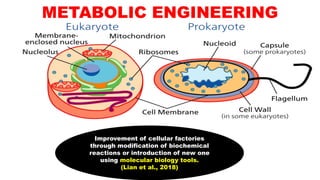
Improvement of cellular factories
through modification of biochemical
reactions or introduction of new one
using molecular biology tools.
(Lian et al., 2018)
METABOLIC ENGINEERING
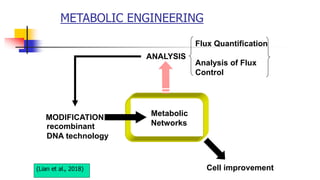
Metabolic
Networks
MODIFICATION
recombinant
DNA technology
ANALYSIS
Flux Quantification
Analysis of Flux
Control
Cell improvement(Lian et al., 2018)
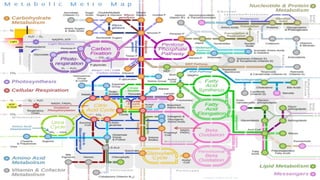
METABOLIC NETWORK
With the sequencing of complete genomes, it is now possible to reconstruct
the network of biochemical reactions in many organisms, from bacteria to
human. Several of these networks are available online: Kyoto Encyclopedia of
Genes and Genomes (KEGG), EcoCyc, BioCyc and metaTIGER. Metabolic
networks are powerful tools for studying and modelling metabolism.
Metabolic Pathway- Metabolic Flux
 We define a metabolic pathway to be any sequence of feasible and
observable biochemical reactions steps connecting a specified set of
input and output metabolites.
 The pathway flux is then defined as the rate at which input
metabolites are processed to form output metabolites.
(Rabiya et al., 2019)
 The determination of metabolic fluxes in vivo has been termed
Metabolic Flux Analysis (MFA).
 There are three steps in the process of systematic investigation of
metabolic fluxes and their control:
 Development of means to observe metabolic pathways and
measure their fluxes.
 Introduction of well-defined perturbations to the bioreaction
network and pathway flux determination at the new state.
 Analysis of flux perturbation results. Perturbation results will
determine the biochemical reaction(s) within the metabolic
network that critically determine the metabolic flux.
Metabolic Flux Analysis
Step one
 The development of means to obtain flux measurements
still tends to be problem specific. Radio or isotopomer
labeling tend to be two popular methods for elucidating
metabolic fluxes.
Step two
 Introduction of perturbations refers to the
targeted change of enzymatic activities
involved in a metabolic pathway.
 The application of such perturbations
tends to be problem specific. Several
experimental methods have been proposed
to that end.
 Such perturbations provide means to
determine, among other things, the
flexibility of metabolic nodes.
Step three
 Fluxes at the new state need to be determined.
 Analysis of the data obtained will provide a clear view of
the way fluxes are controlled intracellularly.
 The understanding of metabolic flux control provides the
basis for rational modification of metabolic pathways.
Implementation
 After the key parameters of flux
control have been determined, one
needs to implement those changes,
usually by applying genetic
modifications.
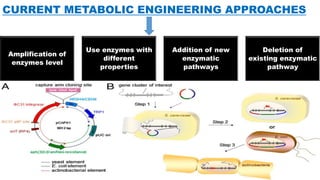
CURRENT METABOLIC ENGINEERING APPROACHES
Amplification of
enzymes level
Use enzymes with
different
properties
Addition of new
enzymatic
pathways
Deletion of
existing enzymatic
pathway
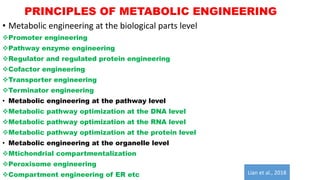
PRINCIPLES OF METABOLIC ENGINEERING
• Metabolic engineering at the biological parts level
Promoter engineering
Pathway enzyme engineering
Regulator and regulated protein engineering
Cofactor engineering
Transporter engineering
Terminator engineering
• Metabolic engineering at the pathway level
Metabolic pathway optimization at the DNA level
Metabolic pathway optimization at the RNA level
Metabolic pathway optimization at the protein level
• Metabolic engineering at the organelle level
Mtichondrial compartmentalization
Peroxisome engineering
Compartment engineering of ER etc Lian et al., 2018
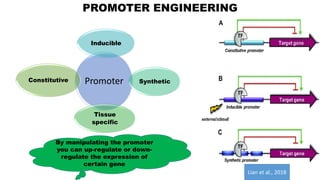
PROMOTER ENGINEERING
Promoter
Inducible
Synthetic
Tissue
specific
Constitutive
By manipulating the promoter
you can up-regulate or down-
regulate the expression of
certain gene
Lian et al., 2018
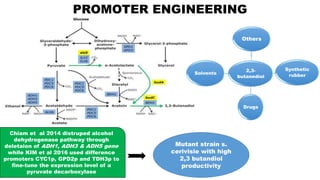
PROMOTER ENGINEERING
Chiam et al 2014 distruped alcohol
dehydrogenase pathway through
deletaion of ADH1, ADH3 & ADH5 gene
while KIM et al 2016 used difference
promoters CYC1p, GPD2p and TDH3p to
fine-tune the expression level of a
pyruvate decarboxylase
Mutant strain s.
cerivisie with high
2,3 butandiol
productivity
2,3-
butanediol
Others
Synthetic
rubber
Drugs
Solvents
Nobel Prize 2018
PATHWAY ENZYME ENGINEERING
• Ways to speed up and control the evolution of proteins to produce greener
technologies and new medicines have won three scientists the 2018 Nobel Prize in
Chemistry.
• Gregory Winter (left), Frances Arnold and George Smith share this year’s Nobel Prize
in Chemistry.Credit: L–R: Aga Machaj; Caltech; Univ. Missouri-Columbia
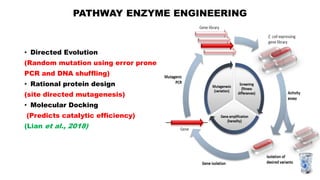
PATHWAY ENZYME ENGINEERING
• Directed Evolution
(Random mutation using error prone
PCR and DNA shuffling)
• Rational protein design
(site directed mutagenesis)
• Molecular Docking
(Predicts catalytic efficiency)
(Lian et al., 2018)
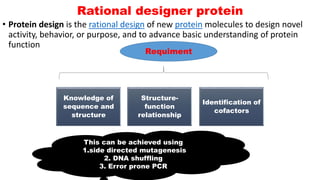
Rational designer protein
• Protein design is the rational design of new protein molecules to design novel
activity, behavior, or purpose, and to advance basic understanding of protein
function
Requiment
Knowledge of
sequence and
structure
Structure-
function
relationship
Identification of
cofactors
This can be achieved using
1.side directed mutagenesis
2. DNA shuffling
3. Error prone PCR
What can be engineered in proteins
• Folding (+structure)
Thermodynamic stability
(equilibrium between: native and unfolded)
Thermal and environmental stability
(temperature, pH, solvent, detergent and salts)
Example the thermostability of a cellobiohydrolase from the thermophilic fungus
Talaromyces emersonii expressed in S. cerevisiae was increased by introducing new
disulfide bridge forming mutations using site-directed mutagenesis. The best mutant,
carrying three disulfide bridges, exhibited a 9 °C increase in unfolding temperature
over the wild type enzyme and improved cellulose hydrolysis at 80 °C.
(Voutilainen et al., 2010)
• Function
Binding
catalysis
REGULATOR AND REGULATED PROTEIN ENGINEERING
This can be achieve through
Mutation of inhibitor or regulator binding site
Removing of regulatory domain
Removal of negative regulators
Overexpression of positive regulators
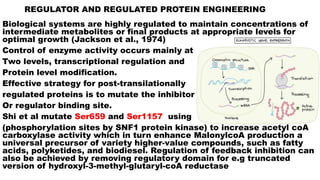
REGULATOR AND REGULATED PROTEIN ENGINEERING
Biological systems are highly regulated to maintain concentrations of
intermediate metabolites or final products at appropriate levels for
optimal growth (Jackson et al., 1974)
Control of enzyme activity occurs mainly at
Two levels, transcriptional regulation and
Protein level modification.
Effective strategy for post-transilationally
regulated proteins is to mutate the inhibitor
Or regulator binding site.
Shi et al mutate Ser659 and Ser1157 using
(phosphorylation sites by SNF1 protein kinase) to increase acetyl coA
carboxylase activity which in turn enhance MalonylcoA production a
universal precursor of variety higher-value compounds, such as fatty
acids, polyketides, and biodiesel. Regulation of feedback inhibition can
also be achieved by removing regulatory domain for e.g truncated
version of hydroxyl-3-methyl-glutaryl-coA reductase
Cofactor engineering
• NAD+/NADH
• CoA/acetyl-CoA
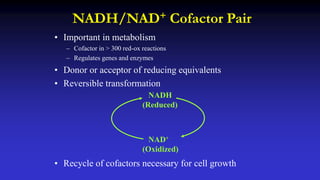
NADH/NAD+ Cofactor Pair
• Important in metabolism
– Cofactor in > 300 red-ox reactions
– Regulates genes and enzymes
• Donor or acceptor of reducing equivalents
• Reversible transformation
• Recycle of cofactors necessary for cell growth
NADH
(Reduced)
NAD+
(Oxidized)
Coenzyme A (CoA)
• Essential intermediates in many biosynthetic and
energy yielding metabolic pathways
• CoA is a carrier of acyl group
• Important role in enzymatic production of
industrially useful compounds like esters,
biopolymers, polyketides etc.
Acetyl-CoA
• Entry point to Energy yielding TCA cycle
• Important component in fatty acid metabolism
• Precursor of malonyl-CoA, acetoacetyl-CoA
• Allosteric activator of certain enzymes
NAD+NADH
Pyruvate Lactate
LDH
Lactic acid Polylactic acid (PLA)
Example: Lactic acid formation
Thank you for listening

Metabolic Engineering

  • 1.
    METABOLIC ENGINEERING PRESENTED BY: MUKHTARALIYU P18LSBC1071 AHMADU BELLO UNIVERSITY, ZARIA Lecturer: Prof. A.B Sallau January, 2020
  • 2.
    BIOENGINEERING • Biological engineering,or bioengineering/bio-engineering, is the application of principles of biology and the tools of engineering to create usable, tangible, economically viable products
  • 3.
    METABOLIC ENGINEERING Improvement ofcellular factories through modification of biochemical reactions or introduction of new one using molecular biology tools. (Lian et al., 2018)
  • 4.
    METABOLIC ENGINEERING Metabolic Networks MODIFICATION recombinant DNA technology ANALYSIS FluxQuantification Analysis of Flux Control Cell improvement(Lian et al., 2018)
  • 5.
    METABOLIC NETWORK With thesequencing of complete genomes, it is now possible to reconstruct the network of biochemical reactions in many organisms, from bacteria to human. Several of these networks are available online: Kyoto Encyclopedia of Genes and Genomes (KEGG), EcoCyc, BioCyc and metaTIGER. Metabolic networks are powerful tools for studying and modelling metabolism.
  • 6.
    Metabolic Pathway- MetabolicFlux  We define a metabolic pathway to be any sequence of feasible and observable biochemical reactions steps connecting a specified set of input and output metabolites.  The pathway flux is then defined as the rate at which input metabolites are processed to form output metabolites.
  • 7.
  • 8.
     The determinationof metabolic fluxes in vivo has been termed Metabolic Flux Analysis (MFA).  There are three steps in the process of systematic investigation of metabolic fluxes and their control:  Development of means to observe metabolic pathways and measure their fluxes.  Introduction of well-defined perturbations to the bioreaction network and pathway flux determination at the new state.  Analysis of flux perturbation results. Perturbation results will determine the biochemical reaction(s) within the metabolic network that critically determine the metabolic flux. Metabolic Flux Analysis
  • 9.
    Step one  Thedevelopment of means to obtain flux measurements still tends to be problem specific. Radio or isotopomer labeling tend to be two popular methods for elucidating metabolic fluxes.
  • 10.
    Step two  Introductionof perturbations refers to the targeted change of enzymatic activities involved in a metabolic pathway.  The application of such perturbations tends to be problem specific. Several experimental methods have been proposed to that end.  Such perturbations provide means to determine, among other things, the flexibility of metabolic nodes.
  • 11.
    Step three  Fluxesat the new state need to be determined.  Analysis of the data obtained will provide a clear view of the way fluxes are controlled intracellularly.  The understanding of metabolic flux control provides the basis for rational modification of metabolic pathways.
  • 12.
    Implementation  After thekey parameters of flux control have been determined, one needs to implement those changes, usually by applying genetic modifications.
  • 14.
    CURRENT METABOLIC ENGINEERINGAPPROACHES Amplification of enzymes level Use enzymes with different properties Addition of new enzymatic pathways Deletion of existing enzymatic pathway
  • 15.
    PRINCIPLES OF METABOLICENGINEERING • Metabolic engineering at the biological parts level Promoter engineering Pathway enzyme engineering Regulator and regulated protein engineering Cofactor engineering Transporter engineering Terminator engineering • Metabolic engineering at the pathway level Metabolic pathway optimization at the DNA level Metabolic pathway optimization at the RNA level Metabolic pathway optimization at the protein level • Metabolic engineering at the organelle level Mtichondrial compartmentalization Peroxisome engineering Compartment engineering of ER etc Lian et al., 2018
  • 16.
    PROMOTER ENGINEERING Promoter Inducible Synthetic Tissue specific Constitutive By manipulatingthe promoter you can up-regulate or down- regulate the expression of certain gene Lian et al., 2018
  • 17.
    PROMOTER ENGINEERING Chiam etal 2014 distruped alcohol dehydrogenase pathway through deletaion of ADH1, ADH3 & ADH5 gene while KIM et al 2016 used difference promoters CYC1p, GPD2p and TDH3p to fine-tune the expression level of a pyruvate decarboxylase Mutant strain s. cerivisie with high 2,3 butandiol productivity 2,3- butanediol Others Synthetic rubber Drugs Solvents
  • 18.
    Nobel Prize 2018 PATHWAYENZYME ENGINEERING • Ways to speed up and control the evolution of proteins to produce greener technologies and new medicines have won three scientists the 2018 Nobel Prize in Chemistry. • Gregory Winter (left), Frances Arnold and George Smith share this year’s Nobel Prize in Chemistry.Credit: L–R: Aga Machaj; Caltech; Univ. Missouri-Columbia
  • 19.
    PATHWAY ENZYME ENGINEERING •Directed Evolution (Random mutation using error prone PCR and DNA shuffling) • Rational protein design (site directed mutagenesis) • Molecular Docking (Predicts catalytic efficiency) (Lian et al., 2018)
  • 20.
    Rational designer protein •Protein design is the rational design of new protein molecules to design novel activity, behavior, or purpose, and to advance basic understanding of protein function Requiment Knowledge of sequence and structure Structure- function relationship Identification of cofactors This can be achieved using 1.side directed mutagenesis 2. DNA shuffling 3. Error prone PCR
  • 21.
    What can beengineered in proteins • Folding (+structure) Thermodynamic stability (equilibrium between: native and unfolded) Thermal and environmental stability (temperature, pH, solvent, detergent and salts) Example the thermostability of a cellobiohydrolase from the thermophilic fungus Talaromyces emersonii expressed in S. cerevisiae was increased by introducing new disulfide bridge forming mutations using site-directed mutagenesis. The best mutant, carrying three disulfide bridges, exhibited a 9 °C increase in unfolding temperature over the wild type enzyme and improved cellulose hydrolysis at 80 °C. (Voutilainen et al., 2010) • Function Binding catalysis
  • 22.
    REGULATOR AND REGULATEDPROTEIN ENGINEERING This can be achieve through Mutation of inhibitor or regulator binding site Removing of regulatory domain Removal of negative regulators Overexpression of positive regulators
  • 23.
    REGULATOR AND REGULATEDPROTEIN ENGINEERING Biological systems are highly regulated to maintain concentrations of intermediate metabolites or final products at appropriate levels for optimal growth (Jackson et al., 1974) Control of enzyme activity occurs mainly at Two levels, transcriptional regulation and Protein level modification. Effective strategy for post-transilationally regulated proteins is to mutate the inhibitor Or regulator binding site. Shi et al mutate Ser659 and Ser1157 using (phosphorylation sites by SNF1 protein kinase) to increase acetyl coA carboxylase activity which in turn enhance MalonylcoA production a universal precursor of variety higher-value compounds, such as fatty acids, polyketides, and biodiesel. Regulation of feedback inhibition can also be achieved by removing regulatory domain for e.g truncated version of hydroxyl-3-methyl-glutaryl-coA reductase
  • 24.
  • 25.
    NADH/NAD+ Cofactor Pair •Important in metabolism – Cofactor in > 300 red-ox reactions – Regulates genes and enzymes • Donor or acceptor of reducing equivalents • Reversible transformation • Recycle of cofactors necessary for cell growth NADH (Reduced) NAD+ (Oxidized)
  • 26.
    Coenzyme A (CoA) •Essential intermediates in many biosynthetic and energy yielding metabolic pathways • CoA is a carrier of acyl group • Important role in enzymatic production of industrially useful compounds like esters, biopolymers, polyketides etc.
  • 27.
    Acetyl-CoA • Entry pointto Energy yielding TCA cycle • Important component in fatty acid metabolism • Precursor of malonyl-CoA, acetoacetyl-CoA • Allosteric activator of certain enzymes
  • 28.
    NAD+NADH Pyruvate Lactate LDH Lactic acidPolylactic acid (PLA) Example: Lactic acid formation
  • 29.
    Thank you forlistening