Introduction to
biotechnnology
Muhammad Qasim
549-fbas-bsbt-s14
STUDENT OF BS-BIOTECHNOLOGY 3rd
SEMESTER S14
FACULTY OF BASIC AND APPLIED SCIENCE
International Islamic University
Islamabad Pakistan
Introduction
to
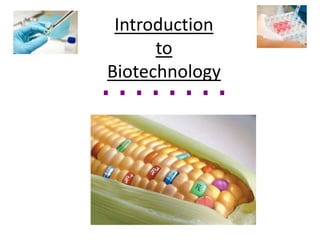
Biotechnology
Introduction
• Use of living organism or their products to modify the human health
and their environment.
• Importance: ?
• Increase in yield
• Clone importance
• Stress and disease resistance
• Emerging field
Origins of Biotechnology
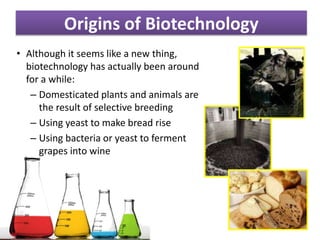
• Although it seems like a new thing,
biotechnology has actually been around
for a while:
• Domesticated plants and animals are
the result of selective breeding
• Using yeast to make bread rise
• Using bacteria or yeast to ferment
grapes into wine
Historical perspectives
• In pre 1800-yeast used by egyptians
• 1800-1900
• 1900-1953
• 1953-1976
• 1976
• 1978
• 1983
• 1900-2003
Classical
Biotechnology
Modern
Biotechnology
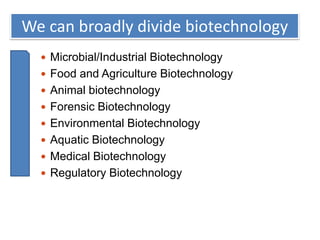
We can broadly divide biotechnology
 Microbial/Industrial Biotechnology
 Food and Agriculture Biotechnology
 Animal biotechnology
 Forensic Biotechnology
 Environmental Biotechnology
 Aquatic Biotechnology
 Medical Biotechnology
 Regulatory Biotechnology
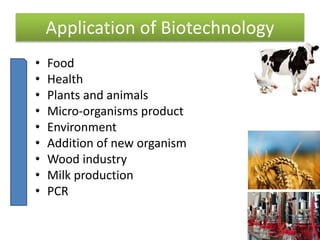
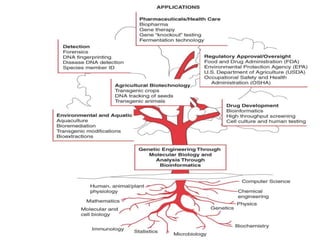
Application of Biotechnology
• Food
• Health
• Plants and animals
• Micro-organisms product
• Environment
• Addition of new organism
• Wood industry
• Milk production
• PCR
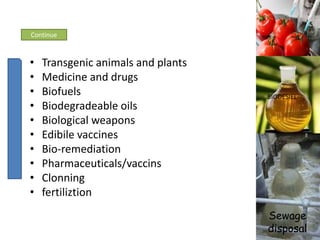
Continue
• Transgenic animals and plants
• Medicine and drugs
• Biofuels
• Biodegradeable oils
• Biological weapons
• Edibile vaccines
• Bio-remediation
• Pharmaceuticals/vaccins
• Clonning
• fertiliztion
Sewage
disposal
BIODESIEL
Mechanism in biotech
Transgenic plant
Transgenic animal
Method 1
Method 2
DNA
Embryonic stem cells
Selection cells expressing
desired gene
Inject
transformed
ES cells into
inner cell mass
blastocyst
Inner cell mass
Implantt in
uterus
Foster
mother
Test offspring for prescence of
gene
Male heterozygote offspring to
produce homozygous transgenic
Implant in
uterus
Desired gene
(with vector)
Fertilized egg
pronuclei
Stem Cell Biology
Clonning
Reproductive
Cloning
Therapeutic
Cloning
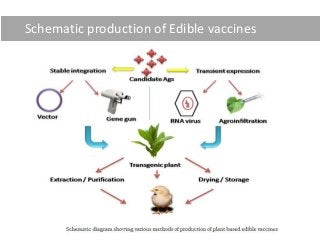
Schematic production of Edible vaccines
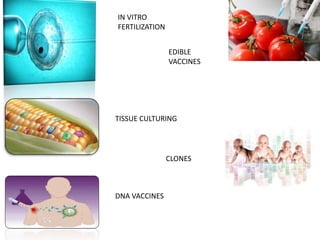
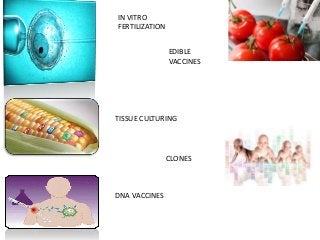
IN VITRO
FERTILIZATION
TISSUE CULTURING
DNA VACCINES
EDIBLE
VACCINES
CLONES
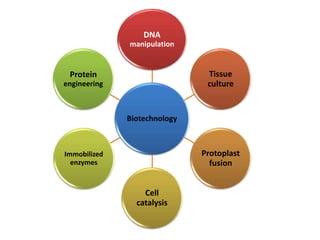
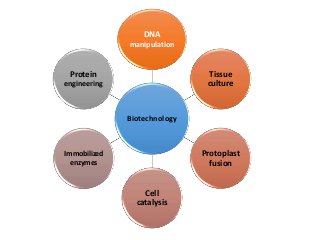
Biotechnology
DNA
manipulation
Tissue
culture
Protoplast
fusion
Cell
catalysis
Immobilized
enzymes
Protein
engineering
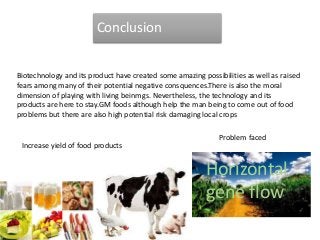
Conclusion
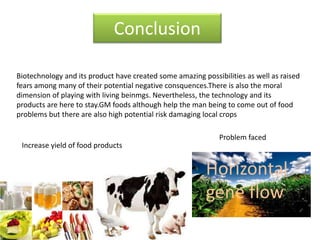
Biotechnology and its product have created some amazing possibilities as well as raised
fears among many of their potential negative consquences.There is also the moral
dimension of playing with living beinmgs. Nevertheless, the technology and its
products are here to stay.GM foods although help the man being to come out of food
problems but there are also high potential risk damaging local crops
Horizontal
gene flow
Increase yield of food products
Problem faced
Web stuff
• 1] BRIDGES Monthly Review. Year 8, Number 3, March 2004.
[2] http://www.biodiv.org/doc/publications/guide.asp
[3] http://www.biodiv.org/doc/publications/guide.asp
[4] http://www.usda.gov/news/releases/2003/05/0157.htm
[5] http://www.ictsd.org/weekly/04-03-10/wtoinbrief.htm#2
• http://listverse.com/2013/06/22/10-problems-genetically-modified-
foods-are-already-causing/
• http://www.wto.org/english/tratop_e/sps_e/sps_agreement_cbt_e/c
8s1p1_e.htm
• http://www.csa.com/discoveryguides/gmfood/overview.php
Any Question?
Thank
s

Introduction to biotechnology by qasim

  • 1.
    Introduction to biotechnnology Muhammad Qasim 549-fbas-bsbt-s14 STUDENTOF BS-BIOTECHNOLOGY 3rd SEMESTER S14 FACULTY OF BASIC AND APPLIED SCIENCE International Islamic University Islamabad Pakistan
  • 2.
  • 3.
    Introduction • Use ofliving organism or their products to modify the human health and their environment. • Importance: ? • Increase in yield • Clone importance • Stress and disease resistance • Emerging field
  • 4.
    Origins of Biotechnology •Although it seems like a new thing, biotechnology has actually been around for a while: • Domesticated plants and animals are the result of selective breeding • Using yeast to make bread rise • Using bacteria or yeast to ferment grapes into wine
  • 5.
    Historical perspectives • Inpre 1800-yeast used by egyptians • 1800-1900 • 1900-1953 • 1953-1976 • 1976 • 1978 • 1983 • 1900-2003 Classical Biotechnology Modern Biotechnology
  • 6.
    We can broadlydivide biotechnology  Microbial/Industrial Biotechnology  Food and Agriculture Biotechnology  Animal biotechnology  Forensic Biotechnology  Environmental Biotechnology  Aquatic Biotechnology  Medical Biotechnology  Regulatory Biotechnology
  • 7.
    Application of Biotechnology •Food • Health • Plants and animals • Micro-organisms product • Environment • Addition of new organism • Wood industry • Milk production • PCR
  • 8.
    Continue • Transgenic animalsand plants • Medicine and drugs • Biofuels • Biodegradeable oils • Biological weapons • Edibile vaccines • Bio-remediation • Pharmaceuticals/vaccins • Clonning • fertiliztion Sewage disposal BIODESIEL
  • 10.
  • 11.
  • 12.
    Transgenic animal Method 1 Method2 DNA Embryonic stem cells Selection cells expressing desired gene Inject transformed ES cells into inner cell mass blastocyst Inner cell mass Implantt in uterus Foster mother Test offspring for prescence of gene Male heterozygote offspring to produce homozygous transgenic Implant in uterus Desired gene (with vector) Fertilized egg pronuclei
  • 13.
  • 14.
  • 15.
    Schematic production ofEdible vaccines
  • 16.
    IN VITRO FERTILIZATION TISSUE CULTURING DNAVACCINES EDIBLE VACCINES CLONES
  • 17.
  • 18.
    Conclusion Biotechnology and itsproduct have created some amazing possibilities as well as raised fears among many of their potential negative consquences.There is also the moral dimension of playing with living beinmgs. Nevertheless, the technology and its products are here to stay.GM foods although help the man being to come out of food problems but there are also high potential risk damaging local crops Horizontal gene flow Increase yield of food products Problem faced
  • 19.
    Web stuff • 1]BRIDGES Monthly Review. Year 8, Number 3, March 2004. [2] http://www.biodiv.org/doc/publications/guide.asp [3] http://www.biodiv.org/doc/publications/guide.asp [4] http://www.usda.gov/news/releases/2003/05/0157.htm [5] http://www.ictsd.org/weekly/04-03-10/wtoinbrief.htm#2 • http://listverse.com/2013/06/22/10-problems-genetically-modified- foods-are-already-causing/ • http://www.wto.org/english/tratop_e/sps_e/sps_agreement_cbt_e/c 8s1p1_e.htm • http://www.csa.com/discoveryguides/gmfood/overview.php
  • 20.
  • 21.

Editor's Notes

  • #4 Bios: Technology:
  • #5 4
  • #6 Selective mating….yougurt and fermentation…1717 small pox vacine. 1857 loius pasteur fermentation…1917(chaim weizmann us pure cultre in indstri)1928 alexander fleming,1940 used as antibiotic. 1941 mutant mcrobes neurospora,1970 artificial gene synth…1972 transfer of g material chakrabarthy.1972paul berg recombinanant dna.1978 insulin cloning. 19883 Pcr 1996 clone human genome project celera corp 1990-2003.6 contries sanger institute nematoda 100 milion base pairs
  • #12 Protein engineering is the process of developing useful or valuable proteins. It is a young discipline, with much research taking place into the understanding of protein foldingand recognition for protein design principles