Oxygen Administration
Sachin Chauhan
(B.Sc. Nursing)
Sachin Chauhan
sachu.chauhan@gmail.com
Definition
Method by which oxygen is supplemented at higher
percentages than what is available in atmospheric
air.
Oxygen (O2) is administered as a corrective
treatment for conditions resulting in hypoxia (low
level of oxygen in the Cells).
Sachin Chauhan
sachu.chauhan@gmail.com
Purpose
• To relieve dyspnea.
• To reduce or prevent hypoxemia (low level of
O2 in blood) and hypoxia (low level of O2 in
cells).
• To alleviate associated with struggle to
breathe.
Sachin Chauhan
sachu.chauhan@gmail.com
Sources of O2
Therapeutic oxygen is available from two
sources:
• 1. Wall Outlets(; Central supply)
• 2. Oxygen cylinders
Sachin Chauhan
sachu.chauhan@gmail.com
Nursing ALERT !
• Oxygen must only be administered at the rate and percentage prescribed, as over-
oxygenation can be dangerous for some individuals, Particularly those with chronic lung
disease who are retaining carbon dioxide, and infants, where there is also a risk of
retinopathy of prematurity (ROP).
• Explain to the client the dangers of lighting matches or smoking cigarettes, cigars, pipes.
Be sure the client has no matches, cigarettes, or smoking materials in the bedside table.
• Make sure that warning signs (OXYGEN - NO SMOKING) are posted on the client’s door
and above the client’s bed.
• Do not use oil on oxygen equipment.( Rationale: Oil can ignite if exposed to oxygen.)
• With all oxygen delivery systems, the oxygen is turned on before the mask is applied to
the client.
• Make sure the tubing is patent at all times and that the equipment is working properly.
• Maintain a constant oxygen concentration for the client to breathe; monitor equipment
at regular intervals.
• Give pain medications as needed, prevent chilling and try to ensure that the client gets
needed rest. Be alert to cues about hunger and elimination.( Rationale: The client’s
physical comfort is important.)
Sachin Chauhan
sachu.chauhan@gmail.com
Nursing ALERT ! (Contd…)
• Watch for respiratory depression or distress.
• Encourage or assist the client to move about in bed. ( Rationale: To prevent
hypostatic pneumonia or circulatory difficulties.) Many clients are reluctant to
move because they are afraid of the oxygen apparatus.
• Provide frequent mouth care. Make sure the oxygen contains proper
humidification.( Rationale: Oxygen can be drying to mucous membrane.)
• Discontinue oxygen only after a physician has evaluated the client. Generally,
you should not abruptly discontinue oxygen given in medium-to-high
concentrations( above 30%). Gradually decrease it in stages, and monitor the
client’s arterial blood gases or oxygen saturation level. ( Rationale: These steps
determine whether the client needs continued support.)
• Always be careful when you give high levels of oxygen to a client with COPD. The
elevated levels of oxygen in the patient’s body can depress their stimulus to
breathe.
• Never use oxygen in the hyperventilation patient.
• Wear gloves any time you might come into contact with the client’s respiratory
secretions.( Rationale: To prevent the spread of infection).
Sachin Chauhan
sachu.chauhan@gmail.com
Articles / Equipment's
1. Client’s chart
2. Oxygen connecting tube (1)
3. Flowmeter (1)
4. Humidifier filled with sterile water (1)
5. Oxygen source: Wall Outlets or Oxygen cylinder
6. Tray with nasal cannula of appropriate size or oxygen mask (1)
7. Kidney tray (1)
8. Adhassive tape
9. Scissors (1)
10. Oxygen stand (1)
11. Gauze pieces, Cotton swabs if needed
12. “No smoking” sign board
13. Gloves (1)
Sachin Chauhan
sachu.chauhan@gmail.com
Sachin Chauhan
sachu.chauhan@gmail.com
Nursing Alert!
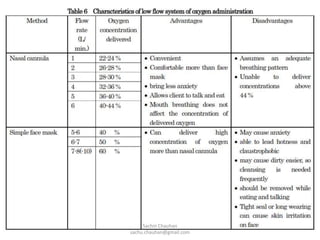
There are another high flow devices such
as venture mask, oxygen hood and
tracheostomy mask. You should choose
appropriate method of oxygen
administration with Dr’s prescription and
nursing assessment.
Sachin Chauhan
sachu.chauhan@gmail.com
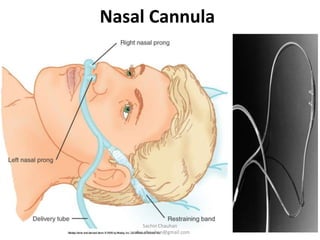
Nasal Cannula
Sachin Chauhan
sachu.chauhan@gmail.com
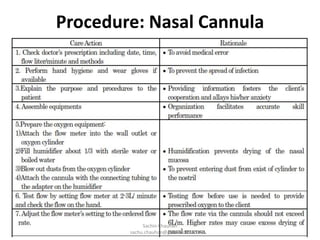
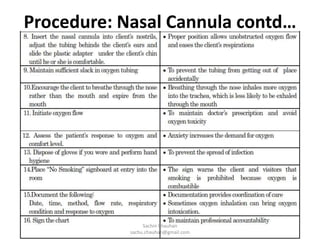
Procedure: Nasal Cannula
Sachin Chauhan
sachu.chauhan@gmail.com
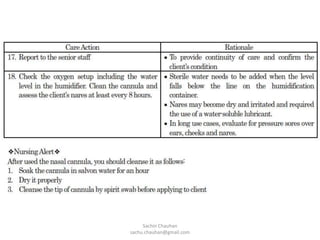
Procedure: Nasal Cannula contd…
Sachin Chauhan
sachu.chauhan@gmail.com
Sachin Chauhan
sachu.chauhan@gmail.com
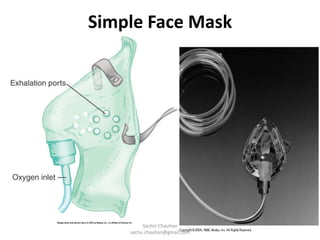
Simple Face Mask
Sachin Chauhan
sachu.chauhan@gmail.com
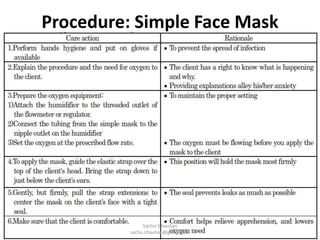
Procedure: Simple Face Mask
Sachin Chauhan
sachu.chauhan@gmail.com
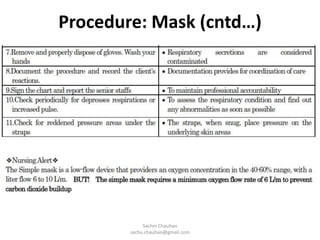
Procedure: Mask (cntd…)
Sachin Chauhan
sachu.chauhan@gmail.com
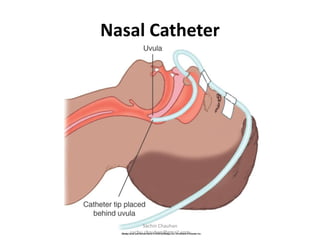
Nasal Catheter
Sachin Chauhan
sachu.chauhan@gmail.com
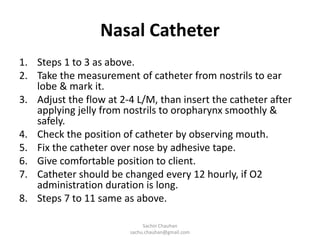
Nasal Catheter
1. Steps 1 to 3 as above.
2. Take the measurement of catheter from nostrils to ear
lobe & mark it.
3. Adjust the flow at 2-4 L/M, than insert the catheter after
applying jelly from nostrils to oropharynx smoothly &
safely.
4. Check the position of catheter by observing mouth.
5. Fix the catheter over nose by adhesive tape.
6. Give comfortable position to client.
7. Catheter should be changed every 12 hourly, if O2
administration duration is long.
8. Steps 7 to 11 same as above.
Sachin Chauhan
sachu.chauhan@gmail.com
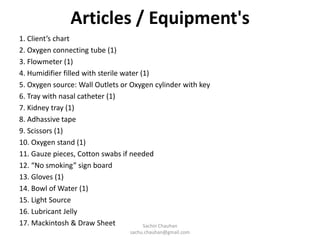
Articles / Equipment's
1. Client’s chart
2. Oxygen connecting tube (1)
3. Flowmeter (1)
4. Humidifier filled with sterile water (1)
5. Oxygen source: Wall Outlets or Oxygen cylinder with key
6. Tray with nasal catheter (1)
7. Kidney tray (1)
8. Adhassive tape
9. Scissors (1)
10. Oxygen stand (1)
11. Gauze pieces, Cotton swabs if needed
12. “No smoking” sign board
13. Gloves (1)
14. Bowl of Water (1)
15. Light Source
16. Lubricant Jelly
17. Mackintosh & Draw Sheet Sachin Chauhan
sachu.chauhan@gmail.com

oxygen administration procedure

  • 1.
    Oxygen Administration Sachin Chauhan (B.Sc.Nursing) Sachin Chauhan sachu.chauhan@gmail.com
  • 2.
    Definition Method by whichoxygen is supplemented at higher percentages than what is available in atmospheric air. Oxygen (O2) is administered as a corrective treatment for conditions resulting in hypoxia (low level of oxygen in the Cells). Sachin Chauhan sachu.chauhan@gmail.com
  • 3.
    Purpose • To relievedyspnea. • To reduce or prevent hypoxemia (low level of O2 in blood) and hypoxia (low level of O2 in cells). • To alleviate associated with struggle to breathe. Sachin Chauhan sachu.chauhan@gmail.com
  • 4.
    Sources of O2 Therapeuticoxygen is available from two sources: • 1. Wall Outlets(; Central supply) • 2. Oxygen cylinders Sachin Chauhan sachu.chauhan@gmail.com
  • 5.
    Nursing ALERT ! •Oxygen must only be administered at the rate and percentage prescribed, as over- oxygenation can be dangerous for some individuals, Particularly those with chronic lung disease who are retaining carbon dioxide, and infants, where there is also a risk of retinopathy of prematurity (ROP). • Explain to the client the dangers of lighting matches or smoking cigarettes, cigars, pipes. Be sure the client has no matches, cigarettes, or smoking materials in the bedside table. • Make sure that warning signs (OXYGEN - NO SMOKING) are posted on the client’s door and above the client’s bed. • Do not use oil on oxygen equipment.( Rationale: Oil can ignite if exposed to oxygen.) • With all oxygen delivery systems, the oxygen is turned on before the mask is applied to the client. • Make sure the tubing is patent at all times and that the equipment is working properly. • Maintain a constant oxygen concentration for the client to breathe; monitor equipment at regular intervals. • Give pain medications as needed, prevent chilling and try to ensure that the client gets needed rest. Be alert to cues about hunger and elimination.( Rationale: The client’s physical comfort is important.) Sachin Chauhan sachu.chauhan@gmail.com
  • 6.
    Nursing ALERT !(Contd…) • Watch for respiratory depression or distress. • Encourage or assist the client to move about in bed. ( Rationale: To prevent hypostatic pneumonia or circulatory difficulties.) Many clients are reluctant to move because they are afraid of the oxygen apparatus. • Provide frequent mouth care. Make sure the oxygen contains proper humidification.( Rationale: Oxygen can be drying to mucous membrane.) • Discontinue oxygen only after a physician has evaluated the client. Generally, you should not abruptly discontinue oxygen given in medium-to-high concentrations( above 30%). Gradually decrease it in stages, and monitor the client’s arterial blood gases or oxygen saturation level. ( Rationale: These steps determine whether the client needs continued support.) • Always be careful when you give high levels of oxygen to a client with COPD. The elevated levels of oxygen in the patient’s body can depress their stimulus to breathe. • Never use oxygen in the hyperventilation patient. • Wear gloves any time you might come into contact with the client’s respiratory secretions.( Rationale: To prevent the spread of infection). Sachin Chauhan sachu.chauhan@gmail.com
  • 7.
    Articles / Equipment's 1.Client’s chart 2. Oxygen connecting tube (1) 3. Flowmeter (1) 4. Humidifier filled with sterile water (1) 5. Oxygen source: Wall Outlets or Oxygen cylinder 6. Tray with nasal cannula of appropriate size or oxygen mask (1) 7. Kidney tray (1) 8. Adhassive tape 9. Scissors (1) 10. Oxygen stand (1) 11. Gauze pieces, Cotton swabs if needed 12. “No smoking” sign board 13. Gloves (1) Sachin Chauhan sachu.chauhan@gmail.com
  • 8.
  • 9.
    Nursing Alert! There areanother high flow devices such as venture mask, oxygen hood and tracheostomy mask. You should choose appropriate method of oxygen administration with Dr’s prescription and nursing assessment. Sachin Chauhan sachu.chauhan@gmail.com
  • 10.
  • 11.
    Procedure: Nasal Cannula SachinChauhan sachu.chauhan@gmail.com
  • 12.
    Procedure: Nasal Cannulacontd… Sachin Chauhan sachu.chauhan@gmail.com
  • 13.
  • 14.
    Simple Face Mask SachinChauhan sachu.chauhan@gmail.com
  • 15.
    Procedure: Simple FaceMask Sachin Chauhan sachu.chauhan@gmail.com
  • 16.
    Procedure: Mask (cntd…) SachinChauhan sachu.chauhan@gmail.com
  • 17.
  • 18.
    Nasal Catheter 1. Steps1 to 3 as above. 2. Take the measurement of catheter from nostrils to ear lobe & mark it. 3. Adjust the flow at 2-4 L/M, than insert the catheter after applying jelly from nostrils to oropharynx smoothly & safely. 4. Check the position of catheter by observing mouth. 5. Fix the catheter over nose by adhesive tape. 6. Give comfortable position to client. 7. Catheter should be changed every 12 hourly, if O2 administration duration is long. 8. Steps 7 to 11 same as above. Sachin Chauhan sachu.chauhan@gmail.com
  • 19.
    Articles / Equipment's 1.Client’s chart 2. Oxygen connecting tube (1) 3. Flowmeter (1) 4. Humidifier filled with sterile water (1) 5. Oxygen source: Wall Outlets or Oxygen cylinder with key 6. Tray with nasal catheter (1) 7. Kidney tray (1) 8. Adhassive tape 9. Scissors (1) 10. Oxygen stand (1) 11. Gauze pieces, Cotton swabs if needed 12. “No smoking” sign board 13. Gloves (1) 14. Bowl of Water (1) 15. Light Source 16. Lubricant Jelly 17. Mackintosh & Draw Sheet Sachin Chauhan sachu.chauhan@gmail.com