SACHIN PATEL
Surfactants
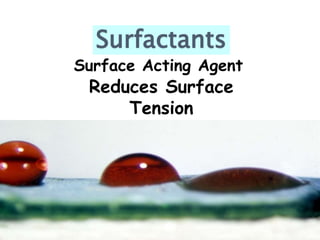
Surface Acting Agent
Reduces Surface
Tension
Definition
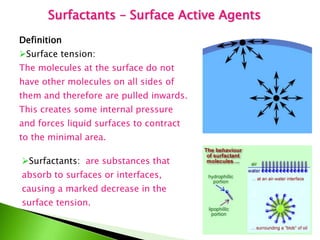
Surface tension:
The molecules at the surface do not
have other molecules on all sides of
them and therefore are pulled inwards.
This creates some internal pressure
and forces liquid surfaces to contract
to the minimal area.
Surfactants: are substances that
absorb to surfaces or interfaces,
causing a marked decrease in the
surface tension.
Surfactants – Surface Active Agents
Surfactant structure
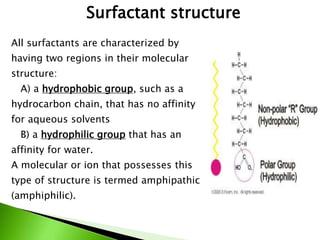
All surfactants are characterized by
having two regions in their molecular
structure:
A) a hydrophobic group, such as a
hydrocarbon chain, that has no affinity
for aqueous solvents
B) a hydrophilic group that has an
affinity for water.
A molecular or ion that possesses this
type of structure is termed amphipathic
(amphiphilic).
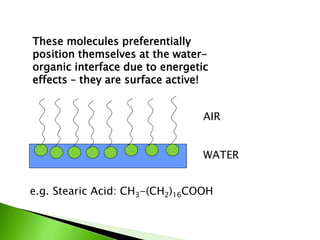
AIR
WATER
These molecules preferentially
position themselves at the water-
organic interface due to energetic
effects – they are surface active!
e.g. Stearic Acid: CH3-(CH2)16COOH
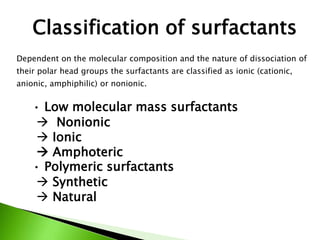
• Low molecular mass surfactants
 Nonionic
 Ionic
 Amphoteric
• Polymeric surfactants
 Synthetic
 Natural
Classification of surfactants
Dependent on the molecular composition and the nature of dissociation of
their polar head groups the surfactants are classified as ionic (cationic,
anionic, amphiphilic) or nonionic.
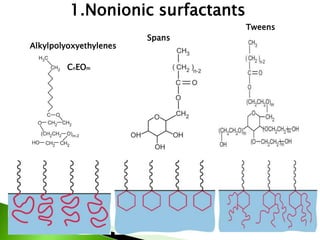
Alkylpolyoxyethylenes
Spans
Tweens
1.Nonionic surfactants
CnEOm
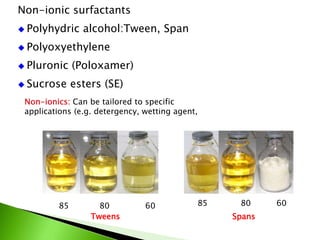
Tweens Spans
85 80 60 85 80 60
Non-ionic surfactants
 Polyhydric alcohol:Tween, Span
 Polyoxyethylene
 Pluronic (Poloxamer)
 Sucrose esters (SE)
Non-ionics: Can be tailored to specific
applications (e.g. detergency, wetting agent,
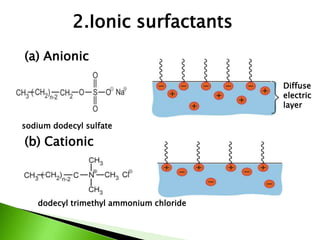
2.Ionic surfactants
(a) Anionic
(b) Cationic
Diffuse
electric
layer
sodium dodecyl sulfate
dodecyl trimethyl ammonium chloride
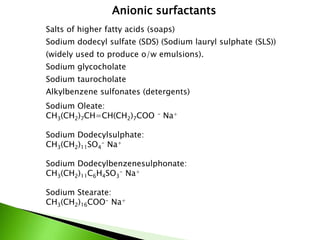
Salts of higher fatty acids (soaps)
Sodium dodecyl sulfate (SDS) (Sodium lauryl sulphate (SLS))
(widely used to produce o/w emulsions).
Sodium glycocholate
Sodium taurocholate
Alkylbenzene sulfonates (detergents)
Sodium Oleate:
CH3(CH2)7CH=CH(CH2)7COO - Na+
Sodium Dodecylsulphate:
CH3(CH2)11SO4
- Na+
Sodium Dodecylbenzenesulphonate:
CH3(CH2)11C6H4SO3
- Na+
Sodium Stearate:
CH3(CH2)16COO- Na+
Anionic surfactants
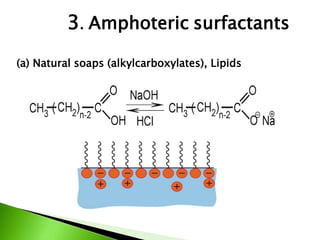
3. Amphoteric surfactants
(a) Natural soaps (alkylcarboxylates), Lipids
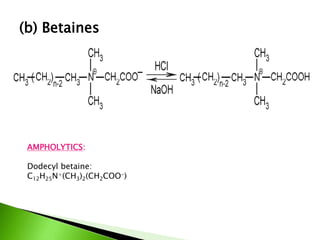
(b) Betaines
AMPHOLYTICS:
Dodecyl betaine:
C12H25N+(CH3)2(CH2COO-)
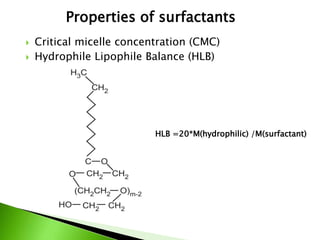
Properties of surfactants
 Critical micelle concentration (CMC)
 Hydrophile Lipophile Balance (HLB)
HLB =20*M(hydrophilic) /M(surfactant)
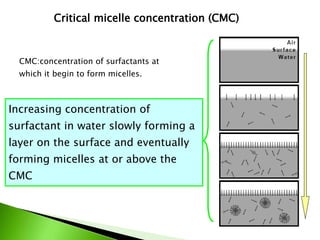
Increasing concentration of
surfactant in water slowly forming a
layer on the surface and eventually
forming micelles at or above the
CMC
CMC:concentration of surfactants at
which it begin to form micelles.
Critical micelle concentration (CMC)
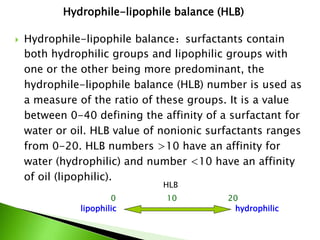
 Hydrophile-lipophile balance:surfactants contain
both hydrophilic groups and lipophilic groups with
one or the other being more predominant, the
hydrophile-lipophile balance (HLB) number is used as
a measure of the ratio of these groups. It is a value
between 0-40 defining the affinity of a surfactant for
water or oil. HLB value of nonionic surfactants ranges
from 0-20. HLB numbers >10 have an affinity for
water (hydrophilic) and number <10 have an affinity
of oil (lipophilic).
hydrophiliclipophilic
HLB
0 10 20
Hydrophile-lipophile balance (HLB)
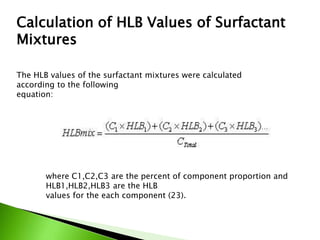
Calculation of HLB Values of Surfactant
Mixtures
The HLB values of the surfactant mixtures were calculated
according to the following
equation:
where C1,C2,C3 are the percent of component proportion and
HLB1,HLB2,HLB3 are the HLB
values for the each component (23).
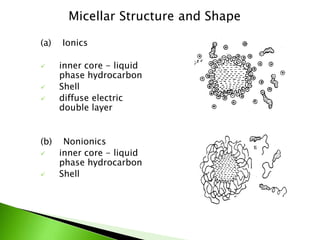
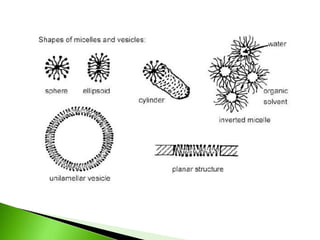
Micellar Structure and Shape
(a) Ionics
 inner core - liquid
phase hydrocarbon
 Shell
 diffuse electric
double layer
(b) Nonionics
 inner core - liquid
phase hydrocarbon
 Shell
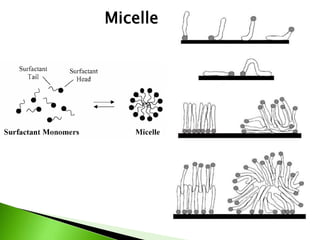
Micelle
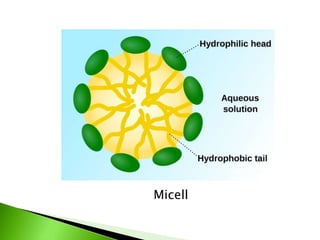
Micell
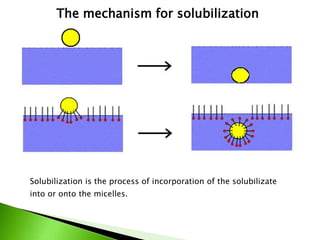
The mechanism for solubilization
Solubilization is the process of incorporation of the solubilizate
into or onto the micelles.
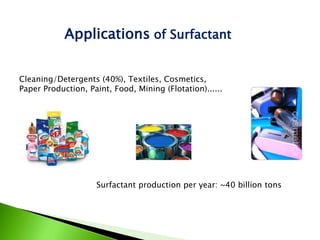
Applications of Surfactant
Cleaning/Detergents (40%), Textiles, Cosmetics,
Paper Production, Paint, Food, Mining (Flotation)......
Surfactant production per year: ~40 billion tons
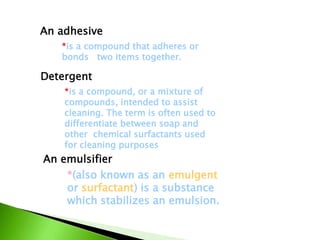
An adhesive
*is a compound, or a mixture of
compounds, intended to assist
cleaning. The term is often used to
differentiate between soap and
other chemical surfactants used
for cleaning purposes
*is a compound that adheres or
bonds two items together.
An emulsifier
*(also known as an emulgent
or surfactant) is a substance
which stabilizes an emulsion.
Detergent
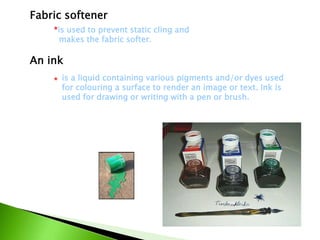
An ink
is a liquid containing various pigments and/or dyes used
for colouring a surface to render an image or text. Ink is
used for drawing or writing with a pen or brush.
*
Fabric softener
*is used to prevent static cling and
makes the fabric softer.
 Paint
 Anti-fogs
 Shampoos
 Toothpastes
 Oil dispersants
 Wetting
 Ski Wax
 Snowboard Wax
 Foaming
 Defoaming
 Quantum dot coating
 Biocides (Sanitizers)
 Hair Conditioners (after shampoo)
Surfactants

Surfactants

  • 1.
  • 2.
  • 3.
    Definition Surface tension: The moleculesat the surface do not have other molecules on all sides of them and therefore are pulled inwards. This creates some internal pressure and forces liquid surfaces to contract to the minimal area. Surfactants: are substances that absorb to surfaces or interfaces, causing a marked decrease in the surface tension. Surfactants – Surface Active Agents
  • 4.
    Surfactant structure All surfactantsare characterized by having two regions in their molecular structure: A) a hydrophobic group, such as a hydrocarbon chain, that has no affinity for aqueous solvents B) a hydrophilic group that has an affinity for water. A molecular or ion that possesses this type of structure is termed amphipathic (amphiphilic).
  • 5.
    AIR WATER These molecules preferentially positionthemselves at the water- organic interface due to energetic effects – they are surface active! e.g. Stearic Acid: CH3-(CH2)16COOH
  • 6.
    • Low molecularmass surfactants  Nonionic  Ionic  Amphoteric • Polymeric surfactants  Synthetic  Natural Classification of surfactants Dependent on the molecular composition and the nature of dissociation of their polar head groups the surfactants are classified as ionic (cationic, anionic, amphiphilic) or nonionic.
  • 7.
  • 8.
    Tweens Spans 85 8060 85 80 60 Non-ionic surfactants  Polyhydric alcohol:Tween, Span  Polyoxyethylene  Pluronic (Poloxamer)  Sucrose esters (SE) Non-ionics: Can be tailored to specific applications (e.g. detergency, wetting agent,
  • 9.
    2.Ionic surfactants (a) Anionic (b)Cationic Diffuse electric layer sodium dodecyl sulfate dodecyl trimethyl ammonium chloride
  • 10.
    Salts of higherfatty acids (soaps) Sodium dodecyl sulfate (SDS) (Sodium lauryl sulphate (SLS)) (widely used to produce o/w emulsions). Sodium glycocholate Sodium taurocholate Alkylbenzene sulfonates (detergents) Sodium Oleate: CH3(CH2)7CH=CH(CH2)7COO - Na+ Sodium Dodecylsulphate: CH3(CH2)11SO4 - Na+ Sodium Dodecylbenzenesulphonate: CH3(CH2)11C6H4SO3 - Na+ Sodium Stearate: CH3(CH2)16COO- Na+ Anionic surfactants
  • 11.
    3. Amphoteric surfactants (a)Natural soaps (alkylcarboxylates), Lipids
  • 12.
  • 13.
    Properties of surfactants Critical micelle concentration (CMC)  Hydrophile Lipophile Balance (HLB) HLB =20*M(hydrophilic) /M(surfactant)
  • 14.
    Increasing concentration of surfactantin water slowly forming a layer on the surface and eventually forming micelles at or above the CMC CMC:concentration of surfactants at which it begin to form micelles. Critical micelle concentration (CMC)
  • 15.
     Hydrophile-lipophile balance:surfactantscontain both hydrophilic groups and lipophilic groups with one or the other being more predominant, the hydrophile-lipophile balance (HLB) number is used as a measure of the ratio of these groups. It is a value between 0-40 defining the affinity of a surfactant for water or oil. HLB value of nonionic surfactants ranges from 0-20. HLB numbers >10 have an affinity for water (hydrophilic) and number <10 have an affinity of oil (lipophilic). hydrophiliclipophilic HLB 0 10 20 Hydrophile-lipophile balance (HLB)
  • 16.
    Calculation of HLBValues of Surfactant Mixtures The HLB values of the surfactant mixtures were calculated according to the following equation: where C1,C2,C3 are the percent of component proportion and HLB1,HLB2,HLB3 are the HLB values for the each component (23).
  • 17.
    Micellar Structure andShape (a) Ionics  inner core - liquid phase hydrocarbon  Shell  diffuse electric double layer (b) Nonionics  inner core - liquid phase hydrocarbon  Shell
  • 18.
  • 19.
  • 21.
    The mechanism forsolubilization Solubilization is the process of incorporation of the solubilizate into or onto the micelles.
  • 22.
    Applications of Surfactant Cleaning/Detergents(40%), Textiles, Cosmetics, Paper Production, Paint, Food, Mining (Flotation)...... Surfactant production per year: ~40 billion tons
  • 23.
    An adhesive *is acompound, or a mixture of compounds, intended to assist cleaning. The term is often used to differentiate between soap and other chemical surfactants used for cleaning purposes *is a compound that adheres or bonds two items together. An emulsifier *(also known as an emulgent or surfactant) is a substance which stabilizes an emulsion. Detergent
  • 24.
    An ink is aliquid containing various pigments and/or dyes used for colouring a surface to render an image or text. Ink is used for drawing or writing with a pen or brush. * Fabric softener *is used to prevent static cling and makes the fabric softer.
  • 25.
     Paint  Anti-fogs Shampoos  Toothpastes  Oil dispersants  Wetting  Ski Wax  Snowboard Wax  Foaming  Defoaming  Quantum dot coating  Biocides (Sanitizers)  Hair Conditioners (after shampoo)