VISIONANDDRIVING
RABIA AMMER
OPTOMETRIST & ORTHOPTIST
GOLD MEDALIST
Vision & Driving
90% of your decisions are based on information you gather with your
eyes
Peripheral Vision = To the sides
Central Vision = In the front
Vertical Vision = Up & Down
Focus Vision = Targeting
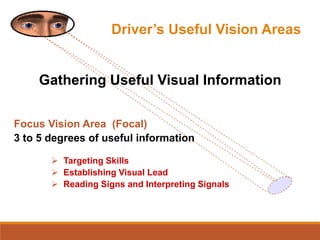
Driver’s Useful Vision Areas
Gathering Useful Visual Information
Focus Vision Area (Focal)
3 to 5 degrees of useful information
 Targeting Skills
 Establishing Visual Lead
 Reading Signs and Interpreting Signals
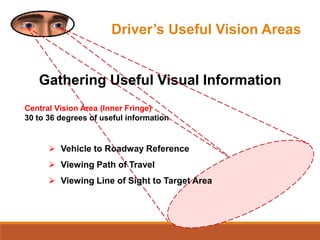
Driver’s Useful Vision Areas
Gathering Useful Visual Information
Central Vision Area (Inner Fringe)
30 to 36 degrees of useful information
 Vehicle to Roadway Reference
 Viewing Path of Travel
 Viewing Line of Sight to Target Area
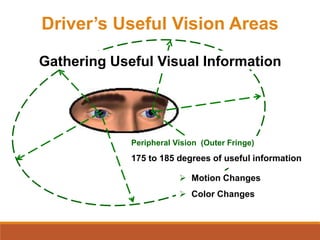
Driver’s Useful Vision Areas
Gathering Useful Visual Information
Peripheral Vision (Outer Fringe)
175 to 185 degrees of useful information
 Motion Changes
 Color Changes
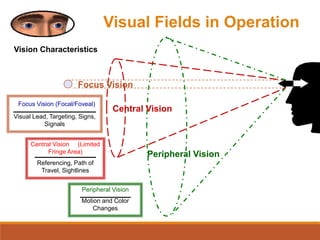
Vision Characteristics
Focus Vision
Central Vision
Peripheral Vision
Peripheral Vision
Motion and Color
Changes
Focus Vision (Focal/Foveal)
Visual Lead, Targeting, Signs,
Signals
Central Vision (Limited
Fringe Area)
Referencing, Path of
Travel, Sightlines
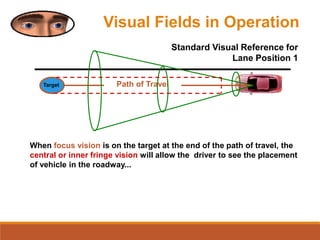
Visual Fields in Operation
Path of TravelTarget
Standard Visual Reference for
Lane Position 1
When focus vision is on the target at the end of the path of travel, the
central or inner fringe vision will allow the driver to see the placement
of vehicle in the roadway...
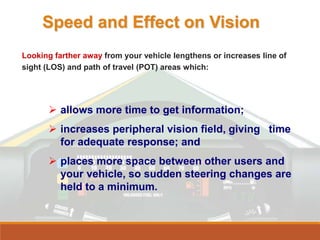
Speed and Effect on Vision
 allows more time to get information;
 increases peripheral vision field, giving time
for adequate response; and
 places more space between other users and
your vehicle, so sudden steering changes are
held to a minimum.
Looking farther away from your vehicle lengthens or increases line of
sight (LOS) and path of travel (POT) areas which:
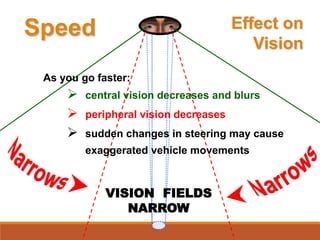
Speed Effect on
Vision
As you go faster:
 central vision decreases and blurs
 peripheral vision decreases
 sudden changes in steering may cause
exaggerated vehicle movements
VISION FIELDS
NARROW
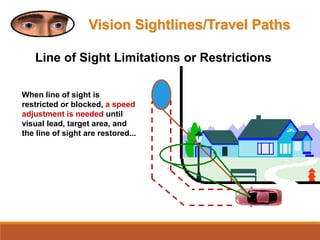
LINE OF SIGHT
Ability to see your path of travel
PATH OF TRAVEL
How you are going to get from point A (where you are)
to point B (where you want to go)
A
B
Vision Sightlines/Travel Paths
Line of Sight Limitations or Restrictions
When line of sight is
restricted or blocked, a speed
adjustment is needed until
visual lead, target area, and
the line of sight are restored...
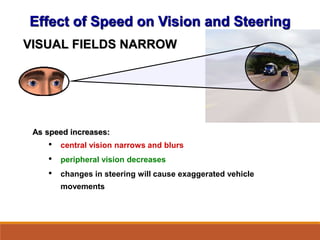
Effect of Speed on Vision and Steering
As speed increases:
• central vision narrows and blurs
• peripheral vision decreases
• changes in steering will cause exaggerated vehicle
movements
VISUAL FIELDS NARROW
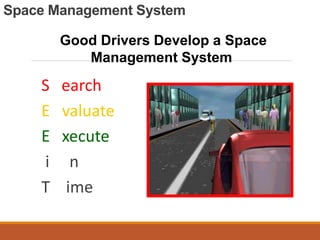
Space Management System
S earch
E valuate
E xecute
i n
T ime
T-3.20a
Good Drivers Develop a Space
Management System
Searching
Identifying high risk situations
- Effective searching techniques
- Having time to identify hazards
- Keeping stable scanning eye
movements
- Getting a large view of the roadway
- Establishing a line of sight and path
of travel position
Gaining information
- Effectively managing space
- Looking for changing areas
- Looking for open areas
- Looking for closed areas
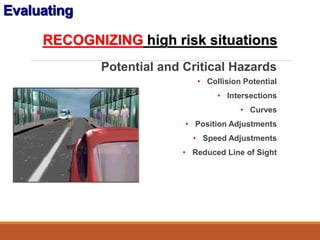
Evaluating
Potential and Critical Hazards
• Collision Potential
• Intersections
• Curves
• Position Adjustments
• Speed Adjustments
• Reduced Line of Sight
RECOGNIZING high risk situations
Evaluating
Decision-making
• Maintain an open line of sight (LOS)
and path of travel (POT)
Motion control
 Controlled/threshold braking
 Progressive acceleration
Steering control
 Hand-to-hand
 Evasive action
Preventing high risk situations
Maintain open LOS, POT, and proper lane position
Manage time and space
Controlling high risk situations
Executing
 Speed changes
 Lane position changes
 Space control
in response to
 risk or danger
 traffic conditions
 roadway conditions
 vehicle balance
Importance of Good Vision
Distance Vision-Ability to see far down the road 20-30 seconds
Depth Perception
◦ Helps you control your following distance and lets you adjust your
position in traffic, change lanes, pass, pull into traffic
◦ To compensate for poor depth perception-Increase following distance
Color Vision
◦ Drivers must recognize colors in objects (signs, signals, etc.)
◦ Can color Bind people drive ? (Shape, Shade, or position)
Vision Problems
Contrast Sensitivity- Helps you see details in the driving environment
Night Vision
◦ Good night vision requires an ability to see in low and variable light conditions
◦ Reduced visibility at night due to dirty windshield, headlights, rain, etc.
◦ Glare Vision- Ability to see when there is rapid increase in light
◦ Headlights
◦ Sun
◦ Snow
◦ Rain
◦ Glare Recovery- Caused by the sudden brightness of oncoming headlights
◦ 1.Do not look directly into headlights
◦ Reduce speed
◦ Be aware on hills and curves
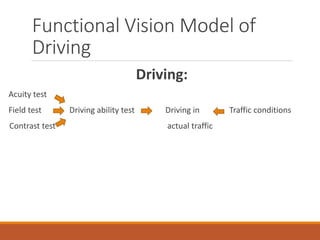
Functional Vision Model of
Driving
Driving:
Acuity test
Field test Driving ability test Driving in Traffic conditions
Contrast test actual traffic
Vision & Driving
Driving is a demanding activity.
The various stages can be summarized as follows:
Perception central ⇒ fixation
peripheral ⇒ scanning
Interpretation / Decision ⇒ reaction time
Action ⇒ motor abilities
Drivers must see obstacles or hazards, straight ahead or in their peripheral
visual field (e.g.; a person crossing the road), consider the possible reactions
of this person, estimate the distance, decide whether they have to slow
down or stop and then react accordingly.
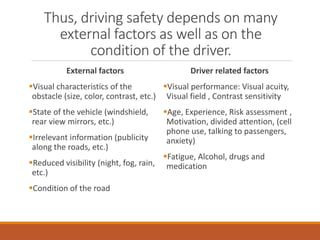
Thus, driving safety depends on many
external factors as well as on the
condition of the driver.
External factors
Visual characteristics of the
obstacle (size, color, contrast, etc.)
State of the vehicle (windshield,
rear view mirrors, etc.)
Irrelevant information (publicity
along the roads, etc.)
Reduced visibility (night, fog, rain,
etc.)
Condition of the road
Driver related factors
Visual performance: Visual acuity,
Visual field , Contrast sensitivity
Age, Experience, Risk assessment ,
Motivation, divided attention, (cell
phone use, talking to passengers,
anxiety)
Fatigue, Alcohol, drugs and
medication
WHICH VISUAL FUNCTIONS
MIGHT BE TESTED?
1. Visual Acuity
2. Visual Fields
3. Contrast Sensitivity
4. Glare Sensitivity
5. Diplopia
6. Colour Vision
7. Night Vision
1. Visual Acuity
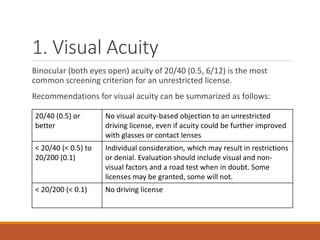
Binocular (both eyes open) acuity of 20/40 (0.5, 6/12) is the most
common screening criterion for an unrestricted license.
Recommendations for visual acuity can be summarized as follows:
20/40 (0.5) or
better
No visual acuity-based objection to an unrestricted
driving license, even if acuity could be further improved
with glasses or contact lenses
< 20/40 (< 0.5) to
20/200 (0.1)
Individual consideration, which may result in restrictions
or denial. Evaluation should include visual and non-
visual factors and a road test when in doubt. Some
licenses may be granted, some will not.
< 20/200 (< 0.1) No driving license
Visual Acuity
Visual acuity is the visual parameter that is most easily and therefore most widely
measured.
It is often mistaken for a general measure of vision, although it only tests the small
foveal area onto which the test letter is projected. For optical problems (defocus,
opacities) this is adequate, since foveal blur predicts perifoveal blur. For retinal
problems (also prevalent in an older population) visual acuity is only a partial
measure, since foveal function does not predict perifoveal function.
The 20/40 (0.5, 6/12) standard is the criterion most widely used. We believe this to
be reasonable, not because one becomes an unsafe driver at 20/50 (0.4, 6/15) but
because it includes a safety margin for adverse conditions. This criterion implies that
subjects who can read 20/40 on a well-lighted, stationary chart, are generally
assumed to still be safe drivers in a moving environment and under adverse
conditions, such as after dark, in rain or in fog.
Normal vision is binocular vision, as recently stressed by a WHO Consultation on
Characterization of Vision Loss. The criteria should thus be based on binocular vision
(both eyes open). In the rare cases where binocular vision is worse (e.g. diplopia),
good monocular acuity should not have precedence.
2. Visual Field
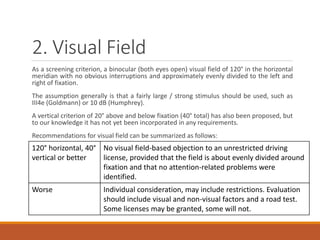
As a screening criterion, a binocular (both eyes open) visual field of 120° in the horizontal
meridian with no obvious interruptions and approximately evenly divided to the left and
right of fixation.
The assumption generally is that a fairly large / strong stimulus should be used, such as
III4e (Goldmann) or 10 dB (Humphrey).
A vertical criterion of 20° above and below fixation (40° total) has also been proposed, but
to our knowledge it has not yet been incorporated in any requirements.
Recommendations for visual field can be summarized as follows:
120° horizontal, 40°
vertical or better
No visual field-based objection to an unrestricted driving
license, provided that the field is about evenly divided around
fixation and that no attention-related problems were
identified.
Worse Individual consideration, may include restrictions. Evaluation
should include visual and non-visual factors and a road test.
Some licenses may be granted, some will not.
Visual Field
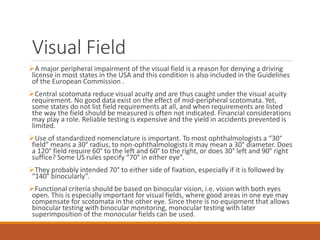
A major peripheral impairment of the visual field is a reason for denying a driving
license in most states in the USA and this condition is also included in the Guidelines
of the European Commission .
Central scotomata reduce visual acuity and are thus caught under the visual acuity
requirement. No good data exist on the effect of mid-peripheral scotomata. Yet,
some states do not list field requirements at all, and when requirements are listed
the way the field should be measured is often not indicated. Financial considerations
may play a role. Reliable testing is expensive and the yield in accidents prevented is
limited.
Use of standardized nomenclature is important. To most ophthalmologists a “30°
field” means a 30° radius, to non-ophthalmologists it may mean a 30° diameter. Does
a 120° field require 60° to the left and 60° to the right, or does 30° left and 90° right
suffice? Some US rules specify “70° in either eye”.
They probably intended 70° to either side of fixation, especially if it is followed by
“140° binocularly”.
Functional criteria should be based on binocular vision, i.e. vision with both eyes
open. This is especially important for visual fields, where good areas in one eye may
compensate for scotomata in the other eye. Since there is no equipment that allows
binocular testing with binocular monitoring, monocular testing with later
superimposition of the monocular fields can be used.
Useful Field of View (UFOV)
This test evaluates to what extent an object in the periphery of the
visual field is not only seen but also perceived. As such, it evaluates a
combination of visual and non-visual factors (attention).
The UFOV test has better sensitivity and specificity than visual sensory
or mental status tests in identifying older drivers at risk for accidents.
The UFOV test has, as far as we know, not yet been accepted for
general use and is not incorporated in the European guidelines. The
UFOV test points to the importance of factors, such as attention, that
are not strictly visual.
3.Contrast Sensitivity
Contrast sensitivity may be reduced due to optical factors, as in cataract patients.
Contrast problems may also result from retinal problems (AMD, glaucoma, etc.) that
are also common among the elderly.
If contrast sensitivity loss is caused by optical problems (defocus, scatter), both
visual acuity and contrast sensitivity will be affected. When contrast sensitivity loss is
caused by retinal problems, visual acuity loss and contrast sensitivity loss are not
necessarily correlated. It is possible to have poor visual acuiy with good contrast
vision; it is also possible to have good visual acuity with poor contrast vision.
Some people in an elderly population may have 20/20 (1.0, 6/6) acuity on a high
contrast chart in good illumination, but may easily drop to 20/200 (0.1, 6/60) or
below with low light, low contrast and glare.
It is strongly suggest to include simple tests for contrast sensitivity and glare
sensitivity in the requirements for a driving license in older drivers.
Various tests are available. The Pelli-Robson contrast sensitivity test chart is
standardized, but not often included in clinical exams.
Contrast Sensitivity
Presently no contrast sensitivity requirements are listed in any
jurisdiction. This does not mean, however, that contrast sensitivity is
unimportant. When a simple, inexpensive screening test becomes
available and is validated, screening would be worthwhile, especially
among the elderly. Those who fail the screening test should be referred
for professional evaluation. Contrast problems due to optical causes are
probably highly related to visual acuity loss, but contrast problems due
to retinal causes (common in the elderly) can exist regardless of the
visual acuity level.
4.Glare Sensitivity
Glare sensitivity may similarly result from optical problems, such as
cataract, or from retinal problems. In the first case straylight and
disability glare are important; in the latter case, glare recovery time is
also important.
5. Diplopia
A few jurisdictions mention diplopia. A recent Canadian proposal
recommends the absence of diplopia within the central 40° (ie: 20° left,
right, above and below fixation).
Individuals vary greatly in the degree to which they are bothered by
diplopia. Some are able to suppress the unattended image when
looking through a monocular telescope or other monocular device,
others close one eye.
6. Color Vision
The Guidelines of the European Commission have dropped color vision
requirements. They are still in use in some states in the USA, in Bulgaria,
Columbia and provinces in Canada.
Studies shown that abnormal color vision is not incompatible with safe
driving. The problem of recognizing traffic lights is overcome by the
standardized position of the different lights, appropriately chosen colors
and in some countries by the differences in their sizes.
7.Night Vision
Problems with night vision are not limited to hemeralopia. Patients with
hemeralopia are aware of their problems and will usually avoid driving at
night.
Patients with IOL’s or who underwent refractive surgery may experience
glare problems and contrast loss when a wide pupil exposes the edges of
the IOL or of the ablation zone. Such problems will never be detected in
daylight testing.
Also, patients with cataract will complain of glare and be extremely
handicapped by the lights of cars driving towards them. Especially older
drivers will be blinded by oncoming cars because of increased intra-ocular
light scattering and glare sensitivity, but also because of prolonged
photostress recovery time.
There are a number of tests that evaluate problems with night vision,
including the Mesotest (Oculus) and the Nyktotest (Rodenstock). None of
them are included in guidelines, although some countries include a crude
estimation of night vision in their criteria.

Vision and Driving

  • 1.
  • 2.
    Vision & Driving 90%of your decisions are based on information you gather with your eyes Peripheral Vision = To the sides Central Vision = In the front Vertical Vision = Up & Down Focus Vision = Targeting
  • 3.
    Driver’s Useful VisionAreas Gathering Useful Visual Information Focus Vision Area (Focal) 3 to 5 degrees of useful information  Targeting Skills  Establishing Visual Lead  Reading Signs and Interpreting Signals
  • 4.
    Driver’s Useful VisionAreas Gathering Useful Visual Information Central Vision Area (Inner Fringe) 30 to 36 degrees of useful information  Vehicle to Roadway Reference  Viewing Path of Travel  Viewing Line of Sight to Target Area
  • 5.
    Driver’s Useful VisionAreas Gathering Useful Visual Information Peripheral Vision (Outer Fringe) 175 to 185 degrees of useful information  Motion Changes  Color Changes
  • 6.
    Vision Characteristics Focus Vision CentralVision Peripheral Vision Peripheral Vision Motion and Color Changes Focus Vision (Focal/Foveal) Visual Lead, Targeting, Signs, Signals Central Vision (Limited Fringe Area) Referencing, Path of Travel, Sightlines Visual Fields in Operation
  • 7.
    Visual Fields inOperation Path of TravelTarget Standard Visual Reference for Lane Position 1 When focus vision is on the target at the end of the path of travel, the central or inner fringe vision will allow the driver to see the placement of vehicle in the roadway...
  • 8.
    Speed and Effecton Vision  allows more time to get information;  increases peripheral vision field, giving time for adequate response; and  places more space between other users and your vehicle, so sudden steering changes are held to a minimum. Looking farther away from your vehicle lengthens or increases line of sight (LOS) and path of travel (POT) areas which:
  • 9.
    Speed Effect on Vision Asyou go faster:  central vision decreases and blurs  peripheral vision decreases  sudden changes in steering may cause exaggerated vehicle movements VISION FIELDS NARROW
  • 10.
    LINE OF SIGHT Abilityto see your path of travel PATH OF TRAVEL How you are going to get from point A (where you are) to point B (where you want to go) A B
  • 11.
    Vision Sightlines/Travel Paths Lineof Sight Limitations or Restrictions When line of sight is restricted or blocked, a speed adjustment is needed until visual lead, target area, and the line of sight are restored...
  • 12.
    Effect of Speedon Vision and Steering As speed increases: • central vision narrows and blurs • peripheral vision decreases • changes in steering will cause exaggerated vehicle movements VISUAL FIELDS NARROW
  • 13.
    Space Management System Search E valuate E xecute i n T ime T-3.20a Good Drivers Develop a Space Management System
  • 14.
    Searching Identifying high risksituations - Effective searching techniques - Having time to identify hazards - Keeping stable scanning eye movements - Getting a large view of the roadway - Establishing a line of sight and path of travel position Gaining information - Effectively managing space - Looking for changing areas - Looking for open areas - Looking for closed areas
  • 15.
    Evaluating Potential and CriticalHazards • Collision Potential • Intersections • Curves • Position Adjustments • Speed Adjustments • Reduced Line of Sight RECOGNIZING high risk situations
  • 16.
    Evaluating Decision-making • Maintain anopen line of sight (LOS) and path of travel (POT) Motion control  Controlled/threshold braking  Progressive acceleration Steering control  Hand-to-hand  Evasive action Preventing high risk situations Maintain open LOS, POT, and proper lane position Manage time and space Controlling high risk situations
  • 17.
    Executing  Speed changes Lane position changes  Space control in response to  risk or danger  traffic conditions  roadway conditions  vehicle balance
  • 18.
    Importance of GoodVision Distance Vision-Ability to see far down the road 20-30 seconds Depth Perception ◦ Helps you control your following distance and lets you adjust your position in traffic, change lanes, pass, pull into traffic ◦ To compensate for poor depth perception-Increase following distance Color Vision ◦ Drivers must recognize colors in objects (signs, signals, etc.) ◦ Can color Bind people drive ? (Shape, Shade, or position)
  • 19.
    Vision Problems Contrast Sensitivity-Helps you see details in the driving environment Night Vision ◦ Good night vision requires an ability to see in low and variable light conditions ◦ Reduced visibility at night due to dirty windshield, headlights, rain, etc. ◦ Glare Vision- Ability to see when there is rapid increase in light ◦ Headlights ◦ Sun ◦ Snow ◦ Rain ◦ Glare Recovery- Caused by the sudden brightness of oncoming headlights ◦ 1.Do not look directly into headlights ◦ Reduce speed ◦ Be aware on hills and curves
  • 20.
    Functional Vision Modelof Driving Driving: Acuity test Field test Driving ability test Driving in Traffic conditions Contrast test actual traffic
  • 21.
    Vision & Driving Drivingis a demanding activity. The various stages can be summarized as follows: Perception central ⇒ fixation peripheral ⇒ scanning Interpretation / Decision ⇒ reaction time Action ⇒ motor abilities Drivers must see obstacles or hazards, straight ahead or in their peripheral visual field (e.g.; a person crossing the road), consider the possible reactions of this person, estimate the distance, decide whether they have to slow down or stop and then react accordingly.
  • 22.
    Thus, driving safetydepends on many external factors as well as on the condition of the driver. External factors Visual characteristics of the obstacle (size, color, contrast, etc.) State of the vehicle (windshield, rear view mirrors, etc.) Irrelevant information (publicity along the roads, etc.) Reduced visibility (night, fog, rain, etc.) Condition of the road Driver related factors Visual performance: Visual acuity, Visual field , Contrast sensitivity Age, Experience, Risk assessment , Motivation, divided attention, (cell phone use, talking to passengers, anxiety) Fatigue, Alcohol, drugs and medication
  • 23.
    WHICH VISUAL FUNCTIONS MIGHTBE TESTED? 1. Visual Acuity 2. Visual Fields 3. Contrast Sensitivity 4. Glare Sensitivity 5. Diplopia 6. Colour Vision 7. Night Vision
  • 24.
    1. Visual Acuity Binocular(both eyes open) acuity of 20/40 (0.5, 6/12) is the most common screening criterion for an unrestricted license. Recommendations for visual acuity can be summarized as follows: 20/40 (0.5) or better No visual acuity-based objection to an unrestricted driving license, even if acuity could be further improved with glasses or contact lenses < 20/40 (< 0.5) to 20/200 (0.1) Individual consideration, which may result in restrictions or denial. Evaluation should include visual and non- visual factors and a road test when in doubt. Some licenses may be granted, some will not. < 20/200 (< 0.1) No driving license
  • 25.
    Visual Acuity Visual acuityis the visual parameter that is most easily and therefore most widely measured. It is often mistaken for a general measure of vision, although it only tests the small foveal area onto which the test letter is projected. For optical problems (defocus, opacities) this is adequate, since foveal blur predicts perifoveal blur. For retinal problems (also prevalent in an older population) visual acuity is only a partial measure, since foveal function does not predict perifoveal function. The 20/40 (0.5, 6/12) standard is the criterion most widely used. We believe this to be reasonable, not because one becomes an unsafe driver at 20/50 (0.4, 6/15) but because it includes a safety margin for adverse conditions. This criterion implies that subjects who can read 20/40 on a well-lighted, stationary chart, are generally assumed to still be safe drivers in a moving environment and under adverse conditions, such as after dark, in rain or in fog. Normal vision is binocular vision, as recently stressed by a WHO Consultation on Characterization of Vision Loss. The criteria should thus be based on binocular vision (both eyes open). In the rare cases where binocular vision is worse (e.g. diplopia), good monocular acuity should not have precedence.
  • 26.
    2. Visual Field Asa screening criterion, a binocular (both eyes open) visual field of 120° in the horizontal meridian with no obvious interruptions and approximately evenly divided to the left and right of fixation. The assumption generally is that a fairly large / strong stimulus should be used, such as III4e (Goldmann) or 10 dB (Humphrey). A vertical criterion of 20° above and below fixation (40° total) has also been proposed, but to our knowledge it has not yet been incorporated in any requirements. Recommendations for visual field can be summarized as follows: 120° horizontal, 40° vertical or better No visual field-based objection to an unrestricted driving license, provided that the field is about evenly divided around fixation and that no attention-related problems were identified. Worse Individual consideration, may include restrictions. Evaluation should include visual and non-visual factors and a road test. Some licenses may be granted, some will not.
  • 27.
    Visual Field A majorperipheral impairment of the visual field is a reason for denying a driving license in most states in the USA and this condition is also included in the Guidelines of the European Commission . Central scotomata reduce visual acuity and are thus caught under the visual acuity requirement. No good data exist on the effect of mid-peripheral scotomata. Yet, some states do not list field requirements at all, and when requirements are listed the way the field should be measured is often not indicated. Financial considerations may play a role. Reliable testing is expensive and the yield in accidents prevented is limited. Use of standardized nomenclature is important. To most ophthalmologists a “30° field” means a 30° radius, to non-ophthalmologists it may mean a 30° diameter. Does a 120° field require 60° to the left and 60° to the right, or does 30° left and 90° right suffice? Some US rules specify “70° in either eye”. They probably intended 70° to either side of fixation, especially if it is followed by “140° binocularly”. Functional criteria should be based on binocular vision, i.e. vision with both eyes open. This is especially important for visual fields, where good areas in one eye may compensate for scotomata in the other eye. Since there is no equipment that allows binocular testing with binocular monitoring, monocular testing with later superimposition of the monocular fields can be used.
  • 28.
    Useful Field ofView (UFOV) This test evaluates to what extent an object in the periphery of the visual field is not only seen but also perceived. As such, it evaluates a combination of visual and non-visual factors (attention). The UFOV test has better sensitivity and specificity than visual sensory or mental status tests in identifying older drivers at risk for accidents. The UFOV test has, as far as we know, not yet been accepted for general use and is not incorporated in the European guidelines. The UFOV test points to the importance of factors, such as attention, that are not strictly visual.
  • 29.
    3.Contrast Sensitivity Contrast sensitivitymay be reduced due to optical factors, as in cataract patients. Contrast problems may also result from retinal problems (AMD, glaucoma, etc.) that are also common among the elderly. If contrast sensitivity loss is caused by optical problems (defocus, scatter), both visual acuity and contrast sensitivity will be affected. When contrast sensitivity loss is caused by retinal problems, visual acuity loss and contrast sensitivity loss are not necessarily correlated. It is possible to have poor visual acuiy with good contrast vision; it is also possible to have good visual acuity with poor contrast vision. Some people in an elderly population may have 20/20 (1.0, 6/6) acuity on a high contrast chart in good illumination, but may easily drop to 20/200 (0.1, 6/60) or below with low light, low contrast and glare. It is strongly suggest to include simple tests for contrast sensitivity and glare sensitivity in the requirements for a driving license in older drivers. Various tests are available. The Pelli-Robson contrast sensitivity test chart is standardized, but not often included in clinical exams.
  • 30.
    Contrast Sensitivity Presently nocontrast sensitivity requirements are listed in any jurisdiction. This does not mean, however, that contrast sensitivity is unimportant. When a simple, inexpensive screening test becomes available and is validated, screening would be worthwhile, especially among the elderly. Those who fail the screening test should be referred for professional evaluation. Contrast problems due to optical causes are probably highly related to visual acuity loss, but contrast problems due to retinal causes (common in the elderly) can exist regardless of the visual acuity level.
  • 31.
    4.Glare Sensitivity Glare sensitivitymay similarly result from optical problems, such as cataract, or from retinal problems. In the first case straylight and disability glare are important; in the latter case, glare recovery time is also important.
  • 32.
    5. Diplopia A fewjurisdictions mention diplopia. A recent Canadian proposal recommends the absence of diplopia within the central 40° (ie: 20° left, right, above and below fixation). Individuals vary greatly in the degree to which they are bothered by diplopia. Some are able to suppress the unattended image when looking through a monocular telescope or other monocular device, others close one eye.
  • 33.
    6. Color Vision TheGuidelines of the European Commission have dropped color vision requirements. They are still in use in some states in the USA, in Bulgaria, Columbia and provinces in Canada. Studies shown that abnormal color vision is not incompatible with safe driving. The problem of recognizing traffic lights is overcome by the standardized position of the different lights, appropriately chosen colors and in some countries by the differences in their sizes.
  • 34.
    7.Night Vision Problems withnight vision are not limited to hemeralopia. Patients with hemeralopia are aware of their problems and will usually avoid driving at night. Patients with IOL’s or who underwent refractive surgery may experience glare problems and contrast loss when a wide pupil exposes the edges of the IOL or of the ablation zone. Such problems will never be detected in daylight testing. Also, patients with cataract will complain of glare and be extremely handicapped by the lights of cars driving towards them. Especially older drivers will be blinded by oncoming cars because of increased intra-ocular light scattering and glare sensitivity, but also because of prolonged photostress recovery time. There are a number of tests that evaluate problems with night vision, including the Mesotest (Oculus) and the Nyktotest (Rodenstock). None of them are included in guidelines, although some countries include a crude estimation of night vision in their criteria.