OPTOM.ASKAR.PK
What is vision screening?
• Vision screening is an efficient and cost-
effective method to identify persons with
visual impairment or eye conditions that are
likely to lead to visual impairment so that a
referral can be made to an appropriate eye
care professional for further evaluation and
treatment.
How is vision screening performed?
• There are a number of methods used to
screen vision.
• Eye Examination:
• A comprehensive investigation of the eyes,
surrounding tissues and visual system,
• to identify and correct refractive error,
binocular abnormalities and diagnose primary
• ocular diseases or ocular diseases secondary
to systemic problems.
• Mobile Clinic:
• A practice which a practitioner conducts out
of a vehicle. This vehicle is used to
• move from place to place to offer care. The
goal of rendering service from a mobile
• clinic is to make health services accessible to
communities who are otherwise under
• serviced
 VISION SCREENING
 Protocols for industrial, corporate,
community and school screening
 In serving its role of protecting and educating
the public and guiding the professions
• Preliminary Disciplinary Committees are
frequently faced with various issues
• pertaining to activities performed under the
guise of vision screening.
• These aberrant activities include canvassing
and touting of patients, exploiting
• medical aid benefits of members, over-
reaching for services rendered (i.e.
• performing a screening, but invoicing a full
examination fee), over-servicing and
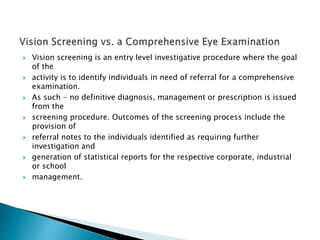
 Vision screening is an entry level investigative procedure where the goal
of the
 activity is to identify individuals in need of referral for a comprehensive
examination.
 As such - no definitive diagnosis, management or prescription is issued
from the
 screening procedure. Outcomes of the screening process include the
provision of
 referral notes to the individuals identified as requiring further
investigation and
 generation of statistical reports for the respective corporate, industrial
or school
 management.
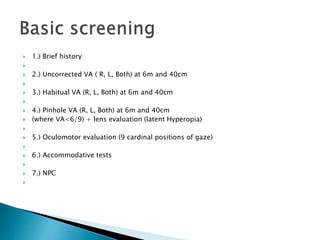
 1.) Brief history

 2.) Uncorrected VA ( R, L, Both) at 6m and 40cm

 3.) Habitual VA (R, L, Both) at 6m and 40cm

 4.) Pinhole VA (R, L, Both) at 6m and 40cm
 (where VA<6/9) + lens evaluation (latent Hyperopia)

 5.) Oculomotor evaluation (9 cardinal positions of gaze)

 6.) Accommodative tests

 7.) NPC

 8.) Pupil responses

 9.) Color vision

 10.) Stereopsis

 11.) Visual fields

 12.) External Health

 13.) Internal Health

 14.) Tonometry
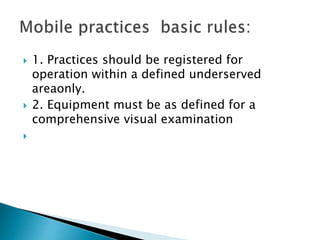
 1. Practices should be registered for
operation within a defined underserved
areaonly.
 2. Equipment must be as defined for a
comprehensive visual examination

 3. Optical appliance dispensing must be
conducted by the original practitioner at the
site visited.
 4. Stand alone mobile clinics are not
encouraged
• Inspection of the eye, pupils and red reflex
• This method can be used on children of all ages. At
each well child visit, the examiner uses a flashlight to
inspect the eyes for abnormality of shape or structure
and to detect irregularity in pupil shape. The pupil
constricts (become smaller) in bright light and dilates
(become larger) in the dark, and both pupils are the
same size.
 An ophthalmoscope is used to observe the
red reflex of the eye. The red reflex is a
reflection from the lining of the inside of the
eye that causes the pupil to look red in
photographs. The red reflex should be bright
in both eyes and equal.
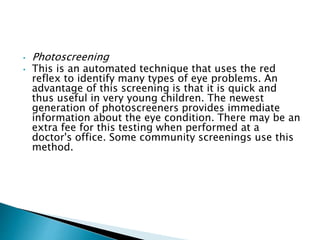
• Photoscreening
• This is an automated technique that uses the red
reflex to identify many types of eye problems. An
advantage of this screening is that it is quick and
thus useful in very young children. The newest
generation of photoscreeners provides immediate
information about the eye condition. There may be an
extra fee for this testing when performed at a
doctor's office. Some community screenings use this
method.
• Corneal light reflex testing
• This simple test can be performed on any child using a
penlight. As a child focuses on a penlight, the position of
the light reflection from the front surface (cornea) of the
eye is observed. The test is accurate only if the child looks
directly at the light and not to the side. Normally the
corneal light reflex is in sharp focus and centered on both
pupils The test is abnormal if the corneal light reflex is not
crisp and clear, or if it is "off-center."
• Cover testing
• This test detects misalignment of the eyes. While
the child focuses on a target, the examiner
covers each eye sequentially to look for a "shift"
in the alignment of the eyes. This test requires a
cooperative child (usually 3 years or older) and
an experienced examiner.
• Subjective visual acuity testing
• The use of an eye chart requires a cooperative
child, so successful testing is greatest with
children 3 years and older. Since it is the only
screening method that directly measures visual
acuity, it is the preferred exam for older children.
Modifications of the adult eye chart make it
easier to test children.
• What kinds of eye problems can be detected on a vision
screening?
• The main goal of vision screening is to identify children
who have or are at risk to develop amblyopia, which can
lead to permanent visual impairment unless treated in early
childhood. Other problems that can be detected by vision
screening include strabismus, cataracts, glaucoma,
refractive errors such as myopia ("nearsightedness"),
hyperopia ("farsightedness") and astigmatism, ptosis and
other more serious conditions such as tumors or
neurological diseases.
• Who performs vision screening?
• Pediatricians, family practitioners, nurses and
technicians can perform vision screening at
regular well care office visits. In addition, many
day care programs, churches, schools and health
departments offer vision screening programs for
children.
 In summary, we can assure honest, reliable
and professional services, promoting quality
visual well-being programs within our clients
companies, inspiring productivity, safety and
good moral amongst employees.
 Optometry practice management
 Industrial optometric safety evaluation
 Quality company and patient reports
 Prescription Safety Spectacles & Safety
Goggles
 Contact Lenses
 Industrial Visual screening
 Professional Optometry consultations
 Operator certification
 Safety glasses cleaning stations
 Sunglasses
Industrial vision screening

Industrial vision screening

  • 1.
  • 2.
    What is visionscreening? • Vision screening is an efficient and cost- effective method to identify persons with visual impairment or eye conditions that are likely to lead to visual impairment so that a referral can be made to an appropriate eye care professional for further evaluation and treatment.
  • 3.
    How is visionscreening performed? • There are a number of methods used to screen vision. • Eye Examination: • A comprehensive investigation of the eyes, surrounding tissues and visual system, • to identify and correct refractive error, binocular abnormalities and diagnose primary • ocular diseases or ocular diseases secondary to systemic problems.
  • 4.
    • Mobile Clinic: •A practice which a practitioner conducts out of a vehicle. This vehicle is used to • move from place to place to offer care. The goal of rendering service from a mobile • clinic is to make health services accessible to communities who are otherwise under • serviced
  • 5.
     VISION SCREENING Protocols for industrial, corporate, community and school screening  In serving its role of protecting and educating the public and guiding the professions
  • 6.
    • Preliminary DisciplinaryCommittees are frequently faced with various issues • pertaining to activities performed under the guise of vision screening. • These aberrant activities include canvassing and touting of patients, exploiting • medical aid benefits of members, over- reaching for services rendered (i.e. • performing a screening, but invoicing a full examination fee), over-servicing and
  • 7.
     Vision screeningis an entry level investigative procedure where the goal of the  activity is to identify individuals in need of referral for a comprehensive examination.  As such - no definitive diagnosis, management or prescription is issued from the  screening procedure. Outcomes of the screening process include the provision of  referral notes to the individuals identified as requiring further investigation and  generation of statistical reports for the respective corporate, industrial or school  management.
  • 8.
     1.) Briefhistory   2.) Uncorrected VA ( R, L, Both) at 6m and 40cm   3.) Habitual VA (R, L, Both) at 6m and 40cm   4.) Pinhole VA (R, L, Both) at 6m and 40cm  (where VA<6/9) + lens evaluation (latent Hyperopia)   5.) Oculomotor evaluation (9 cardinal positions of gaze)   6.) Accommodative tests   7.) NPC 
  • 9.
     8.) Pupilresponses   9.) Color vision   10.) Stereopsis   11.) Visual fields   12.) External Health   13.) Internal Health   14.) Tonometry
  • 10.
     1. Practicesshould be registered for operation within a defined underserved areaonly.  2. Equipment must be as defined for a comprehensive visual examination 
  • 11.
     3. Opticalappliance dispensing must be conducted by the original practitioner at the site visited.  4. Stand alone mobile clinics are not encouraged
  • 12.
    • Inspection ofthe eye, pupils and red reflex • This method can be used on children of all ages. At each well child visit, the examiner uses a flashlight to inspect the eyes for abnormality of shape or structure and to detect irregularity in pupil shape. The pupil constricts (become smaller) in bright light and dilates (become larger) in the dark, and both pupils are the same size.
  • 13.
     An ophthalmoscopeis used to observe the red reflex of the eye. The red reflex is a reflection from the lining of the inside of the eye that causes the pupil to look red in photographs. The red reflex should be bright in both eyes and equal.
  • 14.
    • Photoscreening • Thisis an automated technique that uses the red reflex to identify many types of eye problems. An advantage of this screening is that it is quick and thus useful in very young children. The newest generation of photoscreeners provides immediate information about the eye condition. There may be an extra fee for this testing when performed at a doctor's office. Some community screenings use this method.
  • 15.
    • Corneal lightreflex testing • This simple test can be performed on any child using a penlight. As a child focuses on a penlight, the position of the light reflection from the front surface (cornea) of the eye is observed. The test is accurate only if the child looks directly at the light and not to the side. Normally the corneal light reflex is in sharp focus and centered on both pupils The test is abnormal if the corneal light reflex is not crisp and clear, or if it is "off-center."
  • 16.
    • Cover testing •This test detects misalignment of the eyes. While the child focuses on a target, the examiner covers each eye sequentially to look for a "shift" in the alignment of the eyes. This test requires a cooperative child (usually 3 years or older) and an experienced examiner.
  • 17.
    • Subjective visualacuity testing • The use of an eye chart requires a cooperative child, so successful testing is greatest with children 3 years and older. Since it is the only screening method that directly measures visual acuity, it is the preferred exam for older children. Modifications of the adult eye chart make it easier to test children.
  • 18.
    • What kindsof eye problems can be detected on a vision screening? • The main goal of vision screening is to identify children who have or are at risk to develop amblyopia, which can lead to permanent visual impairment unless treated in early childhood. Other problems that can be detected by vision screening include strabismus, cataracts, glaucoma, refractive errors such as myopia ("nearsightedness"), hyperopia ("farsightedness") and astigmatism, ptosis and other more serious conditions such as tumors or neurological diseases.
  • 19.
    • Who performsvision screening? • Pediatricians, family practitioners, nurses and technicians can perform vision screening at regular well care office visits. In addition, many day care programs, churches, schools and health departments offer vision screening programs for children.
  • 20.
     In summary,we can assure honest, reliable and professional services, promoting quality visual well-being programs within our clients companies, inspiring productivity, safety and good moral amongst employees.
  • 21.
     Optometry practicemanagement  Industrial optometric safety evaluation  Quality company and patient reports  Prescription Safety Spectacles & Safety Goggles
  • 22.
     Contact Lenses Industrial Visual screening  Professional Optometry consultations  Operator certification  Safety glasses cleaning stations  Sunglasses