Epigenetic Regulation in PlantsRyza Aditya Priatama(리자 아디티아)Plant Developmental Genetics LaboratoryGyeongsang National University, Korea
OutlineBenefits of Plants in Epigenetic ResearchMolecular Components of Chromatin in PlantsMolecular Components of RNAi-mediated Gene Silencing PathwaysEpigenetic Regulation without RNA Involvement Outlook
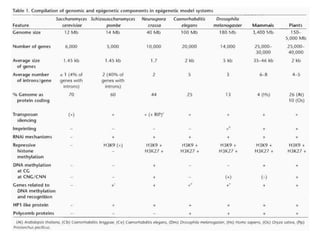
Benefit of Plants in Epigenetic ResearchPlants and Mammals are Similar in Terms of (epi)Genome OrganizationPlants Provide Additional Topics for Epigenetics ResearchPlants have Haploid (gametophyte) stage between meiosis and fertilization (Fig 1.)Somatic Embryogenesis  Differentiation; somaclonal variationHigher tolerance of Polyploidy  Plants Tolerate Methodological Approach that are difficult in MamalsPlants efficient in mutagenesis & rapid growing insertion mutants collection Plants have a Proven Record of Contributing to Epigenetic ResearchDistinction of Euchromation and Heterochromatin (1928)Pioneering work on transposable Element (B. McClintock)
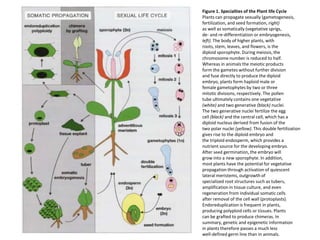
Figure 1. Specialties of the Plant life CyclePlants can propagate sexually (gametogenesis,fertilization, and seed formation, right)as well as somatically (vegetative sprigs,de- and re-differentiation or embryogenesis,left). The body of higher plants, withroots, stem, leaves, and flowers, is thediploid sporophyte. During meiosis, thechromosome number is reduced to half.Whereas in animals the meiotic productsform the gametes without further divisionand fuse directly to produce the diploidembryo, plants form haploid male orfemale gametophytes by two or threemitotic divisions, respectively. The pollentube ultimately contains one vegetative(white) and two generative (black) nuclei.The two generative nuclei fertilize the eggcell (black) and the central cell, which has adiploid nucleus derived from fusion of thetwo polar nuclei (yellow). This double fertilizationgives rise to the diploid embryo andthe triploid endosperm, which provides anutrient source for the developing embryo.After seed germination, the embryo willgrow into a new sporophyte. In addition,most plants have the potential for vegetativepropagation through activation of quiescentlateral meristems, outgrowth ofspecialized root structures such as tubers,amplification in tissue culture, and evenregeneration from individual somatic cellsafter removal of the cell wall (protoplasts).Endoreduplication is frequent in plants,producing polyploid cells or tissues. Plantscan be grafted to produce chimeras. Insummary, genetic and epigenetic informationin plants therefore passes a much lesswell-defined germ line than in animals.
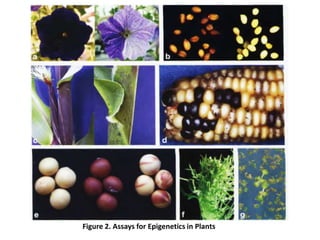
Figure 2. Assays for Epigenetics in Plants
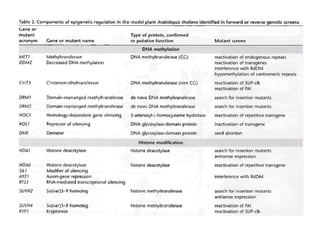
Molecular Components of Chromatin in PlantsRegulators of DNA Methylation in Plants
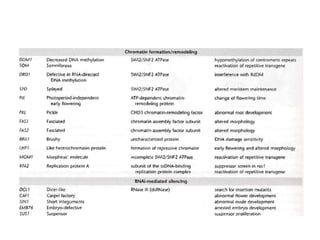
Histone-modifying Enzymes
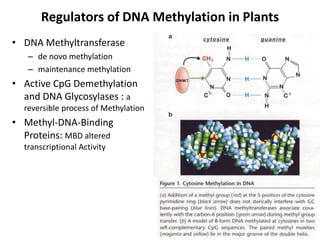
Other Chromatin ProteinRegulators of DNA Methylation in PlantsDNA Methyltransferasede novo methylationmaintenance methylationActive CpGDemethylation and DNA Glycosylases : a reversible process of Methylation Methyl-DNA-Binding Proteins: MBD altered transcriptional Activity
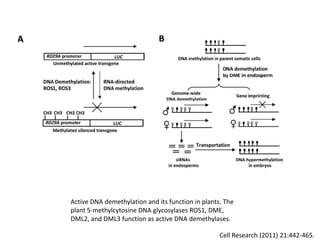
Active DNA demethylation and its function in plants. The plant 5-methylcytosine DNA glycosylases ROS1, DME, DML2, and DML3 function as active DNA demethylases. Cell Research (2011) 21:442-465.
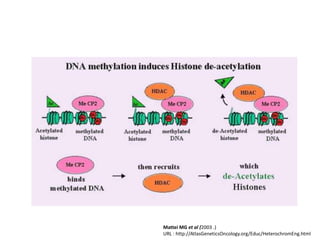
MatteiMG et al (2003 .)URL : http://AtlasGeneticsOncology.org/Educ/HeterochromEng.html
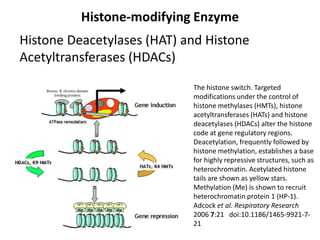
Histone-modifying EnzymeHistone Deacetylases (HAT) and Histone Acetyltransferases (HDACs)The histone switch. Targeted modifications under the control of histone methylases (HMTs), histone acetyltransferases (HATs) and histone deacetylases (HDACs) alter the histone code at gene regulatory regions. Deacetylation, frequently followed by histone methylation, establishes a base for highly repressive structures, such as heterochromatin. Acetylated histone tails are shown as yellow stars. Methylation (Me) is shown to recruit heterochromatin protein 1 (HP-1). Adcock et al.Respiratory Research 2006 7:21   doi:10.1186/1465-9921-7-21
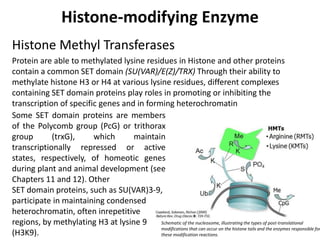
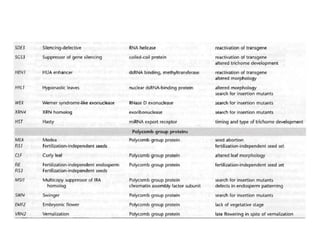
Histone-modifying EnzymeHistone Methyl TransferasesProtein are able to methylated lysine residues in Histone and other proteins contain a common SET domain(SU(VAR)/E(Z)/TRX) Through their ability to methylate histone H3 or H4 at various lysine residues, different complexes containing SET domain proteins play roles in promoting or inhibiting the transcription of specific genes and in forming heterochromatinSome SET domain proteins are members of the Polycomb group (PcG) or trithorax group (trxG), which maintain transcriptionally repressed or active states, respectively, of homeotic genes during plant and animal development (see Chapters 11 and 12). OtherSET domain proteins, such as SU(VAR)3-9, participate in maintaining condensed heterochromatin, often inrepetitiveregions, by methylating H3 at lysine 9 (H3K9).Schematic of the nucleosome, illustrating the types of post-translational modifications that can occur on the histone tails and the enzymes responsible for these modification reactions.
Other Chromatin ProteinsOther Polycomb ProteinsComponent of ImprintingChromatin-remodelling ProteinsChromatin Assembling FactorHeterochromatin-like Proteins
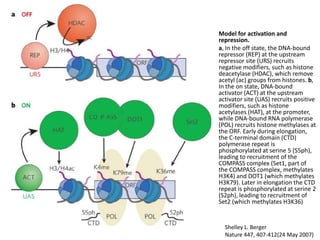
Model for activation and repression.a, In the off state, the DNA-bound repressor (REP) at the upstream repressor site (URS) recruits negative modifiers, such as histone deacetylase (HDAC), which remove acetyl (ac) groups from histones. b, In the on state, DNA-bound activator (ACT) at the upstream activator site (UAS) recruits positive modifiers, such as histone acetylases (HAT), at the promoter, while DNA-bound RNA polymerase (POL) recruits histone methylases at the ORF. Early during elongation, the C-terminal domain (CTD) polymerase repeat is phosphorylated at serine 5 (S5ph), leading to recruitment of the COMPASS complex (Set1, part of the COMPASS complex, methylates H3K4) and DOT1 (which methylates H3K79). Later in elongation the CTD repeat is phosphorylated at serine 2 (S2ph), leading to recruitment of Set2 (which methylates H3K36)Shelley L. BergerNature 447, 407-412(24 May 2007)
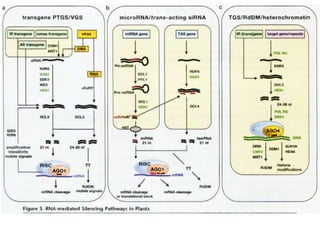
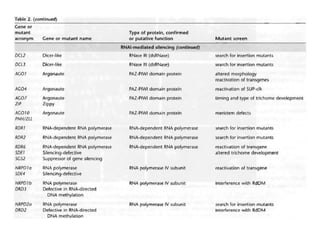
Molecular Components of RNAi-mediated Gene Silencing PathwaysElaboration of RNAi-mediated Silencing in PlantsTransgene-related Posttranscriptional and Virus-induced Silencing (PTGS/VIGS) Regulation of Plant Development by RNAs andTrans-acting siRNAs, Transgene-related Transcriptional Silencing, RNA-directed DNA Methylation, and Heterochromatin Formation
RNAi and related types of gene silencing represent cellular responses to double-stranded RNA (dsRNA). The proliferation of RNAi-mediated gene-silencing pathways in plants is illustrated by1. the expansion and functional diversification of gene families encoding core components of RNAi: the Arabidopsis genome encodes four DICER-LIKE (DCL) proteins and ten Argonaute (AGO) proteins2. the heterogeneity in length and functional diversity of small RNAs, including the 21-nucleotide short interfering RNAs (siRNA) derived from transgenes and viruses, and several types of endogenous small RNAs, such as 21- to 24-nucleotide microRNAs; 21-nucleotide trans-acting siRNAs, and 24- to 26nucleotide heterochromatic siRNAs3. the various modes of gene silencing elicited by different small RNAs: PTGS involves mRNA degradation or repression of translation, and TGS is  associated with epigenetic modifications such as DNA cytosine methylation and histone methylation4. the importance of PTGS in antiviral defense, which can be countered by a variety of plant viral proteins that repress silencing at different steps of the pathway5. the existence of processes, such as non-cellautonomous silencing and transitivity (see Section 3.2, Non-ceil-autonomous silencing and transitivity),that rely on RNA-dependent RNA polymerases, six of which are encoded in the Arabidopsis genome
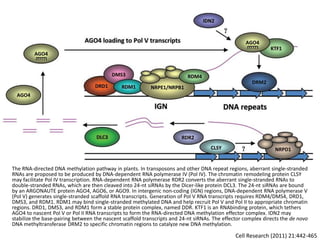
The RNA-directed DNA methylation pathway in plants. In transposons and other DNA repeat regions, aberrant single-stranded RNAs are proposed to be produced by DNA-dependent RNA polymerase IV (Pol IV). The chromatin remodeling protein CLSY may facilitate Pol IV transcription. RNA-dependent RNA polymerase RDR2 converts the aberrant single-stranded RNAs to double-stranded RNAs, which are then cleaved into 24-nt siRNAs by the Dicer-like protein DCL3. The 24-nt siRNAs are bound by an ARGONAUTE protein AGO4, AGO6, or AGO9. In intergenic non-coding (IGN) regions, DNA-dependent RNA polymerase V (Pol V) generates single-stranded scaffold RNA transcripts. Generation of Pol V RNA transcripts requires RDM4/DMS4, DRD1, DMS3, and RDM1. RDM1 may bind single-stranded methylated DNA and help recruit Pol V and Pol II to appropriate chromatin regions. DRD1, DMS3, and RDM1 form a stable protein complex, named DDR. KTF1 is an RNAbinding protein, which tethers AGO4 to nascent Pol V or Pol II RNA transcripts to form the RNA-directed DNA methylation effector complex. IDN2 may stabilize the base-pairing between the nascent scaffold transcripts and 24-nt siRNAs. The effector complex directs the de novo DNA methyltransferase DRM2 to specific chromatin regions to catalyze new DNA methylation.Cell Research (2011) 21:442-465
Epigenetic Regulation without RNA Involvement
Despite the specificity provided by small RNAs, they probably do not induce all epigenetic modifications in plants. For example, MOM, a protein with a partial SNF2 domain, has not yet been implicated in RNAi-mediated TGS. There is also no evidence that PcG proteins in plants are directed to their target genes by small RNAs. Other types of signal, such as homologous pairing of non-transcribed repetitive sequences or special sequence compositions, might nucleate heterochromatin formation or attract DNA methyltransferases. The RNAi machinery, for instance, is dispensable for DNA methylation and histone methylation in Neurospora, where Tarich segments are preferentially targeted for modification
An unusual epigenetic phenomenon in plants that has not yet been shown to involve RNAi is paramutation. Paramutationoccurs when certain alleles, termed paramutagenic, impose an epigenetic imprint on susceptible (paramutable) alleles. The epigenetic imprint is inherited through meiosis and persists even after the two interacting alleles segregate in progeny. Paramutation represents a violation of Mendel's law, which stipulates that alleles segregate unchanged from a heterozygote. Paramutation was first observed decades ago in maize and tomato, but the mechanism(s) has remained enigmatic. The B locus in maize, one of the most intensively studied cases of paramutation, contains a series of direct repeats almost 100 kb from the transcription start site that mediate paramutation in an unknown manner. Although RNA-based silencing has not been fully ruled out, alternate mechanisms relying on pairing of alleles are still under consideration.
Outlook
Plants clearly share a number of features of epigenetic control with other organisms, yet they have also evolved a number of plant-specific variations and innovations. These likely underpin the unique aspects of plant development and their extraordinary ability to survive and reproduce successfully in unpredictable environments. Plants able to induce or erase repressive modifications in nondividing cells-the former through RdDM and histone modifications, and the latter through the activity of DNA glycosylases such as DME and ROS1-allows epigenetic reprogramming without intervening cycles of DNA replication. Unraveling the mechanisms of meiotic inheritance of epigenetic marks in plants could eventually permit scientists to manipulate this feature for improvements in horticulture and agriculture.
The origin of heterosis, the superior performance of hybrids compared to that of inbred parent lines, is still unknown, but it is likely to involve epigenetic alterations triggered by combining two related but distinct genomes. Similarly, polyploidization combines and/or multiplies whole genomes, with innumerable possibilities for epigenetic changes. Learning the epigenetic consequences of polyploidization in plants would also help to understand our own evolutionary historyClearly, even at this scale of inquiry, plant epigenetics can be informative for human biology, justifying their reputation as "masters of epigenetic regulation.
Thank you

Epigenetic regulation in plants

  • 1.
    Epigenetic Regulation inPlantsRyza Aditya Priatama(리자 아디티아)Plant Developmental Genetics LaboratoryGyeongsang National University, Korea
  • 2.
    OutlineBenefits of Plantsin Epigenetic ResearchMolecular Components of Chromatin in PlantsMolecular Components of RNAi-mediated Gene Silencing PathwaysEpigenetic Regulation without RNA Involvement Outlook
  • 3.
    Benefit of Plantsin Epigenetic ResearchPlants and Mammals are Similar in Terms of (epi)Genome OrganizationPlants Provide Additional Topics for Epigenetics ResearchPlants have Haploid (gametophyte) stage between meiosis and fertilization (Fig 1.)Somatic Embryogenesis  Differentiation; somaclonal variationHigher tolerance of Polyploidy Plants Tolerate Methodological Approach that are difficult in MamalsPlants efficient in mutagenesis & rapid growing insertion mutants collection Plants have a Proven Record of Contributing to Epigenetic ResearchDistinction of Euchromation and Heterochromatin (1928)Pioneering work on transposable Element (B. McClintock)
  • 5.
    Figure 1. Specialtiesof the Plant life CyclePlants can propagate sexually (gametogenesis,fertilization, and seed formation, right)as well as somatically (vegetative sprigs,de- and re-differentiation or embryogenesis,left). The body of higher plants, withroots, stem, leaves, and flowers, is thediploid sporophyte. During meiosis, thechromosome number is reduced to half.Whereas in animals the meiotic productsform the gametes without further divisionand fuse directly to produce the diploidembryo, plants form haploid male orfemale gametophytes by two or threemitotic divisions, respectively. The pollentube ultimately contains one vegetative(white) and two generative (black) nuclei.The two generative nuclei fertilize the eggcell (black) and the central cell, which has adiploid nucleus derived from fusion of thetwo polar nuclei (yellow). This double fertilizationgives rise to the diploid embryo andthe triploid endosperm, which provides anutrient source for the developing embryo.After seed germination, the embryo willgrow into a new sporophyte. In addition,most plants have the potential for vegetativepropagation through activation of quiescentlateral meristems, outgrowth ofspecialized root structures such as tubers,amplification in tissue culture, and evenregeneration from individual somatic cellsafter removal of the cell wall (protoplasts).Endoreduplication is frequent in plants,producing polyploid cells or tissues. Plantscan be grafted to produce chimeras. Insummary, genetic and epigenetic informationin plants therefore passes a much lesswell-defined germ line than in animals.
  • 6.
    Figure 2. Assaysfor Epigenetics in Plants
  • 7.
    Molecular Components ofChromatin in PlantsRegulators of DNA Methylation in Plants
  • 8.
  • 9.
    Other Chromatin ProteinRegulatorsof DNA Methylation in PlantsDNA Methyltransferasede novo methylationmaintenance methylationActive CpGDemethylation and DNA Glycosylases : a reversible process of Methylation Methyl-DNA-Binding Proteins: MBD altered transcriptional Activity
  • 10.
    Active DNA demethylationand its function in plants. The plant 5-methylcytosine DNA glycosylases ROS1, DME, DML2, and DML3 function as active DNA demethylases. Cell Research (2011) 21:442-465.
  • 11.
    MatteiMG et al(2003 .)URL : http://AtlasGeneticsOncology.org/Educ/HeterochromEng.html
  • 12.
    Histone-modifying EnzymeHistone Deacetylases(HAT) and Histone Acetyltransferases (HDACs)The histone switch. Targeted modifications under the control of histone methylases (HMTs), histone acetyltransferases (HATs) and histone deacetylases (HDACs) alter the histone code at gene regulatory regions. Deacetylation, frequently followed by histone methylation, establishes a base for highly repressive structures, such as heterochromatin. Acetylated histone tails are shown as yellow stars. Methylation (Me) is shown to recruit heterochromatin protein 1 (HP-1). Adcock et al.Respiratory Research 2006 7:21   doi:10.1186/1465-9921-7-21
  • 13.
    Histone-modifying EnzymeHistone MethylTransferasesProtein are able to methylated lysine residues in Histone and other proteins contain a common SET domain(SU(VAR)/E(Z)/TRX) Through their ability to methylate histone H3 or H4 at various lysine residues, different complexes containing SET domain proteins play roles in promoting or inhibiting the transcription of specific genes and in forming heterochromatinSome SET domain proteins are members of the Polycomb group (PcG) or trithorax group (trxG), which maintain transcriptionally repressed or active states, respectively, of homeotic genes during plant and animal development (see Chapters 11 and 12). OtherSET domain proteins, such as SU(VAR)3-9, participate in maintaining condensed heterochromatin, often inrepetitiveregions, by methylating H3 at lysine 9 (H3K9).Schematic of the nucleosome, illustrating the types of post-translational modifications that can occur on the histone tails and the enzymes responsible for these modification reactions.
  • 14.
    Other Chromatin ProteinsOtherPolycomb ProteinsComponent of ImprintingChromatin-remodelling ProteinsChromatin Assembling FactorHeterochromatin-like Proteins
  • 15.
    Model for activationand repression.a, In the off state, the DNA-bound repressor (REP) at the upstream repressor site (URS) recruits negative modifiers, such as histone deacetylase (HDAC), which remove acetyl (ac) groups from histones. b, In the on state, DNA-bound activator (ACT) at the upstream activator site (UAS) recruits positive modifiers, such as histone acetylases (HAT), at the promoter, while DNA-bound RNA polymerase (POL) recruits histone methylases at the ORF. Early during elongation, the C-terminal domain (CTD) polymerase repeat is phosphorylated at serine 5 (S5ph), leading to recruitment of the COMPASS complex (Set1, part of the COMPASS complex, methylates H3K4) and DOT1 (which methylates H3K79). Later in elongation the CTD repeat is phosphorylated at serine 2 (S2ph), leading to recruitment of Set2 (which methylates H3K36)Shelley L. BergerNature 447, 407-412(24 May 2007)
  • 16.
    Molecular Components ofRNAi-mediated Gene Silencing PathwaysElaboration of RNAi-mediated Silencing in PlantsTransgene-related Posttranscriptional and Virus-induced Silencing (PTGS/VIGS) Regulation of Plant Development by RNAs andTrans-acting siRNAs, Transgene-related Transcriptional Silencing, RNA-directed DNA Methylation, and Heterochromatin Formation
  • 17.
    RNAi and relatedtypes of gene silencing represent cellular responses to double-stranded RNA (dsRNA). The proliferation of RNAi-mediated gene-silencing pathways in plants is illustrated by1. the expansion and functional diversification of gene families encoding core components of RNAi: the Arabidopsis genome encodes four DICER-LIKE (DCL) proteins and ten Argonaute (AGO) proteins2. the heterogeneity in length and functional diversity of small RNAs, including the 21-nucleotide short interfering RNAs (siRNA) derived from transgenes and viruses, and several types of endogenous small RNAs, such as 21- to 24-nucleotide microRNAs; 21-nucleotide trans-acting siRNAs, and 24- to 26nucleotide heterochromatic siRNAs3. the various modes of gene silencing elicited by different small RNAs: PTGS involves mRNA degradation or repression of translation, and TGS is associated with epigenetic modifications such as DNA cytosine methylation and histone methylation4. the importance of PTGS in antiviral defense, which can be countered by a variety of plant viral proteins that repress silencing at different steps of the pathway5. the existence of processes, such as non-cellautonomous silencing and transitivity (see Section 3.2, Non-ceil-autonomous silencing and transitivity),that rely on RNA-dependent RNA polymerases, six of which are encoded in the Arabidopsis genome
  • 19.
    The RNA-directed DNAmethylation pathway in plants. In transposons and other DNA repeat regions, aberrant single-stranded RNAs are proposed to be produced by DNA-dependent RNA polymerase IV (Pol IV). The chromatin remodeling protein CLSY may facilitate Pol IV transcription. RNA-dependent RNA polymerase RDR2 converts the aberrant single-stranded RNAs to double-stranded RNAs, which are then cleaved into 24-nt siRNAs by the Dicer-like protein DCL3. The 24-nt siRNAs are bound by an ARGONAUTE protein AGO4, AGO6, or AGO9. In intergenic non-coding (IGN) regions, DNA-dependent RNA polymerase V (Pol V) generates single-stranded scaffold RNA transcripts. Generation of Pol V RNA transcripts requires RDM4/DMS4, DRD1, DMS3, and RDM1. RDM1 may bind single-stranded methylated DNA and help recruit Pol V and Pol II to appropriate chromatin regions. DRD1, DMS3, and RDM1 form a stable protein complex, named DDR. KTF1 is an RNAbinding protein, which tethers AGO4 to nascent Pol V or Pol II RNA transcripts to form the RNA-directed DNA methylation effector complex. IDN2 may stabilize the base-pairing between the nascent scaffold transcripts and 24-nt siRNAs. The effector complex directs the de novo DNA methyltransferase DRM2 to specific chromatin regions to catalyze new DNA methylation.Cell Research (2011) 21:442-465
  • 20.
  • 21.
    Despite the specificityprovided by small RNAs, they probably do not induce all epigenetic modifications in plants. For example, MOM, a protein with a partial SNF2 domain, has not yet been implicated in RNAi-mediated TGS. There is also no evidence that PcG proteins in plants are directed to their target genes by small RNAs. Other types of signal, such as homologous pairing of non-transcribed repetitive sequences or special sequence compositions, might nucleate heterochromatin formation or attract DNA methyltransferases. The RNAi machinery, for instance, is dispensable for DNA methylation and histone methylation in Neurospora, where Tarich segments are preferentially targeted for modification
  • 22.
    An unusual epigeneticphenomenon in plants that has not yet been shown to involve RNAi is paramutation. Paramutationoccurs when certain alleles, termed paramutagenic, impose an epigenetic imprint on susceptible (paramutable) alleles. The epigenetic imprint is inherited through meiosis and persists even after the two interacting alleles segregate in progeny. Paramutation represents a violation of Mendel's law, which stipulates that alleles segregate unchanged from a heterozygote. Paramutation was first observed decades ago in maize and tomato, but the mechanism(s) has remained enigmatic. The B locus in maize, one of the most intensively studied cases of paramutation, contains a series of direct repeats almost 100 kb from the transcription start site that mediate paramutation in an unknown manner. Although RNA-based silencing has not been fully ruled out, alternate mechanisms relying on pairing of alleles are still under consideration.
  • 23.
  • 24.
    Plants clearly sharea number of features of epigenetic control with other organisms, yet they have also evolved a number of plant-specific variations and innovations. These likely underpin the unique aspects of plant development and their extraordinary ability to survive and reproduce successfully in unpredictable environments. Plants able to induce or erase repressive modifications in nondividing cells-the former through RdDM and histone modifications, and the latter through the activity of DNA glycosylases such as DME and ROS1-allows epigenetic reprogramming without intervening cycles of DNA replication. Unraveling the mechanisms of meiotic inheritance of epigenetic marks in plants could eventually permit scientists to manipulate this feature for improvements in horticulture and agriculture.
  • 25.
    The origin ofheterosis, the superior performance of hybrids compared to that of inbred parent lines, is still unknown, but it is likely to involve epigenetic alterations triggered by combining two related but distinct genomes. Similarly, polyploidization combines and/or multiplies whole genomes, with innumerable possibilities for epigenetic changes. Learning the epigenetic consequences of polyploidization in plants would also help to understand our own evolutionary historyClearly, even at this scale of inquiry, plant epigenetics can be informative for human biology, justifying their reputation as "masters of epigenetic regulation.
  • 26.

Editor's Notes

  • #4 In mammals, genetic approaches are limited by demanding procedures for generating mutations and by the requirement for mating in order to establish homozygous genotypes, which are mandatory for revealing recessive traits.
  • #10 (A) ROS1 was discovered by screening for repressor of silencing in Arabidopsis plants expressing the RD29A promoter-driven luciferase reportergene. ROS1 prevents transgene silencing that is caused by RNA-directed DNA methylation. ROS1 also functions to prevent over-methylation and alleviate the silencing of some endogenous genes and transposons. ROS3 is an RNA-binding protein that may direct ROS1 to specific genome targets. (B) DME is preferentially expressed in endosperms, and is responsible for genome-wide DNA demethylation and gene imprinting. GenomewideDNA demethylation activates transposons and other repetitiveDNA sequences, leading to the enhanced production ofsiRNAs in endosperms. These siRNAs might be transported intoembryos, and contribute to DNA hypermethylation, to ensuregenome stability in embryos. Black and white circles representmethylated and unmethylatedcytosines, respectively
  • #19 The RNA-directed DNA methylation pathway in plants. In transposons and other DNA repeat regions, aberrant single-stranded RNAs are proposed to be produced by DNA-dependent RNA polymerase IV (Pol IV). The chromatin remodelingprotein CLSY may facilitate Pol IV transcription. RNA-dependent RNA polymerase RDR2 converts the aberrant single-strandedRNAs to double-stranded RNAs, which are then cleaved into 24-nt siRNAs by the Dicer-like protein DCL3. The 24-nt siRNAsare bound by an ARGONAUTE protein AGO4, AGO6, or AGO9. In intergenic non-coding (IGN) regions, DNA-dependentRNA polymerase V (Pol V) generates single-stranded scaffold RNA transcripts. Generation of Pol V RNA transcripts requiresRDM4/DMS4, DRD1, DMS3, and RDM1. RDM1 may bind single-stranded methylated DNA and help recruit Pol V and Pol IIto appropriate chromatin regions. DRD1, DMS3, and RDM1 form a stable protein complex, named DDR. KTF1 is an RNAbindingprotein, which tethers AGO4 to nascent Pol V or Pol II RNA transcripts to form the RNA-directed DNA methylation effectorcomplex. IDN2 may stabilize the base-pairing between the nascent scaffold transcripts and 24-nt siRNAs. The effectorcomplex directs the de novo DNA methyltransferase DRM2 to specific chromatin regions to catalyze new DNA methylation.