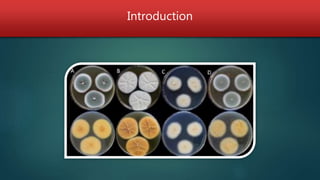
Epigenetics as an emerging tool for improvement of fungals trains used in biotechnology
Presenter : Morteza Miri Supervisor : Dr . Abolmaali
Introduction
Epigenetic
Three major levels of epigenetic regulation
I. DNA methylation
II. chromatin remodeling by histone modification
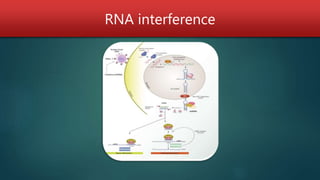
III. RNA interference
DNA methylation
DNA methylation is an epigenetic mechanism that occurs by the addition of a methyl
(CH3) group to DNA, thereby often modifying the function of the genes.
These methyl groups project into the major groove of DNA and inhibit transcription
DNA methylation is a covalent modification of DNA that does not change the DNA
sequence, but has an influence on gene activity.
.
All Type of DNA methylation
The DNA of most organisms is modified by a post-replicative process which
results in three types of methylated bases in DNA :
 C5-methylcytosine(5-mc)
 N4-methylcytosine
 N6-methyladenine.
This Modification is called DNA methylation
All Type of DNA methylation
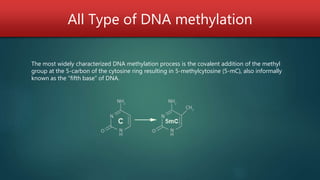
The most widely characterized DNA methylation process is the covalent addition of the methyl
group at the 5-carbon of the cytosine ring resulting in 5-methylcytosine (5-mC), also informally
known as the “fifth base” of DNA.
DNA methylation in fungi
 In the truffle Tubermelanosporum……….which has a genome with a particularly high (58
%) content of transposable elements and repetitive sequences, 5-mC was exclusively
detected in the transposable elements but not the CpGislands
 In N.crassa ……….. 5-mC …………. Is found almost exclusively associated with relics of the
genome defense system repeat-induced point (RIP) mutation
 yeast Metschnikowia reukaufii……... DNA methylation were shown were shown to be
responsible for the ability of the flower-inhabiting (to exploit resources from a broad
range of environments and were particularly important in harsh environments )
DNA methylation in fungi
An alternative approach toward studying DNA methylation featured by many
authors isthe use ofthe DNA methylase inhibitor
5-azacytidine
 In Aspergillus flavus and Aspergillus parasiticus……. two aflatoxin
producers,formation of aflatoxins and asexual sporulation were strongly
reduced upon addition of 5-AC
 in Aspergillus clavatus …………. A decrease in secondary metabolite
production by addition of 5-AC has also been demonstrated
DNMTs DNA methylation
With respect to the enzymes involved, two distinct DNA methyltransferases have
been found in fungi
 In N. crassa …………. DIM-2
 In Ascobolus immersus …. Masc2
are involved in DNA methylation and transcriptional silencing in vegetative cells.
 In Aspergillus nidulans…………. DmtA
DNMTs DNA methylation
 DIM-2-dependent DNA methylation requires complex formation with
heterochromatin protein 1 ((HP1)……the ortholog of Schizosaccharomyces pombe SWI6
a member of SWI/SNF family of ATP-dependent chromatin remodeling complexes
 Masc1………. It is responsible for development and premeiotically induced DNA
methylation during the sexual stage
is a process by which cytosines within repeated DNA sequences are de novo methylated prior to the sexual cycle.
Its N. crassa ortholog RID is required for repeat-induced point (RIP) mutation during
the sexual phase
 in Aspergillus nidulans DmtA…………. is essential for sexual development
Regulation of gene expression by DNA methyltransferases in fungi
Examples of regulation of gene expression by DNA methyltransferases in fungi are rare
 In N. crassa ......... Frq (sequences within the promoter of frequency )…. a negative element of
the circadian clock are methylated in a DIM-2-dependent way.
The circadian clock is an entrainable, free-running, temperature-compensated, anticipatory
system that allows organisms to prepare for daily changes in the environment that arise from
the Earth’s rotation
circadian clock controls asexual spore development in Neurospora
Chromatin modification
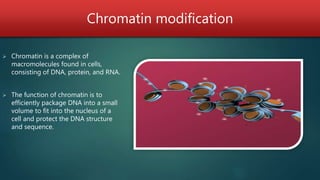
 Chromatin is a complex of
macromolecules found in cells,
consisting of DNA, protein, and RNA.
 The function of chromatin is to
efficiently package DNA into a small
volume to fit into the nucleus of a
cell and protect the DNA structure
and sequence.
The primary and Secondary functions of chromatin are
 1) to package DNA into a more compact, denser shape,
 2) to reinforce the DNA macromolecule to allow mitosis,
 3) to prevent DNA damage,
 4) to control gene expression and DNA replication.
Its secondary role is to carry epigenetic information.
Chromatin modification
 Heterochromatin is a tightly packed form of chromatin that can silence gene
transcription. Heterochromatin constitutes telomeres, pericentric regions and areas
rich in repetitive sequences. Euchromatin is less condensed and contains most
actively transcribed genes
 Certain proteins – including histones, chromatin interacting proteins such as
transcription factors and the DNA repair machinery – play a role in shaping
chromatin structure.
Chromatin modification
Chromatin remodeling complexes can change chromatin architecture by
modulating the interaction between nucleosomes and DNA, often by adding
post-translational modifications to histones…………through methylation,
acetylation, phosphorylation,ubiquitination,SUMOylation,citrullination, and
ADP-ribosylation
Chromatin modification by histone modification in fungi
 In N. crassa and Aspergillus nidulans ………. methylation of lysine (K) and arginine
(R) and acetylation of K residues
The N-terminal tails of H3 and H4 are required to generate transcriptionally repressive
heterochromatin and transcriptionally active euchromatin
 In euchromatin………the K residues in the H3 and H4 tails are hyperacetylated,and
especially,H3K4 is trimethylated
 In heterochromatin ……… on the other hand, H3K9 is trimethylated and other K
residues are hypoacetylated
Chromatin modification by histone modification in fungi
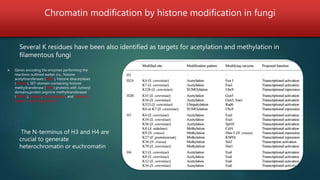
Several K residues have been also identified as targets for acetylation and methylation in
filamentous fungi
 Genes encoding the enzymes performing the
reactions outlined earlier (i.e., histone
acetyltransferases (HATs), histone deacetylases
(HDACs), SET-domain-containing histone
methyltransferase (HMT) proteins with Jumonji
domains,protein arginine methyltransferases
(PRMTs), kinases, phosphatases, and ubiquitin
ligase-containing proteins
The N-terminus of H3 and H4 are
crucial to generate
heterochromatin or euchromatin
Genes Affecting Histone Methylation
HP1 (the heterochromatin protein-1)
The family of Heterochromatin Protein 1 (HP1) ("Chromobox Homolog", CBX) consists of highly
conserved proteins, which have important functions in the cell nucleus
These functions include :
 GENE REPRESSION BY HETEROCHROMATIN FORMATION
 regulation of binding of cohesion complexes to centromeres
 transcriptional arrest
 maintenance of heterochromatin integrity
 gene repression at the single nucleosome level and gene repression by heterochromatization of euchromatin
Genes Affecting Histone Methylation
HP1 binding affinity to nucleosomes containing histone H3 methylated at lysine K9 is higher
than to those with unmethylated lysine K9. HP1 binds nucleosomes as a dimer and in principle
can form multimeric complexes
 Heterochromatin domains are silenced and have hypoacetylation of lysines in H3
and H4 with different degrees of methylation of H3K9 (H3K9me) by a histone
methyltransferase (Clr4 in S. pombe)
As a transcriptional repressor, HP1 recognizes H3K9me and directly binds to it, achieving both
targeting and transcriptional repression by maintaining the heterochromatin structure
Artificial recruitment of HP1 to a gene promoter region leads to gene repression, supporting
that HP1 is essential in gene silencing
Genes Affecting Histone Methylation in fungi
 Aspergillus nidulans ……. HepA…….. HepA is the Aspergillus nidulans homolog of
HP1
HepA acts as an epigenetic repressor in expression of secondary metabolite genes
The deletion of HepA leads to derepression of secondary metabolite biosynthetic genes,
including sterigmatocystin (ST), penicillin (PC), and terrequinone A (TA).
 Biochemical analysis shows that the silent ST gene cluster is marked by H3K9me3 and recruits
high levels of HepA, leading to repression of ST production during growth phase.
 Upon growth arrest and activation of SM, HepA, and H3K9me levels decrease while the
acetylated histone H3 increases
HepA occupancy and H3K9me3 levels are counteracted by the global SM regulator (LaeA)
LaeA
LaeA (loss of aflR expression-A) is a global regulator of SM and development in
filamentous fungi. This nuclear protein was first reported in Aspergillus spp
 The lack of laeA blocks expression of several metabolic gene clusters, including ST,
PC, and lovastatin (LOV).
 The overexpression of laeA contrarily increases expression of ST and LOV gene
clusters and subsequent ST and LOV production
LaeA and regulation of secondary metabolites in fungi
 In Penicillium chrysogenum………. the overexpression of laeA increases PC
production (~ 125 %) and the lack of laeA dramatically reduces PC gene expression
levels and PC production
 in Fusarium fujikuroi ……………….. Similarly, LaeA serves as a positive regulator of GB
production
 In Aspergillus fumigatus …………... microarray analysis indicates that LaeA regulates
up to 9.5 % of the Aspergillus fumigatus transcriptome and up to 13 of its 22
secondary metabolite gene clusters, containing PKS-non-ribosomal peptide
synthetase, polyketide synthase , and P450 monooxygenase genes
LaeA and regulation of secondary metabolites in fungi
 LaeA forms a key heterotrimeric complex with the two velvet proteins, VelB and
VeA. The VelB/VeA/LaeA trimeric complex coordinates light signals with fungal
development and SM
 All three components in this complex are essential for sexual development and ST
production in A. nidulans.
 Previous studies showed that LaeA and VeA interact in P. chrysogenum and F.
fujikuroi, too
LaeA-mediated SM regulation primarily depends on histone methylation
LaeA contains a predicted and functionally necessary S-adenosyl-methionine SAM) binding domain
which is present in all members of the methylase superfamily and has sequence similarity to histone
and arginine methyltransferase
The laeA gene is negatively regulated by AflR, a Zn2/Cys6 transcription factor located in the aflatoxin
and ST gene clusters, in a feedback loop
Biochemical analyses of laeA and heterochromatin mutants (e.g., histone deacetylase and histone
methyltransferase mutants) in A. nidulans demonstrate that LaeA activates SM gene expression by
being involved in the removal of heteromatin marks like H3K9 methylation and HepA binding
.
COMPASS and regulation of secondary metabolites in fungi
 COMPASS (complex proteins associated with Set1) ]
 In Saccharomyces cerevesiae….. is involved in H3K4 mono-, di-, and tri-methylation which is
necessary for RNA Pol II binding and transcriptional activity in development and differentiation
 In A. nidulans …….. CclA (Bre2 in S. cerevisiae) is one of the eight members of COMPASS
The lack of CclA leads to reduced levels of H3K4 and H3K9 di- and tri-methylation, as well as reduced
H3 acetylation
 in S. cerevesiae ….. H3K4 di- and tri-methylation is associated with actively expressed genes and
are required for telomere silencing
 A. nidulans ………… H3K4 di- and tri-methylation is associated with actively expressed genes and are
required for activating SMs e.g. monodictyphenone, emodins, and the polyketides F9775A and
F9775B
 In A. fumigatus……….loss of CclA results in slow fungal growth and increased SM production like
gliotoxin
Genes Influencing Histone Acetylation
Histone Deacetylases (HDAC) Histone deacetylases (HDACs) and histone acetyltransferases
(HATs) play critical roles in fungal epigenetic regulatory mechanism
 Histone acetylation is reversible and controlled by HDACs and HATs
 Both Classes I and II HDACs contain zinc in their catalytic site, and are known as
epigenetic regulators in fungal SM
 Class III HDACs do not have zinc in the catalytic site but require NAD+ instead
 A. nidulans RpdA is a Class I HDAC and the homolog of the global repressor Rpd3 in S.
cerevisiae. RpdA is necessary for growth, conidiation, and gene regulation
 The lack of Rpd3 leads to increased acetylation of H4K5, H4K12, and H3K18 in
derepressed genes
Genes Impacting Sumoylation
 SUMO Small ubiquitin-like modifier (SUMO) is a small protein that has high structural similarity to
ubiquitin, despite its low similarity at the level of the amino acid sequence
 SUMO covalently attaches to other proteins through the activities of an enzyme cascade (E1-E2-E3)
similar to that of ubiquitination, and is known to play a role in histone modification like ubiquitin
 Histone sumoylation mediates gene silencing through recruitment of HDAC and Hp1 both in vitro and in
vivo in human cells
 In A. nidulans……. SUMO represses sexual development and is involved in accurate induction and light
stimulation of asexual development
 . CclA and SetA, two members of COMPASS, connects the SUMO network to histone modification
 The interplay of the fungal sumoylation network controls temporal and spatial steps in cell
differentiation
 SUMO is also essential for sexual fruiting body formation and SM in A. nidulans
 Deleting sumo causes about 200-fold increase of asperthecin production but decreases production of
austinol/dehydroaustinol and ST
RNA interference
RNA interference

Conclusion
Although the application of epigenetic principles and mechanisms has, so far, been used
for fungal strain improvement in only a small number of cases, the results have
nevertheless shown that this is an area of research with high potential.
It now becomes clear that DNA methylation is likely not an appropriate level for strain
improvement, because its role in fungi appears to be in sexual development and defense
against invading elements only.
However, research on chromatin modification has already yielded a number of targets that
can be used for potential strain improvement.
In this regard, it is intriguing to note that most of the respective work has, so far, been
performed with the enigmatic protein LaeA/LAE1 and the Velvet complex, but no research
or patent has, so far, been published on the use of any of the histone methyltransferases or
acetyltransferases or other chromatinmodifying enzymes.
We expect that this will be an upcoming area of research in the next future. Finally, the
possible role of RNA interference has just only been recorded, but attempts toward its
understanding have just only begun.
Epigenetics modification in fungi

Epigenetics modification in fungi

  • 2.
    Epigenetics as anemerging tool for improvement of fungals trains used in biotechnology Presenter : Morteza Miri Supervisor : Dr . Abolmaali
  • 3.
  • 4.
  • 5.
    Three major levelsof epigenetic regulation I. DNA methylation II. chromatin remodeling by histone modification III. RNA interference
  • 6.
    DNA methylation DNA methylationis an epigenetic mechanism that occurs by the addition of a methyl (CH3) group to DNA, thereby often modifying the function of the genes. These methyl groups project into the major groove of DNA and inhibit transcription DNA methylation is a covalent modification of DNA that does not change the DNA sequence, but has an influence on gene activity. .
  • 7.
    All Type ofDNA methylation The DNA of most organisms is modified by a post-replicative process which results in three types of methylated bases in DNA :  C5-methylcytosine(5-mc)  N4-methylcytosine  N6-methyladenine. This Modification is called DNA methylation
  • 8.
    All Type ofDNA methylation The most widely characterized DNA methylation process is the covalent addition of the methyl group at the 5-carbon of the cytosine ring resulting in 5-methylcytosine (5-mC), also informally known as the “fifth base” of DNA.
  • 9.
    DNA methylation infungi  In the truffle Tubermelanosporum……….which has a genome with a particularly high (58 %) content of transposable elements and repetitive sequences, 5-mC was exclusively detected in the transposable elements but not the CpGislands  In N.crassa ……….. 5-mC …………. Is found almost exclusively associated with relics of the genome defense system repeat-induced point (RIP) mutation  yeast Metschnikowia reukaufii……... DNA methylation were shown were shown to be responsible for the ability of the flower-inhabiting (to exploit resources from a broad range of environments and were particularly important in harsh environments )
  • 10.
    DNA methylation infungi An alternative approach toward studying DNA methylation featured by many authors isthe use ofthe DNA methylase inhibitor 5-azacytidine  In Aspergillus flavus and Aspergillus parasiticus……. two aflatoxin producers,formation of aflatoxins and asexual sporulation were strongly reduced upon addition of 5-AC  in Aspergillus clavatus …………. A decrease in secondary metabolite production by addition of 5-AC has also been demonstrated
  • 11.
    DNMTs DNA methylation Withrespect to the enzymes involved, two distinct DNA methyltransferases have been found in fungi  In N. crassa …………. DIM-2  In Ascobolus immersus …. Masc2 are involved in DNA methylation and transcriptional silencing in vegetative cells.  In Aspergillus nidulans…………. DmtA
  • 12.
    DNMTs DNA methylation DIM-2-dependent DNA methylation requires complex formation with heterochromatin protein 1 ((HP1)……the ortholog of Schizosaccharomyces pombe SWI6 a member of SWI/SNF family of ATP-dependent chromatin remodeling complexes  Masc1………. It is responsible for development and premeiotically induced DNA methylation during the sexual stage is a process by which cytosines within repeated DNA sequences are de novo methylated prior to the sexual cycle. Its N. crassa ortholog RID is required for repeat-induced point (RIP) mutation during the sexual phase  in Aspergillus nidulans DmtA…………. is essential for sexual development
  • 13.
    Regulation of geneexpression by DNA methyltransferases in fungi Examples of regulation of gene expression by DNA methyltransferases in fungi are rare  In N. crassa ......... Frq (sequences within the promoter of frequency )…. a negative element of the circadian clock are methylated in a DIM-2-dependent way. The circadian clock is an entrainable, free-running, temperature-compensated, anticipatory system that allows organisms to prepare for daily changes in the environment that arise from the Earth’s rotation circadian clock controls asexual spore development in Neurospora
  • 14.
    Chromatin modification  Chromatinis a complex of macromolecules found in cells, consisting of DNA, protein, and RNA.  The function of chromatin is to efficiently package DNA into a small volume to fit into the nucleus of a cell and protect the DNA structure and sequence.
  • 15.
    The primary andSecondary functions of chromatin are  1) to package DNA into a more compact, denser shape,  2) to reinforce the DNA macromolecule to allow mitosis,  3) to prevent DNA damage,  4) to control gene expression and DNA replication. Its secondary role is to carry epigenetic information.
  • 16.
    Chromatin modification  Heterochromatinis a tightly packed form of chromatin that can silence gene transcription. Heterochromatin constitutes telomeres, pericentric regions and areas rich in repetitive sequences. Euchromatin is less condensed and contains most actively transcribed genes  Certain proteins – including histones, chromatin interacting proteins such as transcription factors and the DNA repair machinery – play a role in shaping chromatin structure.
  • 17.
    Chromatin modification Chromatin remodelingcomplexes can change chromatin architecture by modulating the interaction between nucleosomes and DNA, often by adding post-translational modifications to histones…………through methylation, acetylation, phosphorylation,ubiquitination,SUMOylation,citrullination, and ADP-ribosylation
  • 18.
    Chromatin modification byhistone modification in fungi  In N. crassa and Aspergillus nidulans ………. methylation of lysine (K) and arginine (R) and acetylation of K residues The N-terminal tails of H3 and H4 are required to generate transcriptionally repressive heterochromatin and transcriptionally active euchromatin  In euchromatin………the K residues in the H3 and H4 tails are hyperacetylated,and especially,H3K4 is trimethylated  In heterochromatin ……… on the other hand, H3K9 is trimethylated and other K residues are hypoacetylated
  • 19.
    Chromatin modification byhistone modification in fungi Several K residues have been also identified as targets for acetylation and methylation in filamentous fungi  Genes encoding the enzymes performing the reactions outlined earlier (i.e., histone acetyltransferases (HATs), histone deacetylases (HDACs), SET-domain-containing histone methyltransferase (HMT) proteins with Jumonji domains,protein arginine methyltransferases (PRMTs), kinases, phosphatases, and ubiquitin ligase-containing proteins The N-terminus of H3 and H4 are crucial to generate heterochromatin or euchromatin
  • 20.
    Genes Affecting HistoneMethylation HP1 (the heterochromatin protein-1) The family of Heterochromatin Protein 1 (HP1) ("Chromobox Homolog", CBX) consists of highly conserved proteins, which have important functions in the cell nucleus These functions include :  GENE REPRESSION BY HETEROCHROMATIN FORMATION  regulation of binding of cohesion complexes to centromeres  transcriptional arrest  maintenance of heterochromatin integrity  gene repression at the single nucleosome level and gene repression by heterochromatization of euchromatin
  • 21.
    Genes Affecting HistoneMethylation HP1 binding affinity to nucleosomes containing histone H3 methylated at lysine K9 is higher than to those with unmethylated lysine K9. HP1 binds nucleosomes as a dimer and in principle can form multimeric complexes  Heterochromatin domains are silenced and have hypoacetylation of lysines in H3 and H4 with different degrees of methylation of H3K9 (H3K9me) by a histone methyltransferase (Clr4 in S. pombe) As a transcriptional repressor, HP1 recognizes H3K9me and directly binds to it, achieving both targeting and transcriptional repression by maintaining the heterochromatin structure Artificial recruitment of HP1 to a gene promoter region leads to gene repression, supporting that HP1 is essential in gene silencing
  • 22.
    Genes Affecting HistoneMethylation in fungi  Aspergillus nidulans ……. HepA…….. HepA is the Aspergillus nidulans homolog of HP1 HepA acts as an epigenetic repressor in expression of secondary metabolite genes The deletion of HepA leads to derepression of secondary metabolite biosynthetic genes, including sterigmatocystin (ST), penicillin (PC), and terrequinone A (TA).  Biochemical analysis shows that the silent ST gene cluster is marked by H3K9me3 and recruits high levels of HepA, leading to repression of ST production during growth phase.  Upon growth arrest and activation of SM, HepA, and H3K9me levels decrease while the acetylated histone H3 increases HepA occupancy and H3K9me3 levels are counteracted by the global SM regulator (LaeA)
  • 23.
    LaeA LaeA (loss ofaflR expression-A) is a global regulator of SM and development in filamentous fungi. This nuclear protein was first reported in Aspergillus spp  The lack of laeA blocks expression of several metabolic gene clusters, including ST, PC, and lovastatin (LOV).  The overexpression of laeA contrarily increases expression of ST and LOV gene clusters and subsequent ST and LOV production
  • 24.
    LaeA and regulationof secondary metabolites in fungi  In Penicillium chrysogenum………. the overexpression of laeA increases PC production (~ 125 %) and the lack of laeA dramatically reduces PC gene expression levels and PC production  in Fusarium fujikuroi ……………….. Similarly, LaeA serves as a positive regulator of GB production  In Aspergillus fumigatus …………... microarray analysis indicates that LaeA regulates up to 9.5 % of the Aspergillus fumigatus transcriptome and up to 13 of its 22 secondary metabolite gene clusters, containing PKS-non-ribosomal peptide synthetase, polyketide synthase , and P450 monooxygenase genes
  • 25.
    LaeA and regulationof secondary metabolites in fungi  LaeA forms a key heterotrimeric complex with the two velvet proteins, VelB and VeA. The VelB/VeA/LaeA trimeric complex coordinates light signals with fungal development and SM  All three components in this complex are essential for sexual development and ST production in A. nidulans.  Previous studies showed that LaeA and VeA interact in P. chrysogenum and F. fujikuroi, too
  • 26.
    LaeA-mediated SM regulationprimarily depends on histone methylation LaeA contains a predicted and functionally necessary S-adenosyl-methionine SAM) binding domain which is present in all members of the methylase superfamily and has sequence similarity to histone and arginine methyltransferase The laeA gene is negatively regulated by AflR, a Zn2/Cys6 transcription factor located in the aflatoxin and ST gene clusters, in a feedback loop Biochemical analyses of laeA and heterochromatin mutants (e.g., histone deacetylase and histone methyltransferase mutants) in A. nidulans demonstrate that LaeA activates SM gene expression by being involved in the removal of heteromatin marks like H3K9 methylation and HepA binding .
  • 27.
    COMPASS and regulationof secondary metabolites in fungi  COMPASS (complex proteins associated with Set1) ]  In Saccharomyces cerevesiae….. is involved in H3K4 mono-, di-, and tri-methylation which is necessary for RNA Pol II binding and transcriptional activity in development and differentiation  In A. nidulans …….. CclA (Bre2 in S. cerevisiae) is one of the eight members of COMPASS The lack of CclA leads to reduced levels of H3K4 and H3K9 di- and tri-methylation, as well as reduced H3 acetylation  in S. cerevesiae ….. H3K4 di- and tri-methylation is associated with actively expressed genes and are required for telomere silencing  A. nidulans ………… H3K4 di- and tri-methylation is associated with actively expressed genes and are required for activating SMs e.g. monodictyphenone, emodins, and the polyketides F9775A and F9775B  In A. fumigatus……….loss of CclA results in slow fungal growth and increased SM production like gliotoxin
  • 28.
    Genes Influencing HistoneAcetylation Histone Deacetylases (HDAC) Histone deacetylases (HDACs) and histone acetyltransferases (HATs) play critical roles in fungal epigenetic regulatory mechanism  Histone acetylation is reversible and controlled by HDACs and HATs  Both Classes I and II HDACs contain zinc in their catalytic site, and are known as epigenetic regulators in fungal SM  Class III HDACs do not have zinc in the catalytic site but require NAD+ instead  A. nidulans RpdA is a Class I HDAC and the homolog of the global repressor Rpd3 in S. cerevisiae. RpdA is necessary for growth, conidiation, and gene regulation  The lack of Rpd3 leads to increased acetylation of H4K5, H4K12, and H3K18 in derepressed genes
  • 29.
    Genes Impacting Sumoylation SUMO Small ubiquitin-like modifier (SUMO) is a small protein that has high structural similarity to ubiquitin, despite its low similarity at the level of the amino acid sequence  SUMO covalently attaches to other proteins through the activities of an enzyme cascade (E1-E2-E3) similar to that of ubiquitination, and is known to play a role in histone modification like ubiquitin  Histone sumoylation mediates gene silencing through recruitment of HDAC and Hp1 both in vitro and in vivo in human cells  In A. nidulans……. SUMO represses sexual development and is involved in accurate induction and light stimulation of asexual development  . CclA and SetA, two members of COMPASS, connects the SUMO network to histone modification  The interplay of the fungal sumoylation network controls temporal and spatial steps in cell differentiation  SUMO is also essential for sexual fruiting body formation and SM in A. nidulans  Deleting sumo causes about 200-fold increase of asperthecin production but decreases production of austinol/dehydroaustinol and ST
  • 30.
  • 31.
  • 32.
    Conclusion Although the applicationof epigenetic principles and mechanisms has, so far, been used for fungal strain improvement in only a small number of cases, the results have nevertheless shown that this is an area of research with high potential. It now becomes clear that DNA methylation is likely not an appropriate level for strain improvement, because its role in fungi appears to be in sexual development and defense against invading elements only. However, research on chromatin modification has already yielded a number of targets that can be used for potential strain improvement. In this regard, it is intriguing to note that most of the respective work has, so far, been performed with the enigmatic protein LaeA/LAE1 and the Velvet complex, but no research or patent has, so far, been published on the use of any of the histone methyltransferases or acetyltransferases or other chromatinmodifying enzymes. We expect that this will be an upcoming area of research in the next future. Finally, the possible role of RNA interference has just only been recorded, but attempts toward its understanding have just only begun.