PRESENTED BY
Prashik s shimpi
M.Pharm I SEM
DEPARTMENT OF QUALITY ASSURANCE
R.C. PATEL INSTITUTE OF
PHARMACEUTICAL EDUCATION &
RESEARCH,SHIRPUR.
1
contents
 Introduction
 Defination
 Instrument validation process
 Principle of Autoclave
 Validation of Autoclave
 Conclusion
 References
2
Introduction
 Instrument is one of the basic components of the pharma
processing and hence, a critical validation issue also .if we want
a pharmaceutical process to be validated then the instrument
used play a very major role in the whole process.
 A validation programme involves various components in
pharmaceutical organisation related to process, equipment and
product.
 It is a regulatory requirement for pharmaceutical companies to
perform Instrument Validation on all new instruments.
 Instrument Validation requires detailed knowledge of the
instrumentation system being validated and is therefore usually
performed by the company supplying the instrument
3
Defination of Validation
 “A documented programme, which provides a high
degree of assurance that a specific process will
consistently produce, a product meeting its pre-
determined specifications and quality attributes’’.
4
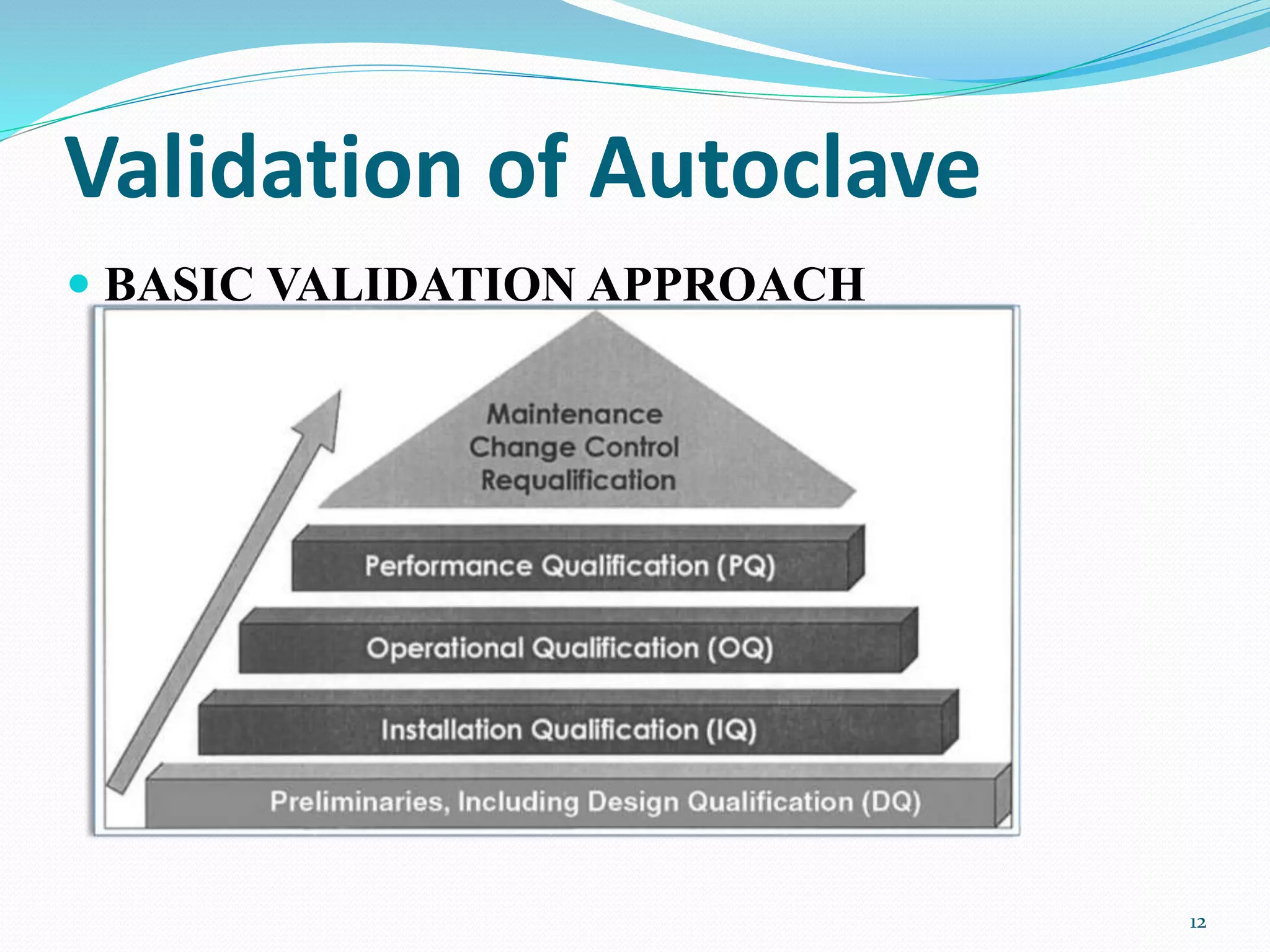
Instrument validation process
 User Requirement Specification. (URS)
 Preparation of Design Qualification and is its
certification. (DQ)
 Installation Qualification. (IQ)
 Operational Qualification. (OQ)
 Performance Qualification. (PQ)
 Revalidation
5
User Requirement specifications
 Size of the equipment.
 Speed of the equipment.
 Effectiveness of equipment.
 Ease of operation,cleaning and maintenance.
 Low dust and sound generation.
 Auto control systems.
 Materials of construction.
 Overall good construction and workmanship etc.
6
Preparation of Design
Qualification and is its
certification.(DQ)
 Standard equipment then the preparation of D.Q does not
verry importatnt because we are accepting the
manufacturer’s design as it is. however, if a particular
equipment is to be fabricated as per our requirements
then the detailed design qualification document
become verry important and essential.
 At this stage to identify the stages during fabrication of the
equipment ,where visual, instrumental,or even
physicochemical testing may be performed.
 Generally ,the Factory Acceptence Test is performed at the
manufacturer’s premises before despatch of the equipment
to the purchaser.
7
Installation Qualification (IQ)
 Installation Qualification may be defined as
“Documented verification that all key aspects of
the installation adhere to manufacturer’s
recommendation, appropriate codes and
approved design quallification’’.
 The simple meaning of this statement is that the
equipment in question can be installed when it is
qualified for installation i.e. when it passes the
I.Q. Test.
8
Operational Qualification (OQ)
 Operational Qualification may be defined as
“Documented verification that the system or
subsystem performs as intended throught all specified
operating range.”The equipment should be operated
only when it passes the Operational Qualification Test.
9
Performance Qualification (PQ)
 Performance Qualification is considered by many as
synonymous with O.Q some experts consider O.Q. as
verification of performance of the system or sub
system without load and P.Q. is the same with load.
 Purpose- To define testing requirements in a
product/process/performance/qualification/validation
protocol.
10
Principle of Autoclaving
 A basic principle of chemistry is that when the pressure of a
gas increases, the temperature of the gas increase
proportionally.
 At 15 psi pressure 121oC temperature can be obtained.
 Moist heat coagulates cell proteins of the microorganisms
and thus kills all the living entities including spores in 15
to 20 minutes.
 It is sufficient to kill all the vegetative forms and spores
of the organisms.
11
Validation of Autoclave
 BASIC VALIDATION APPROACH
12
INSTALLATION QUALIFICATION
• Installation tests should include checking:
1. That the electrical supply is suitable for the autoclave.
2. That the temperature and humidity are sufficiently well
controlled.
3. That there is no interference to or from other equipment.
4. The accuracy of indicators has been certified to national
standards.
5. The temperature and pressure of the chamber during a
sterilization cycle are within specifications.
13
INSTALLATION QUALIFICATION
6. The leakage into the chamber during a vacuum cycle
does not exceed the specified maximum.
7. That there is no leakage of steam, water or effluent
at any point during the sterilization cycle.
8. That both water quality and steam quality comply
with the sterilizer specification
14
INSTALLATION QUALIFICATION
9. Mechanical equipment specification
(Chamber, valves, traps, stainers, filters, regulators, vacuum pump,
heat exchanger, condenser, etc.)
10.Control & instrumentation specifications
(programmable logic controller, operator interface, printer/recorder,
control valves, transducers, pressure & temperature transmitters,
resistance temperature devices, switches, level sensors, interlocks,
photocells.)
11. Site specifications/utilities
(power, grounding, surge protector, uninterruptible power supply,
breakers, water, clean steam, plant steam, drain, isolation valves)
15
INSTALLATION QUALIFICATION
12.Approval documentation ( pressure vessel, electrical
bill of materials, vendor specification sheets, purchase
orders, preventive maintenance programme, piping
installation verification, operating & maintenance
manuals.)
13.Control system documentation
(system configuration/block diagram, flow sheets, display
layouts, general process limits, data monitoring, software
inventory, electronic application code listing, system
security.)
16
The OQ process is intended to demonstrate that the
components of the autoclave operate properly & that the
autoclave is deemed ready for performance or load testing.
An OQ may include the following checks:
Operational tests(operator/supervisory/maintenance
modes, doors, abort & emergency stop, programmable
parameter, menu navigation, power-up & shut down,
procedure select/start control switch & interlock tests.
Leak/air removal/steam penetration/vacuum hold test
Jacket mapping
Saturated steam check
Empty chamber tests
OPERATIONAL QUALIFICATION
17
Empty chamber heat distribution
studies
 Intent of this study to demonstrate the temperature
uniformity and stability of the sterilizing medium
throughout sterilizer.
 Temperature uniformity may be influenced by type, size,
design & installation of sterilizer.
 In production size sterilizer, 15-20 thermocouples are used
& distributed geometrically throughout sterilizer.
 Thermocouple should be placed in the exhaust drain
which is adjacent to the sensor that control vessel
temperature.
 Temperature deviation should not greater than +2.5 degree
celsius of the mean chamber temperature.
18
Thermocouple locations
19
PERFORMANCE QUALIFICATION
 Loaded chamber steam penetration tests:
 intent of this study is to determine the coolest point
within a specified load.
 Load cool points are dependent on the type of objects
that compose the loads i.e. liquid filled containers,
process equipment.etc.
The penetration thermocouples are positioned within
liquid filled containers at the cool point.
20
Loaded chamber microbiological
challenge studies
 Microbial challenge test :
 Keep ampoules containing spores suspension of Bacillus
Stearothermophilus & clostridium sporogenes 106
population at various location of the autoclave along
with probes and maintain the sterilisation temp. at 15
psi and 121oC during the heat penetration
studies,once on the maximum load.
 Acceptance criteria: Autoclaved ampoules containing
Bacillus stearothermophilus spores suspension
ampoules should not show any colour change after
five days of incubation.
21
Revalidation
 Change of formula,equipment,procedures or quality of
raw materials.
 Major changes to process parameters.
 Change & replacement of equipment.
 Changes to facilities and installation which influences
the process.
Document Required
 Sop and records of
prospective,concurrent,retrospective&revalidation.
1 22
Conclusion:
 To ensure that qualification and validation are
performed correctly, the test should only be
carried out by suitably qualified & experienced
personnel & organization.
 To achieve the high standards of purity & quality
product
23
References
1. Pharmaceutical Quality Assurance,by M.A. Potdar,
Nirali Prakashan, Pune.page no 8.1, 8.13 & 8.14.
2. Indian Pharmacopoeia 1996 vol II, Govt. of India
Ministry of Health & family welfare.Appendix-12
Monograph- A-139,A-140.
3. The theory & practice of industrial pharmacy, by Leon
Lachnan . Herbert A. Lieberman, Joseph L. Kanig. 3rd
edition,page no.625.
4. Pharmaceutical process validation,by Robert A. Nash,
Alfred H.Wachter.3rd edition,volume-129,
Page no.98,148-150.100 & 101.
24
Web References
 http://pharmainfo.net/
 http://www.askaboutvalidation.com
 http://pharmaceuticalvalidation.blogspot.in/
 www.pharmaweb.net
25
26

instrument validation

  • 1.
    PRESENTED BY Prashik sshimpi M.Pharm I SEM DEPARTMENT OF QUALITY ASSURANCE R.C. PATEL INSTITUTE OF PHARMACEUTICAL EDUCATION & RESEARCH,SHIRPUR. 1
  • 2.
    contents  Introduction  Defination Instrument validation process  Principle of Autoclave  Validation of Autoclave  Conclusion  References 2
  • 3.
    Introduction  Instrument isone of the basic components of the pharma processing and hence, a critical validation issue also .if we want a pharmaceutical process to be validated then the instrument used play a very major role in the whole process.  A validation programme involves various components in pharmaceutical organisation related to process, equipment and product.  It is a regulatory requirement for pharmaceutical companies to perform Instrument Validation on all new instruments.  Instrument Validation requires detailed knowledge of the instrumentation system being validated and is therefore usually performed by the company supplying the instrument 3
  • 4.
    Defination of Validation “A documented programme, which provides a high degree of assurance that a specific process will consistently produce, a product meeting its pre- determined specifications and quality attributes’’. 4
  • 5.
    Instrument validation process User Requirement Specification. (URS)  Preparation of Design Qualification and is its certification. (DQ)  Installation Qualification. (IQ)  Operational Qualification. (OQ)  Performance Qualification. (PQ)  Revalidation 5
  • 6.
    User Requirement specifications Size of the equipment.  Speed of the equipment.  Effectiveness of equipment.  Ease of operation,cleaning and maintenance.  Low dust and sound generation.  Auto control systems.  Materials of construction.  Overall good construction and workmanship etc. 6
  • 7.
    Preparation of Design Qualificationand is its certification.(DQ)  Standard equipment then the preparation of D.Q does not verry importatnt because we are accepting the manufacturer’s design as it is. however, if a particular equipment is to be fabricated as per our requirements then the detailed design qualification document become verry important and essential.  At this stage to identify the stages during fabrication of the equipment ,where visual, instrumental,or even physicochemical testing may be performed.  Generally ,the Factory Acceptence Test is performed at the manufacturer’s premises before despatch of the equipment to the purchaser. 7
  • 8.
    Installation Qualification (IQ) Installation Qualification may be defined as “Documented verification that all key aspects of the installation adhere to manufacturer’s recommendation, appropriate codes and approved design quallification’’.  The simple meaning of this statement is that the equipment in question can be installed when it is qualified for installation i.e. when it passes the I.Q. Test. 8
  • 9.
    Operational Qualification (OQ) Operational Qualification may be defined as “Documented verification that the system or subsystem performs as intended throught all specified operating range.”The equipment should be operated only when it passes the Operational Qualification Test. 9
  • 10.
    Performance Qualification (PQ) Performance Qualification is considered by many as synonymous with O.Q some experts consider O.Q. as verification of performance of the system or sub system without load and P.Q. is the same with load.  Purpose- To define testing requirements in a product/process/performance/qualification/validation protocol. 10
  • 11.
    Principle of Autoclaving A basic principle of chemistry is that when the pressure of a gas increases, the temperature of the gas increase proportionally.  At 15 psi pressure 121oC temperature can be obtained.  Moist heat coagulates cell proteins of the microorganisms and thus kills all the living entities including spores in 15 to 20 minutes.  It is sufficient to kill all the vegetative forms and spores of the organisms. 11
  • 12.
    Validation of Autoclave BASIC VALIDATION APPROACH 12
  • 13.
    INSTALLATION QUALIFICATION • Installationtests should include checking: 1. That the electrical supply is suitable for the autoclave. 2. That the temperature and humidity are sufficiently well controlled. 3. That there is no interference to or from other equipment. 4. The accuracy of indicators has been certified to national standards. 5. The temperature and pressure of the chamber during a sterilization cycle are within specifications. 13
  • 14.
    INSTALLATION QUALIFICATION 6. Theleakage into the chamber during a vacuum cycle does not exceed the specified maximum. 7. That there is no leakage of steam, water or effluent at any point during the sterilization cycle. 8. That both water quality and steam quality comply with the sterilizer specification 14
  • 15.
    INSTALLATION QUALIFICATION 9. Mechanicalequipment specification (Chamber, valves, traps, stainers, filters, regulators, vacuum pump, heat exchanger, condenser, etc.) 10.Control & instrumentation specifications (programmable logic controller, operator interface, printer/recorder, control valves, transducers, pressure & temperature transmitters, resistance temperature devices, switches, level sensors, interlocks, photocells.) 11. Site specifications/utilities (power, grounding, surge protector, uninterruptible power supply, breakers, water, clean steam, plant steam, drain, isolation valves) 15
  • 16.
    INSTALLATION QUALIFICATION 12.Approval documentation( pressure vessel, electrical bill of materials, vendor specification sheets, purchase orders, preventive maintenance programme, piping installation verification, operating & maintenance manuals.) 13.Control system documentation (system configuration/block diagram, flow sheets, display layouts, general process limits, data monitoring, software inventory, electronic application code listing, system security.) 16
  • 17.
    The OQ processis intended to demonstrate that the components of the autoclave operate properly & that the autoclave is deemed ready for performance or load testing. An OQ may include the following checks: Operational tests(operator/supervisory/maintenance modes, doors, abort & emergency stop, programmable parameter, menu navigation, power-up & shut down, procedure select/start control switch & interlock tests. Leak/air removal/steam penetration/vacuum hold test Jacket mapping Saturated steam check Empty chamber tests OPERATIONAL QUALIFICATION 17
  • 18.
    Empty chamber heatdistribution studies  Intent of this study to demonstrate the temperature uniformity and stability of the sterilizing medium throughout sterilizer.  Temperature uniformity may be influenced by type, size, design & installation of sterilizer.  In production size sterilizer, 15-20 thermocouples are used & distributed geometrically throughout sterilizer.  Thermocouple should be placed in the exhaust drain which is adjacent to the sensor that control vessel temperature.  Temperature deviation should not greater than +2.5 degree celsius of the mean chamber temperature. 18
  • 19.
  • 20.
    PERFORMANCE QUALIFICATION  Loadedchamber steam penetration tests:  intent of this study is to determine the coolest point within a specified load.  Load cool points are dependent on the type of objects that compose the loads i.e. liquid filled containers, process equipment.etc. The penetration thermocouples are positioned within liquid filled containers at the cool point. 20
  • 21.
    Loaded chamber microbiological challengestudies  Microbial challenge test :  Keep ampoules containing spores suspension of Bacillus Stearothermophilus & clostridium sporogenes 106 population at various location of the autoclave along with probes and maintain the sterilisation temp. at 15 psi and 121oC during the heat penetration studies,once on the maximum load.  Acceptance criteria: Autoclaved ampoules containing Bacillus stearothermophilus spores suspension ampoules should not show any colour change after five days of incubation. 21
  • 22.
    Revalidation  Change offormula,equipment,procedures or quality of raw materials.  Major changes to process parameters.  Change & replacement of equipment.  Changes to facilities and installation which influences the process. Document Required  Sop and records of prospective,concurrent,retrospective&revalidation. 1 22
  • 23.
    Conclusion:  To ensurethat qualification and validation are performed correctly, the test should only be carried out by suitably qualified & experienced personnel & organization.  To achieve the high standards of purity & quality product 23
  • 24.
    References 1. Pharmaceutical QualityAssurance,by M.A. Potdar, Nirali Prakashan, Pune.page no 8.1, 8.13 & 8.14. 2. Indian Pharmacopoeia 1996 vol II, Govt. of India Ministry of Health & family welfare.Appendix-12 Monograph- A-139,A-140. 3. The theory & practice of industrial pharmacy, by Leon Lachnan . Herbert A. Lieberman, Joseph L. Kanig. 3rd edition,page no.625. 4. Pharmaceutical process validation,by Robert A. Nash, Alfred H.Wachter.3rd edition,volume-129, Page no.98,148-150.100 & 101. 24
  • 25.
    Web References  http://pharmainfo.net/ http://www.askaboutvalidation.com  http://pharmaceuticalvalidation.blogspot.in/  www.pharmaweb.net 25
  • 26.