A
Technical seminar on

Hybrid Encryption Technology
Guided by
Mr. Y.S .INGLE

Presented By:
Prashant Dahake
Mtech 1st sem (CSE)
Roll No 20

G.H. Raisoni College of Engineering Nagpur
Dept. of Computer Science & Engineering
2013-2014

1 1
1
overview
 Introduction
 What is hybrid encryption.
 What is the need of hybrid encryption.
 Hybrid encryption using DES and RSA.
 Hybrid encryption using RSA and D-H.
 Hybrid encryption in electronic document.
 Conclusion
 References
Introduction
Security of data is important.
 Cryptography is used to secure data.
 4 main requirements of cryptography are
to maintain
 data confidentiality
 data integrity
 authentication and non-repudiation from
unauthenticated users
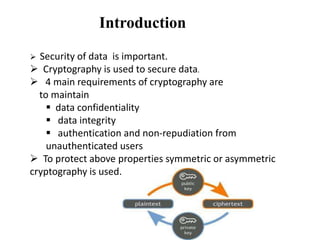
 To protect above properties symmetric or asymmetric
cryptography is used.

Continued…


Symmetric key algorithm :- uses same key .

 Asymmetric key algorithm : - uses different key.
 Use of individual algorithm is still vulnerable .

that’s why researchers came up with technology
called it as
“HYBRID ENCRYPTION TECHNOLOGY”
What is hybrid encryption?
 Combination of more than one cryptographic

algorithm
 It incorporates a combination of asymmetric and
symmetric encryption
 It provides more security.
 Hybrid encryption is considered as highly secure
type of encryption as long as the public and private
keys are fully secure.
What is the Need of Hybrid Encryption
Technology ?
 Conventional

encryption system uses only one key.

 If key is disclosed then complete encryption and
decryption process becomes vulnerable.
 key distribution problem.
 To provide greater security and to avoid explicit
transfer of secret key we need hybrid encryption system.
Hybrid Encryption using DES and RSA


using any symmetric algo and RSA algo

Encryption Steps using Hybrid Crypto System at the
Source
Prerequisite :-source has destination public key(PUK)

 Inputs: Plain Data Block (PDB) Symmetric Key (SK)
 Outputs: Encrypted Data Block (EDB)
 Note: EDB contains both the encrypted PDB (denoted
by ED) concatenated with encrypted SK (denoted by ESK)
Encryption Steps:
1) Encrypt PDB using SK to get ED.

(Note: This can be done using any symmetric-key crypto algorithm
like DES and AES)
2) Encrypt SK using destination’s PUK to get ESK. (Note: This can be
done using any public key algorithm like RSA)

3) Concatenate ED with its corresponding ESK to get EDB which is
sent to the destination.
EDB = { ESK , ED }
Decryption Steps using Hybrid Crypto System at the Destination
Prerequisite: Destination has its Private Key (PRK)
Inputs: Encrypted Data Block (EDB)
Note: EDB contains both the encrypted PDB (denoted by ED) concatenated with
encrypted SK (denoted by ESK)

Outputs: Plain Data Block (PDB)
Decryption Steps:
1) Decrypt ESK using PRK to retrieve SK.

(Note: This should be done using the same public key algorithm which
is used at source)
2) Use the retrieved SK as decryption key to decrypt ED to get PDB.
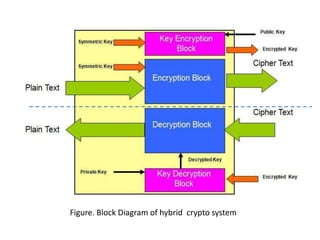
Figure. Block Diagram of hybrid crypto system
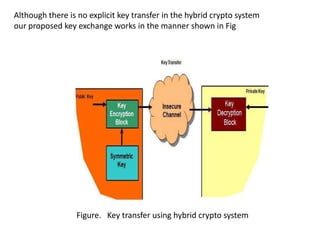
Although there is no explicit key transfer in the hybrid crypto system
our proposed key exchange works in the manner shown in Fig

Figure. Key transfer using hybrid crypto system
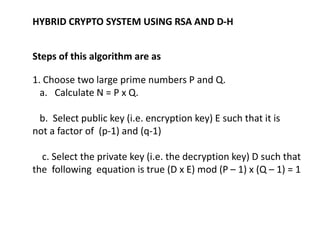
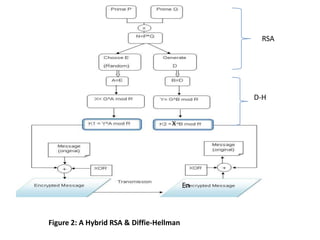
HYBRID CRYPTO SYSTEM USING RSA AND D-H
Steps of this algorithm are as

1. Choose two large prime numbers P and Q.
a. Calculate N = P x Q.
b. Select public key (i.e. encryption key) E such that it is
not a factor of (p-1) and (q-1)
c. Select the private key (i.e. the decryption key) D such that
the following equation is true (D x E) mod (P – 1) x (Q – 1) = 1
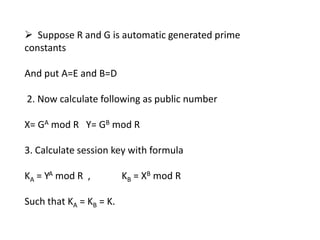
 Suppose R and G is automatic generated prime
constants
And put A=E and B=D
2. Now calculate following as public number
X= GA mod R Y= GB mod R
3. Calculate session key with formula
KA = YA mod R ,
Such that KA = KB = K.

KB = XB mod R
RSA

D-H
X

En

Figure 2: A Hybrid RSA & Diffie-Hellman
Hybrid Encryption in Electronic Document
Electronic document information suffers from
 disclosed, counterfeited, tampered, repudiated and so
on.
To solve the above problem we used hybrid encryption
technology using
 encryption technology, digital digest, digital
authentication and digital signature .
 Adobe Acrobat software uses hybrid approaches so
single documents can be protected for multiple recipients,
each possessing unique key pairs.

 The file size is not significantly increased during this
method because the entire document does not need to
be encrypted for each person.
 Instead, the document is encrypted with a single
symmetric key and that symmetric key is encrypted for
each recipient with their respective public key.
Conclusion
Hybrid encryption technology make use of two different
cryptographic algorithm. Which removes the drawback
of use of any single cryptographic algorithm and provide
double security to secret data .

 It removes the key distribution problem
 Security systems tends to use a hybrid solution to
increase the security and speed of encrypting
documents.
References
1. 2012 International Conference on Advanced Computer Science Applications and
Technologies. Hybrid Crypto Hardware Utilizing Symmetric-Key & Public-Key
Cryptosystems. Adnan Abdul-Aziz Gutub Center of Research Excellence in Hajj.
2. 2012 IEEE International Conference on Computational Intelligence and Computing
Research A Hybrid Encryption Algorithm based on RSA and Diffie-Hellman Shilpi
Gupta and Jaya Sharma Department of Computer Science & Engineering Amity School
of Engineering & Technology
Amity University, India.
3. 2010 International Conference of Information Science and Management
Engineering A Study on the hybrid encryption technology in the security transmission
of electronic documents
4. Xin Zhou, Xiaofei Tang, Research and Implementation of RSA Algorithm for
Encryption and Decryption, 2011 the 6thInternational Forum on Strategic Technology.
Hybrid encryption ppt

Hybrid encryption ppt

  • 1.
    A Technical seminar on HybridEncryption Technology Guided by Mr. Y.S .INGLE Presented By: Prashant Dahake Mtech 1st sem (CSE) Roll No 20 G.H. Raisoni College of Engineering Nagpur Dept. of Computer Science & Engineering 2013-2014 1 1 1
  • 2.
    overview  Introduction  Whatis hybrid encryption.  What is the need of hybrid encryption.  Hybrid encryption using DES and RSA.  Hybrid encryption using RSA and D-H.  Hybrid encryption in electronic document.  Conclusion  References
  • 3.
    Introduction Security of datais important.  Cryptography is used to secure data.  4 main requirements of cryptography are to maintain  data confidentiality  data integrity  authentication and non-repudiation from unauthenticated users  To protect above properties symmetric or asymmetric cryptography is used. 
  • 4.
    Continued…  Symmetric key algorithm:- uses same key .  Asymmetric key algorithm : - uses different key.  Use of individual algorithm is still vulnerable . that’s why researchers came up with technology called it as “HYBRID ENCRYPTION TECHNOLOGY”
  • 5.
    What is hybridencryption?  Combination of more than one cryptographic algorithm  It incorporates a combination of asymmetric and symmetric encryption  It provides more security.  Hybrid encryption is considered as highly secure type of encryption as long as the public and private keys are fully secure.
  • 6.
    What is theNeed of Hybrid Encryption Technology ?  Conventional encryption system uses only one key.  If key is disclosed then complete encryption and decryption process becomes vulnerable.  key distribution problem.  To provide greater security and to avoid explicit transfer of secret key we need hybrid encryption system.
  • 7.
    Hybrid Encryption usingDES and RSA  using any symmetric algo and RSA algo Encryption Steps using Hybrid Crypto System at the Source Prerequisite :-source has destination public key(PUK)  Inputs: Plain Data Block (PDB) Symmetric Key (SK)  Outputs: Encrypted Data Block (EDB)  Note: EDB contains both the encrypted PDB (denoted by ED) concatenated with encrypted SK (denoted by ESK)
  • 8.
    Encryption Steps: 1) EncryptPDB using SK to get ED. (Note: This can be done using any symmetric-key crypto algorithm like DES and AES) 2) Encrypt SK using destination’s PUK to get ESK. (Note: This can be done using any public key algorithm like RSA) 3) Concatenate ED with its corresponding ESK to get EDB which is sent to the destination. EDB = { ESK , ED }
  • 9.
    Decryption Steps usingHybrid Crypto System at the Destination Prerequisite: Destination has its Private Key (PRK) Inputs: Encrypted Data Block (EDB) Note: EDB contains both the encrypted PDB (denoted by ED) concatenated with encrypted SK (denoted by ESK) Outputs: Plain Data Block (PDB)
  • 10.
    Decryption Steps: 1) DecryptESK using PRK to retrieve SK. (Note: This should be done using the same public key algorithm which is used at source) 2) Use the retrieved SK as decryption key to decrypt ED to get PDB.
  • 11.
    Figure. Block Diagramof hybrid crypto system
  • 12.
    Although there isno explicit key transfer in the hybrid crypto system our proposed key exchange works in the manner shown in Fig Figure. Key transfer using hybrid crypto system
  • 13.
    HYBRID CRYPTO SYSTEMUSING RSA AND D-H Steps of this algorithm are as 1. Choose two large prime numbers P and Q. a. Calculate N = P x Q. b. Select public key (i.e. encryption key) E such that it is not a factor of (p-1) and (q-1) c. Select the private key (i.e. the decryption key) D such that the following equation is true (D x E) mod (P – 1) x (Q – 1) = 1
  • 14.
     Suppose Rand G is automatic generated prime constants And put A=E and B=D 2. Now calculate following as public number X= GA mod R Y= GB mod R 3. Calculate session key with formula KA = YA mod R , Such that KA = KB = K. KB = XB mod R
  • 15.
    RSA D-H X En Figure 2: AHybrid RSA & Diffie-Hellman
  • 16.
    Hybrid Encryption inElectronic Document Electronic document information suffers from  disclosed, counterfeited, tampered, repudiated and so on. To solve the above problem we used hybrid encryption technology using  encryption technology, digital digest, digital authentication and digital signature .
  • 17.
     Adobe Acrobatsoftware uses hybrid approaches so single documents can be protected for multiple recipients, each possessing unique key pairs.  The file size is not significantly increased during this method because the entire document does not need to be encrypted for each person.  Instead, the document is encrypted with a single symmetric key and that symmetric key is encrypted for each recipient with their respective public key.
  • 18.
    Conclusion Hybrid encryption technologymake use of two different cryptographic algorithm. Which removes the drawback of use of any single cryptographic algorithm and provide double security to secret data .  It removes the key distribution problem  Security systems tends to use a hybrid solution to increase the security and speed of encrypting documents.
  • 19.
    References 1. 2012 InternationalConference on Advanced Computer Science Applications and Technologies. Hybrid Crypto Hardware Utilizing Symmetric-Key & Public-Key Cryptosystems. Adnan Abdul-Aziz Gutub Center of Research Excellence in Hajj. 2. 2012 IEEE International Conference on Computational Intelligence and Computing Research A Hybrid Encryption Algorithm based on RSA and Diffie-Hellman Shilpi Gupta and Jaya Sharma Department of Computer Science & Engineering Amity School of Engineering & Technology Amity University, India. 3. 2010 International Conference of Information Science and Management Engineering A Study on the hybrid encryption technology in the security transmission of electronic documents 4. Xin Zhou, Xiaofei Tang, Research and Implementation of RSA Algorithm for Encryption and Decryption, 2011 the 6thInternational Forum on Strategic Technology.