1
Hybrid encryption
1
1
What is hybrid encryption?
 combination of more than one cryptographic algorithm
 it provides more security.
 It incorporates a combination of asymmetric and symmetric
encryption
 Hybrid encryption is considered a highly secure type of encryption as
long as the public and private keys are fully secure.
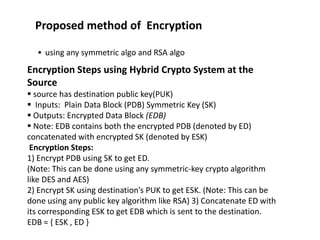
Proposed method of Encryption
 using any symmetric algo and RSA algo
Encryption Steps using Hybrid Crypto System at the
Source
 source has destination public key(PUK)
 Inputs: Plain Data Block (PDB) Symmetric Key (SK)
 Outputs: Encrypted Data Block (EDB)
 Note: EDB contains both the encrypted PDB (denoted by ED)
concatenated with encrypted SK (denoted by ESK)
Encryption Steps:
1) Encrypt PDB using SK to get ED.
(Note: This can be done using any symmetric-key crypto algorithm
like DES and AES)
2) Encrypt SK using destination’s PUK to get ESK. (Note: This can be
done using any public key algorithm like RSA) 3) Concatenate ED with
its corresponding ESK to get EDB which is sent to the destination.
EDB = { ESK , ED }
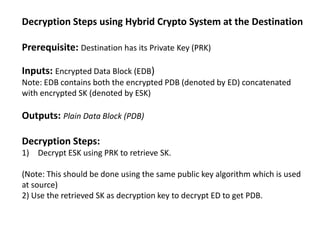
Decryption Steps using Hybrid Crypto System at the Destination
Prerequisite: Destination has its Private Key (PRK)
Inputs: Encrypted Data Block (EDB)
Note: EDB contains both the encrypted PDB (denoted by ED) concatenated
with encrypted SK (denoted by ESK)
Outputs: Plain Data Block (PDB)
Decryption Steps:
1) Decrypt ESK using PRK to retrieve SK.
(Note: This should be done using the same public key algorithm which is used
at source)
2) Use the retrieved SK as decryption key to decrypt ED to get PDB.
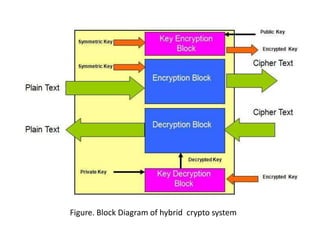
Figure. Block Diagram of hybrid crypto system
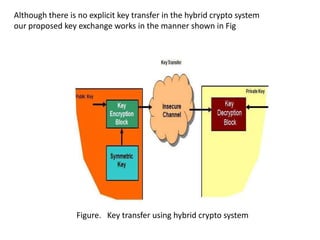
Although there is no explicit key transfer in the hybrid crypto system
our proposed key exchange works in the manner shown in Fig
Figure. Key transfer using hybrid crypto system
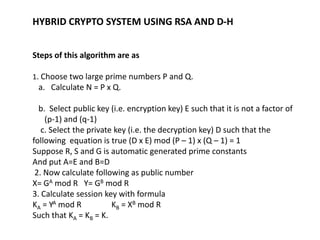
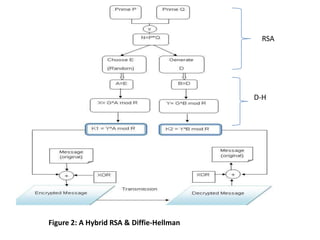
HYBRID CRYPTO SYSTEM USING RSA AND D-H
Steps of this algorithm are as
1. Choose two large prime numbers P and Q.
a. Calculate N = P x Q.
b. Select public key (i.e. encryption key) E such that it is not a factor of
(p-1) and (q-1)
c. Select the private key (i.e. the decryption key) D such that the
following equation is true (D x E) mod (P – 1) x (Q – 1) = 1
Suppose R, S and G is automatic generated prime constants
And put A=E and B=D
2. Now calculate following as public number
X= GA mod R Y= GB mod R
3. Calculate session key with formula
KA = YA mod R KB = XB mod R
Such that KA = KB = K.
Figure 2: A Hybrid RSA & Diffie-Hellman
RSA
D-H
Hybrid Encryption in Electronic Document
conclusion
Hybrid crypto system is presented that utilizes both
symmetric-key and public-key cryptographic algorithms.
The symmetric key algorithms DES are used for data
encryption/decryption. The public key algorithm RSA is
used for encrypting the secret key before performing key
distribution. RSA and DES is more secure than RSA D-H
Hybrid encryption

Hybrid encryption

  • 1.
  • 2.
    What is hybridencryption?  combination of more than one cryptographic algorithm  it provides more security.  It incorporates a combination of asymmetric and symmetric encryption  Hybrid encryption is considered a highly secure type of encryption as long as the public and private keys are fully secure.
  • 3.
    Proposed method ofEncryption  using any symmetric algo and RSA algo Encryption Steps using Hybrid Crypto System at the Source  source has destination public key(PUK)  Inputs: Plain Data Block (PDB) Symmetric Key (SK)  Outputs: Encrypted Data Block (EDB)  Note: EDB contains both the encrypted PDB (denoted by ED) concatenated with encrypted SK (denoted by ESK) Encryption Steps: 1) Encrypt PDB using SK to get ED. (Note: This can be done using any symmetric-key crypto algorithm like DES and AES) 2) Encrypt SK using destination’s PUK to get ESK. (Note: This can be done using any public key algorithm like RSA) 3) Concatenate ED with its corresponding ESK to get EDB which is sent to the destination. EDB = { ESK , ED }
  • 4.
    Decryption Steps usingHybrid Crypto System at the Destination Prerequisite: Destination has its Private Key (PRK) Inputs: Encrypted Data Block (EDB) Note: EDB contains both the encrypted PDB (denoted by ED) concatenated with encrypted SK (denoted by ESK) Outputs: Plain Data Block (PDB) Decryption Steps: 1) Decrypt ESK using PRK to retrieve SK. (Note: This should be done using the same public key algorithm which is used at source) 2) Use the retrieved SK as decryption key to decrypt ED to get PDB.
  • 5.
    Figure. Block Diagramof hybrid crypto system
  • 6.
    Although there isno explicit key transfer in the hybrid crypto system our proposed key exchange works in the manner shown in Fig Figure. Key transfer using hybrid crypto system
  • 7.
    HYBRID CRYPTO SYSTEMUSING RSA AND D-H Steps of this algorithm are as 1. Choose two large prime numbers P and Q. a. Calculate N = P x Q. b. Select public key (i.e. encryption key) E such that it is not a factor of (p-1) and (q-1) c. Select the private key (i.e. the decryption key) D such that the following equation is true (D x E) mod (P – 1) x (Q – 1) = 1 Suppose R, S and G is automatic generated prime constants And put A=E and B=D 2. Now calculate following as public number X= GA mod R Y= GB mod R 3. Calculate session key with formula KA = YA mod R KB = XB mod R Such that KA = KB = K.
  • 8.
    Figure 2: AHybrid RSA & Diffie-Hellman RSA D-H
  • 9.
    Hybrid Encryption inElectronic Document
  • 10.
    conclusion Hybrid crypto systemis presented that utilizes both symmetric-key and public-key cryptographic algorithms. The symmetric key algorithms DES are used for data encryption/decryption. The public key algorithm RSA is used for encrypting the secret key before performing key distribution. RSA and DES is more secure than RSA D-H