VITAL SIGNS
Submitted by-
Ambika Bagora
(RN)
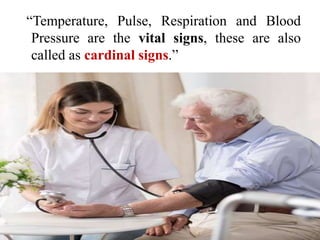
“Temperature, Pulse, Respiration and Blood
Pressure are the vital signs, these are also
called as cardinal signs.”
• They reflect the body’s physiological status
and provide information about the person with
current condition or state of health.
• The frequency of vital signs assessment
depends upon the person’s condition. The
more critical the patient’s condition is, more
often these signs are needed to be taken and
evaluated
When to assess vital signs-
 On the patient admission.
 During physical examination.
 Before and after any invasive diagnostic or
surgical procedure.
 Monitoring during recovery.
 Before and after medications that affect
cardiovascular or respiratory functions.
 In any emergency medical condition.
Body Temperature
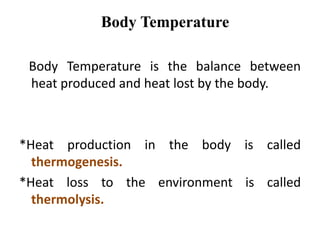
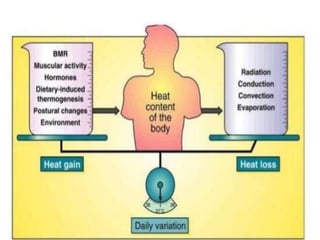
Body Temperature is the balance between
heat produced and heat lost by the body.
*Heat production in the body is called
thermogenesis.
*Heat loss to the environment is called
thermolysis.
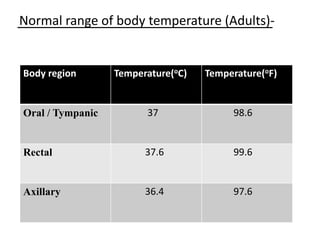
Normal range of body temperature (Adults)-
Body region Temperature(oC) Temperature(oF)
Oral / Tympanic 37 98.6
Rectal 37.6 99.6
Axillary 36.4 97.6
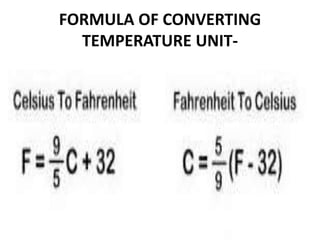
FORMULA OF CONVERTING
TEMPERATURE UNIT-
TYPES OF THERMOMETER-
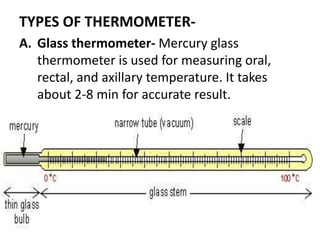
A. Glass thermometer- Mercury glass
thermometer is used for measuring oral,
rectal, and axillary temperature. It takes
about 2-8 min for accurate result.
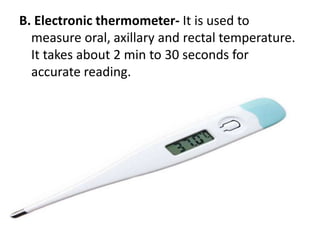
B. Electronic thermometer- It is used to
measure oral, axillary and rectal temperature.
It takes about 2 min to 30 seconds for
accurate reading.
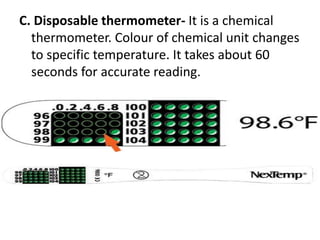
C. Disposable thermometer- It is a chemical
thermometer. Colour of chemical unit changes
to specific temperature. It takes about 60
seconds for accurate reading.
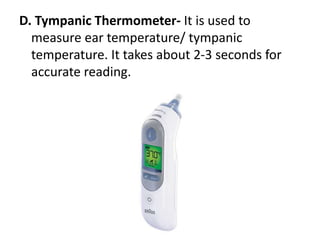
D. Tympanic Thermometer- It is used to
measure ear temperature/ tympanic
temperature. It takes about 2-3 seconds for
accurate reading.
FEVER
Body temperature above than normal is called
as fever or hyperthermia. The person having
fever is indicated as febrile.
Fevers can be categorised in different ways-
a. Low grade fever - above 37.1oC but below
38.2oC .
b. High grade fever - above 38.2oC.
c. Hyperpyrexia - Higher than 40oC
d. Intermittent fever- Alternate febrile episodes
with periods of normal
temperature.
e. Remittent fever- Continuous fever but
variations throughout a
day.
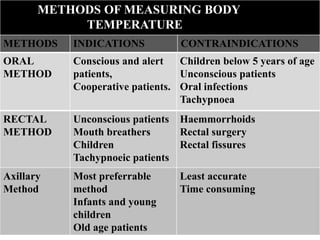
ORAL
METHOD
Conscious and alert
patients,
Cooperative patients.
Children below 5 years of age
Unconscious patients
Oral infections
Tachypnoea
RECTAL
METHOD
Unconscious patients
Mouth breathers
Children
Tachypnoeic patients
Haemmorrhoids
Rectal surgery
Rectal fissures
Axillary
Method
Most preferrable
method
Infants and young
children
Old age patients
Least accurate
Time consuming
METHODS OF MEASURING BODY
TEMPERATURE
METHODS INDICATIONS CONTRAINDICATIONS
PULSE
The pulse is an index of the heart’s rate and
rhythm. Pulse provides valuable data about
person’s cardiovascular status.
DEFINITIONS-
“The pulse is a wave of blood created by
contraction of the left ventricle of the heart.”
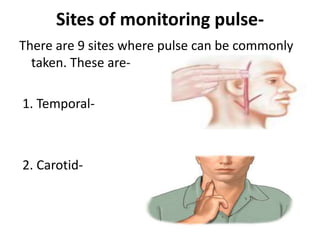
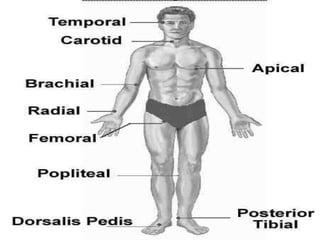
Sites of monitoring pulse-
There are 9 sites where pulse can be commonly
taken. These are-
1. Temporal-
2. Carotid-
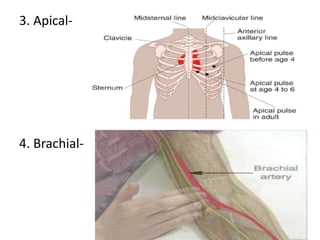
3. Apical-
4. Brachial-
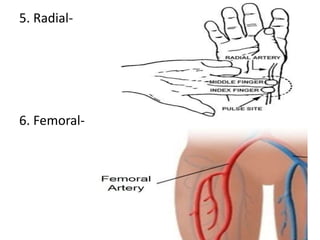
5. Radial-
6. Femoral-
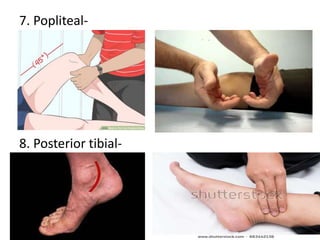
7. Popliteal-
8. Posterior tibial-
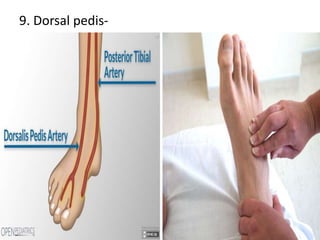
9. Dorsal pedis-
PULSE RANGE-
 Normal pulse rate varies depending on age.
 For a healthy adult the normal resting pulse
ranges from 60-100 beats per minute.
Tacahycardia- An abnormal rapid heart rate
over 100 beats/min.
 Bradycardia- An abnormal slow heart rate
below 60 beats/min.
 Bounding- Strong full force pulse.
Thready/ weak- Difficult to palpate, a pulse
of diminished strength.
 Absent- No palpable pulse.
 Irregular- When interval varies between
pulse.
 Bigeminal pulse- A regular irregular pulse
accuring with premature beats.
 Dicrotic- A split or double pulse beat the
second being weaker than first.
RESPIRATION
* Respiration is the process of bringing oxygen
to body tissues and removing carbon di oxide
from it. The lungs play a major role in this
process.
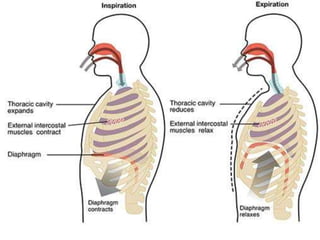
* Respiration is the act of breathing which refers
to two process-
1. External respiration
2. Internal respiration
Characteristics of respiration-
1. Respiration rate: It indicates the number of
times the person breathes in and out in one
minute.
2. Depth: It is estimated by observing the
movement of chest during inspiration, which
may be deep or shallow.
3. Rhythm: It indicate the equal interval
between two respiration.
Normal respiration-
Normal respiration is autonomic, effortless, and
regular. The normal adult rate of respiration is
generally ranged between 14-20
breaths/minutes.
How to take respiratory rate-
Place the patient arm in relaxed position across
his abdomen and place your hand on the
patient’s arm. Now observe complete
respiratory cycle (Inspiration + expiration).
SOME TERMS OF RESPIRATION-
 Tachypnoea- An increased respiratory rate more
than 24 breath/min.
 Bradypnoea- A decreased respiratory rate less
than 10 breath/min.
 Apnoea- Total cessation of breathing or
respiratory rate.
 Hyperapnoea- Increase in the depth of
respiration.
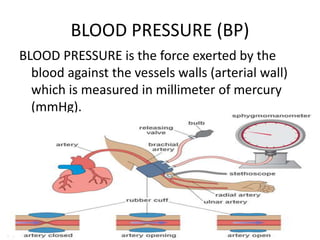
BLOOD PRESSURE (BP)
BLOOD PRESSURE is the force exerted by the
blood against the vessels walls (arterial wall)
which is measured in millimeter of mercury
(mmHg).
Blood pressure measurements includes
systolic and diastolic pressures-
 Systolic pressure- The maximal pressure
exerted on the arteries during contraction of
left ventricles of heart.
Diastolic pressure- The amount of pressure
exerted on the arterial wall with the ventricles
at rest.
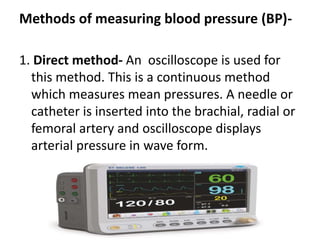
Methods of measuring blood pressure (BP)-
1. Direct method- An oscilloscope is used for
this method. This is a continuous method
which measures mean pressures. A needle or
catheter is inserted into the brachial, radial or
femoral artery and oscilloscope displays
arterial pressure in wave form.
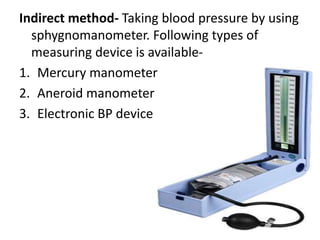
Indirect method- Taking blood pressure by using
sphygnomanometer. Following types of
measuring device is available-
1. Mercury manometer
2. Aneroid manometer
3. Electronic BP device
Normal blood pressure in an adult varies
between 100 to 140 mm of Hg systolic and 60
to 90 mm of Hg diastolic but BP may vary
widely depending on individuals other factors.
Creativity is a habit, and the best
creativity is the result of good work
habits.

vitalsigns-180617200506 2.pdf

  • 1.
  • 2.
    “Temperature, Pulse, Respirationand Blood Pressure are the vital signs, these are also called as cardinal signs.”
  • 3.
    • They reflectthe body’s physiological status and provide information about the person with current condition or state of health. • The frequency of vital signs assessment depends upon the person’s condition. The more critical the patient’s condition is, more often these signs are needed to be taken and evaluated
  • 4.
    When to assessvital signs-  On the patient admission.  During physical examination.  Before and after any invasive diagnostic or surgical procedure.  Monitoring during recovery.  Before and after medications that affect cardiovascular or respiratory functions.  In any emergency medical condition.
  • 5.
    Body Temperature Body Temperatureis the balance between heat produced and heat lost by the body. *Heat production in the body is called thermogenesis. *Heat loss to the environment is called thermolysis.
  • 7.
    Normal range ofbody temperature (Adults)- Body region Temperature(oC) Temperature(oF) Oral / Tympanic 37 98.6 Rectal 37.6 99.6 Axillary 36.4 97.6
  • 8.
  • 9.
    TYPES OF THERMOMETER- A.Glass thermometer- Mercury glass thermometer is used for measuring oral, rectal, and axillary temperature. It takes about 2-8 min for accurate result.
  • 10.
    B. Electronic thermometer-It is used to measure oral, axillary and rectal temperature. It takes about 2 min to 30 seconds for accurate reading.
  • 11.
    C. Disposable thermometer-It is a chemical thermometer. Colour of chemical unit changes to specific temperature. It takes about 60 seconds for accurate reading.
  • 12.
    D. Tympanic Thermometer-It is used to measure ear temperature/ tympanic temperature. It takes about 2-3 seconds for accurate reading.
  • 13.
    FEVER Body temperature abovethan normal is called as fever or hyperthermia. The person having fever is indicated as febrile. Fevers can be categorised in different ways- a. Low grade fever - above 37.1oC but below 38.2oC . b. High grade fever - above 38.2oC. c. Hyperpyrexia - Higher than 40oC
  • 14.
    d. Intermittent fever-Alternate febrile episodes with periods of normal temperature. e. Remittent fever- Continuous fever but variations throughout a day.
  • 15.
    ORAL METHOD Conscious and alert patients, Cooperativepatients. Children below 5 years of age Unconscious patients Oral infections Tachypnoea RECTAL METHOD Unconscious patients Mouth breathers Children Tachypnoeic patients Haemmorrhoids Rectal surgery Rectal fissures Axillary Method Most preferrable method Infants and young children Old age patients Least accurate Time consuming METHODS OF MEASURING BODY TEMPERATURE METHODS INDICATIONS CONTRAINDICATIONS
  • 16.
    PULSE The pulse isan index of the heart’s rate and rhythm. Pulse provides valuable data about person’s cardiovascular status. DEFINITIONS- “The pulse is a wave of blood created by contraction of the left ventricle of the heart.”
  • 17.
    Sites of monitoringpulse- There are 9 sites where pulse can be commonly taken. These are- 1. Temporal- 2. Carotid-
  • 18.
  • 19.
  • 20.
  • 21.
  • 23.
    PULSE RANGE-  Normalpulse rate varies depending on age.  For a healthy adult the normal resting pulse ranges from 60-100 beats per minute. Tacahycardia- An abnormal rapid heart rate over 100 beats/min.  Bradycardia- An abnormal slow heart rate below 60 beats/min.  Bounding- Strong full force pulse.
  • 24.
    Thready/ weak- Difficultto palpate, a pulse of diminished strength.  Absent- No palpable pulse.  Irregular- When interval varies between pulse.  Bigeminal pulse- A regular irregular pulse accuring with premature beats.  Dicrotic- A split or double pulse beat the second being weaker than first.
  • 25.
    RESPIRATION * Respiration isthe process of bringing oxygen to body tissues and removing carbon di oxide from it. The lungs play a major role in this process. * Respiration is the act of breathing which refers to two process- 1. External respiration 2. Internal respiration
  • 27.
    Characteristics of respiration- 1.Respiration rate: It indicates the number of times the person breathes in and out in one minute. 2. Depth: It is estimated by observing the movement of chest during inspiration, which may be deep or shallow. 3. Rhythm: It indicate the equal interval between two respiration.
  • 28.
    Normal respiration- Normal respirationis autonomic, effortless, and regular. The normal adult rate of respiration is generally ranged between 14-20 breaths/minutes. How to take respiratory rate- Place the patient arm in relaxed position across his abdomen and place your hand on the patient’s arm. Now observe complete respiratory cycle (Inspiration + expiration).
  • 30.
    SOME TERMS OFRESPIRATION-  Tachypnoea- An increased respiratory rate more than 24 breath/min.  Bradypnoea- A decreased respiratory rate less than 10 breath/min.  Apnoea- Total cessation of breathing or respiratory rate.  Hyperapnoea- Increase in the depth of respiration.
  • 31.
    BLOOD PRESSURE (BP) BLOODPRESSURE is the force exerted by the blood against the vessels walls (arterial wall) which is measured in millimeter of mercury (mmHg).
  • 32.
    Blood pressure measurementsincludes systolic and diastolic pressures-  Systolic pressure- The maximal pressure exerted on the arteries during contraction of left ventricles of heart. Diastolic pressure- The amount of pressure exerted on the arterial wall with the ventricles at rest.
  • 33.
    Methods of measuringblood pressure (BP)- 1. Direct method- An oscilloscope is used for this method. This is a continuous method which measures mean pressures. A needle or catheter is inserted into the brachial, radial or femoral artery and oscilloscope displays arterial pressure in wave form.
  • 34.
    Indirect method- Takingblood pressure by using sphygnomanometer. Following types of measuring device is available- 1. Mercury manometer 2. Aneroid manometer 3. Electronic BP device
  • 35.
    Normal blood pressurein an adult varies between 100 to 140 mm of Hg systolic and 60 to 90 mm of Hg diastolic but BP may vary widely depending on individuals other factors.
  • 36.
    Creativity is ahabit, and the best creativity is the result of good work habits.