Introduction to Anatomy
& Physiology
Mr. Akash Bansirar
Asst. Professor
Mental Health Nsg.
Introduction (Terms)
 Superior- Toward the head, or the upper part of a
structure.
 Inferior - Away from the head, or the lower part of a
structure.
 Anterior - Nearer to or at the front of the body.
 Posterior - Nearer to or at the back of the body.
 Medial - Nearer to the midline (an imaginary vertical
line that divides the body into equal right and left
sides).
 Lateral- Farther from the midline.
 Intermediate - Between two structures.
Cont.
 Ipsilateral - On the same side of the body as another
structure.
 Contralateral - On the opposite side of the body
from another structure.
 Proximal - Nearer to the attachment of a limb to the
trunk; nearer to the origination of a structure.
 Distal - Farther from the attachment of a limb to the
trunk; farther from the origination of a structure.
 Superficial - Toward or on the surface of the body.
 Deep - Away from the surface of the body.
Plane
 A sagittal plane (SAJ-i-tal; sagitt- = arrow) is a
vertical plane that divides the body or an organ
into right and left sides.
 When such a plane passes through the midline of
the body or an organ and divides it into equal
right and left sides, it is called a midsagittal
plane or a median plane
Cont.
 The midline is an imaginary vertical line that
divides the body into equal left and right sides. If
the sagittal plane does not pass through the
midline but instead divides the body or an organ
into unequal right and left sides, it is called a
para sagittal plane (para- = near).
 A frontal or coronal plane (corona = crown)
divides the body or an organ into anterior (front)
and posterior (back) portions.
Cont.
 A transverse plane or cross-sectional or
horizontal plane divides the body or an organ
into superior (upper) and inferior (lower) portions.
 An oblique plane (oˉ-BLE–K), by contrast, passes
through the body or an organ at an oblique angle
(any angle other than a 90-degree angle).
Body Cavities
 Body cavities are spaces that enclose internal
organs. Bones, muscles, ligaments, and other
structures separate the various body cavities
from one another. Here we discuss several body
cavities .
Cranial cavity
 The cranial bones form a hollow space of the
head called the cranial cavity, which contains
the brain.
 The bones of the vertebral column (backbone)
form the vertebral canal, contains spinal cord.
 Three layers of protective tissue, the meninges,
and a shock-absorbing fluid surround the brain
and spinal cord.
Thoracic cavity
 The thoracic cavity or chest cavity is formed by
the ribs, the muscles of the chest, the sternum
(breastbone), and the thoracic portion of the
vertebral column.
 Within the thoracic cavity are the pericardial
cavity, a fluid-filled space that surrounds the
heart, and two fluid-filled spaces called pleural
cavities.
Mediastinum
 The central part of the thoracic cavity is an
anatomical region called the mediastinum.
 Between the lungs, extending from the sternum to
the vertebral column and from the first rib to the
diaphragm .
 Structures are the heart, esophagus, trachea,
thymus, and several large blood vessels that enter
and exit the heart.
 The diaphragm is a dome-shaped muscle that
separates the thoracic cavity from the
abdominopelvic cavity.
abdominopelvic cavity
 The abdominopelvic cavity extends from the
diaphragm to the groin and is encircled by the
abdominal muscular wall and the bones and
muscles of the pelvis.
 The abdominal cavity, contains the stomach,
spleen, liver, gallbladder, small intestine, and
most of the large intestine.
Cont.
 The inferior portion, the pelvic cavity, contains
the urinary bladder, portions of the large
intestine, and internal organs of the reproductive
system.
Nine abdominal regions
 The superior horizontal line, the subcostal line,
passes across the lowest level of the 10th costal
cartilages; the inferior horizontal line, the
transtubercular line, passes across the superior
margins of the iliac crests of the right and left hip
bone.
 Two vertical lines, the left and right midclavicular
lines, are drawn through the midpoints of the
clavicles, just medial to the nipples.
Cont.
 The names of the nine abdominopelvic regions are
 Right hypochondriac regions,
 Epigastric regions,
 left hypochondriac regions,
 Right lumbar regions,
 Umbilical regions,
 Left lumbar regions,
 Right inguinal (iliac) regions,
 Hypogastric (pubic) regions, and
 Left inguinal (iliac) regions.
Cont.
 Right Hypochondriac
Right portion of the liver, the gallbladder, the right
kidney, and parts of the small intestine.
 Left Hypochondriac
Part of the spleen, the left kidney, part of the
stomach, the pancreas, and parts of the colon.
Cont.
 Epigastric
Majority of the stomach, part of the liver, part of
the pancreas, part of the duodenum, part of the
spleen, and the adrenal glands.
 Right Lumbar
Gallbladder, the right kidney, part of the liver, and
the ascending colon.
 Left Lumbar
Descending colon, the left kidney, and part of the
spleen.
Cont.
 Umbilical
Parts of the small intestine, such as part of the
duodenum, the jejunum, and the ileum,
transverse colon and the bottom portions of both
the left and right kidney.
 Right Iliac
Appendix, cecum, and the right iliac fossa.
Cont.
 Left Iliac
Descending colon, the sigmoid colon, and the left
illiac fossa.
 Hypogastric
Bladder, part of the sigmoid colon, the anus, and
many organs of the reproductive system, such as
the uterus and ovaries in females and the
prostate in males.
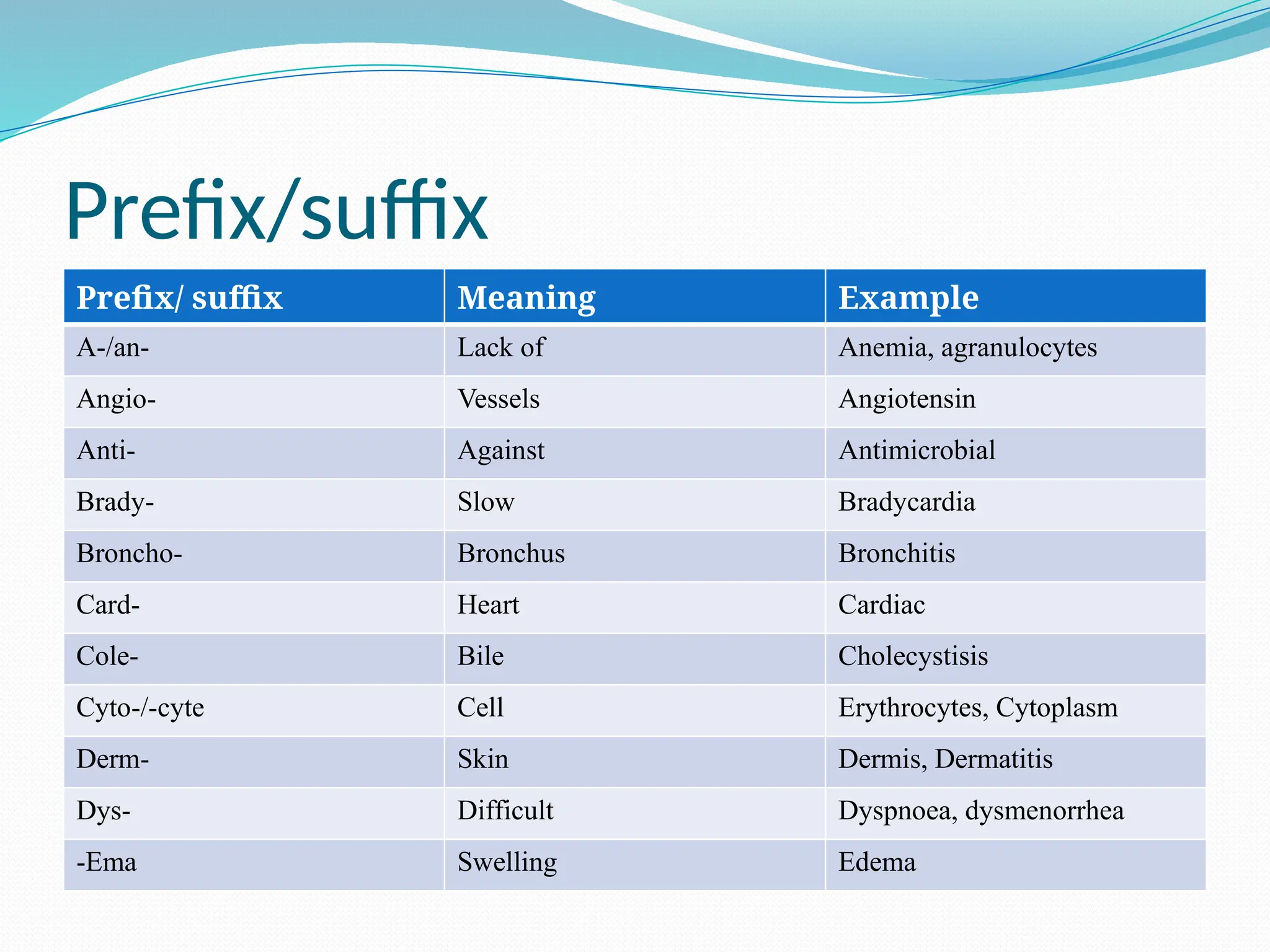
Prefix/suffix
Prefix/ suffix Meaning Example
A-/an- Lack of Anemia, agranulocytes
Angio- Vessels Angiotensin
Anti- Against Antimicrobial
Brady- Slow Bradycardia
Broncho- Bronchus Bronchitis
Card- Heart Cardiac
Cole- Bile Cholecystisis
Cyto-/-cyte Cell Erythrocytes, Cytoplasm
Derm- Skin Dermis, Dermatitis
Dys- Difficult Dyspnoea, dysmenorrhea
-Ema Swelling Edema
Prefix/suffix
Prefix/ suffix Meaning Example
Endo- Inner Endocardium
Erythro- Red Erythropoietin, erythrocytes
Exo-/ Extra- Outside Exocytosis, Exophthalmos,
Extracellular,
-efferent Carry Afferent (to), efferent (from)
Gast- stomach Gastrin, Gastric,
Gastrointestinal
-Gen- Origin/ production Gene, Genome, pathogen,
antigen
-globin Protein Hemoglobin, immunoglobin
-alg Pain Neuralgia
Ana- Up Anabolic reaction
Auto- Self Autoimmunity
Prefix/suffix
Prefix/ suffix Meaning Example
Haem- Blood Haemoglobin, haemorrage
-hydra- Water Hydrostatic, dehydration
Hepat- Liver Hepatitis, hepatomegaly
Hyper- Above/ Excess Hypertension, hyperthyroidism
Hypo- Below Hypoglycemia, hypovolemia
Intra Within Intracranial, Intracellular
-Itis Inflammation Appendicitis, Cystitis
Lact- Milk Lactation
Lymph- Lymph Tissue Lymphoedema, Lymphocytes
Cat- Down Catabolic reaction
-ectomy, -tom, -sect Cut, Cut out Appendectomy, Lobotomy,
Dissect
Prefix/suffix
Prefix/ suffix Meaning Example
Lyso-/- lysis Breaking down Lysosomes, haemolysis,
Gylcolysis
Micro- Small Microbe, Microrganism
Neo New Neonate, neoplasm
Nephro- Kidney Nephron, Nephrosis
Neuro- Nerve Neurons, Neuralgia
-oid Resembling Sigmoid
-ophth- Eye Opthalmic
Osteo- Bone Osteocytes, Osteoblast,
Osteoarthritis
-Plasm Substance Cytoplasm
epi- Upon, Over, Above Epidermis
Prefix/suffix
Prefix/ suffix Meaning Example
Pneumo Lung/air Pneumonia, pneumothorax
Poly- Many/ excess Polyuria, polyphagia
-rrhagia Excessive flow Menorrhagia
Tachy- Excessively fast Tachycardia
Thrombo- Clot Thrombocytes
-uria Urine Polyuria, olygouria
Vas, Vaso- Vessel Vasoconstriction,
Vasodilatation
hyster-, metr- Uterus Hysterectomy, Endometrium
Inter- Between Interstitial fluid
-Plasia Growth Hyperplasia
-pnea breathing Apnea
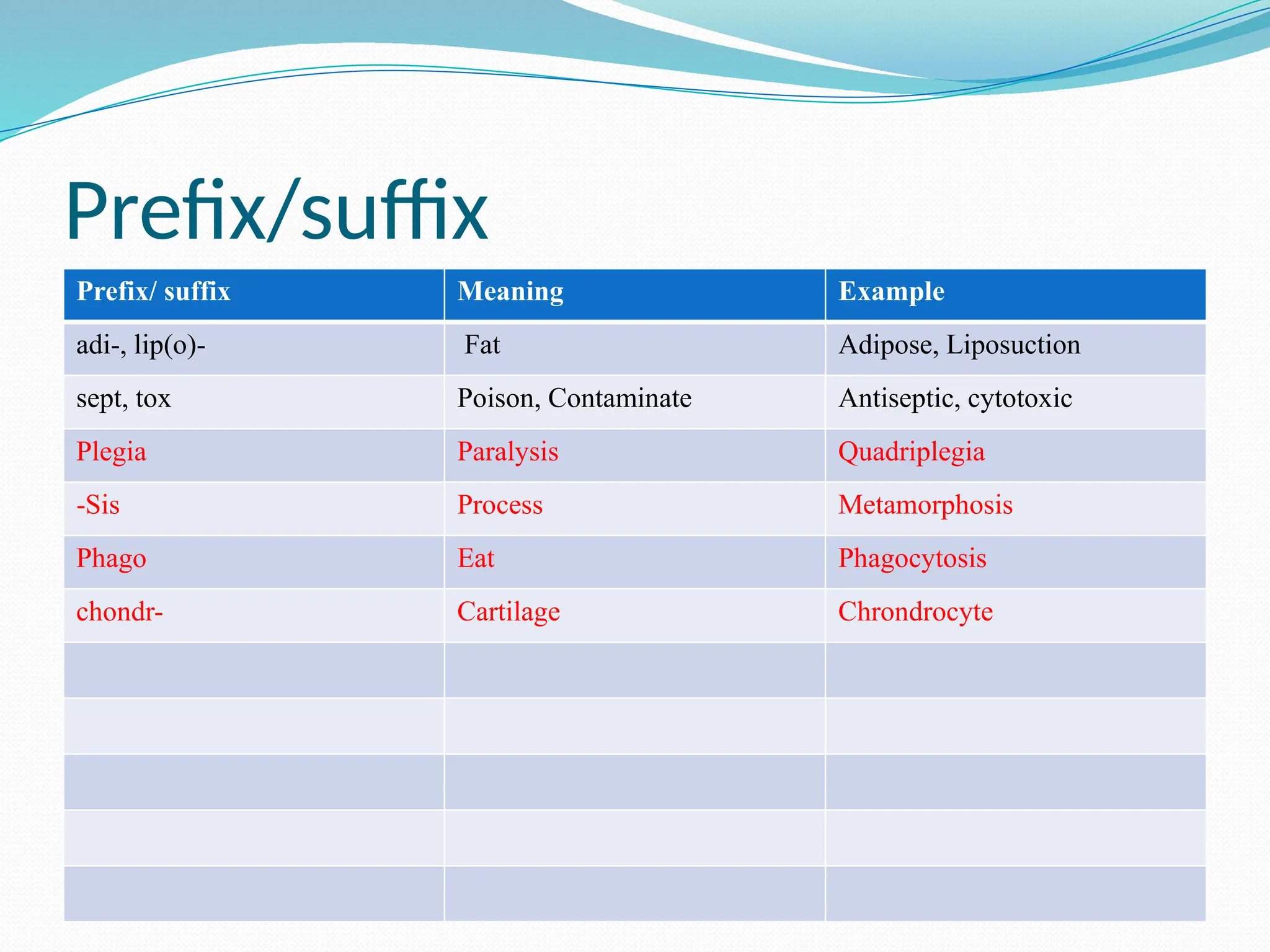
Prefix/suffix
Prefix/ suffix Meaning Example
adi-, lip(o)- Fat Adipose, Liposuction
sept, tox Poison, Contaminate Antiseptic, cytotoxic
Plegia Paralysis Quadriplegia
-Sis Process Metamorphosis
Phago Eat Phagocytosis
chondr- Cartilage Chrondrocyte
Movement
 Flexion- act of bending a joint; especially a joint
between the bones of a limb so that the angle
between them is decreased
 Extension - is the opposite of flexion, describing a
straightening movement that increases the angle
between body parts.
Movement
 Abduction - is any motion of the limbs or other body
parts that pulls away from the midline of the body.
 Adduction - is the movement of a body part toward
the body's midline
 Lateral flexion - is the bending of the neck or body
toward the right or left side.
Cont.
 Circumduction – is the movement of a body
region in a circular manner, in which one end of
the body region being moved stays relatively
stationary while the other end describes a circle.
 Supination - rotation of the forearm and hand so
that the palm faces forward or upward also a
corresponding movement of the foot and leg in
which the foot rolls outward with an elevated
arch
Homeostasis
 The composition of the internal environment is
maintained within narrow limits, and this fairly
constant state is called homeostasis
Negative feedback mechanism
 Also known as an inhibitory loop, a negative
feedback loop allows the body to regulate
itself. The process starts when there is an
increase in output from a body system, which
results in higher levels of certain proteins or
hormones. This stops (inhibits or reverses) future
production by the system.
Positive feedback mechanisms
 Control self-perpetuating events that can be
out of control and do not require continuous
adjustment. In positive feedback mechanisms,
the original stimulus is promoted rather than
negated.
Introduction to Anatomy & Physiology 1.pptx

Introduction to Anatomy & Physiology 1.pptx

  • 1.
    Introduction to Anatomy &Physiology Mr. Akash Bansirar Asst. Professor Mental Health Nsg.
  • 2.
    Introduction (Terms)  Superior-Toward the head, or the upper part of a structure.  Inferior - Away from the head, or the lower part of a structure.  Anterior - Nearer to or at the front of the body.  Posterior - Nearer to or at the back of the body.  Medial - Nearer to the midline (an imaginary vertical line that divides the body into equal right and left sides).  Lateral- Farther from the midline.  Intermediate - Between two structures.
  • 3.
    Cont.  Ipsilateral -On the same side of the body as another structure.  Contralateral - On the opposite side of the body from another structure.  Proximal - Nearer to the attachment of a limb to the trunk; nearer to the origination of a structure.  Distal - Farther from the attachment of a limb to the trunk; farther from the origination of a structure.  Superficial - Toward or on the surface of the body.  Deep - Away from the surface of the body.
  • 5.
    Plane  A sagittalplane (SAJ-i-tal; sagitt- = arrow) is a vertical plane that divides the body or an organ into right and left sides.  When such a plane passes through the midline of the body or an organ and divides it into equal right and left sides, it is called a midsagittal plane or a median plane
  • 6.
    Cont.  The midlineis an imaginary vertical line that divides the body into equal left and right sides. If the sagittal plane does not pass through the midline but instead divides the body or an organ into unequal right and left sides, it is called a para sagittal plane (para- = near).  A frontal or coronal plane (corona = crown) divides the body or an organ into anterior (front) and posterior (back) portions.
  • 7.
    Cont.  A transverseplane or cross-sectional or horizontal plane divides the body or an organ into superior (upper) and inferior (lower) portions.  An oblique plane (oˉ-BLE–K), by contrast, passes through the body or an organ at an oblique angle (any angle other than a 90-degree angle).
  • 9.
    Body Cavities  Bodycavities are spaces that enclose internal organs. Bones, muscles, ligaments, and other structures separate the various body cavities from one another. Here we discuss several body cavities .
  • 10.
    Cranial cavity  Thecranial bones form a hollow space of the head called the cranial cavity, which contains the brain.  The bones of the vertebral column (backbone) form the vertebral canal, contains spinal cord.  Three layers of protective tissue, the meninges, and a shock-absorbing fluid surround the brain and spinal cord.
  • 12.
    Thoracic cavity  Thethoracic cavity or chest cavity is formed by the ribs, the muscles of the chest, the sternum (breastbone), and the thoracic portion of the vertebral column.  Within the thoracic cavity are the pericardial cavity, a fluid-filled space that surrounds the heart, and two fluid-filled spaces called pleural cavities.
  • 13.
    Mediastinum  The centralpart of the thoracic cavity is an anatomical region called the mediastinum.  Between the lungs, extending from the sternum to the vertebral column and from the first rib to the diaphragm .  Structures are the heart, esophagus, trachea, thymus, and several large blood vessels that enter and exit the heart.  The diaphragm is a dome-shaped muscle that separates the thoracic cavity from the abdominopelvic cavity.
  • 14.
    abdominopelvic cavity  Theabdominopelvic cavity extends from the diaphragm to the groin and is encircled by the abdominal muscular wall and the bones and muscles of the pelvis.  The abdominal cavity, contains the stomach, spleen, liver, gallbladder, small intestine, and most of the large intestine.
  • 15.
    Cont.  The inferiorportion, the pelvic cavity, contains the urinary bladder, portions of the large intestine, and internal organs of the reproductive system.
  • 17.
    Nine abdominal regions The superior horizontal line, the subcostal line, passes across the lowest level of the 10th costal cartilages; the inferior horizontal line, the transtubercular line, passes across the superior margins of the iliac crests of the right and left hip bone.  Two vertical lines, the left and right midclavicular lines, are drawn through the midpoints of the clavicles, just medial to the nipples.
  • 18.
    Cont.  The namesof the nine abdominopelvic regions are  Right hypochondriac regions,  Epigastric regions,  left hypochondriac regions,  Right lumbar regions,  Umbilical regions,  Left lumbar regions,  Right inguinal (iliac) regions,  Hypogastric (pubic) regions, and  Left inguinal (iliac) regions.
  • 20.
    Cont.  Right Hypochondriac Rightportion of the liver, the gallbladder, the right kidney, and parts of the small intestine.  Left Hypochondriac Part of the spleen, the left kidney, part of the stomach, the pancreas, and parts of the colon.
  • 21.
    Cont.  Epigastric Majority ofthe stomach, part of the liver, part of the pancreas, part of the duodenum, part of the spleen, and the adrenal glands.  Right Lumbar Gallbladder, the right kidney, part of the liver, and the ascending colon.  Left Lumbar Descending colon, the left kidney, and part of the spleen.
  • 22.
    Cont.  Umbilical Parts ofthe small intestine, such as part of the duodenum, the jejunum, and the ileum, transverse colon and the bottom portions of both the left and right kidney.  Right Iliac Appendix, cecum, and the right iliac fossa.
  • 23.
    Cont.  Left Iliac Descendingcolon, the sigmoid colon, and the left illiac fossa.  Hypogastric Bladder, part of the sigmoid colon, the anus, and many organs of the reproductive system, such as the uterus and ovaries in females and the prostate in males.
  • 24.
    Prefix/suffix Prefix/ suffix MeaningExample A-/an- Lack of Anemia, agranulocytes Angio- Vessels Angiotensin Anti- Against Antimicrobial Brady- Slow Bradycardia Broncho- Bronchus Bronchitis Card- Heart Cardiac Cole- Bile Cholecystisis Cyto-/-cyte Cell Erythrocytes, Cytoplasm Derm- Skin Dermis, Dermatitis Dys- Difficult Dyspnoea, dysmenorrhea -Ema Swelling Edema
  • 25.
    Prefix/suffix Prefix/ suffix MeaningExample Endo- Inner Endocardium Erythro- Red Erythropoietin, erythrocytes Exo-/ Extra- Outside Exocytosis, Exophthalmos, Extracellular, -efferent Carry Afferent (to), efferent (from) Gast- stomach Gastrin, Gastric, Gastrointestinal -Gen- Origin/ production Gene, Genome, pathogen, antigen -globin Protein Hemoglobin, immunoglobin -alg Pain Neuralgia Ana- Up Anabolic reaction Auto- Self Autoimmunity
  • 26.
    Prefix/suffix Prefix/ suffix MeaningExample Haem- Blood Haemoglobin, haemorrage -hydra- Water Hydrostatic, dehydration Hepat- Liver Hepatitis, hepatomegaly Hyper- Above/ Excess Hypertension, hyperthyroidism Hypo- Below Hypoglycemia, hypovolemia Intra Within Intracranial, Intracellular -Itis Inflammation Appendicitis, Cystitis Lact- Milk Lactation Lymph- Lymph Tissue Lymphoedema, Lymphocytes Cat- Down Catabolic reaction -ectomy, -tom, -sect Cut, Cut out Appendectomy, Lobotomy, Dissect
  • 27.
    Prefix/suffix Prefix/ suffix MeaningExample Lyso-/- lysis Breaking down Lysosomes, haemolysis, Gylcolysis Micro- Small Microbe, Microrganism Neo New Neonate, neoplasm Nephro- Kidney Nephron, Nephrosis Neuro- Nerve Neurons, Neuralgia -oid Resembling Sigmoid -ophth- Eye Opthalmic Osteo- Bone Osteocytes, Osteoblast, Osteoarthritis -Plasm Substance Cytoplasm epi- Upon, Over, Above Epidermis
  • 28.
    Prefix/suffix Prefix/ suffix MeaningExample Pneumo Lung/air Pneumonia, pneumothorax Poly- Many/ excess Polyuria, polyphagia -rrhagia Excessive flow Menorrhagia Tachy- Excessively fast Tachycardia Thrombo- Clot Thrombocytes -uria Urine Polyuria, olygouria Vas, Vaso- Vessel Vasoconstriction, Vasodilatation hyster-, metr- Uterus Hysterectomy, Endometrium Inter- Between Interstitial fluid -Plasia Growth Hyperplasia -pnea breathing Apnea
  • 29.
    Prefix/suffix Prefix/ suffix MeaningExample adi-, lip(o)- Fat Adipose, Liposuction sept, tox Poison, Contaminate Antiseptic, cytotoxic Plegia Paralysis Quadriplegia -Sis Process Metamorphosis Phago Eat Phagocytosis chondr- Cartilage Chrondrocyte
  • 30.
    Movement  Flexion- actof bending a joint; especially a joint between the bones of a limb so that the angle between them is decreased  Extension - is the opposite of flexion, describing a straightening movement that increases the angle between body parts.
  • 31.
    Movement  Abduction -is any motion of the limbs or other body parts that pulls away from the midline of the body.  Adduction - is the movement of a body part toward the body's midline  Lateral flexion - is the bending of the neck or body toward the right or left side.
  • 32.
    Cont.  Circumduction –is the movement of a body region in a circular manner, in which one end of the body region being moved stays relatively stationary while the other end describes a circle.  Supination - rotation of the forearm and hand so that the palm faces forward or upward also a corresponding movement of the foot and leg in which the foot rolls outward with an elevated arch
  • 33.
    Homeostasis  The compositionof the internal environment is maintained within narrow limits, and this fairly constant state is called homeostasis
  • 34.
    Negative feedback mechanism Also known as an inhibitory loop, a negative feedback loop allows the body to regulate itself. The process starts when there is an increase in output from a body system, which results in higher levels of certain proteins or hormones. This stops (inhibits or reverses) future production by the system.
  • 36.
    Positive feedback mechanisms Control self-perpetuating events that can be out of control and do not require continuous adjustment. In positive feedback mechanisms, the original stimulus is promoted rather than negated.