


Adrenergic Antagonists
α blockers
Dr. Pramod P Bhalerao (M.D.)
Asst. Professor
Dept. of Pharmacology
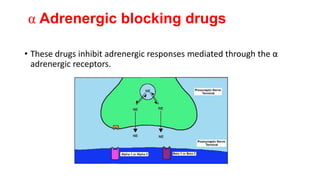
α Adrenergic blocking drugs
• These drugs inhibit adrenergic responses mediated through the α
adrenergic receptors.
General effects of α blockers
• 1. Blockade of vasoconstrictor α1 (also α2) receptors reduces
peripheral resistance and causes pooling of blood in capacitance
vessels → venous return and cardiac output are reduced → fall in
BP.
• Postural reflex is interfered with → marked hypotension occurs on
standing → dizziness and syncope.
General effects of α blockers
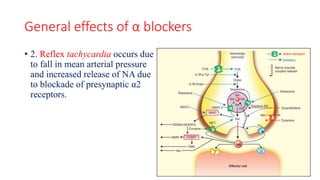
• 2. Reflex tachycardia occurs due
to fall in mean arterial pressure
and increased release of NA due
to blockade of presynaptic α2
receptors.
General effects of α blockers
• 3. Nasal stuffiness result from blockade of α receptors in nasal blood
vessels.
General effects of α blockers
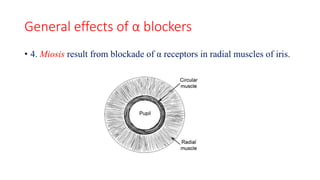
• 4. Miosis result from blockade of α receptors in radial muscles of iris.
General effects of α blockers
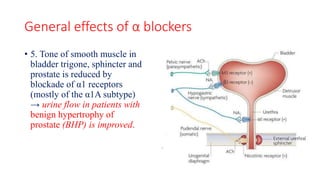
• 5. Tone of smooth muscle in
bladder trigone, sphincter and
prostate is reduced by
blockade of α1 receptors
(mostly of the α1A subtype)
→ urine flow in patients with
benign hypertrophy of
prostate (BHP) is improved.
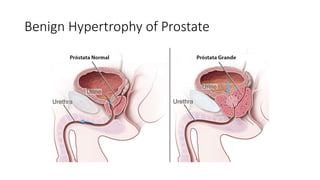
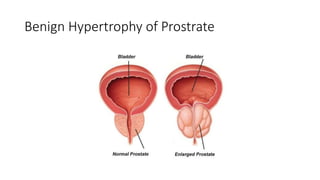
Benign Hypertrophy of Prostate
General effects of α blockers
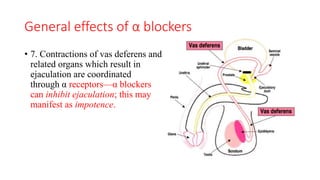
• 7. Contractions of vas deferens and
related organs which result in
ejaculation are coordinated
through α receptors—α blockers
can inhibit ejaculation; this may
manifest as impotence.
α Blockers
Phenoxybenzamine
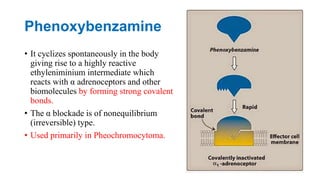
• It cyclizes spontaneously in the body
giving rise to a highly reactive
ethyleniminium intermediate which
reacts with α adrenoceptors and other
biomolecules by forming strong covalent
bonds.
• The α blockade is of nonequilibrium
(irreversible) type.
• Used primarily in Pheochromocytoma.
Phentolamine
• This is a rapidly acting α blocker with short duration of action (in
minutes).
• It is used as a quick and short acting α blocker for diagnosis and
intraoperative management of pheochromocytoma.
Pheochromocytoma
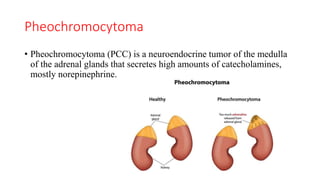
• Pheochromocytoma (PCC) is a neuroendocrine tumor of the medulla
of the adrenal glands that secretes high amounts of catecholamines,
mostly norepinephrine.
Prazosin
• It is first of the highly selective α1 blockers having α1 : α2 selectivity
ratio 1000:1.
• All subtypes of α1 receptor (α1A, α1B, α1D) are blocked equally.
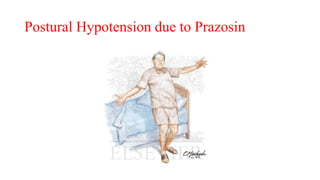
• Postural hypotension is less marked, occurs especially in the
beginning, which may cause dizziness and fainting as ‘first dose
effect’. This can be minimized by starting with a low dose
and taking it at bedtime.
• Other α blocking side effects (miosis, nasal stuffiness, inhibition of
ejaculation) are also milder.
Postural Hypotension due to Prazosin
Prazosin
• Pharmacokinetics
• Prazosin is effective orally (bioavailability ~60%).
• Its plasma t½ is 2– 3 hours; effect of a single dose lasts for 6–8 hours.
Prazosin-Uses
• Prazosin is primarily used as an antihypertensive.
• Other uses are— Benign hypertrophy of prostate (BHP).
• Prazosin blocks α1 receptors in bladder trigone and prostatic smooth
muscle, thereby improves urine flow, reduces residual urine in bladder.
• Dose: Prazosin GITS (gastrointestinal therapeutic system) 2.5 mg and
5 mg tablets; 1 tab OD.
Terazosin
• Higher bioavailability (90%) and longer plasma t½ (~12 hr);
• a single daily dose lowers BP over 24 hrs.
• Terazosin is more popular for use in BHP due to single daily dose and
a probable apoptosis promoting effect on prostate.
Doxazosin
• Another long acting (t½ 18 hr) congener of prazosin with
pharmacological profile, similar to terazosin, including the apoptosis
promoting effect on prostate.
• It is used in hypertension and BHP.
Tamsulosin (Uroselective)
• This relatively uroselective α1A/ α1D blocker (α1A : α1B affinity 7–
38 fold) has been found as effective as terazosin in improving
BHP symptoms, because α1A subtype predominate in the bladder base
and prostate.
• However, it lacks the prostatic apoptosis promoting property of
terazosin and doxazosin.
• Tamsulosin does not cause significant changes in BP or HR at doses
which relieve urinary symptoms, and it is not used as an
antihypertensive.
Tamsulosin
• It may be a better tolerated α1 blocker for BHP in patients who
continue to suffer postural hypotension with terazosin/doxazosin.
• Dose: 0.4 mg MR cap; 1 cap (max 2) in the morning with meals.
Uses of α blockers 1. Pheochromocytoma
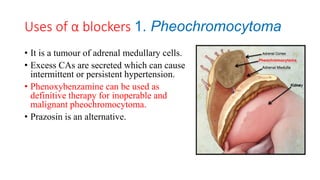
• It is a tumour of adrenal medullary cells.
• Excess CAs are secreted which can cause
intermittent or persistent hypertension.
• Phenoxybenzamine can be used as
definitive therapy for inoperable and
malignant pheochromocytoma.
• Prazosin is an alternative.
Uses of α blockers 1. Pheochromocytoma
• When surgical removal of the tumour is contemplated, it is desirable to
give phenoxybenzamine orally for 1–2 weeks preoperatively and
infuse it i.v. during surgery.
• The rationale is:
(i) Due to excess circulating CAs blood volume is low (they shift fluid
from vascular to extravascular compartment). Treatment with α
blocker normalizes blood volume and distribution of body
water.
• (ii) Handling of the tumour during surgery may cause outpouring of
CAs in blood → marked rise in BP. This is prevented by
phenoxybenzamine given pre and intraoperatively.
Uses of α blockers 2. Hypertension
• α blockers other than those selective for α1 (prazosin-like) have been a
failure in the management of essential hypertension,
because vasodilatation is compensated by cardiac stimulation.
• Moreover, postural hypotension, impotence, nasal blockage and other
side effects produced by nonselective α blockers are unacceptable.
Uses of α blockers 3. Benign hypertrophy of
prostate (BHP)
• The urinary obstruction caused by BHP has a static component due to
increased size of prostate and a dynamic component due to increased
tone of bladder neck/prostate smooth muscle.
• Two classes of drugs are available:
• α1 adrenergic blockers (prazosin like): decrease tone of
prostatic/bladder neck muscles.
• 5-α reductase inhibitor (finasteride): arrest growth/reduce size of
prostate
Benign Hypertrophy of Prostrate
Uses of α blockers 3. Benign hypertrophy of
prostate (BHP)
• Terazosin, doxazosin and tamsulosin are the peferred α1 blockers
because of once daily dosing.
• There is some evidence that terazosin and doxazosin promote
apoptosis in prostate.
• Tamsulosin appears to cause fewer vascular side effects because of
relative α1A /α1D selectivity.
Thank You

Alpha blockers

  • 1.
    Adrenergic Antagonists α blockers Dr.Pramod P Bhalerao (M.D.) Asst. Professor Dept. of Pharmacology
  • 2.
    α Adrenergic blockingdrugs • These drugs inhibit adrenergic responses mediated through the α adrenergic receptors.
  • 4.
    General effects ofα blockers • 1. Blockade of vasoconstrictor α1 (also α2) receptors reduces peripheral resistance and causes pooling of blood in capacitance vessels → venous return and cardiac output are reduced → fall in BP. • Postural reflex is interfered with → marked hypotension occurs on standing → dizziness and syncope.
  • 5.
    General effects ofα blockers • 2. Reflex tachycardia occurs due to fall in mean arterial pressure and increased release of NA due to blockade of presynaptic α2 receptors.
  • 6.
    General effects ofα blockers • 3. Nasal stuffiness result from blockade of α receptors in nasal blood vessels.
  • 7.
    General effects ofα blockers • 4. Miosis result from blockade of α receptors in radial muscles of iris.
  • 8.
    General effects ofα blockers • 5. Tone of smooth muscle in bladder trigone, sphincter and prostate is reduced by blockade of α1 receptors (mostly of the α1A subtype) → urine flow in patients with benign hypertrophy of prostate (BHP) is improved.
  • 9.
  • 10.
    General effects ofα blockers • 7. Contractions of vas deferens and related organs which result in ejaculation are coordinated through α receptors—α blockers can inhibit ejaculation; this may manifest as impotence.
  • 11.
  • 12.
    Phenoxybenzamine • It cyclizesspontaneously in the body giving rise to a highly reactive ethyleniminium intermediate which reacts with α adrenoceptors and other biomolecules by forming strong covalent bonds. • The α blockade is of nonequilibrium (irreversible) type. • Used primarily in Pheochromocytoma.
  • 13.
    Phentolamine • This isa rapidly acting α blocker with short duration of action (in minutes). • It is used as a quick and short acting α blocker for diagnosis and intraoperative management of pheochromocytoma.
  • 14.
    Pheochromocytoma • Pheochromocytoma (PCC)is a neuroendocrine tumor of the medulla of the adrenal glands that secretes high amounts of catecholamines, mostly norepinephrine.
  • 15.
    Prazosin • It isfirst of the highly selective α1 blockers having α1 : α2 selectivity ratio 1000:1. • All subtypes of α1 receptor (α1A, α1B, α1D) are blocked equally. • Postural hypotension is less marked, occurs especially in the beginning, which may cause dizziness and fainting as ‘first dose effect’. This can be minimized by starting with a low dose and taking it at bedtime. • Other α blocking side effects (miosis, nasal stuffiness, inhibition of ejaculation) are also milder.
  • 16.
  • 17.
    Prazosin • Pharmacokinetics • Prazosinis effective orally (bioavailability ~60%). • Its plasma t½ is 2– 3 hours; effect of a single dose lasts for 6–8 hours.
  • 18.
    Prazosin-Uses • Prazosin isprimarily used as an antihypertensive. • Other uses are— Benign hypertrophy of prostate (BHP). • Prazosin blocks α1 receptors in bladder trigone and prostatic smooth muscle, thereby improves urine flow, reduces residual urine in bladder. • Dose: Prazosin GITS (gastrointestinal therapeutic system) 2.5 mg and 5 mg tablets; 1 tab OD.
  • 19.
    Terazosin • Higher bioavailability(90%) and longer plasma t½ (~12 hr); • a single daily dose lowers BP over 24 hrs. • Terazosin is more popular for use in BHP due to single daily dose and a probable apoptosis promoting effect on prostate.
  • 20.
    Doxazosin • Another longacting (t½ 18 hr) congener of prazosin with pharmacological profile, similar to terazosin, including the apoptosis promoting effect on prostate. • It is used in hypertension and BHP.
  • 21.
    Tamsulosin (Uroselective) • Thisrelatively uroselective α1A/ α1D blocker (α1A : α1B affinity 7– 38 fold) has been found as effective as terazosin in improving BHP symptoms, because α1A subtype predominate in the bladder base and prostate. • However, it lacks the prostatic apoptosis promoting property of terazosin and doxazosin. • Tamsulosin does not cause significant changes in BP or HR at doses which relieve urinary symptoms, and it is not used as an antihypertensive.
  • 22.
    Tamsulosin • It maybe a better tolerated α1 blocker for BHP in patients who continue to suffer postural hypotension with terazosin/doxazosin. • Dose: 0.4 mg MR cap; 1 cap (max 2) in the morning with meals.
  • 23.
    Uses of αblockers 1. Pheochromocytoma • It is a tumour of adrenal medullary cells. • Excess CAs are secreted which can cause intermittent or persistent hypertension. • Phenoxybenzamine can be used as definitive therapy for inoperable and malignant pheochromocytoma. • Prazosin is an alternative.
  • 24.
    Uses of αblockers 1. Pheochromocytoma • When surgical removal of the tumour is contemplated, it is desirable to give phenoxybenzamine orally for 1–2 weeks preoperatively and infuse it i.v. during surgery. • The rationale is: (i) Due to excess circulating CAs blood volume is low (they shift fluid from vascular to extravascular compartment). Treatment with α blocker normalizes blood volume and distribution of body water. • (ii) Handling of the tumour during surgery may cause outpouring of CAs in blood → marked rise in BP. This is prevented by phenoxybenzamine given pre and intraoperatively.
  • 25.
    Uses of αblockers 2. Hypertension • α blockers other than those selective for α1 (prazosin-like) have been a failure in the management of essential hypertension, because vasodilatation is compensated by cardiac stimulation. • Moreover, postural hypotension, impotence, nasal blockage and other side effects produced by nonselective α blockers are unacceptable.
  • 26.
    Uses of αblockers 3. Benign hypertrophy of prostate (BHP) • The urinary obstruction caused by BHP has a static component due to increased size of prostate and a dynamic component due to increased tone of bladder neck/prostate smooth muscle. • Two classes of drugs are available: • α1 adrenergic blockers (prazosin like): decrease tone of prostatic/bladder neck muscles. • 5-α reductase inhibitor (finasteride): arrest growth/reduce size of prostate
  • 27.
  • 28.
    Uses of αblockers 3. Benign hypertrophy of prostate (BHP) • Terazosin, doxazosin and tamsulosin are the peferred α1 blockers because of once daily dosing. • There is some evidence that terazosin and doxazosin promote apoptosis in prostate. • Tamsulosin appears to cause fewer vascular side effects because of relative α1A /α1D selectivity.
  • 29.