5-Hydroxytryptamine, its
Antagonists and Drug Therapy
of Migraine
Dr. Anubhuti Khare
Asst. Prof.
Dept. of Pharmacology
5-HYDROXYTRYPTAMINE
(5-HT, Serotonin)
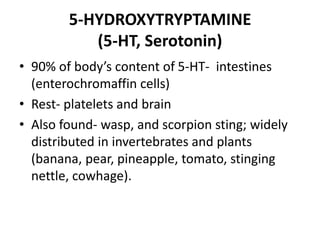
• 90% of body’s content of 5-HT- intestines
(enterochromaffin cells)
• Rest- platelets and brain
• Also found- wasp, and scorpion sting; widely
distributed in invertebrates and plants
(banana, pear, pineapple, tomato, stinging
nettle, cowhage).
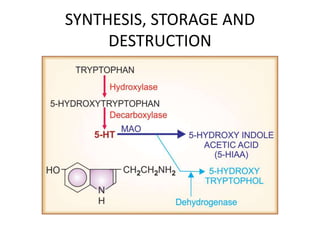
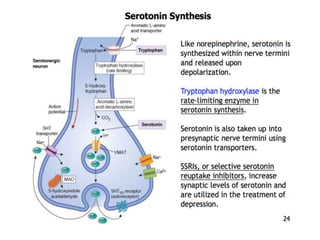
SYNTHESIS, STORAGE AND
DESTRUCTION
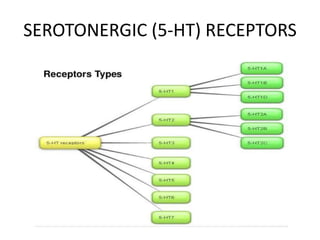
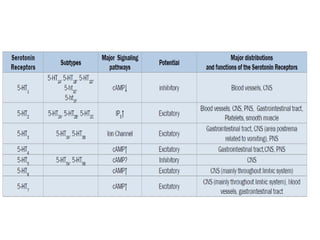
SEROTONERGIC (5-HT) RECEPTORS
Pharmacological actions
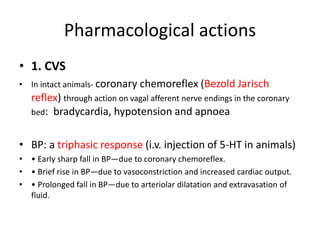
• 1. CVS
• In intact animals- coronary chemoreflex (Bezold Jarisch
reflex) through action on vagal afferent nerve endings in the coronary
bed: bradycardia, hypotension and apnoea
• BP: a triphasic response (i.v. injection of 5-HT in animals)
• • Early sharp fall in BP—due to coronary chemoreflex.
• • Brief rise in BP—due to vasoconstriction and increased cardiac output.
• • Prolonged fall in BP—due to arteriolar dilatation and extravasation of
fluid.
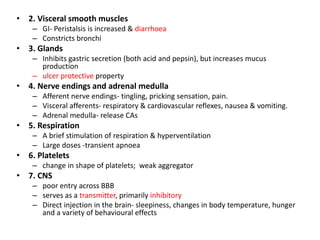
• 2. Visceral smooth muscles
– GI- Peristalsis is increased & diarrhoea
– Constricts bronchi
• 3. Glands
– Inhibits gastric secretion (both acid and pepsin), but increases mucus
production
– ulcer protective property
• 4. Nerve endings and adrenal medulla
– Afferent nerve endings- tingling, pricking sensation, pain.
– Visceral afferents- respiratory & cardiovascular reflexes, nausea & vomiting.
– Adrenal medulla- release CAs
• 5. Respiration
– A brief stimulation of respiration & hyperventilation
– Large doses -transient apnoea
• 6. Platelets
– change in shape of platelets; weak aggregator
• 7. CNS
– poor entry across BBB
– serves as a transmitter, primarily inhibitory
– Direct injection in the brain- sleepiness, changes in body temperature, hunger
and a variety of behavioural effects
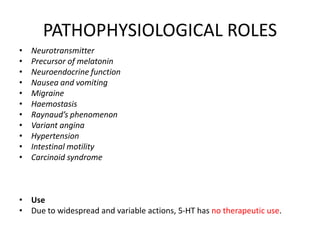
PATHOPHYSIOLOGICAL ROLES
• Neurotransmitter
• Precursor of melatonin
• Neuroendocrine function
• Nausea and vomiting
• Migraine
• Haemostasis
• Raynaud’s phenomenon
• Variant angina
• Hypertension
• Intestinal motility
• Carcinoid syndrome
• Use
• Due to widespread and variable actions, 5-HT has no therapeutic use.
DRUGS AFFECTING 5-HT SYSTEM
• Tryptophan
5-HT precursor
• p-Chlorophenylalanine (PCPA) inhibits tryptophan
hydroxylase (rate limiting step)
Synthesis inhibitor
• TCAs
• SSRIs
Uptake inhibitor
• Reserpine- inhibits VMAT-2
• Fenfluramine- release causing depletion
Storage inhibitor
• Nonselective MAO inhibitor(tranylcypromine)
• selective MAO-A inhibitor (clorgyline)
Degradation inhibitor
• 5, 6 dihydroxytryptamine selectively destroys 5-HT
neurones.
Neuronal degeneration
• D-Lysergic acid diethyl amide
(LSD)- nonselective 5-HT
agonist; hallucinogenic
• Azapirones (buspirone,
gepirone ,ipsapirone)-
antianxiety drugs. PA 5-HT1A
receptors
• Sumatriptan and other
triptans - selective 5-
HT1D/1B agonists; T/t of
MIGRAINE
• Cisapride Renzapride -
prokinetic drugs; selective 5-
HT4 agonist.
5-HT
receptor
agonists
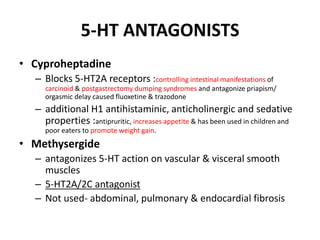
5-HT ANTAGONISTS
• Cyproheptadine
– Blocks 5-HT2A receptors :controlling intestinal manifestations of
carcinoid & postgastrectomy dumping syndromes and antagonize priapism/
orgasmic delay caused fluoxetine & trazodone
– additional H1 antihistaminic, anticholinergic and sedative
properties :antipruritic, increases appetite & has been used in children and
poor eaters to promote weight gain.
• Methysergide
– antagonizes 5-HT action on vascular & visceral smooth
muscles
– 5-HT2A/2C antagonist
– Not used- abdominal, pulmonary & endocardial fibrosis
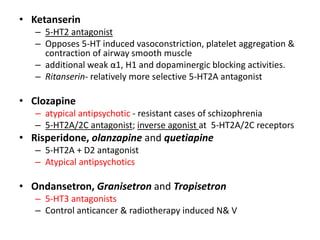
• Ketanserin
– 5-HT2 antagonist
– Opposes 5-HT induced vasoconstriction, platelet aggregation &
contraction of airway smooth muscle
– additional weak α1, H1 and dopaminergic blocking activities.
– Ritanserin- relatively more selective 5-HT2A antagonist
• Clozapine
– atypical antipsychotic - resistant cases of schizophrenia
– 5-HT2A/2C antagonist; inverse agonist at 5-HT2A/2C receptors
• Risperidone, olanzapine and quetiapine
– 5-HT2A + D2 antagonist
– Atypical antipsychotics
• Ondansetron, Granisetron and Tropisetron
– 5-HT3 antagonists
– Control anticancer & radiotherapy induced N& V
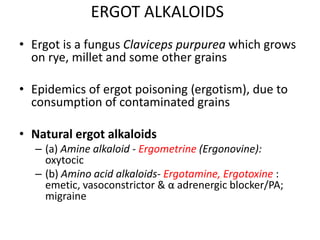
ERGOT ALKALOIDS
• Ergot is a fungus Claviceps purpurea which grows
on rye, millet and some other grains
• Epidemics of ergot poisoning (ergotism), due to
consumption of contaminated grains
• Natural ergot alkaloids
– (a) Amine alkaloid - Ergometrine (Ergonovine):
oxytocic
– (b) Amino acid alkaloids- Ergotamine, Ergotoxine :
emetic, vasoconstrictor & α adrenergic blocker/PA;
migraine
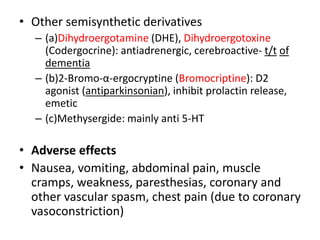
• Other semisynthetic derivatives
– (a)Dihydroergotamine (DHE), Dihydroergotoxine
(Codergocrine): antiadrenergic, cerebroactive- t/t of
dementia
– (b)2-Bromo-α-ergocryptine (Bromocriptine): D2
agonist (antiparkinsonian), inhibit prolactin release,
emetic
– (c)Methysergide: mainly anti 5-HT
• Adverse effects
• Nausea, vomiting, abdominal pain, muscle
cramps, weakness, paresthesias, coronary and
other vascular spasm, chest pain (due to coronary
vasoconstriction)
Selective 5-HT1D/1B agonists
(Triptans)
• Currently, first line drugs for patients who fail to respond to
analgesics [sumatriptan, riza., frova., nara., zolmi.]
• MOA
– 5-HT1D/1B receptor mediated constriction of dilated cranial blood
vessels (in AV shunts in the carotid artery)
– 5-HT1D/1B are presynaptic autoreceptors: triptans reduce 5-HT
release at these blood vessels
– inhibit inflammatory neuropeptide release around the affected vessels
as well as extravasation of plasma proteins across dural vessels
– suppress neurogenic inflammation of cranial vessels
• All triptans: significant pharmacokinetic differences
• Sumatriptan- lowest BA; absorbed rapidly and completely after s.c.
injection; intranasal spray
• Naratriptan & Frovatriptan- longer t½; fewer headache recurrences;
slow in affording initial pain relief.
• Side effects-
– Tightness in head & chest, feeling of heat & other paresthesias
in limbs, dizziness, weakness
– Slight rise in BP; bradycardia, coronary vasospasm & risk of MI-
rare but serious
• Contraindications:
– Ischaemic heart disease, hypertension, epilepsy, hepatic or renal
impairment & pregnancy ; cautioned not to drive.
• Sumatriptan and ergotamine should not be administered
within 24 hours of each other.
• Interaction with 5-HT reuptake inhibitors, MAO inhibitors &
lithium
MIGRAINE
• Pulsating headache
• usually restricted to one side
• attacks lasting 4–48 hours
• often associated with nausea, vomiting,
sensitivity to light and sound, flashes of light,
vertigo, loose motions and other symptoms
• Two major types
– —migraine with aura (classical migraine)
– —migraine without aura (common migraine)
• Pathogenesis
– Vascular theory
– Neurogenic theory
• Mild migraine
– fewer than one attack per month
– lasts upto 8 hours
– does not incapacitate the individual
– Drug therapy - Simple analgesics/NSAIDs or their
combinations (± antiemetic)
– Paracetamol, aspirin, ibuprofen, naproxen, diclofenac
either alone or combined with paracetamol/codeine/
diazepam or another sedative/diphenhydramine or
another antihistaminic/caffeine
• Moderate migraine
– One or more attacks per month
– lasts for 6–24 hours
– Throbbing headache more intense, nausea/vomiting & other
features more prominent
– Patient is functionally impaired
– Drug therapy- NSAIDs combinations/a triptan/ ergot alkaloids
(+ antiemetic)
– Prophylactic therapy advised: attacks more frequent than 2–3
per month
• Severe migraine
– 2–3 or more attacks per month of
– lasts 12–48 hours
– severe throbbing headache, vertigo, vomiting and other
symptoms
– Pt. grossly incapacitated during the attack
– Drug therapy- a Triptan/ergot alkaloids (+ antiemetic)
+ Prophylaxis
PROPHYLAXIS OF MIGRAINE
• (i) β-Adrenergic blockers- Propranolol
• (ii) Tricyclic antidepressants- Amitriptyline
• (iii) Calcium channel blockers- Verapamil
– Flunarizine- cerebro-selective CCB, also inhibits Na+ channels
• (iv)Anticonvulsants - Valproic acid, gabapentin, topiramate
• (v) CGRP antagonist- monoclonal antibody Erenumab (s.c. once a
month)
• Q. Serotonin can be synthesized from:
– a) Tryptophan
– b) Tyrosine
– c) Dopa
– d) Epinephrine
• Q. Drug which blocks both H1 & 5HT2 receptor:
– a) Phenoxybenzamine
– b) Cyprohepatidine
– c) Ritanserin
– d) Ondansetron
• Q. After taking some drug for acute attack of
migraine, a patient developed nausea & vomiting.
He also developed tingling & numbness in the tip
of the finger that also turned blue. Which of the
following is the most likely drug implicated in
causing the above findings?
– a) Dihydroergotamine
– b) Sumatriptan
– c) Aspirin
– d) Butorphanol