Akash Mali,India
Vytautas Magnus University ,Lithuania
• The diploid human genome including twenty-three pairs of
chromosomes is composed of 20–25 thousand genes.
•DNA (Adenine, Thymine, Cytosine and Guanine )
•An allele is positioned on a locus, the specific location of a gene or
DNA sequence on a chromosome; so the diploid genome contains
two alleles of each gene
•Chromosomes 1 to 22 are called autosomes and the twenty-third
pair is the sex chromosomes, i.e. X and Y
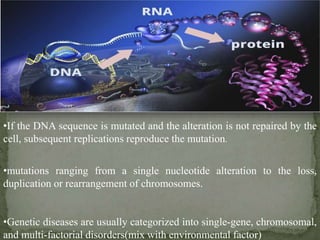
•If the DNA sequence is mutated and the alteration is not repaired by the
cell, subsequent replications reproduce the mutation.
•mutations ranging from a single nucleotide alteration to the loss,
duplication or rearrangement of chromosomes.
•Genetic diseases are usually categorized into single-gene, chromosomal,
and multi-factorial disorders(mix with environmental factor)
• Single gene disorders arising from errors in DNA sequence of a gene
are categorized into autosomal dominant (AD), autosomal recessive
(AR), X-linked recessive (XR), X-linked dominant and Y-linked
(holandric) disorders.
•In autosomal dominant disorders, damage in one allele of a pair of the
gene leads to the deficiency , e.g. a mutation in FGFR3 gene can cause
achondroplasia.
•Mutations in both alleles (loss of function) of a gene are required to
cause the defect to appear in an autosomal recessive disorder, i.e. an
affected person has got one abnormal allele from one heterozygous
parent. In this type of disorders, there is a 25% chance of having an
affected offspring for heterozygous parents
•Somatic cells proliferate via division called mitosis while germ
cells are produced through meiosis division.
•Oogenesis begins in the female fetus at 12 weeks, but it is stopped
in a stage of meiosis I
•Aneuploidy is usually due to failure of segregation of chromosomes
in meiosis I or meiosis II .
examples of numerical aberrations include Down
syndrome (trisomy 21), Edwards syndrome (trisomy 18), Patau
syndrome (trisomy 13), Klinefelter syndrome (XXY syndrome),
Turner syndrome (monosomy X) and trisomy X. Chromosomal
errors in oocytes are increased dramatically with maternal age
•Mutations can also be categorized on the basis of the function:
1) The loss-of-function mutations cause a decrease or a loss of
the gene product or the activity of the gene product.
2)The gain-of-function mutations cause an increase in the
amount of gene product or its activity, and sometimes create a new
property, leading to a toxic product responsible for a pathological
effect.
•The detection of mutations has an increasingly
central role in various areas of genetic diagnosis
including preimplantation genetic diagnosis (PGD),
prenatal diagnosis (PND), presymptomatic testing,
confirmational diagnosis and forensic/identity
testing.
• There are two approaches for genetic diagnosis:
Direct: diagnosis essentially depends on the detection of the genetic
variations responsible for the disease.
Indirect: depends on the results from a genetic linkage analysis using
DNA markers such as STR(short tandem repeat) or VNTR (variable
number tandem repeat) markers flanking or within the gene
•Two groups of tests, molecular and cytogenetic, are used in genetic
syndromes.
• Chromosome studies are advised in the following situations:
suspected chromosome abnormality, sexual disorders, multiple
congenital anomalies and/or developmental retardation, undiagnosed
learning disabilities, infertility .
• Traditionally, the microscopic study of chromosomes is performed on
compacted chromosomes at a magnification of about 1000 at metaphase
•Preparation of a visual karyotype is done by arresting dividing cells at
metaphase stage with a microtubule polymerization inhibitor such as
colchicine; the cells, then, are spread on a glass slide and stained with
Giemsa stain (G-banding)
Conventional Karyotyping
Fluorescence in situ hybridization (FISH)
•FISH is applied to provide specific localization of genes on
chromosomes. Rapid diagnosis of trisomies and microdeletions is
acquired using specific probes. Usually a denatured probe is added to a
metaphase chromosome spread and incubated overnight to allow
sequence-specific hybridization.
Comparative genomic hybridization (CGH)
CGH, a special FISH technique (dual probes), is applied for detecting all genomic
imbalances. The basics of technique is comparison of total genomic DNA of the
given sample DNA (e.g. tumor DNA) with total genomic DNA of normal cells.
It is used to determine copy number alterations of genome in cancer and
those cells whose karyotype is hard or impossible to prepare or analyze.
In array-CGH, metaphase slide is replaced by specific DNA sequences,
spotted in arrays on glass slides; so its resolution is increased.
•It combines laboratory medicine with molecular genetics to develop
DNA/RNA-based analytical methods for monitoring human pathologies.
A wide range of methods has been used for mutation detection
Known Mutations
Molecular diagnostics
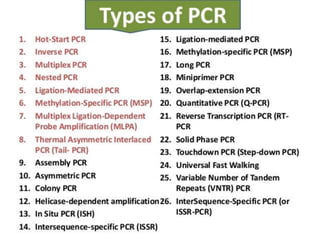
•Polymerase chain reaction (PCR) and its versions
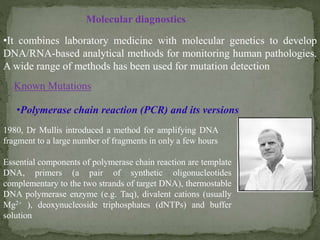
1980, Dr Mullis introduced a method for amplifying DNA
fragment to a large number of fragments in only a few hours
Essential components of polymerase chain reaction are template
DNA, primers (a pair of synthetic oligonucleotides
complementary to the two strands of target DNA), thermostable
DNA polymerase enzyme (e.g. Taq), divalent cations (usually
Mg2+ ), deoxynucleoside triphosphates (dNTPs) and buffer
solution
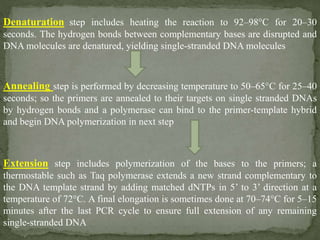
Denaturation step includes heating the reaction to 92–98°C for 20–30
seconds. The hydrogen bonds between complementary bases are disrupted and
DNA molecules are denatured, yielding single-stranded DNA molecules
Annealing step is performed by decreasing temperature to 50–65°C for 25–40
seconds; so the primers are annealed to their targets on single stranded DNAs
by hydrogen bonds and a polymerase can bind to the primer-template hybrid
and begin DNA polymerization in next step
Extension step includes polymerization of the bases to the primers; a
thermostable such as Taq polymerase extends a new strand complementary to
the DNA template strand by adding matched dNTPs in 5’ to 3’ direction at a
temperature of 72°C. A final elongation is sometimes done at 70–74°C for 5–15
minutes after the last PCR cycle to ensure full extension of any remaining
single-stranded DNA
•Reverse transcriptase PCR (RT-PCR): In this version, a strand of RNA
molecule is transcribed reversely into its complementary DNA (cDNA) using
the reverse transcriptase enzyme.
•Multiplex PCR: In this technique, multiple selected target regions in a
sample are amplified simultaneously using different pairs of primers.
•Nested PCR: It includes two successive PCRs; the product of the first PCR
reaction is used as a template for the second PCR. This type of PCR is
employed to amplify templates in low copy numbers in specimens. It has the
benefits of increased sensitivity and specificity.
•Real time PCR: In this technique, the amplified DNA is detected as the PCR
progresses. It is commonly used in gene expression studies and quantification
of initial copy number of the target.
•Amplification refractory mutation system (ARMS) PCR: Allele-specific
amplification (AS-PCR) or ARMS-PCR is a general technique for the
detection of any point mutation or small deletion.
•DNA microarray DNA “chips” or microarrays have been used as a possible
testing for multiple mutations. In this technology, single DNA strands including
sequences of different targets are fixed to a solid support in an array format. On
the other hand, the sample DNA or cDNA labeled with fluorescent dyes is
hybridized to the chip Then using a laser system, the presence of fluorescence
is checked; the sequences and their quantities in the sample are determined.
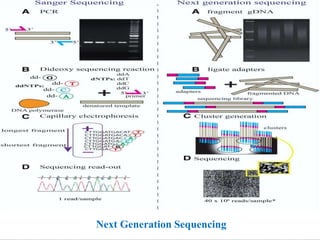
•DNA Sequencing: As a powerful technique in molecular genetics, DNA
sequencing provides analysis of genes at the nucleotide level. The main aim of
DNA sequencing is to determine the sequence of small regions of interest (∼1
kilobase) using a PCR product as a template. Dideoxynucleotide sequencing or
Sanger sequencing represents the most widely used technique for sequencing
DNA
•Multiplex ligation-dependent probe amplification (MLPA): MLPA is
commonly applied to screen deletions and duplications of up to 50 different
genomic DNA or RNA sequences
Unknown Mutations
Single Strand Conformational Polymorphism (SSCP)
DNA fragments are denatured, and renatured under
special conditions preventing the formation of double-
stranded DNA and allowing conformational structures to
form in single-stranded fragments
Denaturing Gradient Gel Electrophoresis (DGGE)
It is based on differences in the melting behavior of small
DNA fragments (200-700 bp); even a single base
substitution can cause such a difference. In this technique,
DNA is first extracted and subjected to denaturing gradient
gel electrophoresis.
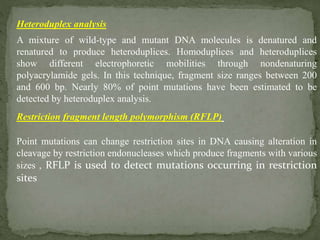
Heteroduplex analysis
A mixture of wild-type and mutant DNA molecules is denatured and
renatured to produce heteroduplices. Homoduplices and heteroduplices
show different electrophoretic mobilities through nondenaturing
polyacrylamide gels. In this technique, fragment size ranges between 200
and 600 bp. Nearly 80% of point mutations have been estimated to be
detected by heteroduplex analysis.
Restriction fragment length polymorphism (RFLP)
Point mutations can change restriction sites in DNA causing alteration in
cleavage by restriction endonucleases which produce fragments with various
sizes , RFLP is used to detect mutations occurring in restriction
sites
Next Generation Sequencing
Conclusion
• PCR as a powerful and sensitive technique
can amplify very small amounts of DNA.
• Characterization of the genetic basis of the
disease is required for an accurate diagnosis.
• Molecular diagnosis of genetic disorders is noticed as the detection of the
pathogenic mutations in DNA and/or RNA samples. It could facilitate fine
subclassification, prognosis, and therapy of disorders.
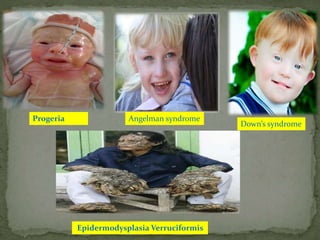
Down’s syndrome
Angelman syndromeProgeria
Epidermodysplasia Verruciformis
Mutation detection methods in genetic disorders

Mutation detection methods in genetic disorders

  • 1.
    Akash Mali,India Vytautas MagnusUniversity ,Lithuania
  • 2.
    • The diploidhuman genome including twenty-three pairs of chromosomes is composed of 20–25 thousand genes. •DNA (Adenine, Thymine, Cytosine and Guanine ) •An allele is positioned on a locus, the specific location of a gene or DNA sequence on a chromosome; so the diploid genome contains two alleles of each gene •Chromosomes 1 to 22 are called autosomes and the twenty-third pair is the sex chromosomes, i.e. X and Y
  • 3.
    •If the DNAsequence is mutated and the alteration is not repaired by the cell, subsequent replications reproduce the mutation. •mutations ranging from a single nucleotide alteration to the loss, duplication or rearrangement of chromosomes. •Genetic diseases are usually categorized into single-gene, chromosomal, and multi-factorial disorders(mix with environmental factor)
  • 4.
    • Single genedisorders arising from errors in DNA sequence of a gene are categorized into autosomal dominant (AD), autosomal recessive (AR), X-linked recessive (XR), X-linked dominant and Y-linked (holandric) disorders. •In autosomal dominant disorders, damage in one allele of a pair of the gene leads to the deficiency , e.g. a mutation in FGFR3 gene can cause achondroplasia. •Mutations in both alleles (loss of function) of a gene are required to cause the defect to appear in an autosomal recessive disorder, i.e. an affected person has got one abnormal allele from one heterozygous parent. In this type of disorders, there is a 25% chance of having an affected offspring for heterozygous parents
  • 5.
    •Somatic cells proliferatevia division called mitosis while germ cells are produced through meiosis division. •Oogenesis begins in the female fetus at 12 weeks, but it is stopped in a stage of meiosis I •Aneuploidy is usually due to failure of segregation of chromosomes in meiosis I or meiosis II . examples of numerical aberrations include Down syndrome (trisomy 21), Edwards syndrome (trisomy 18), Patau syndrome (trisomy 13), Klinefelter syndrome (XXY syndrome), Turner syndrome (monosomy X) and trisomy X. Chromosomal errors in oocytes are increased dramatically with maternal age
  • 6.
    •Mutations can alsobe categorized on the basis of the function: 1) The loss-of-function mutations cause a decrease or a loss of the gene product or the activity of the gene product. 2)The gain-of-function mutations cause an increase in the amount of gene product or its activity, and sometimes create a new property, leading to a toxic product responsible for a pathological effect.
  • 7.
    •The detection ofmutations has an increasingly central role in various areas of genetic diagnosis including preimplantation genetic diagnosis (PGD), prenatal diagnosis (PND), presymptomatic testing, confirmational diagnosis and forensic/identity testing. • There are two approaches for genetic diagnosis: Direct: diagnosis essentially depends on the detection of the genetic variations responsible for the disease. Indirect: depends on the results from a genetic linkage analysis using DNA markers such as STR(short tandem repeat) or VNTR (variable number tandem repeat) markers flanking or within the gene •Two groups of tests, molecular and cytogenetic, are used in genetic syndromes.
  • 8.
    • Chromosome studiesare advised in the following situations: suspected chromosome abnormality, sexual disorders, multiple congenital anomalies and/or developmental retardation, undiagnosed learning disabilities, infertility . • Traditionally, the microscopic study of chromosomes is performed on compacted chromosomes at a magnification of about 1000 at metaphase •Preparation of a visual karyotype is done by arresting dividing cells at metaphase stage with a microtubule polymerization inhibitor such as colchicine; the cells, then, are spread on a glass slide and stained with Giemsa stain (G-banding) Conventional Karyotyping
  • 9.
    Fluorescence in situhybridization (FISH) •FISH is applied to provide specific localization of genes on chromosomes. Rapid diagnosis of trisomies and microdeletions is acquired using specific probes. Usually a denatured probe is added to a metaphase chromosome spread and incubated overnight to allow sequence-specific hybridization. Comparative genomic hybridization (CGH) CGH, a special FISH technique (dual probes), is applied for detecting all genomic imbalances. The basics of technique is comparison of total genomic DNA of the given sample DNA (e.g. tumor DNA) with total genomic DNA of normal cells. It is used to determine copy number alterations of genome in cancer and those cells whose karyotype is hard or impossible to prepare or analyze. In array-CGH, metaphase slide is replaced by specific DNA sequences, spotted in arrays on glass slides; so its resolution is increased.
  • 10.
    •It combines laboratorymedicine with molecular genetics to develop DNA/RNA-based analytical methods for monitoring human pathologies. A wide range of methods has been used for mutation detection Known Mutations Molecular diagnostics •Polymerase chain reaction (PCR) and its versions 1980, Dr Mullis introduced a method for amplifying DNA fragment to a large number of fragments in only a few hours Essential components of polymerase chain reaction are template DNA, primers (a pair of synthetic oligonucleotides complementary to the two strands of target DNA), thermostable DNA polymerase enzyme (e.g. Taq), divalent cations (usually Mg2+ ), deoxynucleoside triphosphates (dNTPs) and buffer solution
  • 12.
    Denaturation step includesheating the reaction to 92–98°C for 20–30 seconds. The hydrogen bonds between complementary bases are disrupted and DNA molecules are denatured, yielding single-stranded DNA molecules Annealing step is performed by decreasing temperature to 50–65°C for 25–40 seconds; so the primers are annealed to their targets on single stranded DNAs by hydrogen bonds and a polymerase can bind to the primer-template hybrid and begin DNA polymerization in next step Extension step includes polymerization of the bases to the primers; a thermostable such as Taq polymerase extends a new strand complementary to the DNA template strand by adding matched dNTPs in 5’ to 3’ direction at a temperature of 72°C. A final elongation is sometimes done at 70–74°C for 5–15 minutes after the last PCR cycle to ensure full extension of any remaining single-stranded DNA
  • 13.
    •Reverse transcriptase PCR(RT-PCR): In this version, a strand of RNA molecule is transcribed reversely into its complementary DNA (cDNA) using the reverse transcriptase enzyme. •Multiplex PCR: In this technique, multiple selected target regions in a sample are amplified simultaneously using different pairs of primers. •Nested PCR: It includes two successive PCRs; the product of the first PCR reaction is used as a template for the second PCR. This type of PCR is employed to amplify templates in low copy numbers in specimens. It has the benefits of increased sensitivity and specificity. •Real time PCR: In this technique, the amplified DNA is detected as the PCR progresses. It is commonly used in gene expression studies and quantification of initial copy number of the target. •Amplification refractory mutation system (ARMS) PCR: Allele-specific amplification (AS-PCR) or ARMS-PCR is a general technique for the detection of any point mutation or small deletion.
  • 14.
    •DNA microarray DNA“chips” or microarrays have been used as a possible testing for multiple mutations. In this technology, single DNA strands including sequences of different targets are fixed to a solid support in an array format. On the other hand, the sample DNA or cDNA labeled with fluorescent dyes is hybridized to the chip Then using a laser system, the presence of fluorescence is checked; the sequences and their quantities in the sample are determined. •DNA Sequencing: As a powerful technique in molecular genetics, DNA sequencing provides analysis of genes at the nucleotide level. The main aim of DNA sequencing is to determine the sequence of small regions of interest (∼1 kilobase) using a PCR product as a template. Dideoxynucleotide sequencing or Sanger sequencing represents the most widely used technique for sequencing DNA •Multiplex ligation-dependent probe amplification (MLPA): MLPA is commonly applied to screen deletions and duplications of up to 50 different genomic DNA or RNA sequences
  • 15.
    Unknown Mutations Single StrandConformational Polymorphism (SSCP) DNA fragments are denatured, and renatured under special conditions preventing the formation of double- stranded DNA and allowing conformational structures to form in single-stranded fragments Denaturing Gradient Gel Electrophoresis (DGGE) It is based on differences in the melting behavior of small DNA fragments (200-700 bp); even a single base substitution can cause such a difference. In this technique, DNA is first extracted and subjected to denaturing gradient gel electrophoresis.
  • 16.
    Heteroduplex analysis A mixtureof wild-type and mutant DNA molecules is denatured and renatured to produce heteroduplices. Homoduplices and heteroduplices show different electrophoretic mobilities through nondenaturing polyacrylamide gels. In this technique, fragment size ranges between 200 and 600 bp. Nearly 80% of point mutations have been estimated to be detected by heteroduplex analysis. Restriction fragment length polymorphism (RFLP) Point mutations can change restriction sites in DNA causing alteration in cleavage by restriction endonucleases which produce fragments with various sizes , RFLP is used to detect mutations occurring in restriction sites
  • 17.
  • 18.
    Conclusion • PCR asa powerful and sensitive technique can amplify very small amounts of DNA. • Characterization of the genetic basis of the disease is required for an accurate diagnosis. • Molecular diagnosis of genetic disorders is noticed as the detection of the pathogenic mutations in DNA and/or RNA samples. It could facilitate fine subclassification, prognosis, and therapy of disorders.
  • 19.