Multiple paternity in loggerhead turtle
(Caretta caretta) nests on Melbourne
Beach, Florida: a microsatellite analysis
Akash Mali,India
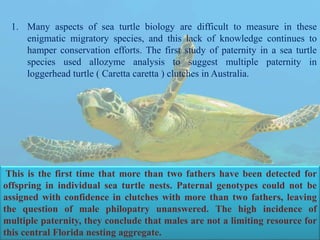
1. Many aspects of sea turtle biology are difficult to measure in these
enigmatic migratory species, and this lack of knowledge continues to
hamper conservation efforts. The first study of paternity in a sea turtle
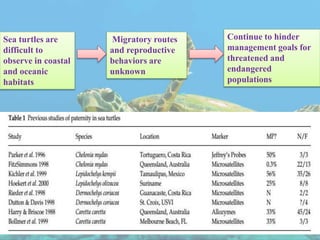
species used allozyme analysis to suggest multiple paternity in
loggerhead turtle ( Caretta caretta ) clutches in Australia.
This is the first time that more than two fathers have been detected for
offspring in individual sea turtle nests. Paternal genotypes could not be
assigned with confidence in clutches with more than two fathers, leaving
the question of male philopatry unanswered. The high incidence of
multiple paternity, they conclude that males are not a limiting resource for
this central Florida nesting aggregate.
Sea turtles are
difficult to
observe in coastal
and oceanic
habitats
Migratory routes
and reproductive
behaviors are
unknown
Continue to hinder
management goals for
threatened and
endangered
populations.
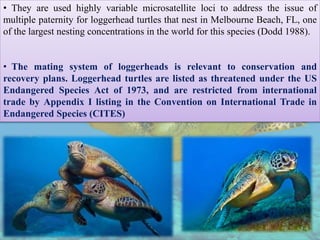
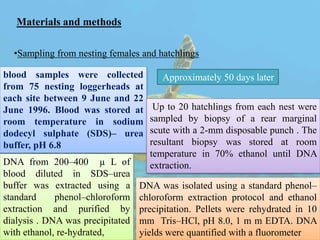
• They are used highly variable microsatellite loci to address the issue of
multiple paternity for loggerhead turtles that nest in Melbourne Beach, FL, one
of the largest nesting concentrations in the world for this species (Dodd 1988).
• The mating system of loggerheads is relevant to conservation and
recovery plans. Loggerhead turtles are listed as threatened under the US
Endangered Species Act of 1973, and are restricted from international
trade by Appendix I listing in the Convention on International Trade in
Endangered Species (CITES)
Materials and methods
•Sampling from nesting females and hatchlings
blood samples were collected
from 75 nesting loggerheads at
each site between 9 June and 22
June 1996. Blood was stored at
room temperature in sodium
dodecyl sulphate (SDS)– urea
buffer, pH 6.8
Approximately 50 days later
Up to 20 hatchlings from each nest were
sampled by biopsy of a rear marginal
scute with a 2-mm disposable punch . The
resultant biopsy was stored at room
temperature in 70% ethanol until DNA
extraction.
DNA was isolated using a standard phenol–
chloroform extraction protocol and ethanol
precipitation. Pellets were rehydrated in 10
mm Tris–HCl, pH 8.0, 1 m m EDTA. DNA
yields were quantified with a fluorometer
DNA from 200–400 µ L of
blood diluted in SDS–urea
buffer was extracted using a
standard phenol–chloroform
extraction and purified by
dialysis . DNA was precipitated
with ethanol, re-hydrated,
Characterization of microsatellites
We constructed a microsatellite-enriched DNA library
Over 300 putative microsatellite clones were sequenced, and many
revealed long (> 400 bp) imperfect repeats, repeat sequences that were
microsatellites within minisatellites, or microsatellites of a desirable
size but with insufficient flanking sequence for primer design.
Allele sizes were assigned using genotyper and genescan analysis software .
DNA from mothers was run alongside DNA from their offspring. Offspring
DNA that yielded novel alleles which indicated a second father was re-
amplified and re-run alongside their mother’s DNA to confirm results. Negative
controls were run with each set of reactions, using 1 µ L of sterile Milli-Q
water in place of the template
Data analysis
Results Population genetic analysis
Alleles shared between mothers and fathers, we could not unequivocally assign
paternal genotypes, so maternal and paternal allele frequencies could not be
com- pared to determine if fathers and mothers represented one population.
Likewise, we could not address the possibility of unequal paternal contribution
Multiple paternity
Of the 150 nests originally marked in this project, 88 nests were located again, caged,
and produced hatchlings. Seventy nests were chosen for analysis because they each had
at least 10 sampled offspring.
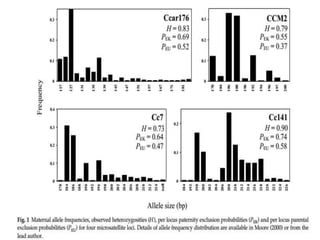
Loci had 10–20 alleles and varied in observed heterozygosity from 0.73 to 0.90
All loci were in Hardy–Weinberg equilibrium ( P = 0.23 for Cc141, P = 0.34 for Cc7,
P = 0.61 for Ccar176, and P = 0.24 for CCM2). Linkage disequilibrium was not
detected for any pair of loci. The paternity exclusion probability with a single locus and
one known parent varied from P EK = 0.55 to P EK = 0.74. With neither parent
known, P EU ranged from 0.37 to 0.58
Discussion
Multiple paternity was common, with 31% of all nests possessing multiple fathers.
The resolution of multiple paternity using molecular techniques is important in
elucidating the basic biology of this little-known species
The advantages of multiple matings are many. If the adult sex ratio is skewed in
this population, it may be that females choose to mate with the first male that
they encounter to ensure fertilization, and then they can ā€˜upgrade’ if they happen
upon a better male later on
the genetic diversity hypothesis is particularly attractive when considered in the
light of known life history patterns. Although females are philopatric, they must
occasionally deviate from natal homing in order to colonize new beaches, as
appropriate nesting habitats come and go over evolutionary time
There is increasing evidence across taxa that sperm competition and post-
copulatory female choice can bias paternity in the offspring of polyandrous
females, and that their offspring gain fitness benefits
These benefits were hypothesized to be due to mate choice, genetic diversity, or
avoidance of genetic incompatibility or inbreeding, the positive effects of
polyandry on the offspring were demonstrable, and there is no reason to suspect
that loggerheads would not likewise benefit from multiple matings.
References
M. K. MOORE and R. M. BALL Jr* , Blackwell Science Ltd Multiple
paternity in loggerhead turtle ( Caretta caretta ) nests on Melbourne Beach,
Florida: a microsatellite analysis , Molecular Ecology (2002) 11 , 281–288
Multiple paternity in loggerhead turtle ( caretta caretta

Multiple paternity in loggerhead turtle ( caretta caretta

  • 1.
    Multiple paternity inloggerhead turtle (Caretta caretta) nests on Melbourne Beach, Florida: a microsatellite analysis Akash Mali,India
  • 2.
    1. Many aspectsof sea turtle biology are difficult to measure in these enigmatic migratory species, and this lack of knowledge continues to hamper conservation efforts. The first study of paternity in a sea turtle species used allozyme analysis to suggest multiple paternity in loggerhead turtle ( Caretta caretta ) clutches in Australia. This is the first time that more than two fathers have been detected for offspring in individual sea turtle nests. Paternal genotypes could not be assigned with confidence in clutches with more than two fathers, leaving the question of male philopatry unanswered. The high incidence of multiple paternity, they conclude that males are not a limiting resource for this central Florida nesting aggregate.
  • 3.
    Sea turtles are difficultto observe in coastal and oceanic habitats Migratory routes and reproductive behaviors are unknown Continue to hinder management goals for threatened and endangered populations.
  • 4.
    • They areused highly variable microsatellite loci to address the issue of multiple paternity for loggerhead turtles that nest in Melbourne Beach, FL, one of the largest nesting concentrations in the world for this species (Dodd 1988). • The mating system of loggerheads is relevant to conservation and recovery plans. Loggerhead turtles are listed as threatened under the US Endangered Species Act of 1973, and are restricted from international trade by Appendix I listing in the Convention on International Trade in Endangered Species (CITES)
  • 5.
    Materials and methods •Samplingfrom nesting females and hatchlings blood samples were collected from 75 nesting loggerheads at each site between 9 June and 22 June 1996. Blood was stored at room temperature in sodium dodecyl sulphate (SDS)– urea buffer, pH 6.8 Approximately 50 days later Up to 20 hatchlings from each nest were sampled by biopsy of a rear marginal scute with a 2-mm disposable punch . The resultant biopsy was stored at room temperature in 70% ethanol until DNA extraction. DNA was isolated using a standard phenol– chloroform extraction protocol and ethanol precipitation. Pellets were rehydrated in 10 mm Tris–HCl, pH 8.0, 1 m m EDTA. DNA yields were quantified with a fluorometer DNA from 200–400 µ L of blood diluted in SDS–urea buffer was extracted using a standard phenol–chloroform extraction and purified by dialysis . DNA was precipitated with ethanol, re-hydrated,
  • 6.
    Characterization of microsatellites Weconstructed a microsatellite-enriched DNA library Over 300 putative microsatellite clones were sequenced, and many revealed long (> 400 bp) imperfect repeats, repeat sequences that were microsatellites within minisatellites, or microsatellites of a desirable size but with insufficient flanking sequence for primer design. Allele sizes were assigned using genotyper and genescan analysis software . DNA from mothers was run alongside DNA from their offspring. Offspring DNA that yielded novel alleles which indicated a second father was re- amplified and re-run alongside their mother’s DNA to confirm results. Negative controls were run with each set of reactions, using 1 µ L of sterile Milli-Q water in place of the template Data analysis
  • 7.
    Results Population geneticanalysis Alleles shared between mothers and fathers, we could not unequivocally assign paternal genotypes, so maternal and paternal allele frequencies could not be com- pared to determine if fathers and mothers represented one population. Likewise, we could not address the possibility of unequal paternal contribution Multiple paternity Of the 150 nests originally marked in this project, 88 nests were located again, caged, and produced hatchlings. Seventy nests were chosen for analysis because they each had at least 10 sampled offspring. Loci had 10–20 alleles and varied in observed heterozygosity from 0.73 to 0.90 All loci were in Hardy–Weinberg equilibrium ( P = 0.23 for Cc141, P = 0.34 for Cc7, P = 0.61 for Ccar176, and P = 0.24 for CCM2). Linkage disequilibrium was not detected for any pair of loci. The paternity exclusion probability with a single locus and one known parent varied from P EK = 0.55 to P EK = 0.74. With neither parent known, P EU ranged from 0.37 to 0.58
  • 9.
    Discussion Multiple paternity wascommon, with 31% of all nests possessing multiple fathers. The resolution of multiple paternity using molecular techniques is important in elucidating the basic biology of this little-known species The advantages of multiple matings are many. If the adult sex ratio is skewed in this population, it may be that females choose to mate with the first male that they encounter to ensure fertilization, and then they can ā€˜upgrade’ if they happen upon a better male later on the genetic diversity hypothesis is particularly attractive when considered in the light of known life history patterns. Although females are philopatric, they must occasionally deviate from natal homing in order to colonize new beaches, as appropriate nesting habitats come and go over evolutionary time
  • 10.
    There is increasingevidence across taxa that sperm competition and post- copulatory female choice can bias paternity in the offspring of polyandrous females, and that their offspring gain fitness benefits These benefits were hypothesized to be due to mate choice, genetic diversity, or avoidance of genetic incompatibility or inbreeding, the positive effects of polyandry on the offspring were demonstrable, and there is no reason to suspect that loggerheads would not likewise benefit from multiple matings.
  • 11.
    References M. K. MOOREand R. M. BALL Jr* , Blackwell Science Ltd Multiple paternity in loggerhead turtle ( Caretta caretta ) nests on Melbourne Beach, Florida: a microsatellite analysis , Molecular Ecology (2002) 11 , 281–288