LEARNING and THE BRAIN
Taking our science lesson forward
Peter Gow
BCDS 2006
August 2006 Progressive Ed 101 @BCDS 2
ABSOLUTE BASICS I
We know that each person’s “cognitive system” is
different—all of us come hard-wired with different
learning styles.
AND, each individual’s “cognitive system” is also
shaped by experience—individual and cultural.
(It’s Nature AND Nurture)
= NO TWO PEOPLE LEARN THE SAME WAY
(and, learning is social)
August 2006 Progressive Ed 101 @BCDS 3
ABSOLUTE BASICS II
The brain NEEDS water, energy, oxygen,
rest, sensory input (= “stimulation”)
The brain LIKES repetition, strong emotional
or sensory associations, patterns,
connection, uncluttered input, positive
reinforcement
August 2006 Progressive Ed 101 @BCDS 4
IMPLICATIONS FOR
EDUCATORS
 Build learning environments and
promote expectations that are
physically, psychologically, and
socially humane; pleasant is good
 Establish personal (emotional)
connections with students
 Shape learning experiences to
respond to a variety of learning styles
August 2006 Progressive Ed 101 @BCDS 5
MORE IMPLICATIONS
 Be flexible and inclusive in the design of
curriculum, assessment, classroom activities
 Be open to student responses that you have
not anticipated
 BUT MOST OF ALL: be thoughtful about
learning styles, pedagogy, curriculum design,
and assessment strategies
August 2006 Progressive Ed 101 @BCDS 6
INTELLIGENCE
What the heck is that?
One of the early 20th
century’s most
entertaining psychological questions
 A measure of “brain capacity” for predictive
purposes; some early theorists literally
measured brain size
 An idea with incredible (and horrific)
potential for the sorting and eugenic
development of humanity
 (White guys in tweeds at the top!)
August 2006 Progressive Ed 101 @BCDS 7
Let’s explore g
(g is the old-time psychologist’s
designation for a kind of intelligence
that is general and above all
measurable--the all-encompassing,
one-stop shopping idea of smarts)
What did we learn?
August 2006 Progressive Ed 101 @BCDS 9
WHO WAS THE SMARTEST
PERSON YOU’VE EVER
KNOWN?
 How did you know s/he was so smart?
 What kind of smart was this person?
 What did being so smart “get” this person?
 What was this person not so smart about?
What did we learn?
August 2006 Progressive Ed 101 @BCDS 11
Contemporary ideas about
“intelligence”
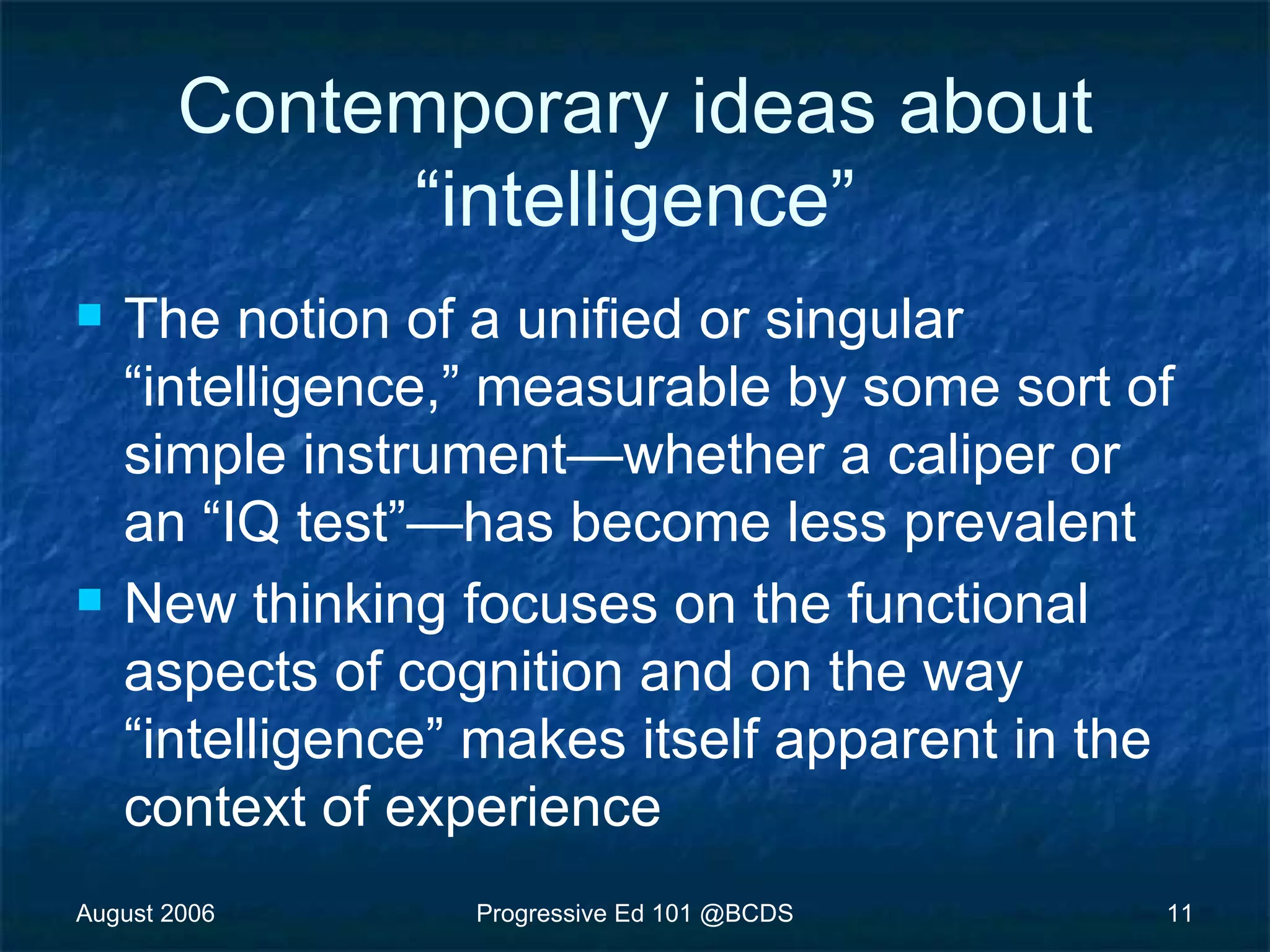
 The notion of a unified or singular
“intelligence,” measurable by some sort of
simple instrument—whether a caliper or
an “IQ test”—has become less prevalent
 New thinking focuses on the functional
aspects of cognition and on the way
“intelligence” makes itself apparent in the
context of experience
August 2006 Progressive Ed 101 @BCDS 12
Multiple-Intelligence Theory
Howard Gardner, 1983
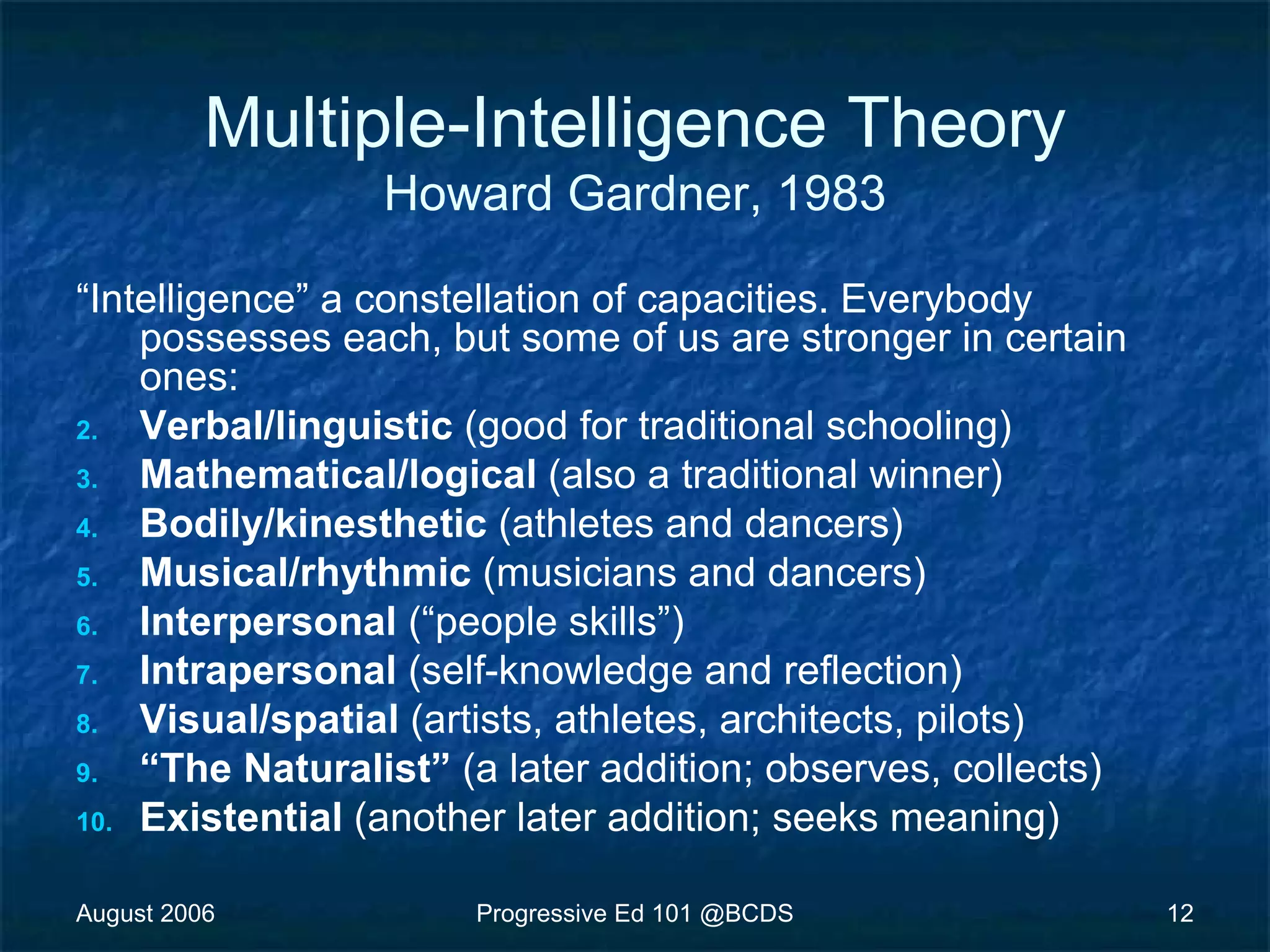
“Intelligence” a constellation of capacities. Everybody
possesses each, but some of us are stronger in certain
ones:
2. Verbal/linguistic (good for traditional schooling)
3. Mathematical/logical (also a traditional winner)
4. Bodily/kinesthetic (athletes and dancers)
5. Musical/rhythmic (musicians and dancers)
6. Interpersonal (“people skills”)
7. Intrapersonal (self-knowledge and reflection)
8. Visual/spatial (artists, athletes, architects, pilots)
9. “The Naturalist” (a later addition; observes, collects)
10. Existential (another later addition; seeks meaning)
August 2006 Progressive Ed 101 @BCDS 13
The Triarchic Theory
Robert Sternberg, 1988
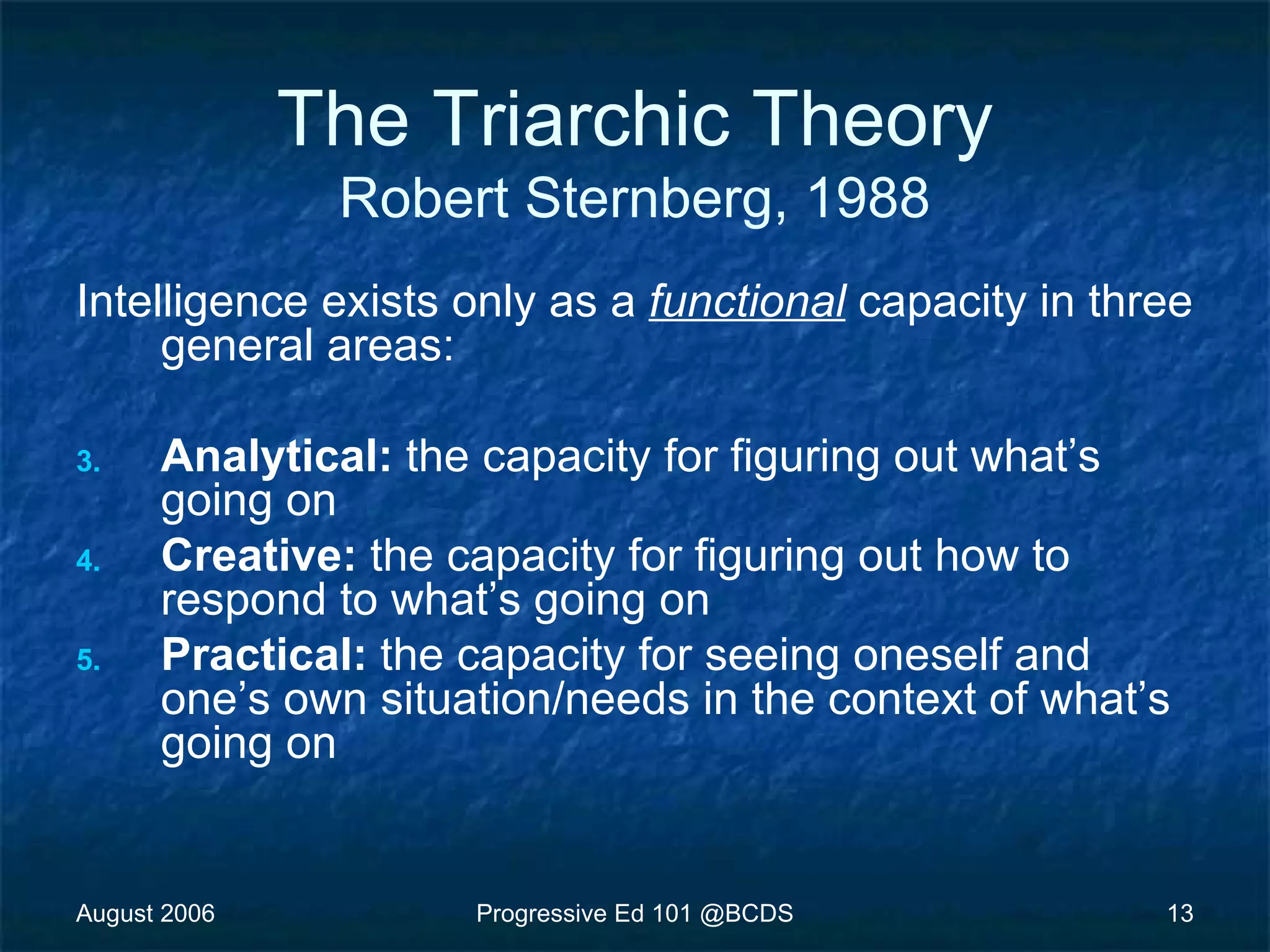
Intelligence exists only as a functional capacity in three
general areas:
3. Analytical: the capacity for figuring out what’s
going on
4. Creative: the capacity for figuring out how to
respond to what’s going on
5. Practical: the capacity for seeing oneself and
one’s own situation/needs in the context of what’s
going on
August 2006 Progressive Ed 101 @BCDS 14
“Dispositional Intelligence”
Perkins, Ritchhart, and others, 1998
“Intelligence” is fully contextualized; it is the
sum of an individual’s “dispositions” to
respond in particular ways when
confronted with a novel intellectual or
cognitive situation.
≈ what educators have been calling
“habits of mind”
August 2006 Progressive Ed 101 @BCDS 15
RETRO BUT USEFUL:
TAXONOMY OF EDUCATIONAL
OBJECTIVES
Benjamin Bloom, 1956
A hierarchy to describe the increasing complexity of
cognitive tasks and capacities
3. Knowledge—has mastered the fundamental facts and
skills
4. Comprehension—understands it
5. Application—can use it
6. Analysis—can use it to break a problem down
7. Synthesis—can put it together with other ideas to
generate new ideas
8. Evaluation—can use it as a basis for judgment
August 2006 Progressive Ed 101 @BCDS 16
And this hierarchy, useful for thinking
about curriculum
Grant Wiggins et al., 1994
 SKILLS—things you must know how to do
to achieve other goals
 UNDERSTANDINGS—things requiring
(deep) conceptual awareness; describable
by degree
 HABITS OF MIND—internalized
dispositions to respond in certain ways to
cognitive stimuli
August 2006 Progressive Ed 101 @BCDS 17
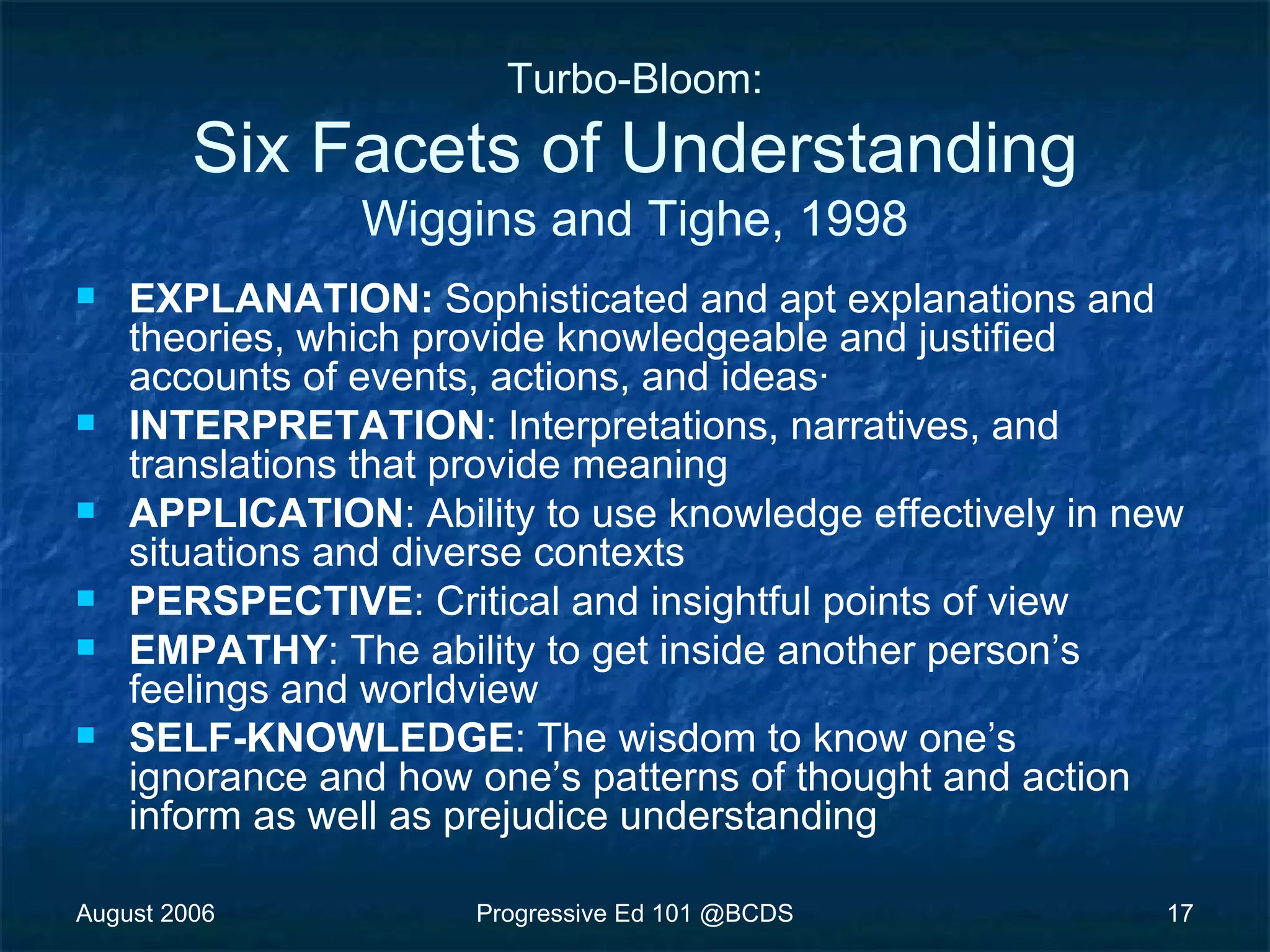
Turbo-Bloom:
Six Facets of Understanding
Wiggins and Tighe, 1998
 EXPLANATION: Sophisticated and apt explanations and
theories, which provide knowledgeable and justified
accounts of events, actions, and ideas·
 INTERPRETATION: Interpretations, narratives, and
translations that provide meaning
 APPLICATION: Ability to use knowledge effectively in new
situations and diverse contexts
 PERSPECTIVE: Critical and insightful points of view
 EMPATHY: The ability to get inside another person’s
feelings and worldview
 SELF-KNOWLEDGE: The wisdom to know one’s
ignorance and how one’s patterns of thought and action
inform as well as prejudice understanding
August 2006 Progressive Ed 101 @BCDS 18
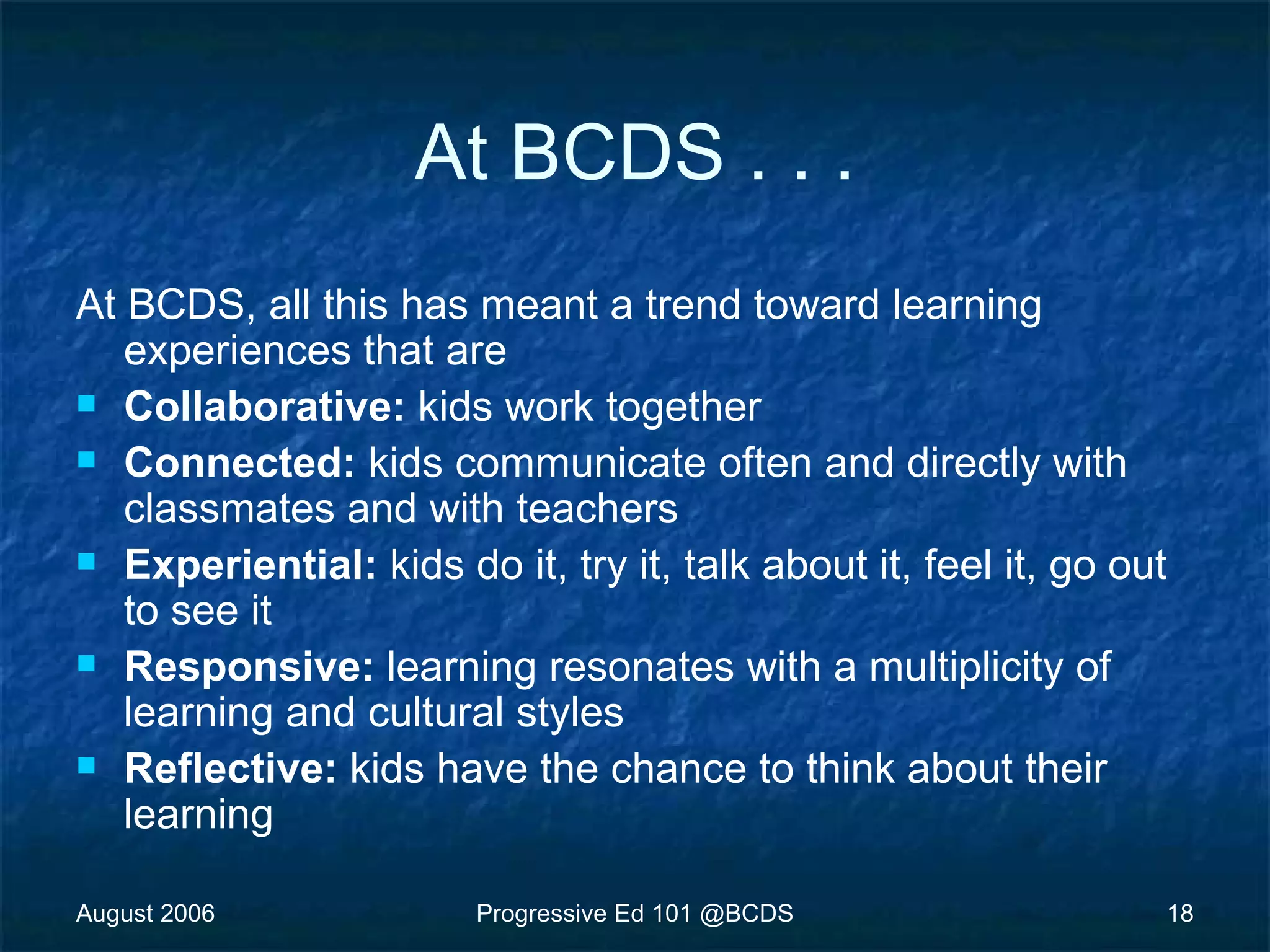
At BCDS . . .
At BCDS, all this has meant a trend toward learning
experiences that are
 Collaborative: kids work together
 Connected: kids communicate often and directly with
classmates and with teachers
 Experiential: kids do it, try it, talk about it, feel it, go out
to see it
 Responsive: learning resonates with a multiplicity of
learning and cultural styles
 Reflective: kids have the chance to think about their
learning
August 2006 Progressive Ed 101 @BCDS 19
Hence:
(You’ve read this before; it’s our “definition” of
Progressive Education at BCDS)
 Progressive education at BCDS puts the student at the
center.
 We believe that every child can meet the highest standard.
 Responsive, pragmatic teaching honors and challenges
the unique experience, creativity, and capacity of each
student.
 The curriculum is designed to deepen understanding and
to inspire students, working individually and
collaboratively, to make connections across disciplines,
culture, and time.

Learning and the Brain

  • 1.
    LEARNING and THEBRAIN Taking our science lesson forward Peter Gow BCDS 2006
  • 2.
    August 2006 ProgressiveEd 101 @BCDS 2 ABSOLUTE BASICS I We know that each person’s “cognitive system” is different—all of us come hard-wired with different learning styles. AND, each individual’s “cognitive system” is also shaped by experience—individual and cultural. (It’s Nature AND Nurture) = NO TWO PEOPLE LEARN THE SAME WAY (and, learning is social)
  • 3.
    August 2006 ProgressiveEd 101 @BCDS 3 ABSOLUTE BASICS II The brain NEEDS water, energy, oxygen, rest, sensory input (= “stimulation”) The brain LIKES repetition, strong emotional or sensory associations, patterns, connection, uncluttered input, positive reinforcement
  • 4.
    August 2006 ProgressiveEd 101 @BCDS 4 IMPLICATIONS FOR EDUCATORS  Build learning environments and promote expectations that are physically, psychologically, and socially humane; pleasant is good  Establish personal (emotional) connections with students  Shape learning experiences to respond to a variety of learning styles
  • 5.
    August 2006 ProgressiveEd 101 @BCDS 5 MORE IMPLICATIONS  Be flexible and inclusive in the design of curriculum, assessment, classroom activities  Be open to student responses that you have not anticipated  BUT MOST OF ALL: be thoughtful about learning styles, pedagogy, curriculum design, and assessment strategies
  • 6.
    August 2006 ProgressiveEd 101 @BCDS 6 INTELLIGENCE What the heck is that? One of the early 20th century’s most entertaining psychological questions  A measure of “brain capacity” for predictive purposes; some early theorists literally measured brain size  An idea with incredible (and horrific) potential for the sorting and eugenic development of humanity  (White guys in tweeds at the top!)
  • 7.
    August 2006 ProgressiveEd 101 @BCDS 7 Let’s explore g (g is the old-time psychologist’s designation for a kind of intelligence that is general and above all measurable--the all-encompassing, one-stop shopping idea of smarts)
  • 8.
  • 9.
    August 2006 ProgressiveEd 101 @BCDS 9 WHO WAS THE SMARTEST PERSON YOU’VE EVER KNOWN?  How did you know s/he was so smart?  What kind of smart was this person?  What did being so smart “get” this person?  What was this person not so smart about?
  • 10.
  • 11.
    August 2006 ProgressiveEd 101 @BCDS 11 Contemporary ideas about “intelligence”  The notion of a unified or singular “intelligence,” measurable by some sort of simple instrument—whether a caliper or an “IQ test”—has become less prevalent  New thinking focuses on the functional aspects of cognition and on the way “intelligence” makes itself apparent in the context of experience
  • 12.
    August 2006 ProgressiveEd 101 @BCDS 12 Multiple-Intelligence Theory Howard Gardner, 1983 “Intelligence” a constellation of capacities. Everybody possesses each, but some of us are stronger in certain ones: 2. Verbal/linguistic (good for traditional schooling) 3. Mathematical/logical (also a traditional winner) 4. Bodily/kinesthetic (athletes and dancers) 5. Musical/rhythmic (musicians and dancers) 6. Interpersonal (“people skills”) 7. Intrapersonal (self-knowledge and reflection) 8. Visual/spatial (artists, athletes, architects, pilots) 9. “The Naturalist” (a later addition; observes, collects) 10. Existential (another later addition; seeks meaning)
  • 13.
    August 2006 ProgressiveEd 101 @BCDS 13 The Triarchic Theory Robert Sternberg, 1988 Intelligence exists only as a functional capacity in three general areas: 3. Analytical: the capacity for figuring out what’s going on 4. Creative: the capacity for figuring out how to respond to what’s going on 5. Practical: the capacity for seeing oneself and one’s own situation/needs in the context of what’s going on
  • 14.
    August 2006 ProgressiveEd 101 @BCDS 14 “Dispositional Intelligence” Perkins, Ritchhart, and others, 1998 “Intelligence” is fully contextualized; it is the sum of an individual’s “dispositions” to respond in particular ways when confronted with a novel intellectual or cognitive situation. ≈ what educators have been calling “habits of mind”
  • 15.
    August 2006 ProgressiveEd 101 @BCDS 15 RETRO BUT USEFUL: TAXONOMY OF EDUCATIONAL OBJECTIVES Benjamin Bloom, 1956 A hierarchy to describe the increasing complexity of cognitive tasks and capacities 3. Knowledge—has mastered the fundamental facts and skills 4. Comprehension—understands it 5. Application—can use it 6. Analysis—can use it to break a problem down 7. Synthesis—can put it together with other ideas to generate new ideas 8. Evaluation—can use it as a basis for judgment
  • 16.
    August 2006 ProgressiveEd 101 @BCDS 16 And this hierarchy, useful for thinking about curriculum Grant Wiggins et al., 1994  SKILLS—things you must know how to do to achieve other goals  UNDERSTANDINGS—things requiring (deep) conceptual awareness; describable by degree  HABITS OF MIND—internalized dispositions to respond in certain ways to cognitive stimuli
  • 17.
    August 2006 ProgressiveEd 101 @BCDS 17 Turbo-Bloom: Six Facets of Understanding Wiggins and Tighe, 1998  EXPLANATION: Sophisticated and apt explanations and theories, which provide knowledgeable and justified accounts of events, actions, and ideas·  INTERPRETATION: Interpretations, narratives, and translations that provide meaning  APPLICATION: Ability to use knowledge effectively in new situations and diverse contexts  PERSPECTIVE: Critical and insightful points of view  EMPATHY: The ability to get inside another person’s feelings and worldview  SELF-KNOWLEDGE: The wisdom to know one’s ignorance and how one’s patterns of thought and action inform as well as prejudice understanding
  • 18.
    August 2006 ProgressiveEd 101 @BCDS 18 At BCDS . . . At BCDS, all this has meant a trend toward learning experiences that are  Collaborative: kids work together  Connected: kids communicate often and directly with classmates and with teachers  Experiential: kids do it, try it, talk about it, feel it, go out to see it  Responsive: learning resonates with a multiplicity of learning and cultural styles  Reflective: kids have the chance to think about their learning
  • 19.
    August 2006 ProgressiveEd 101 @BCDS 19 Hence: (You’ve read this before; it’s our “definition” of Progressive Education at BCDS)  Progressive education at BCDS puts the student at the center.  We believe that every child can meet the highest standard.  Responsive, pragmatic teaching honors and challenges the unique experience, creativity, and capacity of each student.  The curriculum is designed to deepen understanding and to inspire students, working individually and collaboratively, to make connections across disciplines, culture, and time.