Biomedical waste
management
13-10-2018 1
SUNIL KUMAR. P ST.JOHN'S
MEDICAL COLLEGE ,
BANGALORE
Definition
Waste generated during the
diagnosis, testing, treatment,
research or production of
biological products for
humans or animals (WHO)
13-10-2018 2
SUNIL KUMAR. P ST.JOHN'S
MEDICAL COLLEGE ,
BANGALORE
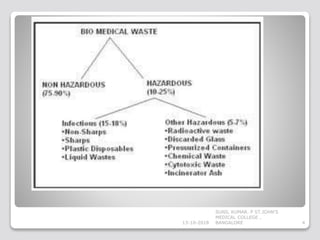
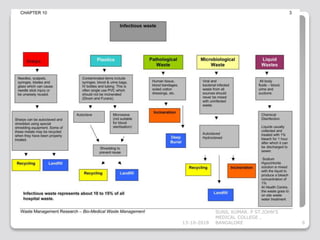
World Health Organization states
 that 85% of hospital wastes are actually
non-hazardous,
 whereas 10% are infectious and
 5% are non-infectious but they are
included in hazardous wastes.
 About 15% to 35% of Hospital waste is
regulated as infectious waste. This range
is dependent on the total amount of waste
generated
13-10-2018 3
SUNIL KUMAR. P ST.JOHN'S
MEDICAL COLLEGE ,
BANGALORE
13-10-2018 4
SUNIL KUMAR. P ST.JOHN'S
MEDICAL COLLEGE ,
BANGALORE
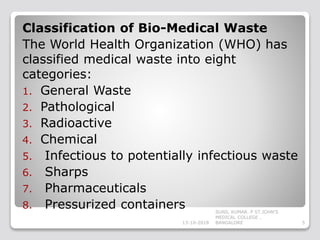
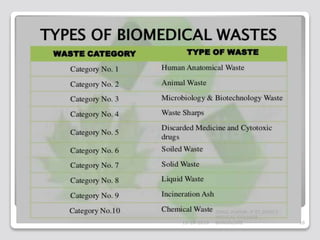
Classification of Bio-Medical Waste
The World Health Organization (WHO) has
classified medical waste into eight
categories:
1. General Waste
2. Pathological
3. Radioactive
4. Chemical
5. Infectious to potentially infectious waste
6. Sharps
7. Pharmaceuticals
8. Pressurized containers
13-10-2018 5
SUNIL KUMAR. P ST.JOHN'S
MEDICAL COLLEGE ,
BANGALORE
13-10-2018 6
SUNIL KUMAR. P ST.JOHN'S
MEDICAL COLLEGE ,
BANGALORE
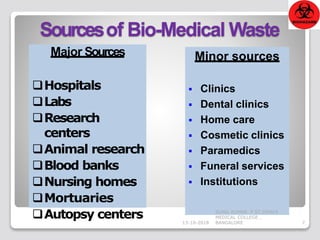
Sourcesof Bio-Medical Waste
Major Sources
Hospitals
Labs
Research
centers
Animal research
Blood banks
Nursing homes
Mortuaries
Autopsy centers
Minor sources
 Clinics
 Dental clinics
 Home care
 Cosmetic clinics
 Paramedics
 Funeral services
 Institutions
13-10-2018 7
SUNIL KUMAR. P ST.JOHN'S
MEDICAL COLLEGE ,
BANGALORE
Problems relating to biomedical
waste
 A major issue-- some hospitals are
disposing of waste in a haphazard,
improper and indiscriminate manner.
 Lack of segregation practices, results in
mixing of hospital wastes with general
waste making the whole waste stream
hazardous.
 Inappropriate segregation ultimately
results in an incorrect method of waste
disposal.
13-10-2018 8
SUNIL KUMAR. P ST.JOHN'S
MEDICAL COLLEGE ,
BANGALORE
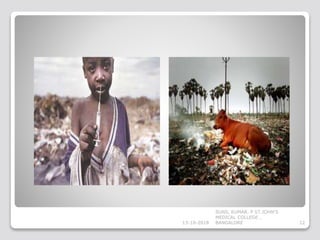
Inadequate Bio-Medical waste management thus will cause
 environmental pollution,
 unpleasant smell,
 growth and multiplication of vectors like insects, rodents and
worms and may lead to the transmission of diseases like
typhoid, cholera, hepatitis and AIDS through injuries from
syringes and needles which are contaminated
 Various communicable diseases, which spread through water,
sweat, blood, body fluids and contaminated organs, are
important to be prevented.
 The Bio Medical Waste scattered in and around the hospitals
invites flies, insects, rodents, cats and dogs that are responsible
for the spread of communication disease like plague and rabies.
 Rag pickers in the hospital, sorting out the garbage are at a risk
of getting tetanus.
13-10-2018 9
SUNIL KUMAR. P ST.JOHN'S
MEDICAL COLLEGE ,
BANGALORE
Hazardoushealth care
waste canresult in
1. Infection
2. Genotoxicity and Cytotoxicity
3. Chemical toxicity
4. Radioactivity hazards.
5. Physical injuries
6. Public sensitivity. 13-10-2018 10
SUNIL KUMAR. P ST.JOHN'S
MEDICAL COLLEGE ,
BANGALORE
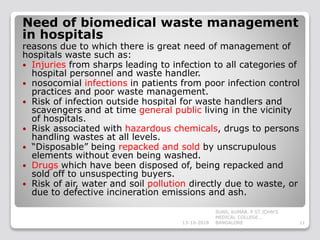
Need of biomedical waste management
in hospitals
reasons due to which there is great need of management of
hospitals waste such as:
 Injuries from sharps leading to infection to all categories of
hospital personnel and waste handler.
 nosocomial infections in patients from poor infection control
practices and poor waste management.
 Risk of infection outside hospital for waste handlers and
scavengers and at time general public living in the vicinity
of hospitals.
 Risk associated with hazardous chemicals, drugs to persons
handling wastes at all levels.
 “Disposable” being repacked and sold by unscrupulous
elements without even being washed.
 Drugs which have been disposed of, being repacked and
sold off to unsuspecting buyers.
 Risk of air, water and soil pollution directly due to waste, or
due to defective incineration emissions and ash.
13-10-2018 11
SUNIL KUMAR. P ST.JOHN'S
MEDICAL COLLEGE ,
BANGALORE
13-10-2018 12
SUNIL KUMAR. P ST.JOHN'S
MEDICAL COLLEGE ,
BANGALORE
13-10-2018 13
SUNIL KUMAR. P ST.JOHN'S
MEDICAL COLLEGE ,
BANGALORE
Biomedical Waste Management
Process
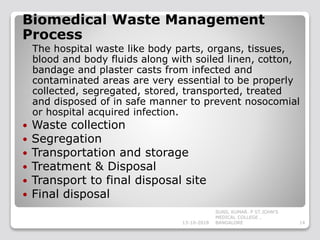
The hospital waste like body parts, organs, tissues,
blood and body fluids along with soiled linen, cotton,
bandage and plaster casts from infected and
contaminated areas are very essential to be properly
collected, segregated, stored, transported, treated
and disposed of in safe manner to prevent nosocomial
or hospital acquired infection.
 Waste collection
 Segregation
 Transportation and storage
 Treatment & Disposal
 Transport to final disposal site
 Final disposal
13-10-2018 14
SUNIL KUMAR. P ST.JOHN'S
MEDICAL COLLEGE ,
BANGALORE
Segregation of biomedical
waste
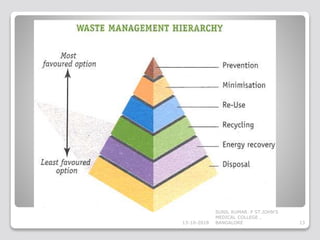
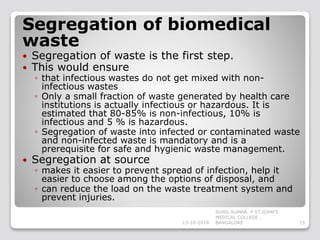
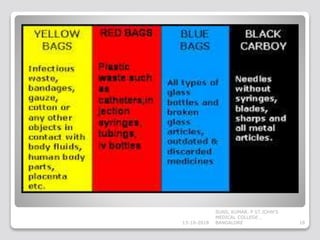
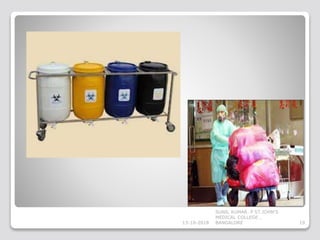
 Segregation of waste is the first step.
 This would ensure
◦ that infectious wastes do not get mixed with non-
infectious wastes
◦ Only a small fraction of waste generated by health care
institutions is actually infectious or hazardous. It is
estimated that 80-85% is non-infectious, 10% is
infectious and 5 % is hazardous.
◦ Segregation of waste into infected or contaminated waste
and non-infected waste is mandatory and is a
prerequisite for safe and hygienic waste management.
 Segregation at source
◦ makes it easier to prevent spread of infection, help it
easier to choose among the options of disposal, and
◦ can reduce the load on the waste treatment system and
prevent injuries.
13-10-2018 15
SUNIL KUMAR. P ST.JOHN'S
MEDICAL COLLEGE ,
BANGALORE
13-10-2018 16
SUNIL KUMAR. P ST.JOHN'S
MEDICAL COLLEGE ,
BANGALORE
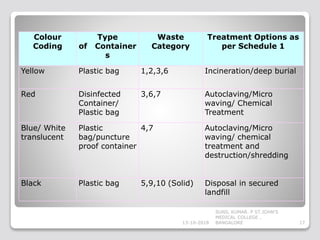
Colour
Coding
Type
of Container
s
Waste
Category
Treatment Options as
per Schedule 1
Yellow Plastic bag 1,2,3,6 Incineration/deep burial
Red Disinfected
Container/
Plastic bag
3,6,7 Autoclaving/Micro
waving/ Chemical
Treatment
Blue/ White
translucent
Plastic
bag/puncture
proof container
4,7 Autoclaving/Micro
waving/ chemical
treatment and
destruction/shredding
Black Plastic bag 5,9,10 (Solid) Disposal in secured
landfill
13-10-2018 17
SUNIL KUMAR. P ST.JOHN'S
MEDICAL COLLEGE ,
BANGALORE
13-10-2018 18
SUNIL KUMAR. P ST.JOHN'S
MEDICAL COLLEGE ,
BANGALORE
13-10-2018 19
SUNIL KUMAR. P ST.JOHN'S
MEDICAL COLLEGE ,
BANGALORE
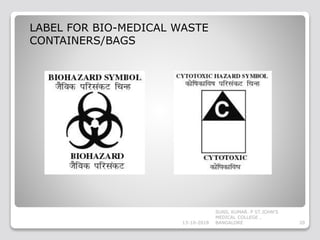
LABEL FOR BIO-MEDICAL WASTE
CONTAINERS/BAGS
13-10-2018 20
SUNIL KUMAR. P ST.JOHN'S
MEDICAL COLLEGE ,
BANGALORE
Transportation
 Untreated biomedical waste shall be transported only in
specially designed vehicles.
 The waste should be transported for treatment either in
trolleys or in covered wheelbarrows.
 Manual loading should be avoided as far as possible.
 The bags / container containing biomedical wastes should
be tied/ lidded before transportation.
 Before transporting the bag containing biomedical wastes,
it should be accompanied with a signed document by
Nurse/ Doctor mentioning date, shift, quantity and
destination.
 Special vehicles must be used so as to prevent access to,
and direct contact with, the waste by the transportation
operators, the scavengers and the public.
 The transport containers should be properly enclosed.
 The effects of traffic accidents should be considered in the
design, and the driver must be trained in the procedures
he must follow in case of an accidental spillage.
 It should also be possible to wash the interior of the
containers thoroughly
13-10-2018 21
SUNIL KUMAR. P ST.JOHN'S
MEDICAL COLLEGE ,
BANGALORE
Personnel safety devices
 The use of protective gears should be made mandatory for all the
personnel handling waste.
 Gloves:
◦ Heavy-duty rubber gloves
◦ This should be bright yellow in colour. After handling the waste, the gloves
should be washed twice.
◦ The gloves should be washed after every use with carbolic soap and a
disinfectant.
◦ The size should fit the operator.
 Aprons, gowns, suits or other apparels:
◦ Apparel is worn to prevent contamination of clothing and protect skin.
 Masks:
◦ Various types of masks, goggles, and face shields are worn alone or in
combination, to provide a protective barrier. It is mandatory for personnel
working in the incinerator chamber to wear a mask covering both nose and
mouth, preferably a gas mask with filters.
 Boots:
◦ Leg coverings, boots or shoe-covers provide greater protection to the skin
when splashes or large quantities of infected waste have to be handled. The
boots should be rubber-soled and anti-skid type. They should cover the leg
up to the ankle.
13-10-2018 22
SUNIL KUMAR. P ST.JOHN'S
MEDICAL COLLEGE ,
BANGALORE
Biomedical Waste Treatment and
Disposal
Incineration Technology
 This is a high temperature thermal process employing
combustion of the waste under controlled condition for
converting them into inert material and gases. Incinerators
can be oil fired or electrically powered or a combination
thereof.
 Broadly, three types of incinerators are used for hospital
waste:
 multiple hearth type, rotary kiln and controlled air types.
Non-IncinerationTechnology
 Non-incineration treatment includes four basic processes:
thermal, chemical, irradiative, and biological. The majority
of non-incineration technologies employ the thermal and
chemical processes. The main purpose of the treatment
technology is to decontaminate waste by destroying
pathogens.
13-10-2018 23
SUNIL KUMAR. P ST.JOHN'S
MEDICAL COLLEGE ,
BANGALORE
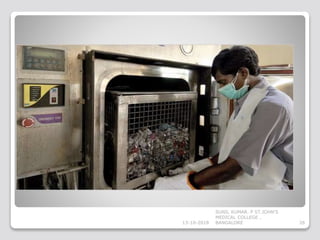
 Autoclaving
The process involves using steam at high
temperatures.
◦ These are also of three types: Gravity type, Pre-
vacuum type and Autoclave treatment has been
recommended for microbiology and biotechnology
waste, waste sharps, soiled and solid wastes.
◦ This technology renders certain categories
(mentioned in the rules) of bio-medical waste
innocuous and unrecognizable so that the treated
residue can be land filled.
 Microwave Irradiation
◦ The microwave is based on the principle of
generation of high frequency waves.
◦ These waves cause the particles within the waste
material to vibrate, generating heat.
◦ This heat generated from within kills all pathogens.
13-10-2018 24
SUNIL KUMAR. P ST.JOHN'S
MEDICAL COLLEGE ,
BANGALORE
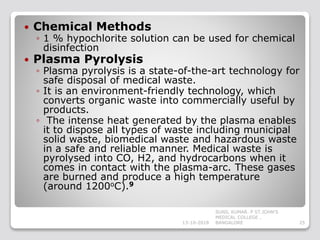
 Chemical Methods
◦ 1 % hypochlorite solution can be used for chemical
disinfection
 Plasma Pyrolysis
◦ Plasma pyrolysis is a state-of-the-art technology for
safe disposal of medical waste.
◦ It is an environment-friendly technology, which
converts organic waste into commercially useful by
products.
◦ The intense heat generated by the plasma enables
it to dispose all types of waste including municipal
solid waste, biomedical waste and hazardous waste
in a safe and reliable manner. Medical waste is
pyrolysed into CO, H2, and hydrocarbons when it
comes in contact with the plasma-arc. These gases
are burned and produce a high temperature
(around 1200oC).9
13-10-2018 25
SUNIL KUMAR. P ST.JOHN'S
MEDICAL COLLEGE ,
BANGALORE
13-10-2018 26
SUNIL KUMAR. P ST.JOHN'S
MEDICAL COLLEGE ,
BANGALORE
Benefits of Biomedical Waste
Management
 Cleaner and healthier surroundings.
 Reduction in the incidence of hospital acquired and
general infections.
 Reduction in the cost of infection control within the
hospital.
 Reduction in the possibility of disease and death due
to reuse and repackaging of infectious disposables.
 Low incidence of community and occupational health
hazards.
 Reduction in the cost of waste management and
generation of revenue through appropriate treatment
and disposal of waste.
 Improved image of the healthcare establishment and
increase the quality of life.
13-10-2018 27
SUNIL KUMAR. P ST.JOHN'S
MEDICAL COLLEGE ,
BANGALORE
CONCLUSION
 Medical wastes should be classified according to
their source, typology and risk factors associated
with their handling, storage and ultimate
disposal.
 The segregation of waste at source is the key
step and reduction, reuse and recycling should
be considered in proper perspectives.
 scientifically manage growing quantities of
biomedical waste that go beyond past practices.
 Proper disposal of the waste.
 If we want to protect our environment and
health of community we must sensitize our
selves to this important issue not only in the
interest of health managers but also in the
interest of community.
13-10-2018 28
SUNIL KUMAR. P ST.JOHN'S
MEDICAL COLLEGE ,
BANGALORE
13-10-2018 29
SUNIL KUMAR. P ST.JOHN'S
MEDICAL COLLEGE ,
BANGALORE
Healthy community
Healthy environment
Healthy you
Healthy me
Wake up
Lets follow the rules and
protect ourselves and our
loved ones
Let the wastes of the sick not
contaminate the lives of the
healthy.
13-10-2018 30
SUNIL KUMAR. P ST.JOHN'S
MEDICAL COLLEGE ,
BANGALORE

Biomedical waste management_ppt

  • 1.
    Biomedical waste management 13-10-2018 1 SUNILKUMAR. P ST.JOHN'S MEDICAL COLLEGE , BANGALORE
  • 2.
    Definition Waste generated duringthe diagnosis, testing, treatment, research or production of biological products for humans or animals (WHO) 13-10-2018 2 SUNIL KUMAR. P ST.JOHN'S MEDICAL COLLEGE , BANGALORE
  • 3.
    World Health Organizationstates  that 85% of hospital wastes are actually non-hazardous,  whereas 10% are infectious and  5% are non-infectious but they are included in hazardous wastes.  About 15% to 35% of Hospital waste is regulated as infectious waste. This range is dependent on the total amount of waste generated 13-10-2018 3 SUNIL KUMAR. P ST.JOHN'S MEDICAL COLLEGE , BANGALORE
  • 4.
    13-10-2018 4 SUNIL KUMAR.P ST.JOHN'S MEDICAL COLLEGE , BANGALORE
  • 5.
    Classification of Bio-MedicalWaste The World Health Organization (WHO) has classified medical waste into eight categories: 1. General Waste 2. Pathological 3. Radioactive 4. Chemical 5. Infectious to potentially infectious waste 6. Sharps 7. Pharmaceuticals 8. Pressurized containers 13-10-2018 5 SUNIL KUMAR. P ST.JOHN'S MEDICAL COLLEGE , BANGALORE
  • 6.
    13-10-2018 6 SUNIL KUMAR.P ST.JOHN'S MEDICAL COLLEGE , BANGALORE
  • 7.
    Sourcesof Bio-Medical Waste MajorSources Hospitals Labs Research centers Animal research Blood banks Nursing homes Mortuaries Autopsy centers Minor sources  Clinics  Dental clinics  Home care  Cosmetic clinics  Paramedics  Funeral services  Institutions 13-10-2018 7 SUNIL KUMAR. P ST.JOHN'S MEDICAL COLLEGE , BANGALORE
  • 8.
    Problems relating tobiomedical waste  A major issue-- some hospitals are disposing of waste in a haphazard, improper and indiscriminate manner.  Lack of segregation practices, results in mixing of hospital wastes with general waste making the whole waste stream hazardous.  Inappropriate segregation ultimately results in an incorrect method of waste disposal. 13-10-2018 8 SUNIL KUMAR. P ST.JOHN'S MEDICAL COLLEGE , BANGALORE
  • 9.
    Inadequate Bio-Medical wastemanagement thus will cause  environmental pollution,  unpleasant smell,  growth and multiplication of vectors like insects, rodents and worms and may lead to the transmission of diseases like typhoid, cholera, hepatitis and AIDS through injuries from syringes and needles which are contaminated  Various communicable diseases, which spread through water, sweat, blood, body fluids and contaminated organs, are important to be prevented.  The Bio Medical Waste scattered in and around the hospitals invites flies, insects, rodents, cats and dogs that are responsible for the spread of communication disease like plague and rabies.  Rag pickers in the hospital, sorting out the garbage are at a risk of getting tetanus. 13-10-2018 9 SUNIL KUMAR. P ST.JOHN'S MEDICAL COLLEGE , BANGALORE
  • 10.
    Hazardoushealth care waste canresultin 1. Infection 2. Genotoxicity and Cytotoxicity 3. Chemical toxicity 4. Radioactivity hazards. 5. Physical injuries 6. Public sensitivity. 13-10-2018 10 SUNIL KUMAR. P ST.JOHN'S MEDICAL COLLEGE , BANGALORE
  • 11.
    Need of biomedicalwaste management in hospitals reasons due to which there is great need of management of hospitals waste such as:  Injuries from sharps leading to infection to all categories of hospital personnel and waste handler.  nosocomial infections in patients from poor infection control practices and poor waste management.  Risk of infection outside hospital for waste handlers and scavengers and at time general public living in the vicinity of hospitals.  Risk associated with hazardous chemicals, drugs to persons handling wastes at all levels.  “Disposable” being repacked and sold by unscrupulous elements without even being washed.  Drugs which have been disposed of, being repacked and sold off to unsuspecting buyers.  Risk of air, water and soil pollution directly due to waste, or due to defective incineration emissions and ash. 13-10-2018 11 SUNIL KUMAR. P ST.JOHN'S MEDICAL COLLEGE , BANGALORE
  • 12.
    13-10-2018 12 SUNIL KUMAR.P ST.JOHN'S MEDICAL COLLEGE , BANGALORE
  • 13.
    13-10-2018 13 SUNIL KUMAR.P ST.JOHN'S MEDICAL COLLEGE , BANGALORE
  • 14.
    Biomedical Waste Management Process Thehospital waste like body parts, organs, tissues, blood and body fluids along with soiled linen, cotton, bandage and plaster casts from infected and contaminated areas are very essential to be properly collected, segregated, stored, transported, treated and disposed of in safe manner to prevent nosocomial or hospital acquired infection.  Waste collection  Segregation  Transportation and storage  Treatment & Disposal  Transport to final disposal site  Final disposal 13-10-2018 14 SUNIL KUMAR. P ST.JOHN'S MEDICAL COLLEGE , BANGALORE
  • 15.
    Segregation of biomedical waste Segregation of waste is the first step.  This would ensure ◦ that infectious wastes do not get mixed with non- infectious wastes ◦ Only a small fraction of waste generated by health care institutions is actually infectious or hazardous. It is estimated that 80-85% is non-infectious, 10% is infectious and 5 % is hazardous. ◦ Segregation of waste into infected or contaminated waste and non-infected waste is mandatory and is a prerequisite for safe and hygienic waste management.  Segregation at source ◦ makes it easier to prevent spread of infection, help it easier to choose among the options of disposal, and ◦ can reduce the load on the waste treatment system and prevent injuries. 13-10-2018 15 SUNIL KUMAR. P ST.JOHN'S MEDICAL COLLEGE , BANGALORE
  • 16.
    13-10-2018 16 SUNIL KUMAR.P ST.JOHN'S MEDICAL COLLEGE , BANGALORE
  • 17.
    Colour Coding Type of Container s Waste Category Treatment Optionsas per Schedule 1 Yellow Plastic bag 1,2,3,6 Incineration/deep burial Red Disinfected Container/ Plastic bag 3,6,7 Autoclaving/Micro waving/ Chemical Treatment Blue/ White translucent Plastic bag/puncture proof container 4,7 Autoclaving/Micro waving/ chemical treatment and destruction/shredding Black Plastic bag 5,9,10 (Solid) Disposal in secured landfill 13-10-2018 17 SUNIL KUMAR. P ST.JOHN'S MEDICAL COLLEGE , BANGALORE
  • 18.
    13-10-2018 18 SUNIL KUMAR.P ST.JOHN'S MEDICAL COLLEGE , BANGALORE
  • 19.
    13-10-2018 19 SUNIL KUMAR.P ST.JOHN'S MEDICAL COLLEGE , BANGALORE
  • 20.
    LABEL FOR BIO-MEDICALWASTE CONTAINERS/BAGS 13-10-2018 20 SUNIL KUMAR. P ST.JOHN'S MEDICAL COLLEGE , BANGALORE
  • 21.
    Transportation  Untreated biomedicalwaste shall be transported only in specially designed vehicles.  The waste should be transported for treatment either in trolleys or in covered wheelbarrows.  Manual loading should be avoided as far as possible.  The bags / container containing biomedical wastes should be tied/ lidded before transportation.  Before transporting the bag containing biomedical wastes, it should be accompanied with a signed document by Nurse/ Doctor mentioning date, shift, quantity and destination.  Special vehicles must be used so as to prevent access to, and direct contact with, the waste by the transportation operators, the scavengers and the public.  The transport containers should be properly enclosed.  The effects of traffic accidents should be considered in the design, and the driver must be trained in the procedures he must follow in case of an accidental spillage.  It should also be possible to wash the interior of the containers thoroughly 13-10-2018 21 SUNIL KUMAR. P ST.JOHN'S MEDICAL COLLEGE , BANGALORE
  • 22.
    Personnel safety devices The use of protective gears should be made mandatory for all the personnel handling waste.  Gloves: ◦ Heavy-duty rubber gloves ◦ This should be bright yellow in colour. After handling the waste, the gloves should be washed twice. ◦ The gloves should be washed after every use with carbolic soap and a disinfectant. ◦ The size should fit the operator.  Aprons, gowns, suits or other apparels: ◦ Apparel is worn to prevent contamination of clothing and protect skin.  Masks: ◦ Various types of masks, goggles, and face shields are worn alone or in combination, to provide a protective barrier. It is mandatory for personnel working in the incinerator chamber to wear a mask covering both nose and mouth, preferably a gas mask with filters.  Boots: ◦ Leg coverings, boots or shoe-covers provide greater protection to the skin when splashes or large quantities of infected waste have to be handled. The boots should be rubber-soled and anti-skid type. They should cover the leg up to the ankle. 13-10-2018 22 SUNIL KUMAR. P ST.JOHN'S MEDICAL COLLEGE , BANGALORE
  • 23.
    Biomedical Waste Treatmentand Disposal Incineration Technology  This is a high temperature thermal process employing combustion of the waste under controlled condition for converting them into inert material and gases. Incinerators can be oil fired or electrically powered or a combination thereof.  Broadly, three types of incinerators are used for hospital waste:  multiple hearth type, rotary kiln and controlled air types. Non-IncinerationTechnology  Non-incineration treatment includes four basic processes: thermal, chemical, irradiative, and biological. The majority of non-incineration technologies employ the thermal and chemical processes. The main purpose of the treatment technology is to decontaminate waste by destroying pathogens. 13-10-2018 23 SUNIL KUMAR. P ST.JOHN'S MEDICAL COLLEGE , BANGALORE
  • 24.
     Autoclaving The processinvolves using steam at high temperatures. ◦ These are also of three types: Gravity type, Pre- vacuum type and Autoclave treatment has been recommended for microbiology and biotechnology waste, waste sharps, soiled and solid wastes. ◦ This technology renders certain categories (mentioned in the rules) of bio-medical waste innocuous and unrecognizable so that the treated residue can be land filled.  Microwave Irradiation ◦ The microwave is based on the principle of generation of high frequency waves. ◦ These waves cause the particles within the waste material to vibrate, generating heat. ◦ This heat generated from within kills all pathogens. 13-10-2018 24 SUNIL KUMAR. P ST.JOHN'S MEDICAL COLLEGE , BANGALORE
  • 25.
     Chemical Methods ◦1 % hypochlorite solution can be used for chemical disinfection  Plasma Pyrolysis ◦ Plasma pyrolysis is a state-of-the-art technology for safe disposal of medical waste. ◦ It is an environment-friendly technology, which converts organic waste into commercially useful by products. ◦ The intense heat generated by the plasma enables it to dispose all types of waste including municipal solid waste, biomedical waste and hazardous waste in a safe and reliable manner. Medical waste is pyrolysed into CO, H2, and hydrocarbons when it comes in contact with the plasma-arc. These gases are burned and produce a high temperature (around 1200oC).9 13-10-2018 25 SUNIL KUMAR. P ST.JOHN'S MEDICAL COLLEGE , BANGALORE
  • 26.
    13-10-2018 26 SUNIL KUMAR.P ST.JOHN'S MEDICAL COLLEGE , BANGALORE
  • 27.
    Benefits of BiomedicalWaste Management  Cleaner and healthier surroundings.  Reduction in the incidence of hospital acquired and general infections.  Reduction in the cost of infection control within the hospital.  Reduction in the possibility of disease and death due to reuse and repackaging of infectious disposables.  Low incidence of community and occupational health hazards.  Reduction in the cost of waste management and generation of revenue through appropriate treatment and disposal of waste.  Improved image of the healthcare establishment and increase the quality of life. 13-10-2018 27 SUNIL KUMAR. P ST.JOHN'S MEDICAL COLLEGE , BANGALORE
  • 28.
    CONCLUSION  Medical wastesshould be classified according to their source, typology and risk factors associated with their handling, storage and ultimate disposal.  The segregation of waste at source is the key step and reduction, reuse and recycling should be considered in proper perspectives.  scientifically manage growing quantities of biomedical waste that go beyond past practices.  Proper disposal of the waste.  If we want to protect our environment and health of community we must sensitize our selves to this important issue not only in the interest of health managers but also in the interest of community. 13-10-2018 28 SUNIL KUMAR. P ST.JOHN'S MEDICAL COLLEGE , BANGALORE
  • 29.
    13-10-2018 29 SUNIL KUMAR.P ST.JOHN'S MEDICAL COLLEGE , BANGALORE
  • 30.
    Healthy community Healthy environment Healthyyou Healthy me Wake up Lets follow the rules and protect ourselves and our loved ones Let the wastes of the sick not contaminate the lives of the healthy. 13-10-2018 30 SUNIL KUMAR. P ST.JOHN'S MEDICAL COLLEGE , BANGALORE