DECISSION SUPPORT SYSTEM
DECISION Making decisions concerning complex systems often strains our cognitive capabilities. Predicting how the system will react to an external manipulation such as a policy decision is often difficult.
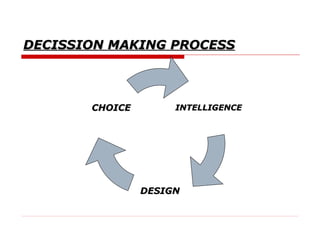
DECISSION MAKING PROCESS INTELLIGENCE DESIGN CHOICE
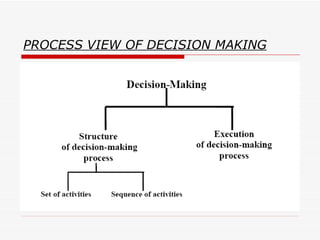
PROCESS VIEW OF DECISION MAKING
Decision support system Decision Support Systems (DSS) are a specific class of computerized information system that supports business and organizational decision-making activities . A properly designed DSS is an interactive software-based system intended to help decision makers compile useful information from raw data, documents, personal knowledge, and/or business models to identify and solve problems and make decisions .
WHY DSS Because decision-making involves a complex sequence of activities over time, it implies there are at least three functions that should be assigned to DSSs: 1) The capability of capturing and saving information from previous activities; 2) Data processing capability; 3) Data retrieval capability.
COMPONENTS OF DSS There are three fundamental components of DSS : DATA BASE MANAGEMENT SYSTEM (DBMS) MODEL BASED MANAGEMENT SYSTEM (MBMS) DIALOG GENERATION &MANAGEMENT SYSTEM (DGMS)
THE ARCHITECTURE OF DSS
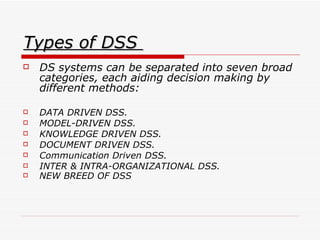
Types of DSS  DS systems can be separated into seven broad categories, each aiding decision making by different methods: DATA DRIVEN DSS. MODEL-DRIVEN DSS. KNOWLEDGE DRIVEN DSS. DOCUMENT DRIVEN DSS. Communication Driven DSS. INTER & INTRA-ORGANIZATIONAL DSS. NEW BREED OF DSS
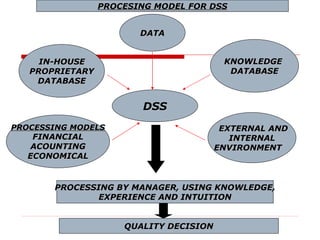
DSS IN-HOUSE PROPRIETARY DATABASE KNOWLEDGE  DATABASE DATA PROCESSING MODELS FINANCIAL ACOUNTING ECONOMICAL EXTERNAL AND INTERNAL ENVIRONMENT  PROCESSING BY MANAGER, USING KNOWLEDGE, EXPERIENCE AND INTUITION QUALITY DECISION PROCESING MODEL FOR DSS
 
NEW BREEDS OF DSS HYBRID SYSTEM Eg.-WEB BASED DSS On-line Analytical Processing (OLAP)
MANAGEMENT REQUIREMENT OF DSS ALLOCATING RESOURCES PREPARING BUDGETS OBSERVATION OF RESULTS EVALUATION OF RESULT MODIFICATION OF ACTIVITES AND RESOURCES
Intangible payoffs DSS Improved internal control. Enhances long term profitability by improving quality of decision making. Faster response to changes in business environment  .
Cont …. Better management awareness of internal strength and weaknesses and external threats and opportunities. Allows managers’ to record experience and use it in future for similar scenarios that may arise within the organization.

Decision Support System

  • 1.
  • 2.
    DECISION Making decisionsconcerning complex systems often strains our cognitive capabilities. Predicting how the system will react to an external manipulation such as a policy decision is often difficult.
  • 3.
    DECISSION MAKING PROCESSINTELLIGENCE DESIGN CHOICE
  • 4.
    PROCESS VIEW OFDECISION MAKING
  • 5.
    Decision support systemDecision Support Systems (DSS) are a specific class of computerized information system that supports business and organizational decision-making activities . A properly designed DSS is an interactive software-based system intended to help decision makers compile useful information from raw data, documents, personal knowledge, and/or business models to identify and solve problems and make decisions .
  • 6.
    WHY DSS Becausedecision-making involves a complex sequence of activities over time, it implies there are at least three functions that should be assigned to DSSs: 1) The capability of capturing and saving information from previous activities; 2) Data processing capability; 3) Data retrieval capability.
  • 7.
    COMPONENTS OF DSSThere are three fundamental components of DSS : DATA BASE MANAGEMENT SYSTEM (DBMS) MODEL BASED MANAGEMENT SYSTEM (MBMS) DIALOG GENERATION &MANAGEMENT SYSTEM (DGMS)
  • 8.
  • 9.
    Types of DSS DS systems can be separated into seven broad categories, each aiding decision making by different methods: DATA DRIVEN DSS. MODEL-DRIVEN DSS. KNOWLEDGE DRIVEN DSS. DOCUMENT DRIVEN DSS. Communication Driven DSS. INTER & INTRA-ORGANIZATIONAL DSS. NEW BREED OF DSS
  • 10.
    DSS IN-HOUSE PROPRIETARYDATABASE KNOWLEDGE DATABASE DATA PROCESSING MODELS FINANCIAL ACOUNTING ECONOMICAL EXTERNAL AND INTERNAL ENVIRONMENT PROCESSING BY MANAGER, USING KNOWLEDGE, EXPERIENCE AND INTUITION QUALITY DECISION PROCESING MODEL FOR DSS
  • 11.
  • 12.
    NEW BREEDS OFDSS HYBRID SYSTEM Eg.-WEB BASED DSS On-line Analytical Processing (OLAP)
  • 13.
    MANAGEMENT REQUIREMENT OFDSS ALLOCATING RESOURCES PREPARING BUDGETS OBSERVATION OF RESULTS EVALUATION OF RESULT MODIFICATION OF ACTIVITES AND RESOURCES
  • 14.
    Intangible payoffs DSSImproved internal control. Enhances long term profitability by improving quality of decision making. Faster response to changes in business environment .
  • 15.
    Cont …. Bettermanagement awareness of internal strength and weaknesses and external threats and opportunities. Allows managers’ to record experience and use it in future for similar scenarios that may arise within the organization.