DECISION SUPPORT
SYSTEMS
WHAT IS DECISION MAKING?
• A selection process, concerned with selecting the best type of alternative
• The thought process of selecting a logical choice from the available options
• The process by which managers respond to opportunities and threats
• It leads to commitment. The commitment depends upon the nature of the
decision whether short term or long term.
MANAGERS AND DECISION MAKING
• It is very difficult for managers to make good decisions without valid, timely
and relevant information:
 Number of alternatives to be considered is increasing
 Many decisions are made under time pressure
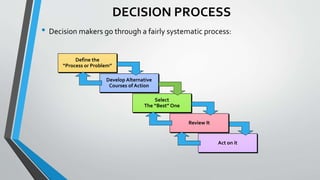
DECISION PROCESS
• Decision makers go through a fairly systematic process:
Act on it
Review It
Define the
“Process or Problem”
Develop Alternative
Courses of Action
Select
The “Best” One
THE NATURE OF DECISIONS
• Information systems can support decision-making levels.
• These include the three levels of management activity.
 Strategic management
 Tactical management
 Operational management
INFORMATION REQUIREMENTS BY
MANAGEMENT LEVEL
Strategic
Management
Tactical
Management
Operational
Management
TYPES OF DECISIONS
• The decision fall into one of the following categories:
 Structured Decisions
 Unstructured
 Semi-Structured
STRUCTURED DECISIONS
• Structured decisions are repetitive and routine problems for which standard
solutions exist
• Ex: finding an appropriate inventory level, finding an optimal investment
strategy
UNSTRUCTURED DECISIONS
• Unstructured decisions are non-routine and complex.
• We cannot specify some procedures to make a decision
• Ex: expanding the business, moving operations to foreign countries.
• IS must provide a wide range of information products to support these types
of decisions at all levels of the organization
SEMI-STRUCTURED DECISIONS
• Semi-structured decisions fall between structured and unstructured
decisions
• It requires a combination of standard procedures and individual judgment.
• Ex: annual evaluation of employees, trading bonds, setting marketing
budgets for consumer products.
WHAT IS DSS?
• A decision support system is a computer application that analyzes business
data and presents it so that users can make business decisions more easily.
• It is an informational application.
• Typical information that a decision support application might gather and
present would be:
 Comparative sales figures between one week and the next
 Projected revenue figures based on new product sales assumptions
 The consequences of different decision alternatives, given past
experience in a context that is described
DSS ARCHITECTURE
• Three fundamental components of a DSS architecture are:
• the database (or knowledge base),
• the model (i.e., the decision context and user criteria), and
• the user interface
The users themselves are also important components of the architecture.
TYPES OF MODELS
• DSS software is a collection of software tools that are used for data analysis
or a collection of mathematical and analytical models.
• There can be 3 different types of modeling software for DSSs:
 Statistical models
 Optimization models
 Forecasting models
STATISTICAL MODELING
• Statistical modeling software can be used to help establish relationships
such as relating product sales to differences in age, income or other factors
between communities.
• Ex: SPSS.
OPTIMIZATION MODELS
• Optimization models often using Linear Programming (LP) determine the
proper mix of products within a given market to maximize profit.
FORECASTING MODELS
• The user of this type of model might supply a range of historical data to
project future conditions and sales that might result from those conditions.
• Companies often use this software to predict the action of competitors.
CAPABILITIES OF DSS
• Using a DSS involves 4 basic types of analytical modeling activities:
 What-if analysis
 Sensitivity analysis
 Goal-seeking analysis
 Optimization analysis
WHAT-IF ANALYSIS
• What-If analysis is used to determine what some of the possible changes
could be on a theoretical solution.
• Observing how changes to selected variables affect the other variables.
• E.g. What if we cut advertising by 10%?What would happen to sales?
SENSITIVITY ANALYSIS
• Sensitivity analysis is the study of how different variables effect one and
other, when change occurs.
• Observing how repeated changes to a single variables affect other variables.
• E.g: Let's cut advertising by $1000 repeatedly so we can see its relationship
to sales.
GOAL-SEEKING ANALYSIS
• Compiles all of the given data and determines what inputs are required to
reach specific goals.
• Making repeated changes to selected variables until a chosen variable
reaches to a target value.
• E.g. Let's try increase in advertising until sales reach to target
OPTIMIZATION ANALYSIS
• To find the optimum value for one or more target variables, given certain
constraints.
• Finding an optimum value for selected variables, given certain constraints.
• E.g. What's the best amount of advertising to have, our budget and choice of
media?
CHARACTERISTICS OF DSS
• Improved decision making through better understanding of the businesses
• An increased number of decision alternatives examined
• The ability to implement ad hoc analysis
• Faster response
• Improved communication
• More effective teamwork
• Better control
• Time and costs savings
THANKYOU

Decision support systems

  • 1.
  • 2.
    WHAT IS DECISIONMAKING? • A selection process, concerned with selecting the best type of alternative • The thought process of selecting a logical choice from the available options • The process by which managers respond to opportunities and threats • It leads to commitment. The commitment depends upon the nature of the decision whether short term or long term.
  • 3.
    MANAGERS AND DECISIONMAKING • It is very difficult for managers to make good decisions without valid, timely and relevant information:  Number of alternatives to be considered is increasing  Many decisions are made under time pressure
  • 4.
    DECISION PROCESS • Decisionmakers go through a fairly systematic process: Act on it Review It Define the “Process or Problem” Develop Alternative Courses of Action Select The “Best” One
  • 5.
    THE NATURE OFDECISIONS • Information systems can support decision-making levels. • These include the three levels of management activity.  Strategic management  Tactical management  Operational management
  • 6.
    INFORMATION REQUIREMENTS BY MANAGEMENTLEVEL Strategic Management Tactical Management Operational Management
  • 7.
    TYPES OF DECISIONS •The decision fall into one of the following categories:  Structured Decisions  Unstructured  Semi-Structured
  • 8.
    STRUCTURED DECISIONS • Structureddecisions are repetitive and routine problems for which standard solutions exist • Ex: finding an appropriate inventory level, finding an optimal investment strategy
  • 9.
    UNSTRUCTURED DECISIONS • Unstructureddecisions are non-routine and complex. • We cannot specify some procedures to make a decision • Ex: expanding the business, moving operations to foreign countries. • IS must provide a wide range of information products to support these types of decisions at all levels of the organization
  • 10.
    SEMI-STRUCTURED DECISIONS • Semi-structureddecisions fall between structured and unstructured decisions • It requires a combination of standard procedures and individual judgment. • Ex: annual evaluation of employees, trading bonds, setting marketing budgets for consumer products.
  • 11.
    WHAT IS DSS? •A decision support system is a computer application that analyzes business data and presents it so that users can make business decisions more easily. • It is an informational application. • Typical information that a decision support application might gather and present would be:  Comparative sales figures between one week and the next  Projected revenue figures based on new product sales assumptions  The consequences of different decision alternatives, given past experience in a context that is described
  • 12.
    DSS ARCHITECTURE • Threefundamental components of a DSS architecture are: • the database (or knowledge base), • the model (i.e., the decision context and user criteria), and • the user interface The users themselves are also important components of the architecture.
  • 13.
    TYPES OF MODELS •DSS software is a collection of software tools that are used for data analysis or a collection of mathematical and analytical models. • There can be 3 different types of modeling software for DSSs:  Statistical models  Optimization models  Forecasting models
  • 14.
    STATISTICAL MODELING • Statisticalmodeling software can be used to help establish relationships such as relating product sales to differences in age, income or other factors between communities. • Ex: SPSS.
  • 15.
    OPTIMIZATION MODELS • Optimizationmodels often using Linear Programming (LP) determine the proper mix of products within a given market to maximize profit.
  • 16.
    FORECASTING MODELS • Theuser of this type of model might supply a range of historical data to project future conditions and sales that might result from those conditions. • Companies often use this software to predict the action of competitors.
  • 17.
    CAPABILITIES OF DSS •Using a DSS involves 4 basic types of analytical modeling activities:  What-if analysis  Sensitivity analysis  Goal-seeking analysis  Optimization analysis
  • 18.
    WHAT-IF ANALYSIS • What-Ifanalysis is used to determine what some of the possible changes could be on a theoretical solution. • Observing how changes to selected variables affect the other variables. • E.g. What if we cut advertising by 10%?What would happen to sales?
  • 19.
    SENSITIVITY ANALYSIS • Sensitivityanalysis is the study of how different variables effect one and other, when change occurs. • Observing how repeated changes to a single variables affect other variables. • E.g: Let's cut advertising by $1000 repeatedly so we can see its relationship to sales.
  • 20.
    GOAL-SEEKING ANALYSIS • Compilesall of the given data and determines what inputs are required to reach specific goals. • Making repeated changes to selected variables until a chosen variable reaches to a target value. • E.g. Let's try increase in advertising until sales reach to target
  • 21.
    OPTIMIZATION ANALYSIS • Tofind the optimum value for one or more target variables, given certain constraints. • Finding an optimum value for selected variables, given certain constraints. • E.g. What's the best amount of advertising to have, our budget and choice of media?
  • 22.
    CHARACTERISTICS OF DSS •Improved decision making through better understanding of the businesses • An increased number of decision alternatives examined • The ability to implement ad hoc analysis • Faster response • Improved communication • More effective teamwork • Better control • Time and costs savings
  • 23.