Basics of  Telecommunications  and Networking
Lecture Plan Network Architecture Network standards and open systems Virtual private network  Network management system
Networking  A network is a group of interconnected  systems which share services and interact with each other by means of a shared  communication link. These systems can be located anywhere. Network is often classified according  to its geographical size.
Classification of Network The  most  common  classifications  of  networks  are: Local  Area  Networks (LAN) Wide  Area  Networks (WAN) Metropolitan Area Networks (MAN) Personal Area Networks (PAN)
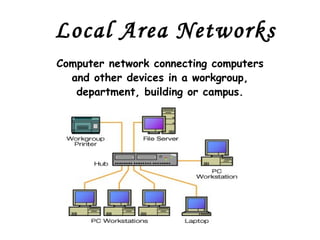
Computer network connecting computers and other devices in a workgroup, department, building or campus. Local Area Networks
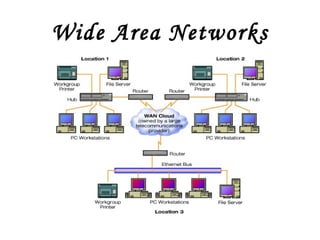
Connects BNs and MANs and are usually leased from inter-exchange carriers.  Typically span hundreds or thousands of miles. Supports data rates of 28.8 Kbps to 2 Gbps. Wide Area Networks
Wide Area Networks
Metropolitan Area Networks Is a telecommunication network that connects users and their computers in a geographical area This area is larger than covered by a LAN but smaller than covered by WAN. E.g City or college campus
A network that supports the interconnection of information technology within a range of 33 feet or so. Personal Area Networks
You  may  be  connected  through: Satellite Dial-up Leased line RF Link
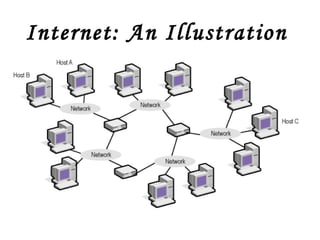
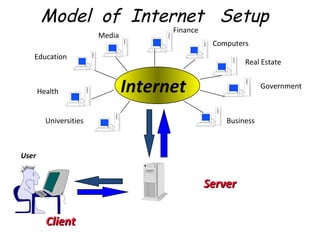
What is Internet? The Internet is “The Network of Networks” Internet is like a phone system which connects( almost anywhere in the world), Exchanges information Acts as Global link between regional networks Allows unrestricted access 3.  Used for Communication through email, Chatting  News groups, Files transfer Documents, data (multimedia )sharing etc
Internet: An Illustration
Internet Media Finance Computers Real Estate Education Health Government Universities Business Server User Client Model  of  Internet  Setup
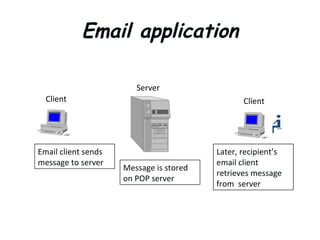
Email application Client Server Client Email client sends message to server Message is stored on POP server Later, recipient’s email client retrieves message from  server
Internet Publicly accessible network of interconnected computers which communicate via software protocol standards Easily accessed (via modem and phone line, ISDN, direct cable landline, satellite) Expanding global infrastructure
Intranet It is an internal corporate network built using Internet and World Wide Web standards and products. It is used by employees to gain access to company information
Extranet A network based on web technologies that links selected resources of a company’s intranet with its customers, suppliers, or other business partners.
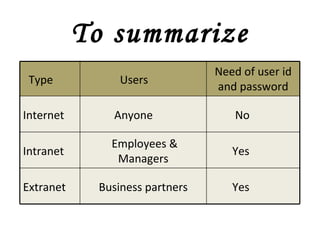
To summarize Yes Business partners Extranet Yes Employees & Managers Intranet No Anyone Internet Need of user id and password Users Type
Virtual Private Network It is used for secure intranet and extranet access applications. A VPN is a secure connection between two points across the Internet.
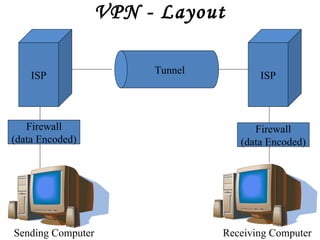
VPN - Layout Tunnel ISP ISP Firewall (data Encoded) Firewall (data Encoded) Sending Computer Receiving Computer
Computer Network topology A communications network is two or more computers connected to share data and resources are “networked.”  The simple idea behind computer networking is to allow users to access more information and give them access to devices not directly attached to their “local” system, such as printers or storage devices.
Computer Networks Network connections can also be made using RADIO transmission – Wireless. Allows user to stay connected to their home/office network using portable PC or PDA or may be Cell phone. Two Technologies that use wireless networking – Bluetooth (for home or small office use) and wireless Ethernet.
Local Area Networks-  3 basic  topologies These are either the logical or physical way the computers  are connected. Each connection on the network is known as a  node . These topologies are: Star Bus Ring Mesh [ Partially connected, Fully connected ] Tree
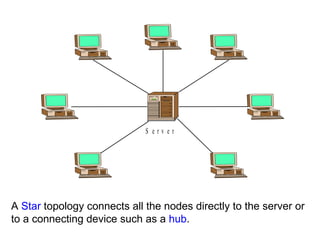
A  Star  topology connects all the nodes directly to the server or to a connecting device such as a  hub .
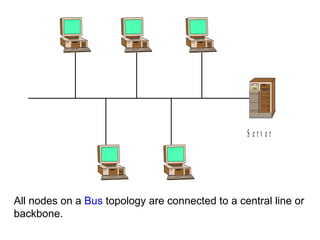
All nodes on a  Bus  topology are connected to a central line or backbone.
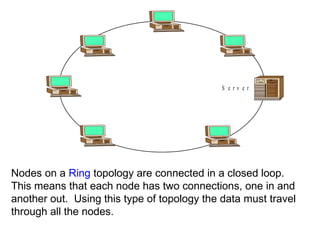
Nodes on a  Ring  topology are connected in a closed loop.  This means that each node has two connections, one in and another out.  Using this type of topology the data must travel through all the nodes.
Thank You…. Help is available !

Basics Of Networking

  • 1.
    Basics of Telecommunications and Networking
  • 2.
    Lecture Plan NetworkArchitecture Network standards and open systems Virtual private network Network management system
  • 3.
    Networking Anetwork is a group of interconnected systems which share services and interact with each other by means of a shared communication link. These systems can be located anywhere. Network is often classified according to its geographical size.
  • 4.
    Classification of NetworkThe most common classifications of networks are: Local Area Networks (LAN) Wide Area Networks (WAN) Metropolitan Area Networks (MAN) Personal Area Networks (PAN)
  • 5.
    Computer network connectingcomputers and other devices in a workgroup, department, building or campus. Local Area Networks
  • 6.
    Connects BNs andMANs and are usually leased from inter-exchange carriers. Typically span hundreds or thousands of miles. Supports data rates of 28.8 Kbps to 2 Gbps. Wide Area Networks
  • 7.
  • 8.
    Metropolitan Area NetworksIs a telecommunication network that connects users and their computers in a geographical area This area is larger than covered by a LAN but smaller than covered by WAN. E.g City or college campus
  • 9.
    A network thatsupports the interconnection of information technology within a range of 33 feet or so. Personal Area Networks
  • 10.
    You may be connected through: Satellite Dial-up Leased line RF Link
  • 11.
    What is Internet?The Internet is “The Network of Networks” Internet is like a phone system which connects( almost anywhere in the world), Exchanges information Acts as Global link between regional networks Allows unrestricted access 3. Used for Communication through email, Chatting News groups, Files transfer Documents, data (multimedia )sharing etc
  • 12.
  • 13.
    Internet Media FinanceComputers Real Estate Education Health Government Universities Business Server User Client Model of Internet Setup
  • 14.
    Email application ClientServer Client Email client sends message to server Message is stored on POP server Later, recipient’s email client retrieves message from server
  • 15.
    Internet Publicly accessiblenetwork of interconnected computers which communicate via software protocol standards Easily accessed (via modem and phone line, ISDN, direct cable landline, satellite) Expanding global infrastructure
  • 16.
    Intranet It isan internal corporate network built using Internet and World Wide Web standards and products. It is used by employees to gain access to company information
  • 17.
    Extranet A networkbased on web technologies that links selected resources of a company’s intranet with its customers, suppliers, or other business partners.
  • 18.
    To summarize YesBusiness partners Extranet Yes Employees & Managers Intranet No Anyone Internet Need of user id and password Users Type
  • 19.
    Virtual Private NetworkIt is used for secure intranet and extranet access applications. A VPN is a secure connection between two points across the Internet.
  • 20.
    VPN - LayoutTunnel ISP ISP Firewall (data Encoded) Firewall (data Encoded) Sending Computer Receiving Computer
  • 21.
    Computer Network topologyA communications network is two or more computers connected to share data and resources are “networked.” The simple idea behind computer networking is to allow users to access more information and give them access to devices not directly attached to their “local” system, such as printers or storage devices.
  • 22.
    Computer Networks Networkconnections can also be made using RADIO transmission – Wireless. Allows user to stay connected to their home/office network using portable PC or PDA or may be Cell phone. Two Technologies that use wireless networking – Bluetooth (for home or small office use) and wireless Ethernet.
  • 23.
    Local Area Networks- 3 basic topologies These are either the logical or physical way the computers are connected. Each connection on the network is known as a node . These topologies are: Star Bus Ring Mesh [ Partially connected, Fully connected ] Tree
  • 24.
    A Star topology connects all the nodes directly to the server or to a connecting device such as a hub .
  • 25.
    All nodes ona Bus topology are connected to a central line or backbone.
  • 26.
    Nodes on a Ring topology are connected in a closed loop. This means that each node has two connections, one in and another out. Using this type of topology the data must travel through all the nodes.
  • 27.
    Thank You…. Helpis available !

Editor's Notes

  • #16 ISDN-Integrated services digital network