An Overview of Service Management Processes Presented by Jerree Catlin,  Sue Silkey & Thelma Simons
Introduction to ITIL ITIL โ€“ Information Technology Infrastructure Library Developed by the Office for Government Commerce (OGC) in England Best practices focused on the management of IT service processes  Open source
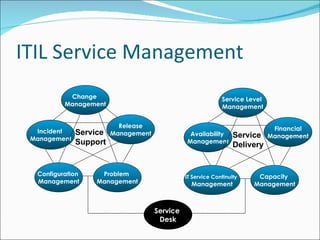
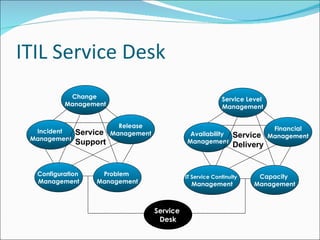
ITIL Service Management (ITSM) Two main components: Service Support โ€“ five processes that provide support for day-to-day operation of IT services Service Delivery โ€“ five processes that focus on long-term planning and improvement of IT services These two components are linked together through the Service Desk โ€“ a function that provides a single point of contact that focuses on rapid restoration of normal service operations to users
ITIL Service Management  Service Level  Management Financial Management Availability  Management IT Service Continuity   Management Capacity  Management Service Delivery Service  Desk Change  Management Release Management Incident  Management Configuration  Management Problem  Management Service Support
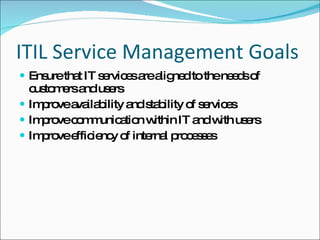
ITIL Service Management Goals Ensure that IT services are aligned to the needs of customers and users Improve availability and stability of services Improve communication within IT and with users Improve efficiency of internal processes
ITIL Processes Each ITIL process has associated: Goals Definitions Activities
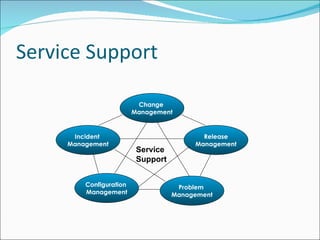
Service Support Change  Management Release Management Incident  Management Configuration  Management Problem  Management Service Support
Change Management Goal To ensure that standardized methods and procedures are used for efficient and prompt handling of all changes to minimize the impact of any related incidents upon service. Definition Change is an action that results in a new status for one or more IT infrastructure Configuration Items (CI).
Change Management Activities Accept, record, authorize, plan, test, implement and review Requests for Change (RFCs) Provides reports of changes to the infrastructure Provides updates to the Configuration Management Database (CMDB). Formal process
Configuration Management Goal To provide a logical model of the IT infrastructure (hardware, software and associated documentation) by identifying, maintaining and verifying the version of all configuration items. Definition A Configuration Item (CI) is a component of the infrastructure. Configuration Management Database (CMDB) is a database which holds a record of all configuration items associated the IT infrastructure.
Configuration Management Activities Plan, design and manage a Configuration Management Database (CMDB) Identify CIs for entry into CMDB and their relationships to each other Verify CMDB accuracy
Incident Management Goal To restore normal service operation as quickly as possible and minimize the adverse impact on users and the organization.  Definition An incident is any event which causes, or may cause an interruption to, or a reduction in, the quality of a service.
Incident Management Activities Detect, classify, record, and provide initial support of incidents Prioritize incidents based upon impact and urgency Service Desk is responsible for Incident Management
Problem Management Goal To minimize the adverse impacts of incidents and to prevent recurrence of incidents. Problem Management seeks to get to the root cause and initiate action to remove the error. Definition A problem is the unknown, underlying cause of one or more incidents. A known error is when the root cause of a problem is known and a temporary workaround or alternative has been identified.
Problem Management Activities Analyze incidents to identify underlying problems Record, classify and diagnose problems Transfer problems into โ€œknown errorsโ€ Generate Requests for Changes (RFCs) to resolve problems and errors Problems are identified and managed separately from incidents (although linked)
Release Management Goal To coordinate service providers and vendors involved with a significant release of hardware, software and associated documentation across a distributed environment. Definition A release is a collection of authorized changes to an IT service and is defined by the RFC that it implements.
Release Management Activities Plan and oversee successful rollout of new and changed software, hardware and documentation Collaborate with Change Management Verify that all release items are entered into the CMDB Manage customer and user expectations. Maintain Definitive Software Library (DSL) and Definitive Hardware Store (DHS)
ITIL Service Desk  Service Level  Management Financial Management Availability  Management IT Service Continuity   Management Capacity  Management Service Delivery Service  Desk Change  Management Release Management Incident  Management Configuration  Management Problem  Management Service Support
Service Desk Goal A single point of contact that provides advice and guidance and rapid restoration of normal service operations to users  Definition A Service Request is a request that is not due to disruption.
Service Desk Activities Manage the Incident and Service Request life-cycle, including closure Communicate with customers concerning request status and progress Provide initial assessment and attempt to resolve incidents working with appropriate IT staff Provide reports and recommendations to management for service improvement
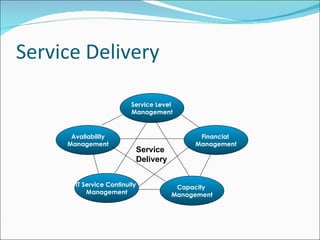
Service Delivery Service Level  Management Financial  Management Availability Management IT Service Continuity  Management Capacity  Management Service Delivery
Service Level Management Goal To maintain and improve IT Service quality through a constant cycle of agreeing, monitoring and reporting to meet the customersโ€™ objectives. Definition Service Level Agreement (SLA) is a written agreement with the customer. Operational Level Agreement (OLA) is an agreement between two internal areas.
Availability Management Goal To optimize the capability of the IT infrastructure, services, and supporting organization to deliver a cost effective and sustained level of availability enabling IT to meet their objectives. Definition Availability is the ability of an IT service or component to perform its required function at a stated instant or over a stated period of time.
Capacity Management Goal To ensure that all the current and future capacity and performance aspects of the business requirements are provided cost effectively.
Financial Management Goal To provide cost-effective stewardship of the IT assets and resources used in providing IT services.
IT Service Continuity Management Goal To ensure that the require IT technical and service facilities can be recovered within required and agreed timeframes Definition A crisis is an unplanned situation when one or more IT services is unavailable and when the outage exceeds the expectations of the customer

Iti Lprocessmgmt

  • 1.
    An Overview ofService Management Processes Presented by Jerree Catlin, Sue Silkey & Thelma Simons
  • 2.
    Introduction to ITILITIL โ€“ Information Technology Infrastructure Library Developed by the Office for Government Commerce (OGC) in England Best practices focused on the management of IT service processes Open source
  • 3.
    ITIL Service Management(ITSM) Two main components: Service Support โ€“ five processes that provide support for day-to-day operation of IT services Service Delivery โ€“ five processes that focus on long-term planning and improvement of IT services These two components are linked together through the Service Desk โ€“ a function that provides a single point of contact that focuses on rapid restoration of normal service operations to users
  • 4.
    ITIL Service Management Service Level Management Financial Management Availability Management IT Service Continuity Management Capacity Management Service Delivery Service Desk Change Management Release Management Incident Management Configuration Management Problem Management Service Support
  • 5.
    ITIL Service ManagementGoals Ensure that IT services are aligned to the needs of customers and users Improve availability and stability of services Improve communication within IT and with users Improve efficiency of internal processes
  • 6.
    ITIL Processes EachITIL process has associated: Goals Definitions Activities
  • 7.
    Service Support Change Management Release Management Incident Management Configuration Management Problem Management Service Support
  • 8.
    Change Management GoalTo ensure that standardized methods and procedures are used for efficient and prompt handling of all changes to minimize the impact of any related incidents upon service. Definition Change is an action that results in a new status for one or more IT infrastructure Configuration Items (CI).
  • 9.
    Change Management ActivitiesAccept, record, authorize, plan, test, implement and review Requests for Change (RFCs) Provides reports of changes to the infrastructure Provides updates to the Configuration Management Database (CMDB). Formal process
  • 10.
    Configuration Management GoalTo provide a logical model of the IT infrastructure (hardware, software and associated documentation) by identifying, maintaining and verifying the version of all configuration items. Definition A Configuration Item (CI) is a component of the infrastructure. Configuration Management Database (CMDB) is a database which holds a record of all configuration items associated the IT infrastructure.
  • 11.
    Configuration Management ActivitiesPlan, design and manage a Configuration Management Database (CMDB) Identify CIs for entry into CMDB and their relationships to each other Verify CMDB accuracy
  • 12.
    Incident Management GoalTo restore normal service operation as quickly as possible and minimize the adverse impact on users and the organization. Definition An incident is any event which causes, or may cause an interruption to, or a reduction in, the quality of a service.
  • 13.
    Incident Management ActivitiesDetect, classify, record, and provide initial support of incidents Prioritize incidents based upon impact and urgency Service Desk is responsible for Incident Management
  • 14.
    Problem Management GoalTo minimize the adverse impacts of incidents and to prevent recurrence of incidents. Problem Management seeks to get to the root cause and initiate action to remove the error. Definition A problem is the unknown, underlying cause of one or more incidents. A known error is when the root cause of a problem is known and a temporary workaround or alternative has been identified.
  • 15.
    Problem Management ActivitiesAnalyze incidents to identify underlying problems Record, classify and diagnose problems Transfer problems into โ€œknown errorsโ€ Generate Requests for Changes (RFCs) to resolve problems and errors Problems are identified and managed separately from incidents (although linked)
  • 16.
    Release Management GoalTo coordinate service providers and vendors involved with a significant release of hardware, software and associated documentation across a distributed environment. Definition A release is a collection of authorized changes to an IT service and is defined by the RFC that it implements.
  • 17.
    Release Management ActivitiesPlan and oversee successful rollout of new and changed software, hardware and documentation Collaborate with Change Management Verify that all release items are entered into the CMDB Manage customer and user expectations. Maintain Definitive Software Library (DSL) and Definitive Hardware Store (DHS)
  • 18.
    ITIL Service Desk Service Level Management Financial Management Availability Management IT Service Continuity Management Capacity Management Service Delivery Service Desk Change Management Release Management Incident Management Configuration Management Problem Management Service Support
  • 19.
    Service Desk GoalA single point of contact that provides advice and guidance and rapid restoration of normal service operations to users Definition A Service Request is a request that is not due to disruption.
  • 20.
    Service Desk ActivitiesManage the Incident and Service Request life-cycle, including closure Communicate with customers concerning request status and progress Provide initial assessment and attempt to resolve incidents working with appropriate IT staff Provide reports and recommendations to management for service improvement
  • 21.
    Service Delivery ServiceLevel Management Financial Management Availability Management IT Service Continuity Management Capacity Management Service Delivery
  • 22.
    Service Level ManagementGoal To maintain and improve IT Service quality through a constant cycle of agreeing, monitoring and reporting to meet the customersโ€™ objectives. Definition Service Level Agreement (SLA) is a written agreement with the customer. Operational Level Agreement (OLA) is an agreement between two internal areas.
  • 23.
    Availability Management GoalTo optimize the capability of the IT infrastructure, services, and supporting organization to deliver a cost effective and sustained level of availability enabling IT to meet their objectives. Definition Availability is the ability of an IT service or component to perform its required function at a stated instant or over a stated period of time.
  • 24.
    Capacity Management GoalTo ensure that all the current and future capacity and performance aspects of the business requirements are provided cost effectively.
  • 25.
    Financial Management GoalTo provide cost-effective stewardship of the IT assets and resources used in providing IT services.
  • 26.
    IT Service ContinuityManagement Goal To ensure that the require IT technical and service facilities can be recovered within required and agreed timeframes Definition A crisis is an unplanned situation when one or more IT services is unavailable and when the outage exceeds the expectations of the customer