Cooling system
Submitted by -
Nitesh Anjane
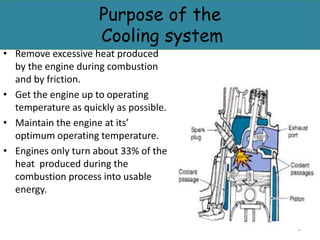
Purpose of the
Cooling system
• Remove excessive heat produced
by the engine during combustion
and by friction.
• Get the engine up to operating
temperature as quickly as possible.
• Maintain the engine at its’
optimum operating temperature.
• Engines only turn about 33% of the
heat produced during the
combustion process into usable
energy.
2
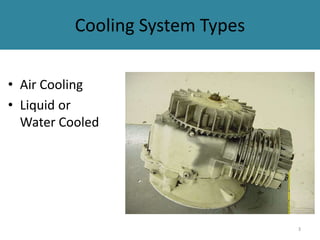
Cooling System Types
• Air Cooling
• Liquid or
Water Cooled
3
Air cooling
• In this type of cooling system, the heat, which
is conducted to the outer parts of the engine,
is radiated and conducted away by the stream
of air, which is obtained from the atmosphere.
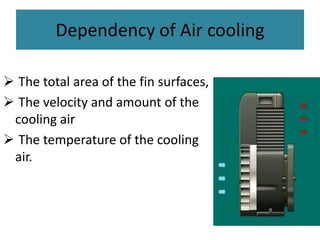
Dependency of Air cooling
 The total area of the fin surfaces,
 The velocity and amount of the
cooling air
 The temperature of the cooling
air.
Advantage and disadvantage of air
cooling
• Air Cooled engines are light and use a very
simple cooling system.
• Coolant or antifreeze solution are not required
• Require little or no maintenance.
• Cannot cool as efficiently as liquid cooling
systems
Water cooling
It serves two purposes in the working of an
engine:
a) It takes away the excessive heat generated in
the engine and saves it from over heating.
a) It keeps the engine at working temperature
for efficient and economical working
Advantage and disad. Of water cooling
• Uniform cooling of cylinder, cylinder head and
valves.
• Specific fuel consumption of engine improves.
• Engine is less noise as compare to air cooled
engine.
• More component in water cooled engine
make it costly.
• Depends on supply of water.
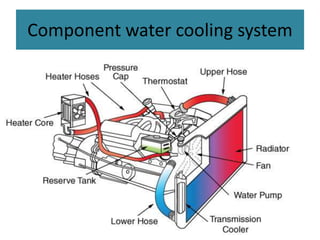
Component water cooling system
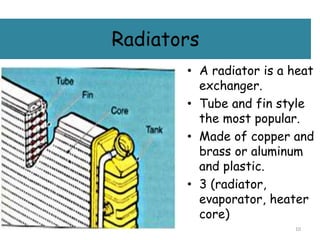
Radiators
• A radiator is a heat
exchanger.
• Tube and fin style
the most popular.
• Made of copper and
brass or aluminum
and plastic.
• 3 (radiator,
evaporator, heater
core)
10
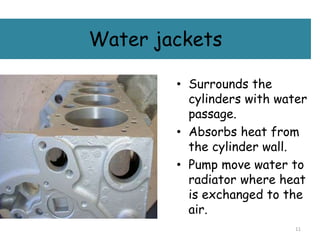
Water jackets
• Surrounds the
cylinders with water
passage.
• Absorbs heat from
the cylinder wall.
• Pump move water to
radiator where heat
is exchanged to the
air.
11
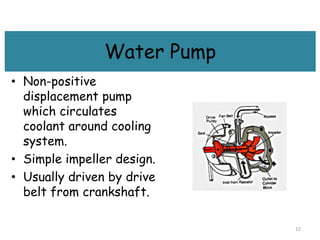
Water Pump
• Non-positive
displacement pump
which circulates
coolant around cooling
system.
• Simple impeller design.
• Usually driven by drive
belt from crankshaft.
12
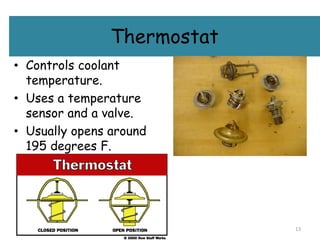
Thermostat
• Controls coolant
temperature.
• Uses a temperature
sensor and a valve.
• Usually opens around
195 degrees F.
13
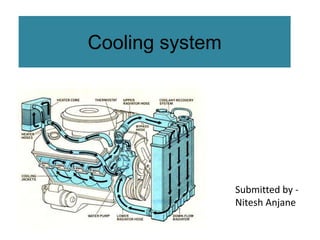
Cooling system

Cooling system

  • 1.
  • 2.
    Purpose of the Coolingsystem • Remove excessive heat produced by the engine during combustion and by friction. • Get the engine up to operating temperature as quickly as possible. • Maintain the engine at its’ optimum operating temperature. • Engines only turn about 33% of the heat produced during the combustion process into usable energy. 2
  • 3.
    Cooling System Types •Air Cooling • Liquid or Water Cooled 3
  • 4.
    Air cooling • Inthis type of cooling system, the heat, which is conducted to the outer parts of the engine, is radiated and conducted away by the stream of air, which is obtained from the atmosphere.
  • 5.
    Dependency of Aircooling  The total area of the fin surfaces,  The velocity and amount of the cooling air  The temperature of the cooling air.
  • 6.
    Advantage and disadvantageof air cooling • Air Cooled engines are light and use a very simple cooling system. • Coolant or antifreeze solution are not required • Require little or no maintenance. • Cannot cool as efficiently as liquid cooling systems
  • 7.
    Water cooling It servestwo purposes in the working of an engine: a) It takes away the excessive heat generated in the engine and saves it from over heating. a) It keeps the engine at working temperature for efficient and economical working
  • 8.
    Advantage and disad.Of water cooling • Uniform cooling of cylinder, cylinder head and valves. • Specific fuel consumption of engine improves. • Engine is less noise as compare to air cooled engine. • More component in water cooled engine make it costly. • Depends on supply of water.
  • 9.
  • 10.
    Radiators • A radiatoris a heat exchanger. • Tube and fin style the most popular. • Made of copper and brass or aluminum and plastic. • 3 (radiator, evaporator, heater core) 10
  • 11.
    Water jackets • Surroundsthe cylinders with water passage. • Absorbs heat from the cylinder wall. • Pump move water to radiator where heat is exchanged to the air. 11
  • 12.
    Water Pump • Non-positive displacementpump which circulates coolant around cooling system. • Simple impeller design. • Usually driven by drive belt from crankshaft. 12
  • 13.
    Thermostat • Controls coolant temperature. •Uses a temperature sensor and a valve. • Usually opens around 195 degrees F. 13