Interesting Electrolyte Cases Joel M. Topf, M.D. Nephrology 248.470.8163 http://PBFluids.blogspot.com
58 y.o. female with weakness and muscle aches 7.34 / 87 / 33 / 17 139  115 3.1  17 16 1.0
Determine the primary acid-base disorder Acidosis or alkalosis If the pH is less than 7.4 it is acidosis If the pH is greater than 7.4 it is alkalosis Determine if it is respiratory or metabolic If the pH, bicarbonate and pCO 2  all move in the same direction (up  or  down) it is metabolic If the pH, bicarbonate and pCO 2  move in discordant directions (up  and  down) it is respiratory 7.34  / 87  /  33  /  16 pH  /  pO2    /  pCO 2  /  HCO 3
Determine the primary acid-base disorder Acidosis or alkalosis If the pH is less than 7.4 it is acidosis If the pH is greater than 7.4 it is alkalosis Determine if it is respiratory or metabolic If the pH, bicarbonate and pCO 2  all move in the same direction (up  or  down) it is metabolic If the pH, bicarbonate and pCO 2  move in discordant directions (up  and  down) it is respiratory Acidosis or alkalosis If the pH is less than 7.4 it is acidosis If the pH is greater than 7.4 it is alkalosis 7.34  / 87  /  33  /  16 pH  /  pO2    /  pCO 2  /  HCO 3 7.34   / 87  /  33  /  16 pH  /  pO2    /  pCO 2  /  HCO 3
Determine the primary acid-base disorder Acidosis or alkalosis If the pH is less than 7.4 it is acidosis If the pH is greater than 7.4 it is alkalosis Determine if it is respiratory or metabolic If the pH, bicarbonate and pCO 2  all move in the same direction (up  or  down) it is metabolic If the pH, bicarbonate and pCO 2  move in discordant directions (up  and  down) it is respiratory Acidosis or alkalosis If the pH is less than 7.4 it is acidosis If the pH is greater than 7.4 it is alkalosis Determine if it is respiratory or metabolic If   the pH, bicarbonate and pCO 2  all move in the same direction (up or down) it is metabolic If the pH, bicarbonate and pCO 2  move in discordant directions (up and down) it is respiratory 7.34  / 87  /  33  /  16 pH  /  pO2    /  pCO 2  /  HCO 3 7.34   / 87  /  33  /  16 pH  /  pO2    /  pCO 2  /  HCO 3
Determine the primary disorder Acidosis or alkalosis If the pH is less than 7.4 it is acidosis If the pH is greater than 7.4 it is alkalosis Determine if it is respiratory or metabolic If the pH, bicarbonate and pCO 2  all move in the same direction (up  or  down) it is metabolic If the pH, bicarbonate and pCO 2  move in discordant directions (up  and  down) it is respiratory Acidosis or alkalosis If the pH is less than 7.4 it is acidosis If the pH is greater than 7.4 it is alkalosis Determine if it is respiratory or metabolic If   the pH, bicarbonate and pCO 2  all move in the same direction (up or down) it is metabolic If the pH, bicarbonate and pCO 2  move in discordant directions (up and down) it is respiratory Metabolic Acidosis 7.34  / 87  /  33  /  16 pH  /  pO2    /  pCO 2  /  HCO 3 7.34   / 87  /  33  /  16 pH  /  pO2    /  pCO 2  /  HCO 3
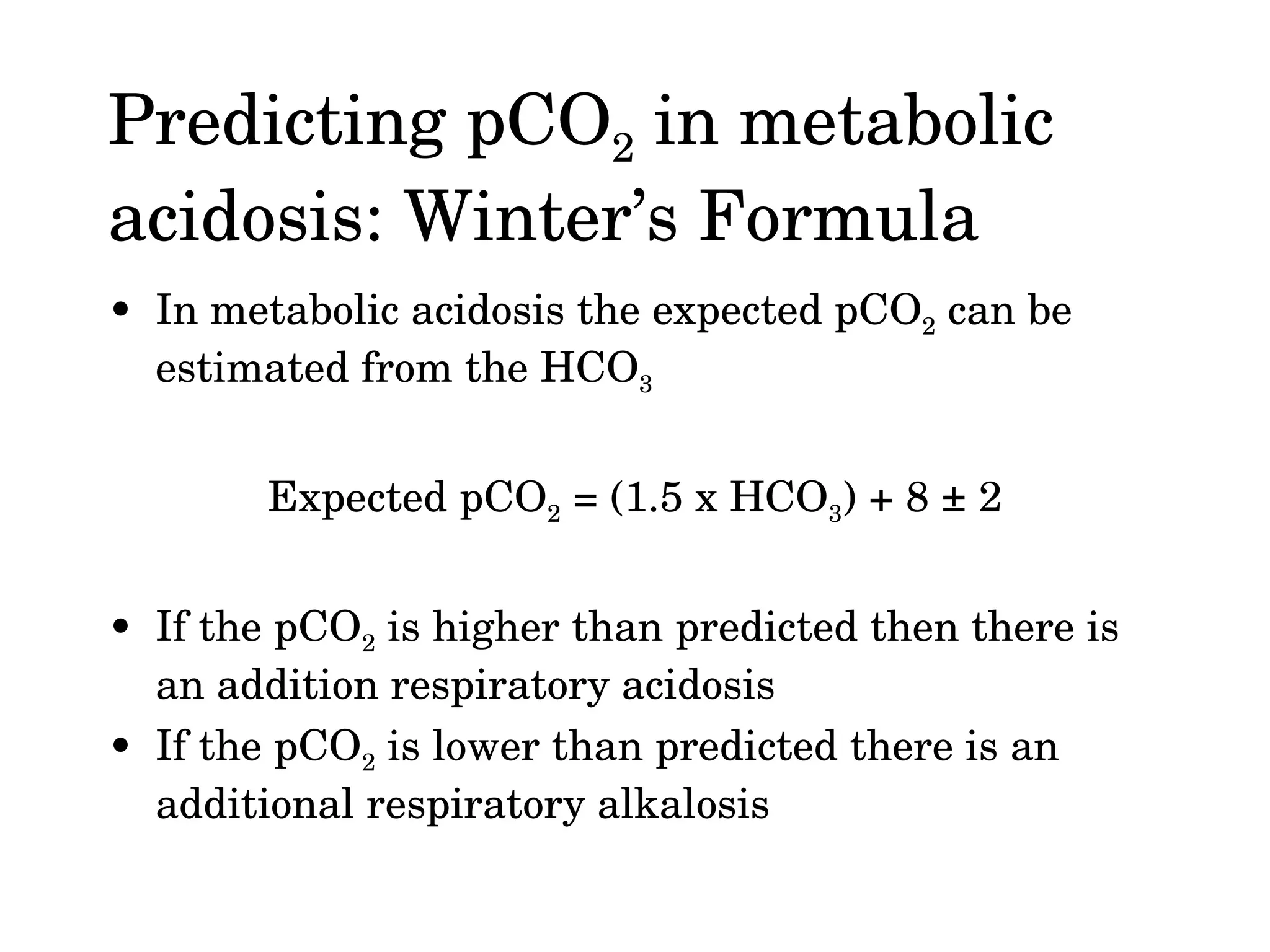
Predicting pCO 2  in metabolic acidosis: Winter’s Formula In metabolic acidosis the expected pCO 2  can be estimated from the HCO 3 Expected pCO 2  = (1.5 x HCO 3 ) + 8 ± 2 If the pCO 2  is higher than predicted then there is an addition respiratory acidosis If the pCO 2  is lower than predicted there is an additional respiratory alkalosis
Expected pCO 2  = (1.5 x HCO 3 ) + 8 ±2 Predicting pCO 2  in metabolic acidosis: Winter’s Formula 7.33 / 87 / 33 / 17 pH  /  pO2  /  pCO 2  /  HCO 3
Expected pCO 2  = (1.5 x HCO 3 ) + 8 ±2 Expected pCO 2  = 31-35 Predicting pCO 2  in metabolic acidosis: Winter’s Formula 7.33 / 87 / 33 / 17 pH  /  pO2  /  pCO 2  /  HCO 3
Expected pCO 2  = (1.5 x HCO 3 ) + 8 ±2 Expected pCO 2  = 31-35 Actual pCO 2  is 33, which is within the predicted range, indicating a simple metabolic acidosis Predicting pCO 2  in metabolic acidosis: Winter’s Formula 7.33 / 87 / 33 / 17 pH  /  pO2  /  pCO 2  /  HCO 3
Expected pCO 2  = (1.5 x HCO 3 ) + 8 ±2 Expected pCO 2  = 31-35 Actual pCO 2  is 33, which is within the predicted range, indicating a simple metabolic acidosis Predicting pCO 2  in metabolic acidosis: Winter’s Formula Appropriately compensated metabolic acidosis 7.33 / 87 / 33 / 17 pH  /  pO2  /  pCO 2  /  HCO 3
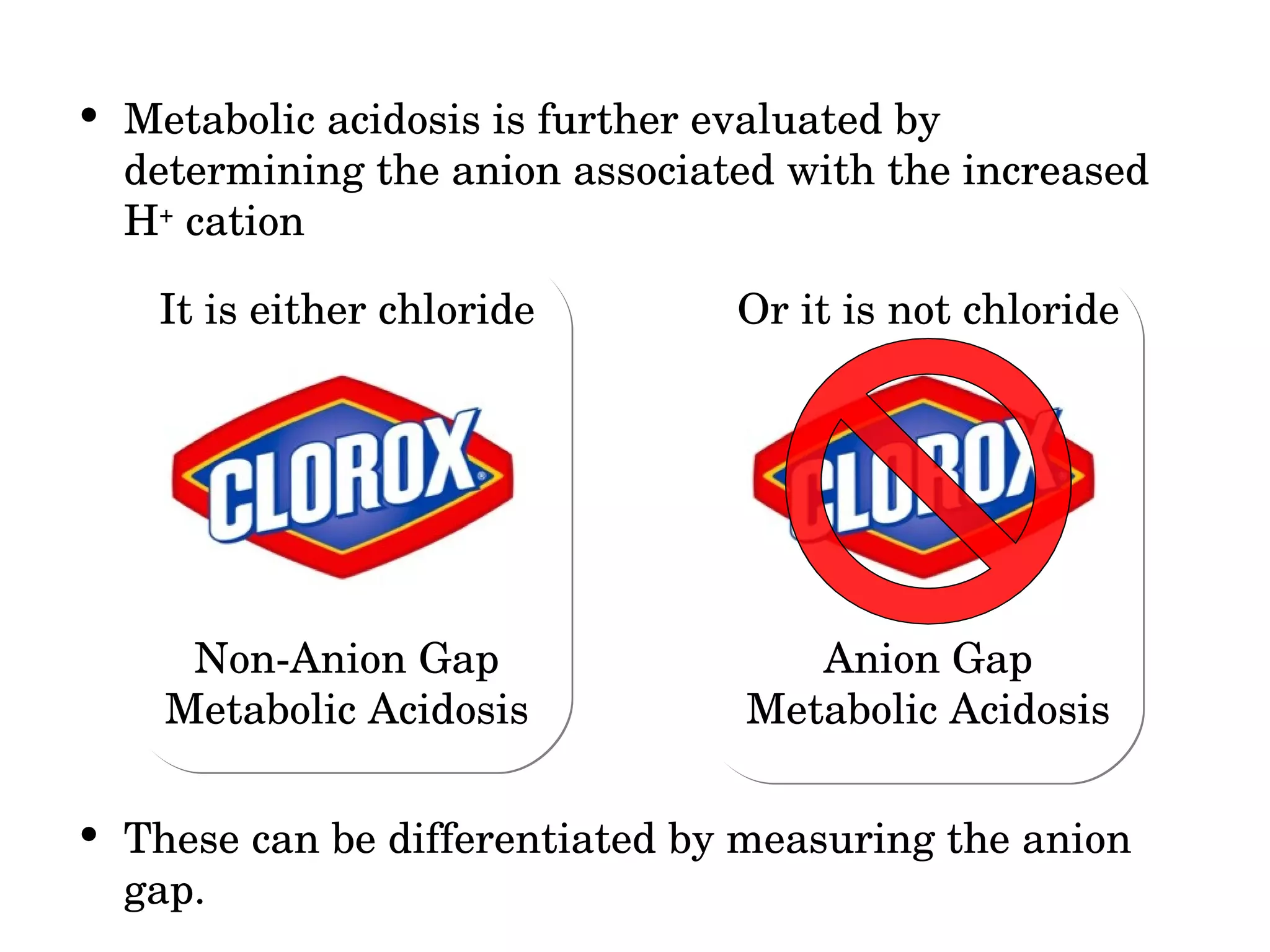
Metabolic acidosis is further evaluated by determining the anion associated with the increased H +  cation
Metabolic acidosis is further evaluated by determining the anion associated with the increased H +  cation It is either chloride Non-Anion Gap Metabolic Acidosis
Metabolic acidosis is further evaluated by determining the anion associated with the increased H +  cation It is either chloride Non-Anion Gap Metabolic Acidosis Or it is not chloride Anion Gap Metabolic Acidosis
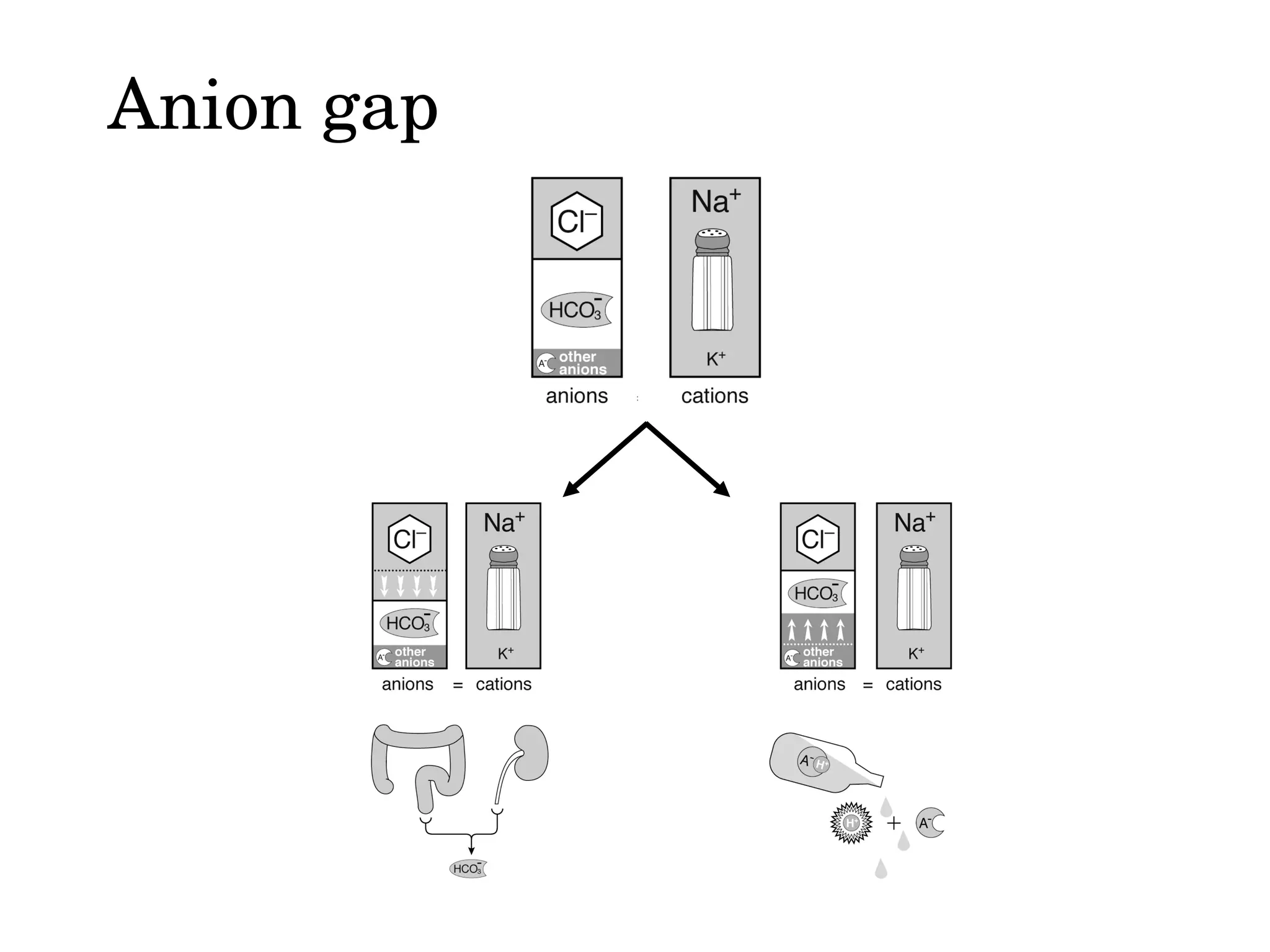
Metabolic acidosis is further evaluated by determining the anion associated with the increased H +  cation These can be differentiated by measuring the anion gap. It is either chloride Non-Anion Gap Metabolic Acidosis Or it is not chloride Anion Gap Metabolic Acidosis
Anion gap =
Anion gap =
Anion gap =
Anion gap =
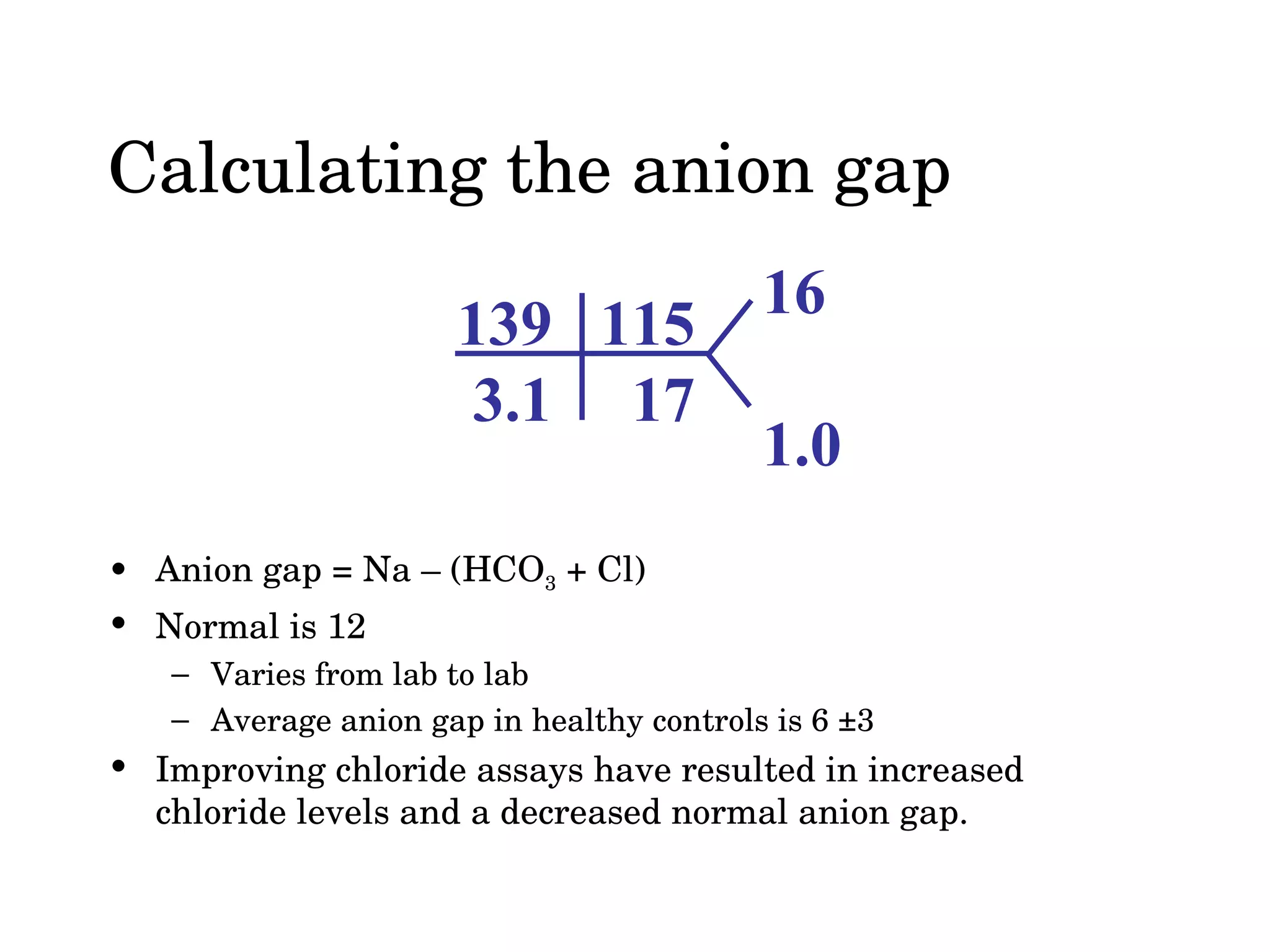
Calculating the anion gap Anion gap = Na – (HCO 3  + Cl) Normal is 12 Varies from lab to lab Average anion gap in healthy controls is 6 ±3 Improving chloride assays have resulted in increased chloride levels and a decreased normal anion gap. 139  115 3.1  17 16 1.0
Calculating the anion gap Anion gap = 139 – (17 + 115) Anion gap = 7 Anion gap = Na – (HCO 3  + Cl) Normal is 12 139  115 3.1  17 16 1.0
Calculating the anion gap Anion gap = 139 – (17 + 115) Anion gap = 7 Varies from lab to lab Average anion gap in healthy controls is 6 ±3 Improving chloride assays have resulted in increased chloride levels and a decreased normal anion gap. Anion gap = Na – (HCO 3  + Cl) Normal is 12 Varies from lab to lab Average anion gap in healthy controls is 6 ±3 Improving chloride assays have resulted in increased chloride levels and a decreased normal anion gap. Appropriately compensated  non-anion gap metabolic acidosis 139  115 3.1  17 16 1.0
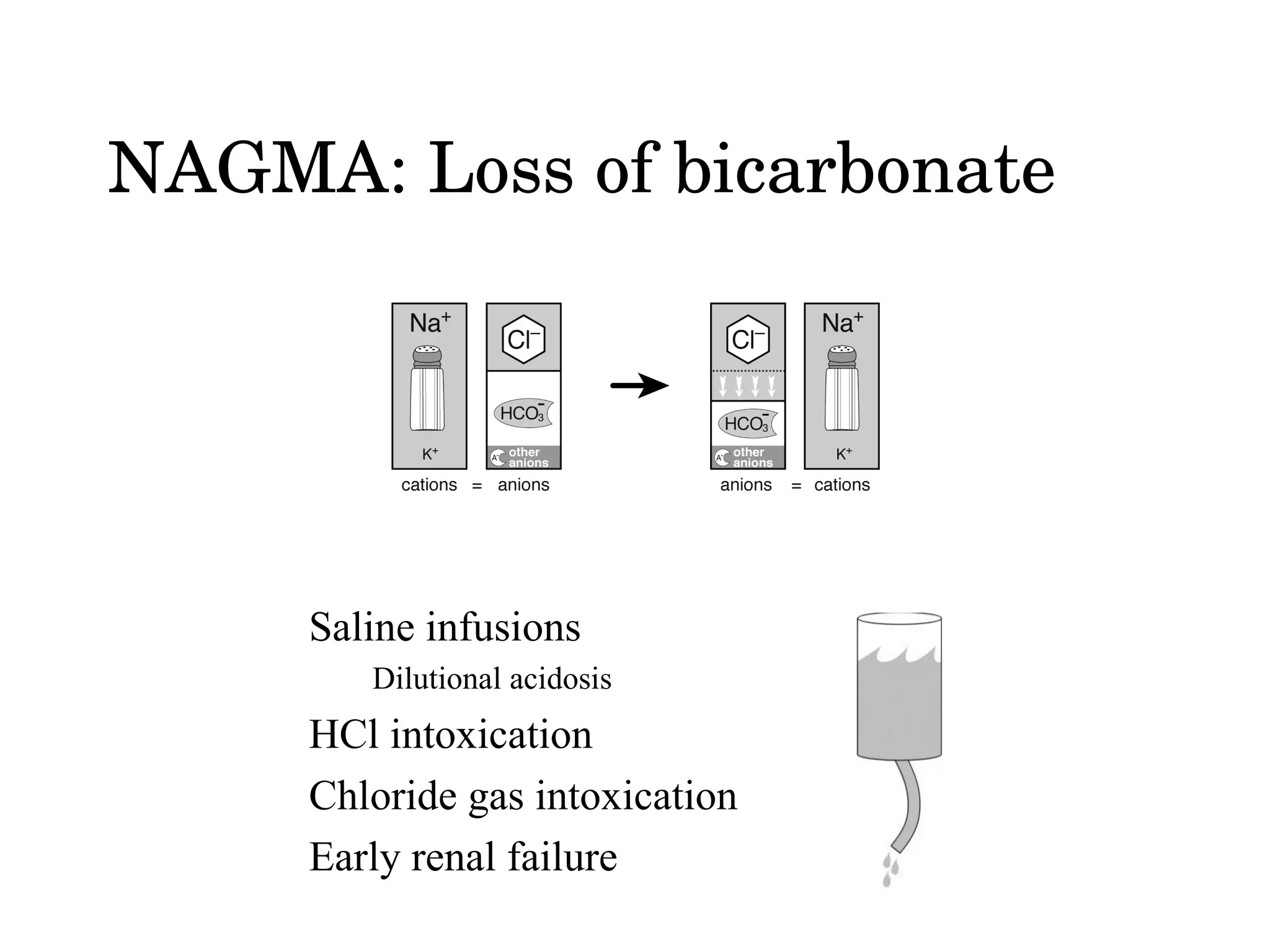
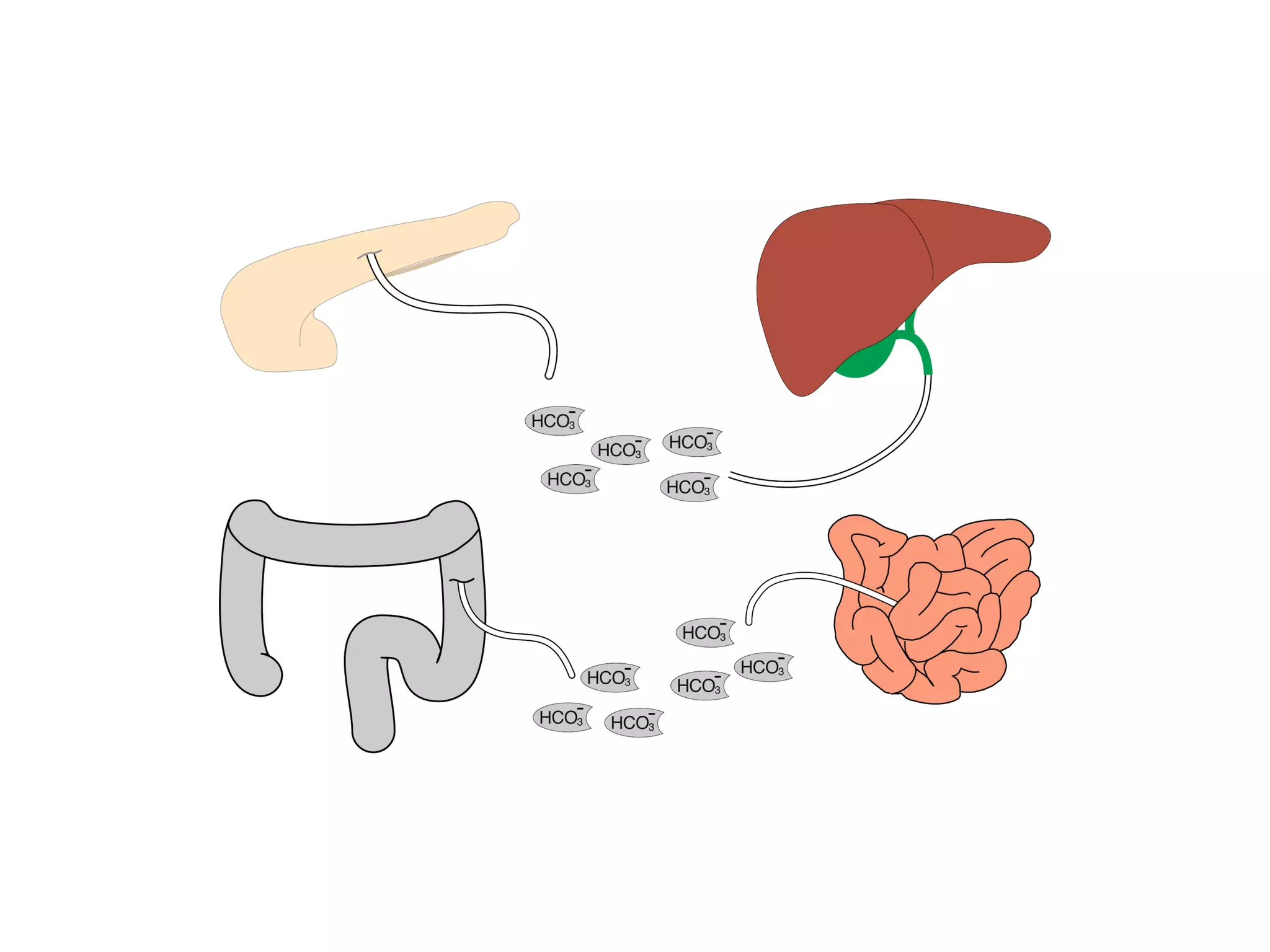
NAGMA: Loss of bicarbonate GI loss of HCO 3 Diarrhea Surgical drains Fistulas Ureterosigmoidostomy Obstructed ureteroileostomy Cholestyramine Renal loss of HCO 3 Renal tubular acidosis Proximal Distal Hypoaldosteronism Saline infusions Dilutional acidosis HCl intoxication Chloride gas intoxication Early renal failure
NAGMA: Loss of bicarbonate GI loss of HCO 3 Diarrhea Surgical drains Fistulas Ureterosigmoidostomy Obstructed ureteroileostomy Cholestyramine Renal loss of HCO 3 Renal tubular acidosis Proximal Distal Hypoaldosteronism
 
Plasma Bile Pancreas Small intestines Large intestines 140  102 4.4  24 135  100 5.0  35 135  50 5.0  90 135  50 5.0  90 110  90 35  40
 
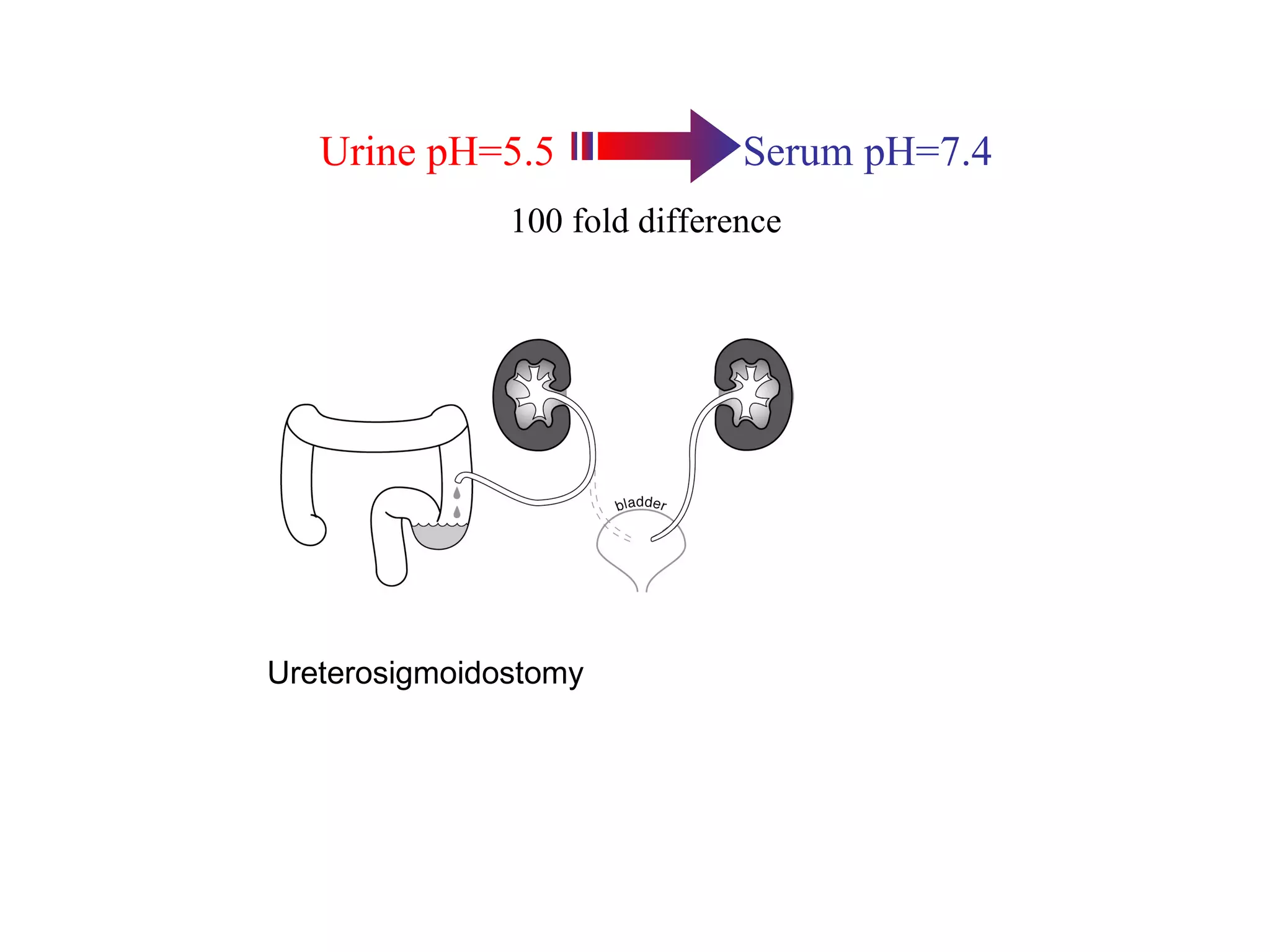
Urine pH=5.5 Serum pH=7.4 100 fold difference
Ureterosigmoidostomy Urine pH=5.5 Serum pH=7.4 100 fold difference
Ureterosigmoidostomy Ureteroileostomy Urine pH=5.5 Serum pH=7.4 100 fold difference
Renal causes of non-anion gap Renal tubular acidosis is a failure of the kidney to reabsorb all of the filtered bicarbonate or synthesize new bicarbonate to keep up with metabolic demands. Daily acid load Protein metabolism consumes bicarbonate This bicarbonate must be replaced Generally equal to 1 mmol/kg
Bicarbonate handling Normally 144 mmol of bicarbonate per hour are filtered at the glomerulus 24 mmol/L x 100 mL/min x 60 min/hour Equivalent to 3 amps of bicarb per hour or a bicarb drip running 1 liter per hour 3456 mmol/day 50-100 mmol/day
Bicarbonate handling Normally 144 mmol of bicarbonate per hour are filtered at the glomerulus 24 mmol/L x 100 mL/min x 60 min/hour Equivalent to 3 amps of bicarb per hour or a bicarb drip running 1 liter per hour The kidney must create 50-100 mmol per day of new bicarb-onate to replace bicarbonate lost buffering the daily acid load. 3456 mmol/day 50-100 mmol/day
Proximal tubule: reabsorption of filtered bicarbonate
Distal tubule, completion of reabsorption and replacing bicarbonate lost to the daily acid load.
Fate of excreted hydrogen ion The minimal urine pH is 4.5. This is a H +  concentration a 1000 times that of plasma.
Fate of excreted hydrogen ion The minimal urine pH is 4.5. This is a H +  concentration a 1000 times that of plasma. But It still is only 0.04 mmol/L
Fate of excreted hydrogen ion The minimal urine pH is 4.5. This is a H +  concentration a 1000 times that of plasma. But It still is only 0.04 mmol/L In order to excrete 50 mmol (to produce enough bicarb-onate to account for the daily acid load) one would need to produce 1250 liters of urine.
Fate of excreted hydrogen ion Ammonium Titratable acid
Proximal RTA (Type 2) The Tm is the maximum plasma concentration of any solute at which the proximal tubule is able to completely reabsorb the solute. Beyond the Tm the substance will be incompletely reabsorbed and spill in the urine. In Proximal RTA the Tm for bicarbonate is reduced from 26 to 15-20 mmol/L. Na + H 2 O HCO 3 Glucose Amino Acids
Proximal RTA Tm for bicarbonate at 15 Serum bicarbonate above the Tm Proximal RTA (Type 2) 24 mmol/L 15 mmol/L pH 8
Proximal RTA Tm for bicarbonate at 15 Serum bicarbonate at the Tm Proximal RTA (Type 2) 15 mmol/L 15 mmol/L pH 5
Proximal RTA Tm for bicarbonate at 15 Serum bicarbonate below the Tm Proximal RTA (Type 2) 12 mmol/L 12 mmol/L pH 5
Proximal RTA: etiologies Acquired Acetylzolamide  Ifosfamide  Chronic hypocalcemia Multiple myeloma Cisplatin Lead toxicity Mercury poisoning Streptozocin Expired tetracycline Genetic Cystinosis Galactosemia Hereditary fructose intolerance Wilson’s disease Hyperparathyroidism Chronic hypocapnia Intracellular alkalosis
Proximal RTA: consequences Hypokalemia Bone disease Bone buffering of the acidosis Decreased 1,25 OH D leading to hypocalcemia and 2° HPTH Not typically complicated by stones
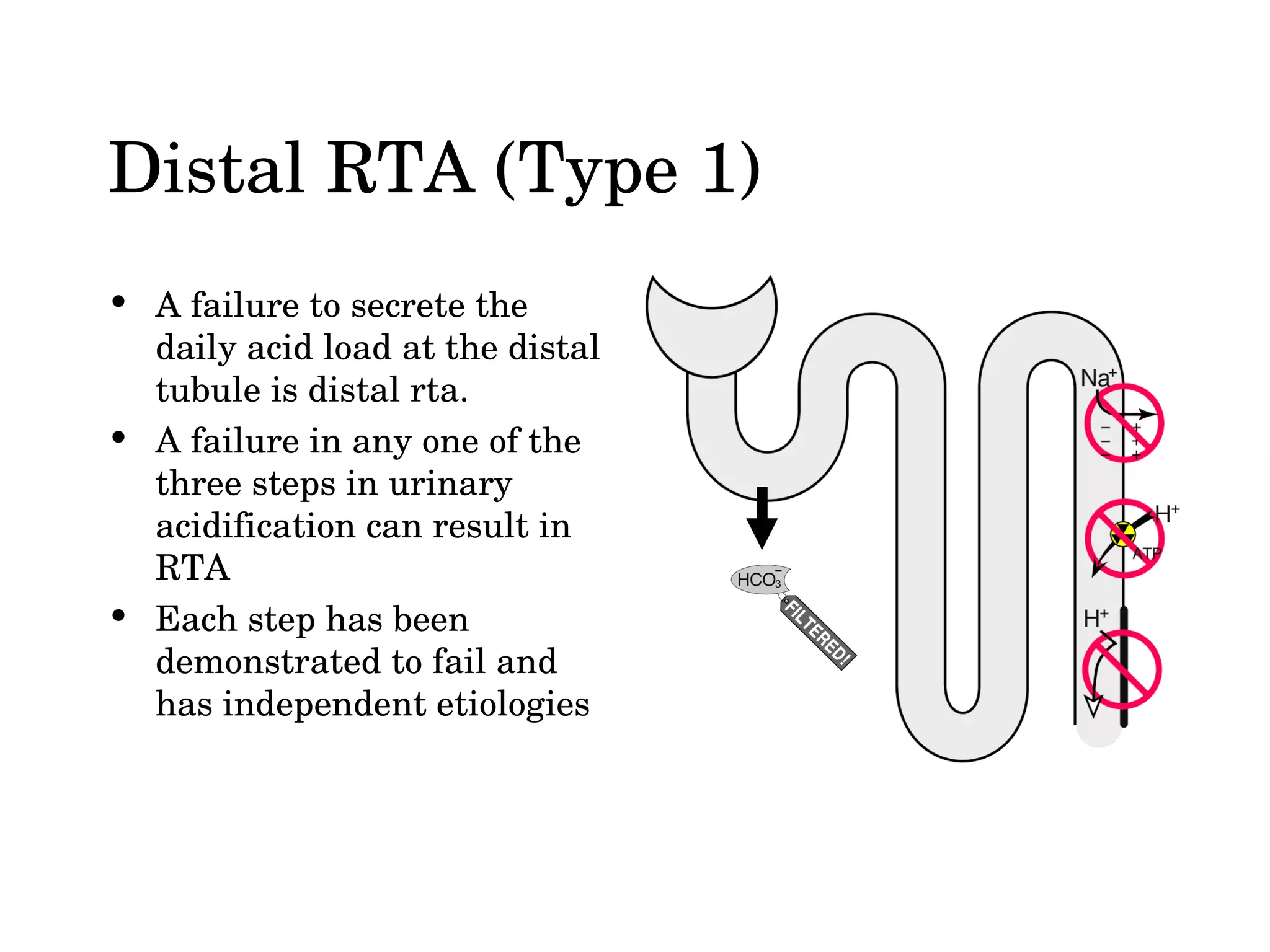
Distal RTA (Type 1) A failure to secrete the daily acid load at the distal tubule is distal rta. A failure in any one of the three steps in urinary acidification can result in RTA Each step has been demonstrated to fail and has independent etiologies
Distal RTA:  Voltage dependent Only variety of distal RTA which is hyperkalemic Differentiate from type 4 by failure to respond to fludrocortisone. Obstructive uropathy Sickle cell anemia Lupus Triameterene Amiloride
Distal RTA:  H +  Secretion Called classic distal RTA Most common cause of distal RTA Congenital Lithium Multiple myeloma Lupus Pyelonephritis Sickle cell anemia Sjögren’s syndrome Toluene (Glue sniffing) Wilson’s disease
Distal RTA:  Gradient defect Amphotercin B
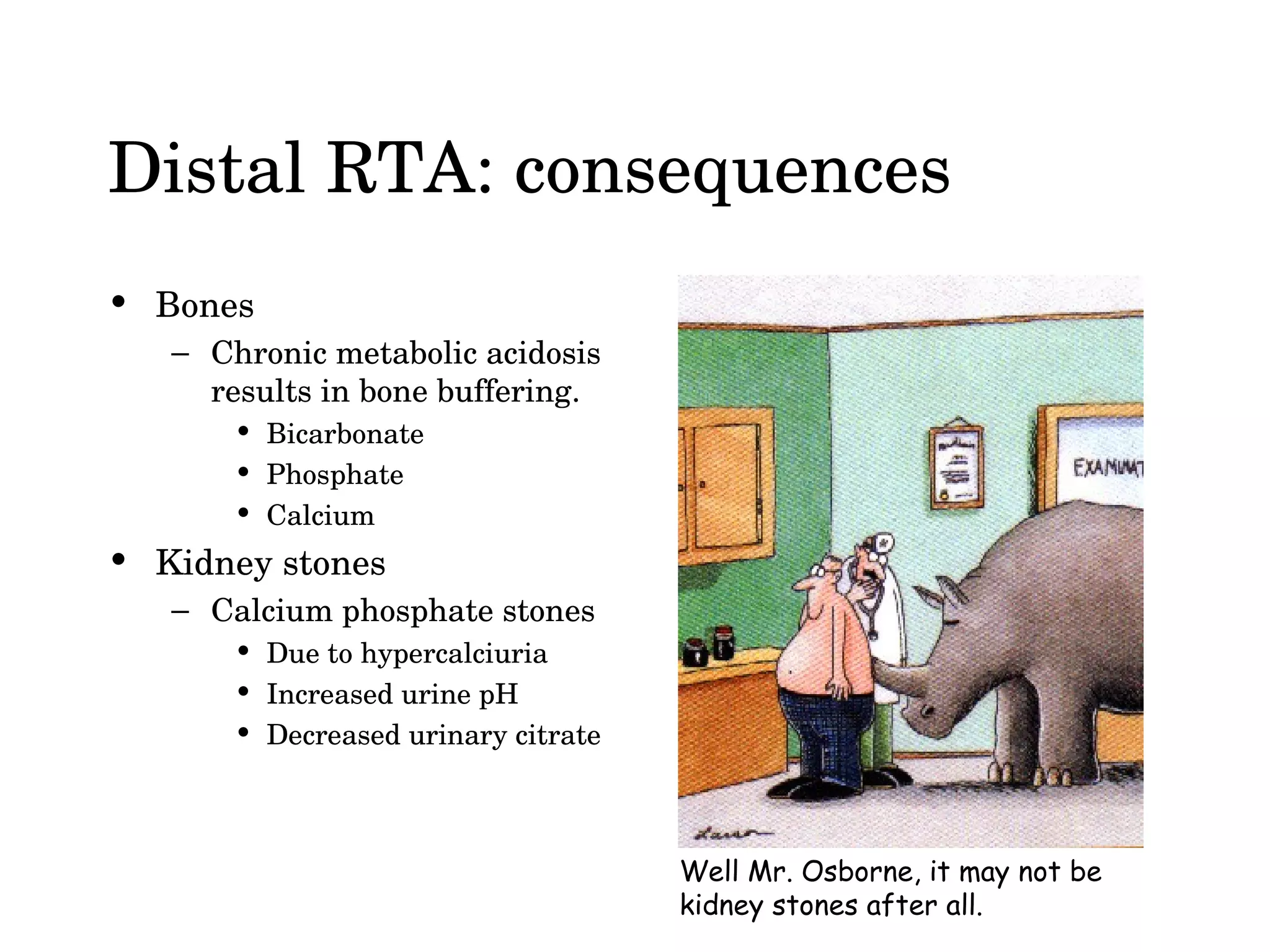
Distal RTA: consequences Bones Chronic metabolic acidosis results in bone buffering. Bicarbonate Phosphate  Calcium Kidney stones Calcium phosphate stones Due to hypercalciuria Increased urine pH Decreased urinary citrate Well Mr. Osborne, it may not be kidney stones after all.
Hypoaldosteronism Chronic hyperkalemia of any etiology decreases ammonia- genesis Without ammonia to convert to ammonium total acid excretion is modest Urinary acidification is intact Acidosis is typically mild without significant bone or stone disease Primary problem is with high potassium
Diagnosing the cause of: non-anion gap metabolic acidosis
To look for renal H +  clearance look for urinary ammonium Ammonium Titratable acid
To look for renal H +  clearance look for urinary ammonium Ammonium Titratable acid NH 4 +
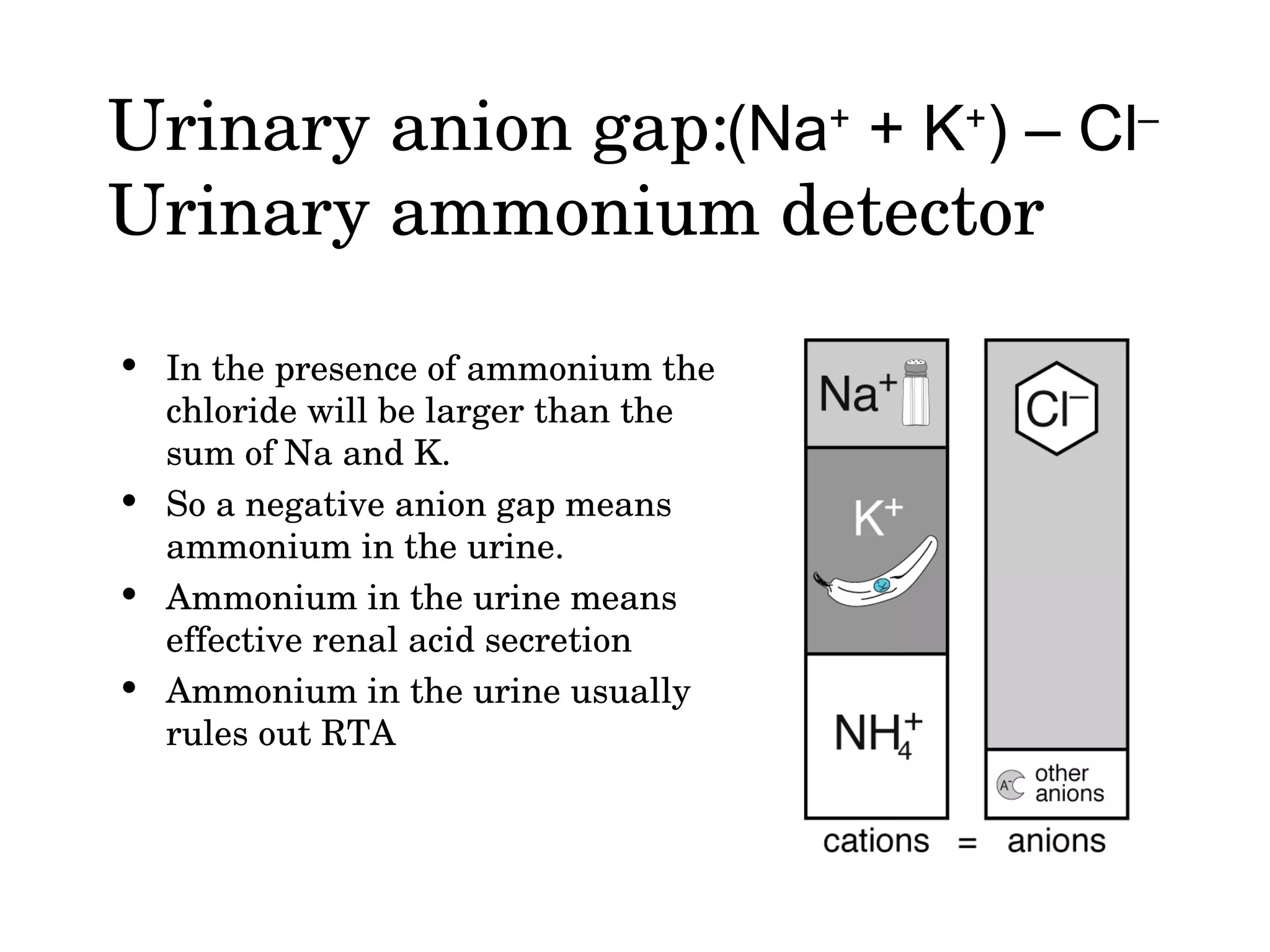
Urinary anion gap:  Urinary ammonium detector In the presence of ammonium the chloride will be larger than the sum of Na and K. So a negative anion gap means ammonium in the urine. Ammonium in the urine means effective renal acid secretion Ammonium in the urine usually rules out RTA (Na +  + K + ) – Cl –
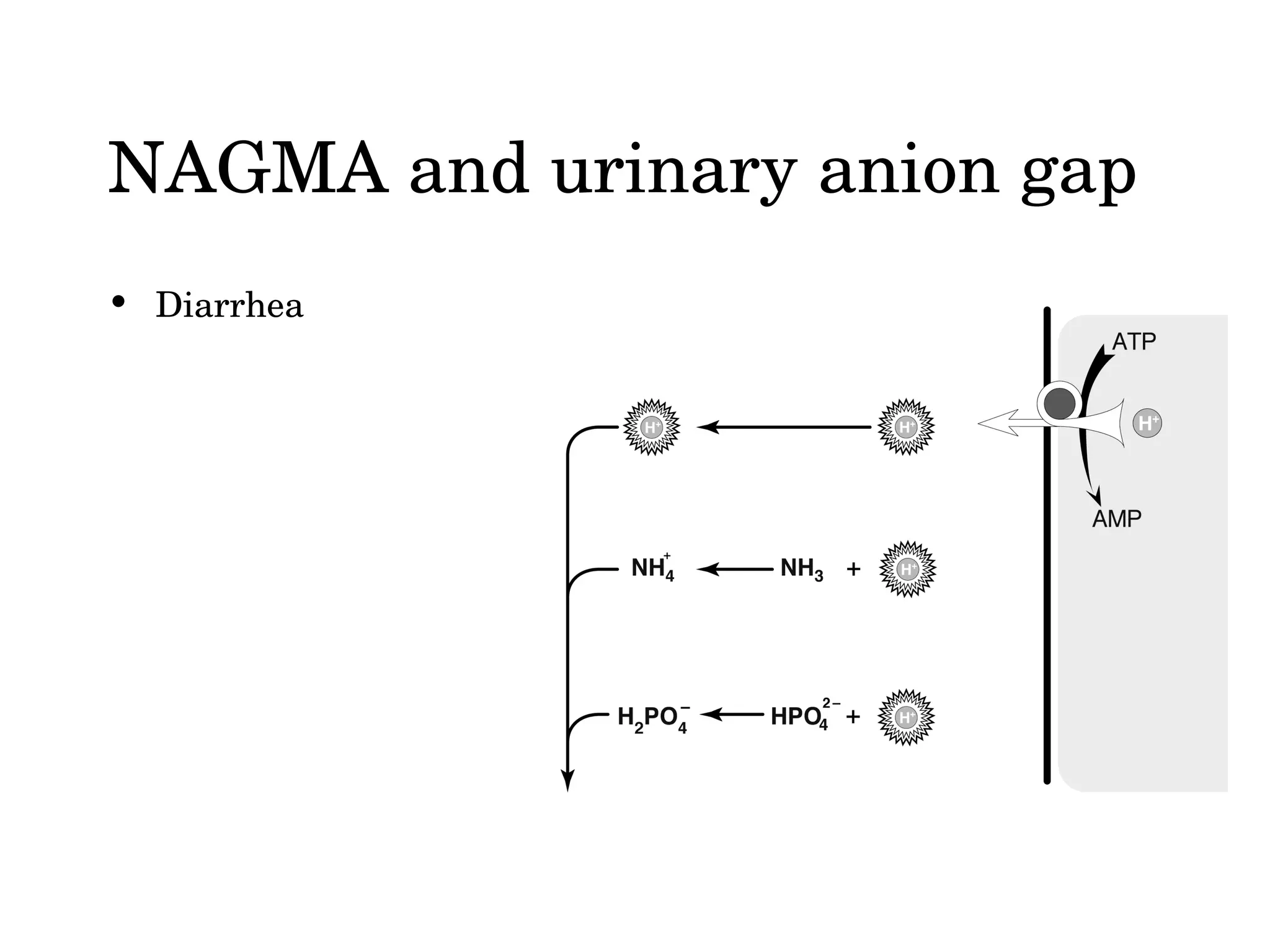
NAGMA and urinary anion gap Diarrhea
NAGMA and urinary anion gap Diarrhea Negative
NAGMA and urinary anion gap Diarrhea Negative Proximal RTA At baseline 15 mmol/L 15 mmol/L pH 5
NAGMA and urinary anion gap Diarrhea Negative Proximal RTA At baseline Negative 15 mmol/L 15 mmol/L pH 5
NAGMA and urinary anion gap Diarrhea Negative Proximal RTA At baseline Negative During treatment 24 mmol/L 15 mmol/L pH 8
NAGMA and urinary anion gap Diarrhea Negative Proximal RTA At baseline Negative During treatment Positive 24 mmol/L 15 mmol/L pH 8
NAGMA and urinary anion gap Diarrhea Negative Proximal RTA At baseline Negative During treatment Positive During acid load 12 mmol/L 12 mmol/L pH 5
NAGMA and urinary anion gap Diarrhea Negative Proximal RTA At baseline Negative During treatment Positive During acid load Negative 12 mmol/L 12 mmol/L pH 5
NAGMA and urinary anion gap Diarrhea Negative Proximal RTA At baseline Negative During treatment Positive During acid load Negative Distal RTA
NAGMA and urinary anion gap Diarrhea Negative Proximal RTA At baseline Negative During treatment Positive During acid load Negative Distal RTA: Positive
NAGMA and urinary anion gap Diarrhea Negative Proximal RTA At baseline Negative During treatment Positive During acid load Negative Distal RTA: Positive Type IV RTA
NAGMA and urinary anion gap Diarrhea Negative Proximal RTA At baseline Negative During treatment Positive During acid load Negative Distal RTA: Positive Type IV RTA Positive
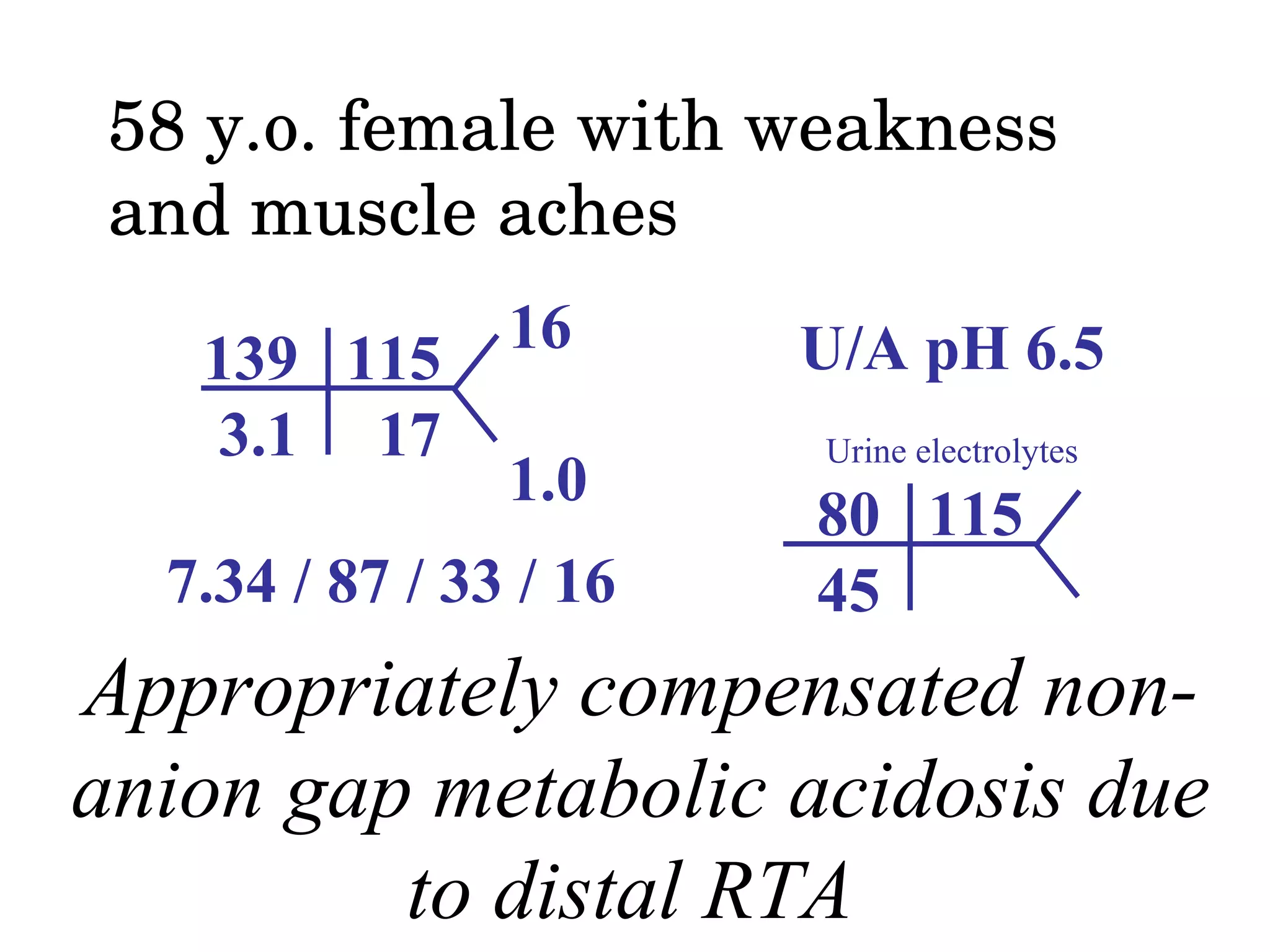
58 y.o. female with weakness and muscle aches 7.34 / 87 / 33 / 16 U/A pH 6.5 Urine electrolytes 139  115 3.1  17 16 1.0 80  115 45
58 y.o. female with weakness and muscle aches 7.34 / 87 / 33 / 16 U/A pH 6.5 Urine electrolytes Appropriately compensated non-anion gap metabolic acidosis due to distal RTA  139  115 3.1  17 16 1.0 80  115 45
74 y.o. female with 34 year history of DM c/o weakness 7.34 / 87 / 33 / 16 Albumin 1.8 139  123 6.6  17 21 1.2
Determine the primary disorder Acidosis or alkalosis If the pH is less than 7.4 it is acidosis If the pH is greater than 7.4 it is alkalosis Determine if it is respiratory or metabolic If the pH, bicarbonate and pCO 2  all move in the same direction (up  or  down) it is metabolic If the pH, bicarbonate and pCO 2  move in discordant directions (up  and  down) it is respiratory 7.34  / 87  /  33  /  16 pH  /  pO2    /  pCO 2  /  HCO 3
Determine the primary disorder Acidosis or alkalosis If the pH is less than 7.4 it is acidosis If the pH is greater than 7.4 it is alkalosis Determine if it is respiratory or metabolic If the pH, bicarbonate and pCO 2  all move in the same direction (up  or  down) it is metabolic If the pH, bicarbonate and pCO 2  move in discordant directions (up  and  down) it is respiratory Acidosis or alkalosis If the pH is less than 7.4 it is acidosis If the pH is greater than 7.4 it is alkalosis 7.34  / 87  /  33  /  16 pH  /  pO2    /  pCO 2  /  HCO 3 7.34   / 87  /  33  /  16 pH  /  pO2    /  pCO 2  /  HCO 3
Determine the primary disorder Acidosis or alkalosis If the pH is less than 7.4 it is acidosis If the pH is greater than 7.4 it is alkalosis Determine if it is respiratory or metabolic If the pH, bicarbonate and pCO 2  all move in the same direction (up  or  down) it is metabolic If the pH, bicarbonate and pCO 2  move in discordant directions (up  and  down) it is respiratory Acidosis or alkalosis If the pH is less than 7.4 it is acidosis If the pH is greater than 7.4 it is alkalosis Determine if it is respiratory or metabolic If   the pH, bicarbonate and pCO 2  all move in the same direction (up or down) it is metabolic If the pH, bicarbonate and pCO 2  move in discordant directions (up and down) it is respiratory 7.34  / 87  /  33  /  16 pH  /  pO2    /  pCO 2  /  HCO 3 7.34   / 87  /  33  /  16 pH  /  pO2    /  pCO 2  /  HCO 3
Determine the primary disorder Acidosis or alkalosis If the pH is less than 7.4 it is acidosis If the pH is greater than 7.4 it is alkalosis Determine if it is respiratory or metabolic If the pH, bicarbonate and pCO 2  all move in the same direction (up  or  down) it is metabolic If the pH, bicarbonate and pCO 2  move in discordant directions (up  and  down) it is respiratory Acidosis or alkalosis If the pH is less than 7.4 it is acidosis If the pH is greater than 7.4 it is alkalosis Determine if it is respiratory or metabolic If   the pH, bicarbonate and pCO 2  all move in the same direction (up or down) it is metabolic If the pH, bicarbonate and pCO 2  move in discordant directions (up and down) it is respiratory Metabolic Acidosis 7.34  / 87  /  33  /  16 pH  /  pO2    /  pCO 2  /  HCO 3 7.34   / 87  /  33  /  16 pH  /  pO2    /  pCO 2  /  HCO 3
Expected pCO 2  = (1.5 x HCO 3 ) + 8 ±2 Expected pCO 2  = 31-35 Actual pCO 2  is 33, which is within the predicted range, indicating a simple metabolic acidosis Predicting pCO 2  in metabolic acidosis: Winter’s Formula 7.33 / 87 / 33 / 17 pH  /  pO2  /  pCO 2  /  HCO 3
Expected pCO 2  = (1.5 x HCO 3 ) + 8 ±2 Expected pCO 2  = 31-35 Actual pCO 2  is 33, which is within the predicted range, indicating a simple metabolic acidosis Predicting pCO 2  in metabolic acidosis: Winter’s Formula Appropriately compensated metabolic acidosis 7.33 / 87 / 33 / 17 pH  /  pO2  /  pCO 2  /  HCO 3
Calculating the anion gap Anion gap = Na – (HCO 3  + Cl) 139  123 6.6  17 16 1.0
Calculating the anion gap Anion gap = Na – (HCO 3  + Cl) Anion gap = 139 – (123 + 17) Anion gap = -1 139  123 6.6  17 16 1.0
Calculating the anion gap Anion gap = Na – (HCO 3  + Cl) Anion gap = 139 – (123 + 17) Anion gap = -1 A negative anion gap! That’s got to mean something! 139  123 6.6  17 16 1.0
Hypoalbuminuria, hypophosphatemia The “other anions” includes phosphate and albumin Hypoalbuminuria and hypophosphatemia lowers the anion gap If one fails to adjust the upper and lower limit of the normal anion gap, altered albumin and phosphorous can hide a pathologic anion gap
Hypoalbuminuria, hypophosphatemia The “other anions” includes phosphate and albumin Hypoalbuminuria and hypophosphatemia lowers the anion gap If one fails to adjust the upper and lower limit of the normal anion gap, altered albumin and phosphorous can hide a pathologic anion gap Adjusted Normal Anion Gap
Hypoalbuminuria, hypophosphatemia The “other anions” includes phosphate and albumin To estimate the normal anion gap for any individual multiply the albumin by 2.5 and add half the phosphorous Hypoalbuminuria and hypophosphatemia lowers the anion gap If one fails to adjust the upper and lower limit of the normal anion gap, altered albumin and phosphorous can hide a pathologic anion gap Adjusted Normal Anion Gap
Other causes of a low anion gap Increased chloride Hypertriglyceridemia Bromide Iodide Decreased “ Unmeasured anions ” Albumin Phosphorous IgA Increased “ Unmeasured cations ” Hyperkalemia Hypercalcemia Hypermagnesemia Lithium Increased cationic paraproteins IgG Albumin Phos IgA Chloride Bicarb Sodium Potassium Calcium Magnesium IgG Normal anion gap
Recent lab history
Diagnose the cause of: non-anion gap metabolic  acidosis with hyperkalemia
Diagnose the cause of: non-anion gap metabolic  acidosis with hyperkalemia Type four RTA,  hyporenin-hypoaldo
Diagnose the cause of: non-anion gap metabolic  acidosis with hyperkalemia Type four RTA,  hyporenin-hypoaldo Hyperkalemic Distal (Type 1) RTA, voltage dependent distal RTA
A dipstick for aldosterone activity: The trans-tubular potassium gradient The TTKG
Trans-tubular Potassium Gradient (TTKG) The ratio of tubular to venous K indicates the level of aldosterone activity. In the presence of hyperkalemia the ratio should be > 10. In the presence of hypokalemia the ratio of < 4.
The trans-tubular potassium gradient adjusts the urine potassium for water loss in the collecting ducts. This allows the use of urinary potassium to calculate the ratio of potassium from the tubule to the interstitium in the CCD. Trans-tubular Potassium Gradient (TTKG)
Pre-requisites to using the TTKG as a measure of aldosterone activity: Trans-tubular Potassium Gradient (TTKG) Urine osmolality > serum osmolality
Pre-requisites to using the TTKG as a measure of aldosterone activity: Trans-tubular Potassium Gradient (TTKG) Urine osmolality > serum osmolality Fluid leaving the LoH has an osmolality  of 100 mOsm/Kg
Pre-requisites to using the TTKG as a measure of aldosterone activity: Trans-tubular Potassium Gradient (TTKG) Urine osmolality > serum osmolality Fluid leaving the LoH has an osmolality  of 100 mOsm/Kg In the presence of ADH water leaves the DCT so that the tubular fluid becomes isosmotic
Pre-requisites to using the TTKG as a measure of aldosterone activity: Trans-tubular Potassium Gradient (TTKG) Urine osmolality > serum osmolality Urine Na > 20 mmol/L Fluid leaving the LoH has an osmolality  of 100 mOsm/Kg In the presence of ADH water leaves the DCT so that the tubular fluid becomes isosmotic
Type four RTA,  hyporenin-hypoaldo Hyperkalemic Distal (Type 1) RTA, voltage dependent distal RTA Trans-tubular Potassium Gradient (TTKG) Lets play low normal or high!  TTKG and Aldo level
Type four RTA,  hyporenin-hypoaldo Hyperkalemic Distal (Type 1) RTA, voltage dependent distal RTA Trans-tubular Potassium Gradient (TTKG) Type four RTA,  hyporenin-hypoaldo Low TTKG Low aldosterone Lets play low normal or high!  TTKG and Aldo level
Type four RTA,  hyporenin-hypoaldo Hyperkalemic Distal (Type 1) RTA, voltage dependent distal RTA Trans-tubular Potassium Gradient (TTKG) Type four RTA,  hyporenin-hypoaldo Low TTKG Low aldosterone Hyperkalemic Distal (Type 1) RTA, voltage dependent distal RTA Low TTKG High aldosterone Lets play low normal or high!  TTKG and Aldo level
58 y.o. female with weakness and muscle aches
58 y.o. female with weakness and muscle aches Both the bicarbonate and potassium were normal at admission. This is hospital acquired RTA (type 1 or 4)
Type four RTA,  hyporenin-hypoaldo Hyperkalemic Distal (Type 1), voltage dependent distal RTA Hospital acquired RTA really means drug induced RTA
Type four RTA,  hyporenin-hypoaldo Hyperkalemic Distal (Type 1), voltage dependent distal RTA Hospital acquired RTA really means drug induced RTA Lets play: Name that drug!
Type four RTA,  hyporenin-hypoaldo Hyperkalemic Distal (Type 1), voltage dependent distal RTA Hospital acquired RTA really means drug induced RTA Type four RTA,  hyporenin-hypoaldo Spironolactone ACEi/ARB Heparin Lets play: Name that drug!
Type four RTA,  hyporenin-hypoaldo Hyperkalemic Distal (Type 1), voltage dependent distal RTA Hospital acquired RTA really means drug induced RTA Type four RTA,  hyporenin-hypoaldo Spironolactone ACEi/ARB Heparin Hyperkalemic Distal (Type 1), voltage dependent distal RTA Amiloride Triamterene Trimethoprim Lets play: Name that drug!
Type four RTA,  hyporenin-hypoaldo Hyperkalemic Distal (Type 1), voltage dependent distal RTA 58 y.o. female with weakness and muscle aches
Type four RTA,  hyporenin-hypoaldo Hyperkalemic Distal (Type 1), voltage dependent distal RTA 58 y.o. female with weakness and muscle aches Patient’s TTKG was 2.7 with a K of 5.7 Aldosterone was 22 The patient had been started on a high dose of TMP/SMX for a partially resistant urinary tract infection
Two women with non-anion gap metabolic acidosis One with hypokalemia One with hyperkalemia Both with distal RTA
Fin

Non-anion gap Metabolic Acidosis (NAGMA)

  • 1.
    Interesting Electrolyte CasesJoel M. Topf, M.D. Nephrology 248.470.8163 http://PBFluids.blogspot.com
  • 2.
    58 y.o. femalewith weakness and muscle aches 7.34 / 87 / 33 / 17 139 115 3.1 17 16 1.0
  • 3.
    Determine the primaryacid-base disorder Acidosis or alkalosis If the pH is less than 7.4 it is acidosis If the pH is greater than 7.4 it is alkalosis Determine if it is respiratory or metabolic If the pH, bicarbonate and pCO 2 all move in the same direction (up or down) it is metabolic If the pH, bicarbonate and pCO 2 move in discordant directions (up and down) it is respiratory 7.34 / 87 / 33 / 16 pH / pO2 / pCO 2 / HCO 3
  • 4.
    Determine the primaryacid-base disorder Acidosis or alkalosis If the pH is less than 7.4 it is acidosis If the pH is greater than 7.4 it is alkalosis Determine if it is respiratory or metabolic If the pH, bicarbonate and pCO 2 all move in the same direction (up or down) it is metabolic If the pH, bicarbonate and pCO 2 move in discordant directions (up and down) it is respiratory Acidosis or alkalosis If the pH is less than 7.4 it is acidosis If the pH is greater than 7.4 it is alkalosis 7.34 / 87 / 33 / 16 pH / pO2 / pCO 2 / HCO 3 7.34 / 87 / 33 / 16 pH / pO2 / pCO 2 / HCO 3
  • 5.
    Determine the primaryacid-base disorder Acidosis or alkalosis If the pH is less than 7.4 it is acidosis If the pH is greater than 7.4 it is alkalosis Determine if it is respiratory or metabolic If the pH, bicarbonate and pCO 2 all move in the same direction (up or down) it is metabolic If the pH, bicarbonate and pCO 2 move in discordant directions (up and down) it is respiratory Acidosis or alkalosis If the pH is less than 7.4 it is acidosis If the pH is greater than 7.4 it is alkalosis Determine if it is respiratory or metabolic If the pH, bicarbonate and pCO 2 all move in the same direction (up or down) it is metabolic If the pH, bicarbonate and pCO 2 move in discordant directions (up and down) it is respiratory 7.34 / 87 / 33 / 16 pH / pO2 / pCO 2 / HCO 3 7.34 / 87 / 33 / 16 pH / pO2 / pCO 2 / HCO 3
  • 6.
    Determine the primarydisorder Acidosis or alkalosis If the pH is less than 7.4 it is acidosis If the pH is greater than 7.4 it is alkalosis Determine if it is respiratory or metabolic If the pH, bicarbonate and pCO 2 all move in the same direction (up or down) it is metabolic If the pH, bicarbonate and pCO 2 move in discordant directions (up and down) it is respiratory Acidosis or alkalosis If the pH is less than 7.4 it is acidosis If the pH is greater than 7.4 it is alkalosis Determine if it is respiratory or metabolic If the pH, bicarbonate and pCO 2 all move in the same direction (up or down) it is metabolic If the pH, bicarbonate and pCO 2 move in discordant directions (up and down) it is respiratory Metabolic Acidosis 7.34 / 87 / 33 / 16 pH / pO2 / pCO 2 / HCO 3 7.34 / 87 / 33 / 16 pH / pO2 / pCO 2 / HCO 3
  • 7.
    Predicting pCO 2 in metabolic acidosis: Winter’s Formula In metabolic acidosis the expected pCO 2 can be estimated from the HCO 3 Expected pCO 2 = (1.5 x HCO 3 ) + 8 ± 2 If the pCO 2 is higher than predicted then there is an addition respiratory acidosis If the pCO 2 is lower than predicted there is an additional respiratory alkalosis
  • 8.
    Expected pCO 2 = (1.5 x HCO 3 ) + 8 ±2 Predicting pCO 2 in metabolic acidosis: Winter’s Formula 7.33 / 87 / 33 / 17 pH / pO2 / pCO 2 / HCO 3
  • 9.
    Expected pCO 2 = (1.5 x HCO 3 ) + 8 ±2 Expected pCO 2 = 31-35 Predicting pCO 2 in metabolic acidosis: Winter’s Formula 7.33 / 87 / 33 / 17 pH / pO2 / pCO 2 / HCO 3
  • 10.
    Expected pCO 2 = (1.5 x HCO 3 ) + 8 ±2 Expected pCO 2 = 31-35 Actual pCO 2 is 33, which is within the predicted range, indicating a simple metabolic acidosis Predicting pCO 2 in metabolic acidosis: Winter’s Formula 7.33 / 87 / 33 / 17 pH / pO2 / pCO 2 / HCO 3
  • 11.
    Expected pCO 2 = (1.5 x HCO 3 ) + 8 ±2 Expected pCO 2 = 31-35 Actual pCO 2 is 33, which is within the predicted range, indicating a simple metabolic acidosis Predicting pCO 2 in metabolic acidosis: Winter’s Formula Appropriately compensated metabolic acidosis 7.33 / 87 / 33 / 17 pH / pO2 / pCO 2 / HCO 3
  • 12.
    Metabolic acidosis isfurther evaluated by determining the anion associated with the increased H + cation
  • 13.
    Metabolic acidosis isfurther evaluated by determining the anion associated with the increased H + cation It is either chloride Non-Anion Gap Metabolic Acidosis
  • 14.
    Metabolic acidosis isfurther evaluated by determining the anion associated with the increased H + cation It is either chloride Non-Anion Gap Metabolic Acidosis Or it is not chloride Anion Gap Metabolic Acidosis
  • 15.
    Metabolic acidosis isfurther evaluated by determining the anion associated with the increased H + cation These can be differentiated by measuring the anion gap. It is either chloride Non-Anion Gap Metabolic Acidosis Or it is not chloride Anion Gap Metabolic Acidosis
  • 16.
  • 17.
  • 18.
  • 19.
  • 20.
    Calculating the aniongap Anion gap = Na – (HCO 3 + Cl) Normal is 12 Varies from lab to lab Average anion gap in healthy controls is 6 ±3 Improving chloride assays have resulted in increased chloride levels and a decreased normal anion gap. 139 115 3.1 17 16 1.0
  • 21.
    Calculating the aniongap Anion gap = 139 – (17 + 115) Anion gap = 7 Anion gap = Na – (HCO 3 + Cl) Normal is 12 139 115 3.1 17 16 1.0
  • 22.
    Calculating the aniongap Anion gap = 139 – (17 + 115) Anion gap = 7 Varies from lab to lab Average anion gap in healthy controls is 6 ±3 Improving chloride assays have resulted in increased chloride levels and a decreased normal anion gap. Anion gap = Na – (HCO 3 + Cl) Normal is 12 Varies from lab to lab Average anion gap in healthy controls is 6 ±3 Improving chloride assays have resulted in increased chloride levels and a decreased normal anion gap. Appropriately compensated non-anion gap metabolic acidosis 139 115 3.1 17 16 1.0
  • 23.
    NAGMA: Loss ofbicarbonate GI loss of HCO 3 Diarrhea Surgical drains Fistulas Ureterosigmoidostomy Obstructed ureteroileostomy Cholestyramine Renal loss of HCO 3 Renal tubular acidosis Proximal Distal Hypoaldosteronism Saline infusions Dilutional acidosis HCl intoxication Chloride gas intoxication Early renal failure
  • 24.
    NAGMA: Loss ofbicarbonate GI loss of HCO 3 Diarrhea Surgical drains Fistulas Ureterosigmoidostomy Obstructed ureteroileostomy Cholestyramine Renal loss of HCO 3 Renal tubular acidosis Proximal Distal Hypoaldosteronism
  • 25.
    NAGMA: Loss ofbicarbonate GI loss of HCO 3 Diarrhea Surgical drains Fistulas Ureterosigmoidostomy Obstructed ureteroileostomy Cholestyramine Renal loss of HCO 3 Renal tubular acidosis Proximal Distal Hypoaldosteronism
  • 26.
  • 27.
    Plasma Bile PancreasSmall intestines Large intestines 140 102 4.4 24 135 100 5.0 35 135 50 5.0 90 135 50 5.0 90 110 90 35 40
  • 28.
  • 29.
    Urine pH=5.5 SerumpH=7.4 100 fold difference
  • 30.
    Ureterosigmoidostomy Urine pH=5.5Serum pH=7.4 100 fold difference
  • 31.
    Ureterosigmoidostomy Ureteroileostomy UrinepH=5.5 Serum pH=7.4 100 fold difference
  • 32.
    Renal causes ofnon-anion gap Renal tubular acidosis is a failure of the kidney to reabsorb all of the filtered bicarbonate or synthesize new bicarbonate to keep up with metabolic demands. Daily acid load Protein metabolism consumes bicarbonate This bicarbonate must be replaced Generally equal to 1 mmol/kg
  • 33.
    Bicarbonate handling Normally144 mmol of bicarbonate per hour are filtered at the glomerulus 24 mmol/L x 100 mL/min x 60 min/hour Equivalent to 3 amps of bicarb per hour or a bicarb drip running 1 liter per hour 3456 mmol/day 50-100 mmol/day
  • 34.
    Bicarbonate handling Normally144 mmol of bicarbonate per hour are filtered at the glomerulus 24 mmol/L x 100 mL/min x 60 min/hour Equivalent to 3 amps of bicarb per hour or a bicarb drip running 1 liter per hour The kidney must create 50-100 mmol per day of new bicarb-onate to replace bicarbonate lost buffering the daily acid load. 3456 mmol/day 50-100 mmol/day
  • 35.
    Proximal tubule: reabsorptionof filtered bicarbonate
  • 36.
    Proximal tubule: reabsorptionof filtered bicarbonate
  • 37.
    Proximal tubule: reabsorptionof filtered bicarbonate
  • 38.
    Distal tubule, completionof reabsorption and replacing bicarbonate lost to the daily acid load.
  • 39.
    Distal tubule, completionof reabsorption and replacing bicarbonate lost to the daily acid load.
  • 40.
    Distal tubule, completionof reabsorption and replacing bicarbonate lost to the daily acid load.
  • 41.
    Fate of excretedhydrogen ion The minimal urine pH is 4.5. This is a H + concentration a 1000 times that of plasma.
  • 42.
    Fate of excretedhydrogen ion The minimal urine pH is 4.5. This is a H + concentration a 1000 times that of plasma. But It still is only 0.04 mmol/L
  • 43.
    Fate of excretedhydrogen ion The minimal urine pH is 4.5. This is a H + concentration a 1000 times that of plasma. But It still is only 0.04 mmol/L In order to excrete 50 mmol (to produce enough bicarb-onate to account for the daily acid load) one would need to produce 1250 liters of urine.
  • 44.
    Fate of excretedhydrogen ion Ammonium Titratable acid
  • 45.
    Proximal RTA (Type2) The Tm is the maximum plasma concentration of any solute at which the proximal tubule is able to completely reabsorb the solute. Beyond the Tm the substance will be incompletely reabsorbed and spill in the urine. In Proximal RTA the Tm for bicarbonate is reduced from 26 to 15-20 mmol/L. Na + H 2 O HCO 3 Glucose Amino Acids
  • 46.
    Proximal RTA Tmfor bicarbonate at 15 Serum bicarbonate above the Tm Proximal RTA (Type 2) 24 mmol/L 15 mmol/L pH 8
  • 47.
    Proximal RTA Tmfor bicarbonate at 15 Serum bicarbonate at the Tm Proximal RTA (Type 2) 15 mmol/L 15 mmol/L pH 5
  • 48.
    Proximal RTA Tmfor bicarbonate at 15 Serum bicarbonate below the Tm Proximal RTA (Type 2) 12 mmol/L 12 mmol/L pH 5
  • 49.
    Proximal RTA: etiologiesAcquired Acetylzolamide Ifosfamide Chronic hypocalcemia Multiple myeloma Cisplatin Lead toxicity Mercury poisoning Streptozocin Expired tetracycline Genetic Cystinosis Galactosemia Hereditary fructose intolerance Wilson’s disease Hyperparathyroidism Chronic hypocapnia Intracellular alkalosis
  • 50.
    Proximal RTA: consequencesHypokalemia Bone disease Bone buffering of the acidosis Decreased 1,25 OH D leading to hypocalcemia and 2° HPTH Not typically complicated by stones
  • 51.
    Distal RTA (Type1) A failure to secrete the daily acid load at the distal tubule is distal rta. A failure in any one of the three steps in urinary acidification can result in RTA Each step has been demonstrated to fail and has independent etiologies
  • 52.
    Distal RTA: Voltage dependent Only variety of distal RTA which is hyperkalemic Differentiate from type 4 by failure to respond to fludrocortisone. Obstructive uropathy Sickle cell anemia Lupus Triameterene Amiloride
  • 53.
    Distal RTA: Voltage dependent Only variety of distal RTA which is hyperkalemic Differentiate from type 4 by failure to respond to fludrocortisone. Obstructive uropathy Sickle cell anemia Lupus Triameterene Amiloride
  • 54.
    Distal RTA: Voltage dependent Only variety of distal RTA which is hyperkalemic Differentiate from type 4 by failure to respond to fludrocortisone. Obstructive uropathy Sickle cell anemia Lupus Triameterene Amiloride
  • 55.
    Distal RTA: Voltage dependent Only variety of distal RTA which is hyperkalemic Differentiate from type 4 by failure to respond to fludrocortisone. Obstructive uropathy Sickle cell anemia Lupus Triameterene Amiloride
  • 56.
    Distal RTA: H + Secretion Called classic distal RTA Most common cause of distal RTA Congenital Lithium Multiple myeloma Lupus Pyelonephritis Sickle cell anemia Sjögren’s syndrome Toluene (Glue sniffing) Wilson’s disease
  • 57.
    Distal RTA: Gradient defect Amphotercin B
  • 58.
    Distal RTA: consequencesBones Chronic metabolic acidosis results in bone buffering. Bicarbonate Phosphate Calcium Kidney stones Calcium phosphate stones Due to hypercalciuria Increased urine pH Decreased urinary citrate Well Mr. Osborne, it may not be kidney stones after all.
  • 59.
    Hypoaldosteronism Chronic hyperkalemiaof any etiology decreases ammonia- genesis Without ammonia to convert to ammonium total acid excretion is modest Urinary acidification is intact Acidosis is typically mild without significant bone or stone disease Primary problem is with high potassium
  • 60.
    Diagnosing the causeof: non-anion gap metabolic acidosis
  • 61.
    To look forrenal H + clearance look for urinary ammonium Ammonium Titratable acid
  • 62.
    To look forrenal H + clearance look for urinary ammonium Ammonium Titratable acid NH 4 +
  • 63.
    Urinary anion gap: Urinary ammonium detector In the presence of ammonium the chloride will be larger than the sum of Na and K. So a negative anion gap means ammonium in the urine. Ammonium in the urine means effective renal acid secretion Ammonium in the urine usually rules out RTA (Na + + K + ) – Cl –
  • 64.
    NAGMA and urinaryanion gap Diarrhea
  • 65.
    NAGMA and urinaryanion gap Diarrhea Negative
  • 66.
    NAGMA and urinaryanion gap Diarrhea Negative Proximal RTA At baseline 15 mmol/L 15 mmol/L pH 5
  • 67.
    NAGMA and urinaryanion gap Diarrhea Negative Proximal RTA At baseline Negative 15 mmol/L 15 mmol/L pH 5
  • 68.
    NAGMA and urinaryanion gap Diarrhea Negative Proximal RTA At baseline Negative During treatment 24 mmol/L 15 mmol/L pH 8
  • 69.
    NAGMA and urinaryanion gap Diarrhea Negative Proximal RTA At baseline Negative During treatment Positive 24 mmol/L 15 mmol/L pH 8
  • 70.
    NAGMA and urinaryanion gap Diarrhea Negative Proximal RTA At baseline Negative During treatment Positive During acid load 12 mmol/L 12 mmol/L pH 5
  • 71.
    NAGMA and urinaryanion gap Diarrhea Negative Proximal RTA At baseline Negative During treatment Positive During acid load Negative 12 mmol/L 12 mmol/L pH 5
  • 72.
    NAGMA and urinaryanion gap Diarrhea Negative Proximal RTA At baseline Negative During treatment Positive During acid load Negative Distal RTA
  • 73.
    NAGMA and urinaryanion gap Diarrhea Negative Proximal RTA At baseline Negative During treatment Positive During acid load Negative Distal RTA: Positive
  • 74.
    NAGMA and urinaryanion gap Diarrhea Negative Proximal RTA At baseline Negative During treatment Positive During acid load Negative Distal RTA: Positive Type IV RTA
  • 75.
    NAGMA and urinaryanion gap Diarrhea Negative Proximal RTA At baseline Negative During treatment Positive During acid load Negative Distal RTA: Positive Type IV RTA Positive
  • 76.
    58 y.o. femalewith weakness and muscle aches 7.34 / 87 / 33 / 16 U/A pH 6.5 Urine electrolytes 139 115 3.1 17 16 1.0 80 115 45
  • 77.
    58 y.o. femalewith weakness and muscle aches 7.34 / 87 / 33 / 16 U/A pH 6.5 Urine electrolytes Appropriately compensated non-anion gap metabolic acidosis due to distal RTA 139 115 3.1 17 16 1.0 80 115 45
  • 78.
    74 y.o. femalewith 34 year history of DM c/o weakness 7.34 / 87 / 33 / 16 Albumin 1.8 139 123 6.6 17 21 1.2
  • 79.
    Determine the primarydisorder Acidosis or alkalosis If the pH is less than 7.4 it is acidosis If the pH is greater than 7.4 it is alkalosis Determine if it is respiratory or metabolic If the pH, bicarbonate and pCO 2 all move in the same direction (up or down) it is metabolic If the pH, bicarbonate and pCO 2 move in discordant directions (up and down) it is respiratory 7.34 / 87 / 33 / 16 pH / pO2 / pCO 2 / HCO 3
  • 80.
    Determine the primarydisorder Acidosis or alkalosis If the pH is less than 7.4 it is acidosis If the pH is greater than 7.4 it is alkalosis Determine if it is respiratory or metabolic If the pH, bicarbonate and pCO 2 all move in the same direction (up or down) it is metabolic If the pH, bicarbonate and pCO 2 move in discordant directions (up and down) it is respiratory Acidosis or alkalosis If the pH is less than 7.4 it is acidosis If the pH is greater than 7.4 it is alkalosis 7.34 / 87 / 33 / 16 pH / pO2 / pCO 2 / HCO 3 7.34 / 87 / 33 / 16 pH / pO2 / pCO 2 / HCO 3
  • 81.
    Determine the primarydisorder Acidosis or alkalosis If the pH is less than 7.4 it is acidosis If the pH is greater than 7.4 it is alkalosis Determine if it is respiratory or metabolic If the pH, bicarbonate and pCO 2 all move in the same direction (up or down) it is metabolic If the pH, bicarbonate and pCO 2 move in discordant directions (up and down) it is respiratory Acidosis or alkalosis If the pH is less than 7.4 it is acidosis If the pH is greater than 7.4 it is alkalosis 7.34 / 87 / 33 / 16 pH / pO2 / pCO 2 / HCO 3 7.34 / 87 / 33 / 16 pH / pO2 / pCO 2 / HCO 3
  • 82.
    Determine the primarydisorder Acidosis or alkalosis If the pH is less than 7.4 it is acidosis If the pH is greater than 7.4 it is alkalosis Determine if it is respiratory or metabolic If the pH, bicarbonate and pCO 2 all move in the same direction (up or down) it is metabolic If the pH, bicarbonate and pCO 2 move in discordant directions (up and down) it is respiratory Acidosis or alkalosis If the pH is less than 7.4 it is acidosis If the pH is greater than 7.4 it is alkalosis Determine if it is respiratory or metabolic If the pH, bicarbonate and pCO 2 all move in the same direction (up or down) it is metabolic If the pH, bicarbonate and pCO 2 move in discordant directions (up and down) it is respiratory 7.34 / 87 / 33 / 16 pH / pO2 / pCO 2 / HCO 3 7.34 / 87 / 33 / 16 pH / pO2 / pCO 2 / HCO 3
  • 83.
    Determine the primarydisorder Acidosis or alkalosis If the pH is less than 7.4 it is acidosis If the pH is greater than 7.4 it is alkalosis Determine if it is respiratory or metabolic If the pH, bicarbonate and pCO 2 all move in the same direction (up or down) it is metabolic If the pH, bicarbonate and pCO 2 move in discordant directions (up and down) it is respiratory Acidosis or alkalosis If the pH is less than 7.4 it is acidosis If the pH is greater than 7.4 it is alkalosis Determine if it is respiratory or metabolic If the pH, bicarbonate and pCO 2 all move in the same direction (up or down) it is metabolic If the pH, bicarbonate and pCO 2 move in discordant directions (up and down) it is respiratory Metabolic Acidosis 7.34 / 87 / 33 / 16 pH / pO2 / pCO 2 / HCO 3 7.34 / 87 / 33 / 16 pH / pO2 / pCO 2 / HCO 3
  • 84.
    Expected pCO 2 = (1.5 x HCO 3 ) + 8 ±2 Expected pCO 2 = 31-35 Actual pCO 2 is 33, which is within the predicted range, indicating a simple metabolic acidosis Predicting pCO 2 in metabolic acidosis: Winter’s Formula 7.33 / 87 / 33 / 17 pH / pO2 / pCO 2 / HCO 3
  • 85.
    Expected pCO 2 = (1.5 x HCO 3 ) + 8 ±2 Expected pCO 2 = 31-35 Actual pCO 2 is 33, which is within the predicted range, indicating a simple metabolic acidosis Predicting pCO 2 in metabolic acidosis: Winter’s Formula 7.33 / 87 / 33 / 17 pH / pO2 / pCO 2 / HCO 3
  • 86.
    Expected pCO 2 = (1.5 x HCO 3 ) + 8 ±2 Expected pCO 2 = 31-35 Actual pCO 2 is 33, which is within the predicted range, indicating a simple metabolic acidosis Predicting pCO 2 in metabolic acidosis: Winter’s Formula 7.33 / 87 / 33 / 17 pH / pO2 / pCO 2 / HCO 3
  • 87.
    Expected pCO 2 = (1.5 x HCO 3 ) + 8 ±2 Expected pCO 2 = 31-35 Actual pCO 2 is 33, which is within the predicted range, indicating a simple metabolic acidosis Predicting pCO 2 in metabolic acidosis: Winter’s Formula Appropriately compensated metabolic acidosis 7.33 / 87 / 33 / 17 pH / pO2 / pCO 2 / HCO 3
  • 88.
    Calculating the aniongap Anion gap = Na – (HCO 3 + Cl) 139 123 6.6 17 16 1.0
  • 89.
    Calculating the aniongap Anion gap = Na – (HCO 3 + Cl) Anion gap = 139 – (123 + 17) Anion gap = -1 139 123 6.6 17 16 1.0
  • 90.
    Calculating the aniongap Anion gap = Na – (HCO 3 + Cl) Anion gap = 139 – (123 + 17) Anion gap = -1 A negative anion gap! That’s got to mean something! 139 123 6.6 17 16 1.0
  • 91.
    Hypoalbuminuria, hypophosphatemia The“other anions” includes phosphate and albumin Hypoalbuminuria and hypophosphatemia lowers the anion gap If one fails to adjust the upper and lower limit of the normal anion gap, altered albumin and phosphorous can hide a pathologic anion gap
  • 92.
    Hypoalbuminuria, hypophosphatemia The“other anions” includes phosphate and albumin Hypoalbuminuria and hypophosphatemia lowers the anion gap If one fails to adjust the upper and lower limit of the normal anion gap, altered albumin and phosphorous can hide a pathologic anion gap
  • 93.
    Hypoalbuminuria, hypophosphatemia The“other anions” includes phosphate and albumin Hypoalbuminuria and hypophosphatemia lowers the anion gap If one fails to adjust the upper and lower limit of the normal anion gap, altered albumin and phosphorous can hide a pathologic anion gap Adjusted Normal Anion Gap
  • 94.
    Hypoalbuminuria, hypophosphatemia The“other anions” includes phosphate and albumin Hypoalbuminuria and hypophosphatemia lowers the anion gap If one fails to adjust the upper and lower limit of the normal anion gap, altered albumin and phosphorous can hide a pathologic anion gap Adjusted Normal Anion Gap
  • 95.
    Hypoalbuminuria, hypophosphatemia The“other anions” includes phosphate and albumin To estimate the normal anion gap for any individual multiply the albumin by 2.5 and add half the phosphorous Hypoalbuminuria and hypophosphatemia lowers the anion gap If one fails to adjust the upper and lower limit of the normal anion gap, altered albumin and phosphorous can hide a pathologic anion gap Adjusted Normal Anion Gap
  • 96.
    Other causes ofa low anion gap Increased chloride Hypertriglyceridemia Bromide Iodide Decreased “ Unmeasured anions ” Albumin Phosphorous IgA Increased “ Unmeasured cations ” Hyperkalemia Hypercalcemia Hypermagnesemia Lithium Increased cationic paraproteins IgG Albumin Phos IgA Chloride Bicarb Sodium Potassium Calcium Magnesium IgG Normal anion gap
  • 97.
  • 98.
    Diagnose the causeof: non-anion gap metabolic acidosis with hyperkalemia
  • 99.
    Diagnose the causeof: non-anion gap metabolic acidosis with hyperkalemia Type four RTA, hyporenin-hypoaldo
  • 100.
    Diagnose the causeof: non-anion gap metabolic acidosis with hyperkalemia Type four RTA, hyporenin-hypoaldo Hyperkalemic Distal (Type 1) RTA, voltage dependent distal RTA
  • 101.
    A dipstick foraldosterone activity: The trans-tubular potassium gradient The TTKG
  • 102.
    Trans-tubular Potassium Gradient(TTKG) The ratio of tubular to venous K indicates the level of aldosterone activity. In the presence of hyperkalemia the ratio should be > 10. In the presence of hypokalemia the ratio of < 4.
  • 103.
    Trans-tubular Potassium Gradient(TTKG) The ratio of tubular to venous K indicates the level of aldosterone activity. In the presence of hyperkalemia the ratio should be > 10. In the presence of hypokalemia the ratio of < 4.
  • 104.
    Trans-tubular Potassium Gradient(TTKG) The ratio of tubular to venous K indicates the level of aldosterone activity. In the presence of hyperkalemia the ratio should be > 10. In the presence of hypokalemia the ratio of < 4.
  • 105.
    Trans-tubular Potassium Gradient(TTKG) The ratio of tubular to venous K indicates the level of aldosterone activity. In the presence of hyperkalemia the ratio should be > 10. In the presence of hypokalemia the ratio of < 4.
  • 106.
    The trans-tubular potassiumgradient adjusts the urine potassium for water loss in the collecting ducts. This allows the use of urinary potassium to calculate the ratio of potassium from the tubule to the interstitium in the CCD. Trans-tubular Potassium Gradient (TTKG)
  • 107.
    The trans-tubular potassiumgradient adjusts the urine potassium for water loss in the collecting ducts. This allows the use of urinary potassium to calculate the ratio of potassium from the tubule to the interstitium in the CCD. Trans-tubular Potassium Gradient (TTKG)
  • 108.
    The trans-tubular potassiumgradient adjusts the urine potassium for water loss in the collecting ducts. This allows the use of urinary potassium to calculate the ratio of potassium from the tubule to the interstitium in the CCD. Trans-tubular Potassium Gradient (TTKG)
  • 109.
    The trans-tubular potassiumgradient adjusts the urine potassium for water loss in the collecting ducts. This allows the use of urinary potassium to calculate the ratio of potassium from the tubule to the interstitium in the CCD. Trans-tubular Potassium Gradient (TTKG)
  • 110.
    Pre-requisites to usingthe TTKG as a measure of aldosterone activity: Trans-tubular Potassium Gradient (TTKG) Urine osmolality > serum osmolality
  • 111.
    Pre-requisites to usingthe TTKG as a measure of aldosterone activity: Trans-tubular Potassium Gradient (TTKG) Urine osmolality > serum osmolality Fluid leaving the LoH has an osmolality of 100 mOsm/Kg
  • 112.
    Pre-requisites to usingthe TTKG as a measure of aldosterone activity: Trans-tubular Potassium Gradient (TTKG) Urine osmolality > serum osmolality Fluid leaving the LoH has an osmolality of 100 mOsm/Kg In the presence of ADH water leaves the DCT so that the tubular fluid becomes isosmotic
  • 113.
    Pre-requisites to usingthe TTKG as a measure of aldosterone activity: Trans-tubular Potassium Gradient (TTKG) Urine osmolality > serum osmolality Urine Na > 20 mmol/L Fluid leaving the LoH has an osmolality of 100 mOsm/Kg In the presence of ADH water leaves the DCT so that the tubular fluid becomes isosmotic
  • 114.
    Type four RTA, hyporenin-hypoaldo Hyperkalemic Distal (Type 1) RTA, voltage dependent distal RTA Trans-tubular Potassium Gradient (TTKG) Lets play low normal or high! TTKG and Aldo level
  • 115.
    Type four RTA, hyporenin-hypoaldo Hyperkalemic Distal (Type 1) RTA, voltage dependent distal RTA Trans-tubular Potassium Gradient (TTKG) Type four RTA, hyporenin-hypoaldo Low TTKG Low aldosterone Lets play low normal or high! TTKG and Aldo level
  • 116.
    Type four RTA, hyporenin-hypoaldo Hyperkalemic Distal (Type 1) RTA, voltage dependent distal RTA Trans-tubular Potassium Gradient (TTKG) Type four RTA, hyporenin-hypoaldo Low TTKG Low aldosterone Hyperkalemic Distal (Type 1) RTA, voltage dependent distal RTA Low TTKG High aldosterone Lets play low normal or high! TTKG and Aldo level
  • 117.
    58 y.o. femalewith weakness and muscle aches
  • 118.
    58 y.o. femalewith weakness and muscle aches Both the bicarbonate and potassium were normal at admission. This is hospital acquired RTA (type 1 or 4)
  • 119.
    Type four RTA, hyporenin-hypoaldo Hyperkalemic Distal (Type 1), voltage dependent distal RTA Hospital acquired RTA really means drug induced RTA
  • 120.
    Type four RTA, hyporenin-hypoaldo Hyperkalemic Distal (Type 1), voltage dependent distal RTA Hospital acquired RTA really means drug induced RTA Lets play: Name that drug!
  • 121.
    Type four RTA, hyporenin-hypoaldo Hyperkalemic Distal (Type 1), voltage dependent distal RTA Hospital acquired RTA really means drug induced RTA Type four RTA, hyporenin-hypoaldo Spironolactone ACEi/ARB Heparin Lets play: Name that drug!
  • 122.
    Type four RTA, hyporenin-hypoaldo Hyperkalemic Distal (Type 1), voltage dependent distal RTA Hospital acquired RTA really means drug induced RTA Type four RTA, hyporenin-hypoaldo Spironolactone ACEi/ARB Heparin Hyperkalemic Distal (Type 1), voltage dependent distal RTA Amiloride Triamterene Trimethoprim Lets play: Name that drug!
  • 123.
    Type four RTA, hyporenin-hypoaldo Hyperkalemic Distal (Type 1), voltage dependent distal RTA 58 y.o. female with weakness and muscle aches
  • 124.
    Type four RTA, hyporenin-hypoaldo Hyperkalemic Distal (Type 1), voltage dependent distal RTA 58 y.o. female with weakness and muscle aches Patient’s TTKG was 2.7 with a K of 5.7 Aldosterone was 22 The patient had been started on a high dose of TMP/SMX for a partially resistant urinary tract infection
  • 125.
    Two women withnon-anion gap metabolic acidosis One with hypokalemia One with hyperkalemia Both with distal RTA
  • 126.